Guest Post: Spotlight for “The Pirate’s Physician” by Amy Maroney

I am pleased to welcome Amy Maroney back to my blog to share a spotlight for her latest novel, “The Pirate’s Physician.” I want to thank Amy Maroney and The Coffee Pot Book Club for allowing me to participate in this blog tour.
Blurb:  

When her world shatters, she dares to trust a pirate. Will she survive what comes next? 

The Pirate’s Physician is the story of Giuliana Rinaldi, a student at Salerno’s famed medieval medical school, whose lifelong dream of becoming a physician crumbles when her uncle and mentor dies suddenly.  

Faced with an unwanted marriage to a ruthless merchant, Giuliana enlists the help of a Basque pirate and flees home for the dangers of the open sea.  

Will she make it to Genoa, where her only remaining relative awaits? Or will this impulsive decision seal her own doom? 

A delightful seafaring adventure packed with romance and intrigue, The Pirate’s Physician is a companion novella to the award-winning Sea and Stone Chronicles series of historical novels by Amy Maroney: Island of Gold, Sea of Shadows, and The Queen’s Scribe. 

Buy Link: 

Universal Buy Link: https://mybook.to/PiratesPhysician  

Author Bio:  

Amy Maroney lives in the Pacific Northwest with her family, and spent many years as a writer and editor of nonfiction before turning her hand to historical fiction. 

Amy is the author of the Miramonde Series, a trilogy about a Renaissance-era female artist and the modern-day scholar on her trial. Amy’s new series, Sea and Stone Chronicles, features strong, talented women seeking their fortunes in the medieval Mediterranean.  

To receive a free prequel novella to the Miramonde Series, join Amy Maroney’s readers’ group at http://www.amymaroney.com.  

Author Links

Website: https://www.amymaroney.com/ 

Twitter: https://x.com/wilaroney 

Facebook: https://www.facebook.com/amymaroneyauthor/ 

Instagram: https://www.instagram.com/amymaroneywrites/ 

Pinterest: https://www.pinterest.com/amyloveshistory/ 

Book Bub:  https://www.bookbub.com/authors/amy-maroney 

Amazon Author Page: https://www.amazon.com/stores/Amy-Maroney/author/B01LYHPXEO 

Goodreads: https://www.goodreads.com/author/show/15831603.Amy_Maroney

Guest Post: Spotlight for “The Dragon Tree” by Julia Ibbotson

I am pleased to welcome Julia Ibbotson to my blog today to share a spotlight for her novel, “The Dragon Tree.” I want to thank Julia Ibbotson and The Coffee Pot Book Club for allowing me to be part of this blog tour. 

Blurb: 

A haunting medieval time-slip (#2 in the Dr. DuLac series, the sequel to A Shape on the Air, but can be read as a stand-alone) 

Echoes of the past resonate through time and disturb medievalist Dr Viv DuLac as she struggles with misfortune in the present. She and Rev Rory have escaped to the island of Madeira on secondment from their posts, yet they are not to find peace – until they can solve the mystery of the shard of azulejo and the ancient ammonite. Viv’s search brings her into contact with two troubled women: a noblewoman shipwrecked on the island in the 14th century and a rebellious nun at the island convent in the 16th century. As Viv reaches out across the centuries, their lives become intertwined, and she must uncover the secrets of the ominous Dragon Tree in order to locate lost artifacts that can shape the future. 

For fans of Barbara Erskine, Pamela Hartshorne, Susanna Kearsley, and Christina Courtenay. 

“The idea of being able to ‘feel’ what happened in the past is enticing … The sense of the island is wonderful … Julia brings it to life evocatively.”
~ Joanna Barnden 

 “Julia does an incredible job of setting up the idea of time-shift so that it’s believable and makes sense.”
~ book tour reviewer 

“… an engaging and original time-slip novel that keeps the reader turning the pages…the characters are authentic and the mystery is neatly woven between the centuries … seamless time transitions …”
~ Melissa Morgan  

Buy Links: 

This title is available to read on #KindleUnlimited. 


Universal Buy Link:  https://mybook.to/TDT 

Author Bio

Julia Ibbotson is fascinated by the medieval world and the concept of time. She is the author of historical mysteries with a frisson of romance. Her books are evocative of time and place, well-researched, and uplifting page-turners. Her current series focuses on early medieval time-slip/dual-time mysteries. Julia read English at Keele University, England, specializing in medieval language/literature/history, and has a PhD in socio-linguistics. 

After a turbulent time in Ghana, West Africa, she became a school teacher, and then a university academic and researcher. Her break as an author came soon after she joined the RNA’s New Writers’ Scheme in 2015, with a three-book deal from Lume Books for a trilogy (Drumbeats) set in Ghana in the 1960s. She has published five other books, including A Shape on the Air, an Anglo-Saxon timeslip mystery, and its two sequels The Dragon Tree and The Rune Stone

Her work in progress is a new series of Anglo-Saxon mystery romances, beginning with Daughter of Mercia, where echoes of the past resonate across the centuries. Her books will appeal to fans of Barbara Erskine, Pamela Hartshorne, Susanna Kearsley, and Christina Courtenay. Her readers say: ‘Julia’s books captured my imagination’, ‘beautiful storytelling’, ‘evocative and well-paced storylines’, ‘brilliant and fascinating’, and ‘I just couldn’t put it down’. 

Author Links

Website: https://juliaibbotsonauthor.com  

Twitter:   https://x.com/JuliaIbbotson  

Facebook: https://www.facebook.com/JuliaIbbotsonauthor  

LinkedIn:  https://www.linkedin.com/in/dr-julia-ibbotson-62a5401a/  

Instagram: https://instagram.com/julia.ibbotson  

Pinterest:   http://www.pinterest.co.uk/juliai1  

Book Bub: https://www.bookbub.com/authors/julia-ibbotson  

Amazon Author Page:  https://Author.to/JuliaIbbotsonauthor  

Goodreads:   https://www.goodreads.com/juliaibbotson  

Guest Post: “Excerpt from ‘ Try Before You Trust: To All Gentlewomen and Other Maids in Love’” by Constance Briones

I am pleased to welcome Constance Briones to my blog today to share an excerpt from her novel, “Try Before You Trust: To All Gentlewomen and Other Maids in Love.” I would like to thank Constance Briones and The Coffee Pot Book Club for allowing me to be part of this blog tour.

Excerpt:

On a brisk September morn in the ninth year of Queen Elizabeth’s reign, I arrived at the Bramwell House, the London estate of Lady Bramwell, a widowed baroness and my new mistress. The fiery hue of the red brick facade made the house seem indestructible as it stood bold and vibrant in the late morning sunlight on the bank of the Thames. I counted eight chimney stacks and forty mullioned windows with diamond-shaped glass and mused whether I would find friend or foe within. 


As I gazed at the gables and corner turrets, my sisters’ sweet laughter reverberated in the cool breeze that swept across my cheeks. How they twirled and giggled with delight when my mother promised that, like me, when they reach the age of eighteen, they too will venture from home to work for a grand lady, acquiring superior housewifery skills that would help them snag a well-bred gentleman. 


Blurb: 

What if Taylor Swift found herself penning songs about love in Elizabethan England when women were required to be chaste, obedient, and silent? 

Isabella Whitney, an ambitious and daring eighteen-year-old maidservant turned poet, sets out to do just that. Having risked reputation and virtue by allowing her passions for her employer’s aristocratic nephew to get the better of her, Isabella Whitney enters the fray of the pamphlet wars, a scurrilous debate on the merits of women. 


She’s determined to make her mark by becoming the first woman to write a poem defending women in love, highlighting the deceptive practices of the men who woo them. Her journey to publication is fraught with challenges as she navigates through the male-dominated literary world and the harsh realities of life in sixteenth-century London for a single woman. 

Loosely based on the life of Elizabethan poet Isabella Whitney, this is a compelling tale of a young woman’s resilience and determination to challenge the status quo and leave her mark in a world that was not ready for her. 

Buy Link: 

Universal Buy Link: https://books2read.com/u/3Jly0J  

Author Bio: 

Constance Briones has a Master’s in Woman’s History, which informs her writing. 

She first learned about the subject of her debut historical fiction novel, the sixteenth-century English poet Isabella Whitney, while doing research for her thesis on literacy and women in Tudor England. Isabella Whitney’s gusty personality to defy the conventions of her day, both in her thinking and actions, impressed Constance enough to imagine that she would make a very engaging literary heroine. 

As a writer, Constance is interested in highlighting the little-known stories of women in history. She is a contributing writer to Historical Times, an online magazine. When not writing, she lends her time as an educational docent for her town’s historical society. 

She contently lives in Connecticut with her husband and Maine coon sibling cats, Thor and Percy. 

Author Links

Facebook: www.facebook.com/constancebrionesauthor  

LinkedIn: www.linkedin.com/in/constance-briones-a55a9168 

Pinterest: www.pinterest.com/constancebrionesauthor  

Amazon Author Page: www.amazon.com/stores/author/B0CPX8T7CB/about 

Guest Post: “King Matyas- The Raven King of Hungary” by Katerina Dunne

Today, I am pleased to welcome Katerina Dunne to my blog to share a bit of her research for her latest novel, “Return to the Eyrie.” I want to thank Katerina Dunne and The Coffee Pot Book Club for allowing me to be part of this blog tour.

The history of medieval Hungary is fascinating, yet few in the English-speaking world know much about it. From nomadic tribes raiding across Europe in the 9th-10th century, the Hungarian conquerors settled in the Carpathian basin, converted to Christianity, and, together with the peoples they found already living there, created a powerful multi-ethnic and multi-lingual kingdom, which at its peak stretched from Southern Poland to the Adriatic Sea and from lower Austria to Central Romania as the below map demonstrates:

15th-century Europe map copied from
https://www.gifex.com/detail-en/2009-09-17-811/Europe-during-the-15th-Century.html

Return to the Eyrie (released in April 2024) is set during the second half of the 15th century (1470 to 1480) mostly in Transylvania and Belgrade, which were part of the medieval Kingdom of Hungary. The main characters are fictional, but they interact with real historical figures of the time and participate in real historical events. I have presented the heroine as a (fictional) member of two powerful baronial clans from Transylvania and Eastern Hungary.

The 15th century was a turbulent time for the Kingdom of Hungary due to internal conflict as well as the expansionist efforts of the Ottoman Empire towards the west and north. After the Ottoman conquest of Serbia and Bosnia, and the submission of Wallachia to the Sultan as a vassal state, Hungary became the last frontier holding back the Ottoman advance towards Central Europe.

The years between 1458 and 1490 were dominated by the figure of Mátyás (Matthias) Hunyadi, who became king aged fifteen in January 1458. His father was the formidable János Hunyadi, a lesser nobleman whose meteoric rise to power in the 1440s and early 1450s made him the most powerful baron in the kingdom. However, after his death, his enemies accused his eldest son, László, of treason. Under the influence of several barons who opposed the Hunyadi family, the King (also called László) arrested both Hunyadi’s sons in the spring of 1457. While he had László executed, he imprisoned fourteen-year-old Mátyás and many of their supporters.

When the King died in 1457 without an heir, the vacant throne was filled by Mátyás, following his mother’s and his uncle’s relentless campaign of negotiations, promises, bribes, and intimidation. The legend has it that the Royal Council deliberated in Buda Castle and made the public announcement while the crowds of lesser nobles stood literally on the river Danube, the waters of which had frozen solid.

But Mátyás was still held captive by the Bohemian king and Hussite leader, George of Podebrady. It took a large ransom to release Mátyás to his family, and the teenager was finally enthroned in February 1458. He could not be crowned though because the Hungarian Holy Crown was in the hands of the Holy Roman Emperor, Frederick III. How the crown had ended up there is another story—one of the most fascinating episodes in late medieval Hungarian history—which deserves separate attention. It took another four years and the astronomical sum of 80,000 gold florins to recover the crown. Mátyás was finally crowned with all the appropriate ceremony on 29 March 1464.

He became known as Mátyás Corvinus (nicknamed The Raven King because of the Hunyadi coat of arms, which depicted a raven with a golden ring in its beak) One of the most important rulers in 15th century Europe, he brought the Italian Renaissance and Humanism to Hungary, upgraded the royal palace in Buda, established the famous Corvina Library and was the patron of many scholars and artists. Due to the fact that he was a member of the nobility rather than of royal blood, he faced strong opposition both from inside Hungary and from abroad (Holy Roman Empire, Bohemia, and Poland) and he had to fight several wars to secure his grip on the throne. He kept a defensive stance towards the Ottomans, with relative success, and competed with them in his efforts to influence politics in neighboring Wallachia, Moldavia, and Bosnia.

Mátyás is well-known for keeping Prince Vlad III of Wallachia (Vlad the Impaler) imprisoned for several years before finally releasing him in 1475 to place him on the Wallachian throne as an ally.

Mátyás conquered Vienna in 1485 and was negotiating his possible future designation as Holy Roman Emperor when he died in April 1490.

He has since become the subject of many legends not only in Hungary but also in several neighboring Central European countries.

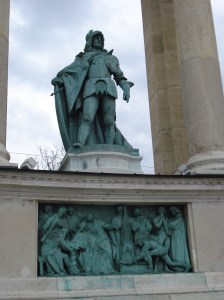
Statue of King Mátyás Hunyadi in Heroes’ Square Budapest (my photo)

King Mátyás plays a small but pivotal role in my novel, Return to the Eyrie. The heroine, Margit, is distantly related to him as her father (fictional character) was a third cousin of the king’s mother, Erzsébet Szilágyi.

Margit needs the King’s support to reclaim her inheritance, which was violently taken when she was a child by her close relatives.

Apart from being a historical adventure, the novel also addresses the issue of female inheritance. Despite her noble status, Margit could not inherit landed property from her father due to the strict inheritance laws in the Kingdom of Hungary. Noble daughters were only entitled to a monetary dowry when they married unless their husband was a commoner, in which case—ironically—they could inherit part of the land. So, according to the law, Margit’s land would pass to her closest male relative (her first cousin in this case).

However, a nobleman could invoke the custom of Prefection (Fiúsítás in Hungarian or praefectio in filium in Latin), whereby he could petition the King to “promote” his daughter to a son and therefore, allow her to inherit landed property. This would usually happen when there were no close male relatives, or in other exceptional cases. Margit’s father had sent such a petition to King Mátyás, but his relatives plotted against him. With an evil trick, they presented him as a traitor to the King’s eyes, had him murdered, and took over his land while Margit barely escaped with her life thanks to her father’s most loyal friend.

Blurb:
Honour, revenge, and the quest for justice.
Belgrade, Kingdom of Hungary, 1470:

Raised in exile, adolescent noblewoman Margit Szilágyi dreams of returning to her homeland of Transylvania to avenge her father’s murder and reclaim her stolen legacy. To achieve this, she must break the constraints of her gender and social status and secretly train in combat.
When the king offers her a chance at justice, she seizes it—even if it means disguising herself as a man to infiltrate the vultures’ nest that now occupies her ancestral ‘eyrie’.

Plagued by childhood trauma and torn between two passionate loves, Margit faces brutal battles, her murderous kin’s traps, and inner demons on her quest for vengeance. Only by confronting the past can she reclaim her honour—if she can survive long enough to see it through.

Return to the Eyrie is an epic coming-of-age tale of a young woman’s unwavering pursuit of justice and destiny in 15th-century Hungary.

Buy Link:
Universal Buy Link: https://books2read.com/u/bz8gJL

Author Bio:

Katerina Dunne is the pen name of Katerina Vavoulidou. Originally from Athens, Greece, Katerina has been living in Ireland since 1999. She has a degree in English Language and Literature from the University of Athens, an MA in Film Studies from University College Dublin, and an MPhil in Medieval History from Trinity College Dublin.

Katerina is passionate about history, especially medieval history, and her main area of interest is 13th to 15th-century Hungary. Although the main characters of her stories are fictional, Katerina uses real events and personalities as part of her narrative to bring to life the fascinating history of the medieval Kingdom of Hungary, a location and period not so well-known to English-speaking readers.

Return to the Eyrie (published April 2024) is the second book in the Medieval Hungary series, a sequel to Lord of the Eyrie (published in February 2022).

Author Links:

Website (publisher): https://www.thehistoricalfictioncompany.com/hp-authors/katerina-dunne
Facebook: https://www.facebook.com/profile.php?id=100076818802721
LinkedIn: https://www.linkedin.com/in/katerina-vavoulidou-07962a85/
Amazon Author Page: https://www.amazon.com/stores/Katerina-Dunne/author/B09R4P733K
Goodreads: https://www.goodreads.com/author/show/22196953.Katerina_Dunne

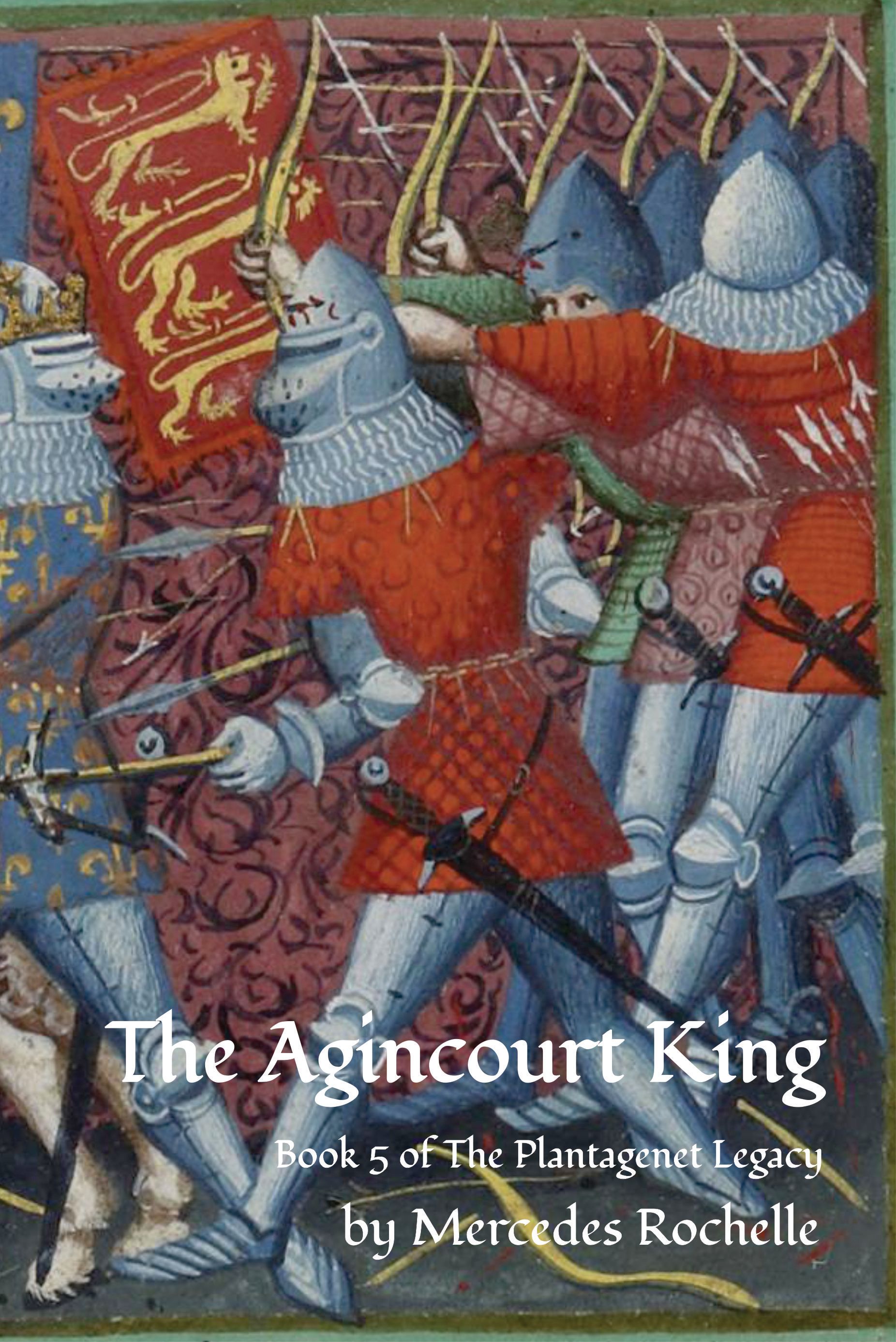
Guest Post: “Excerpt from ‘The Agincourt King’ by Mercedes Rochelle”

PWIzRwyKI am pleased to welcome Mercedes Rochelle back to my blog to share an excerpt from her novel, “The Agincourt King.” I would like to thank Mercedes Rochelle and The Coffee Pot Book Club for allowing me to be part of this blog tour.
THE CABOCHIEN REVOLT IN PARIS 

There was no doubt that France was in turmoil. King Henry IV of England wasn’t even cold in his grave at Canterbury Cathedral when a fierce rebellion broke out in Paris. As usual, King Charles VI had sunk into insensibility and the city simmered uneasily, agitated by John the Fearless, the Duke of Burgundy. Private and public accusations were aimed against the king’s ministers, and the most threatened among them started to leave town for the safety of the provinces. But another consideration had arisen to complicate matters. Louis the Dauphin had reached his sixteenth year and was poised to take on the regency while his father was incapacitated. Already he was chafing under Burgundy’s authority… 

Although today Burgundy was in charge, he was concerned about Louis the Dauphin. To control the heir to the throne, he had arranged a marriage between Louis and his daughter Margaret. Unfortunately, the union was not working out. The lad showed a disturbing independence and tended to reject his wife whenever possible. It was time to teach him a good lesson.  

It didn’t take long to devise a plan. Duke John secretly conversed with Governor Jacqueville (who happened to be the chamberlain) and others of his household. As he conveniently withdrew, the citizens worked themselves into another frenzy under the urging of their governor. Jacqueville mounted a platform and held up his hands for attention. 

“I have a list of traitors the Dauphin harbours under his protection,” he shouted. “They seek to strip you of your rights and privileges. We must take them prisoner! See here, the Duke of Bar is your enemy, and the Dauphin’s chancellor Jehan de Vailly. We must arrest the queen’s brother Duke Louis of Bavaria, members of her household, and her ladies in waiting. I have the list here!”  

Jacqueville waved a paper over his head. He was about to say more when a burly citizen mounted the platform. The crowd cheered and he recognized this man, a well-known mischief-maker who was popular with the people. He was dressed as a common workman, with a swarthy face and hair that stuck up like a brush. He strutted across the platform like he owned the place. 

“I am Simon Caboche, to those who do not know me,” the newcomer called out to much laughter. “I am a skinner of the ParisBoucherie and leader of our butcher’s guild. Follow me to the Hôtel de Guyenne, where we will have a parley with the Dauphin.” He pulled out a white hood—chaperon—from under his belt. “All those who are with me, here is our badge!” And to the governor’s amazement, most of the Parisians had a white hood, too. Who was playing into whose hand?   

Giving Jacqueville a meaningful look, Caboche took charge and led a shouting mob to the Dauphin’s hôtel. By the time they reached the Rue St. Antoine, they were six thousand strong and growing. The men guarding the door didn’t even try to interfere. While the Parisians surrounded the hôtel, the leaders pushed their way inside.  

“Where is he?” bellowed Caboche at the first servant he saw. The man backed against the wall. “Where is the Dauphin?” 

The poor servant blubbered in terror, and Caboche growled at him before continuing down the hall. Two old women carrying linens were just coming out a door when the butcher pointed at them. “Take us to the Dauphin!” he demanded. Looking at each other, the servants froze. 

“Come, friends,” he said more gently. “We won’t hurt you. We need to speak to the Dauphin.” 

One of the women pursed her lips and then gave her bundle to her companion. Jerking her head, she led the intruders to the Dauphin’s private apartment. Nodding his thanks, Caboche shoved open the door with a slam, surprising Louis while he was conversing with the Duke of Bar. 

Louis sprang awkwardly to his feet. “What is the meaning of this?” he cried in an unsteady voice. Unfortunately, the Dauphin did not inspire confidence and he knew it. His short frame was overweight, heavy, and slow. He was already known for keeping late hours and general laziness. Fond of excessive jewellery and rich clothing, he relied on the trappings of royalty to sustain his fragile dignity.  

Caboche stepped forward, flanked by his closest associates. He did not remove his white hood. “Our most redoubted lord,” he said, his voice barely respectful, “I have come with my fellow Parisians, who require, for your welfare and your father’s, that you deliver up certain traitors who are now in your hôtel.”  

Recovering his nerve, the Dauphin was filled with anger. “This is absurd. What you demand is impossible. There are no traitors in this hôtel.”  

“That is not true. I see them right before me.” Caboche nodded toward his victims and some of his men leapt across the room, grabbing the Duke of Bar by the arm; others seized the Dauphin’s chancellor. While Louis turned around in apprehension, his wife screamed. She had thrown her arm around one of his valets, trying to hold him back from two of the butchers who yanked him loose. Another servant was thrown to the floor.  

“Stop this!” cried Louis.  

Caboche gave him a sideways grin. “If you are willing to give them up,” he said, “well and good. Otherwise, we will take them right before your face and punish them as they deserve.” 

“I command you to let them go!” shouted the Dauphin. “My affairs are none of yours.” 

Jacqueville stepped up beside the butcher. “Monseigneur, this is very much our business. You have been badly misled, and your behaviour is that of a spoiled young man. You are sorely in need of correction.” 

“Get out of my sight!” cried the Dauphin. “Guards, help me! Guards!” 

Alerted by the shouting, several of the Dauphin’s men rushed into the room and threw themselves onto the intruders, who enthusiastically fought back. But no sooner had the scuffle begun when the Duke of Burgundy pushed his way into the room, shouting for order. His own men bore halberds and quickly interceded, pushing the antagonists apart. The Cabochiens, as they already called themselves, grouped together, still hanging onto their prisoners.  

Louis whirled around, pointing at his father-in-law. “This is your doing,” he growled. “These are your men. One day you will regret this. I won’t always be under your thumb.” 

LgQJ75mEBlurb:  

From the day he was crowned, Henry V was determined to prove the legitimacy of his house. His father’s usurpation weighed heavily on his mind. Only a grand gesture would capture the respect of his own countrymen and the rest of Europe. He would follow in his great-grandfather Edward III’s footsteps, and recover lost territory in France. 

Better yet, why not go for the crown? Poor, deranged Charles VI couldn’t manage his own barons. The civil war between the Burgundians and Armagnacs was more of a threat to his country than the English, even after Henry laid siege to Harfleur. But once Harfleur had fallen, the French came to their senses and determined to block his path to Calais and destroy him. 

By the time the English reached Agincourt, they were starving, exhausted, and easy pickings. Or so the French thought. Little did they reckon on Henry’s leadership and the stout-hearted English archers who proved, once again, that numbers didn’t matter when God was on their side. 

Buy Links: 

This title is available to read on #KindleUnlimited. 

Universal Buy Link: https://books2read.com/u/mq70Ze  

0S8YcxEYAuthor Bio:  

Mercedes Rochelle is an ardent lover of medieval history and has channeled this interest into fiction writing. Her first four books cover eleventh-century Britain and events surrounding the Norman Conquest of England. The next series is called “The Plantagenet Legacy” and begins with the reign of Richard II.  

She also writes a blog: www.HistoricalBritainBlog.com to explore the history behind the story. Born in St. Louis, MO, she received by BA in Literature at the Univ. of Missouri St.Louis in 1979 then moved to New York in 1982 while in her mid-20s to “see the world”. The search hasn’t ended! 

Today she lives in Sergeantsville, NJ with her husband in a log home they had built themselves. 

Author Links

Website: https://mercedesrochelle.com/  

Blog:  https://historicalbritainblog.com/  

Twitter / X: https://x.com/authorrochelle  

Facebook:  https://www.facebook.com/mercedesrochelle.net  

Book Bub: https://www.bookbub.com/authors/mercedes-rochelle  

Amazon Author Page:  https://www.amazon.com/stores/Mercedes-Rochelle/author/B001KMG5P6  

Goodreads: https://www.goodreads.com/author/show/1696491.Mercedes_Rochelle  

Guest Post: “Spotlight for ‘Courage of the Conquered’ by Anna Chant”

MvNt5SsqI am pleased to welcome Anna Chant to my blog today to share a spotlight for her novel, “Courage of the Conquered.” I would like to thank The Coffee Pot Book Club and Anna Chant for allowing me to be part of this blog tour.

-sR48dJ6Blurb:  

All the wonders of the Mediterranean have not prepared the English for the splendors of Constantinople. As Siward of Gloucester settles into the city, he is grateful to have finally found what he was looking for A fine, god-fearing lord he is proud to serve and a safe place where he and Oswyth can await the birth of their child. 

But as the months pass, doubts creep in. Emperor Michael proves to be a weak ruler, continually threatened with rebellion. Determined to keep the English army close, his promises of reward grow increasingly vague. 

With tension in the city rising, Siward and his friends are caught up in the power struggle. While Bridwin maintains his loyalty to the emperor and Siward continues to trust in the friendship of the cunning Alexios Komnenos, Frebern grows close to John Bryennios, a man whose ambitions may include the imperial throne itself. With the friends drawn in different directions, Siward fears they could find themselves fighting on opposing sides. 

Desperate to escape, he renews his efforts to find the home the English have so long craved. But the beauty of Constantinople conceals dangers that go far beyond Siward’s fears as sordid secrets and ruthless betrayals stalk the lives of those he holds dear. 

As the English prepare for battle yet again, will Siward’s quest for New England end in a heart-breaking tragedy? 

Buy Links: 

This title is available to read on #KindleUnlimited. 

Universal Buy Link: https://mybook.to/CourageoftheConquered 

UO_6RN6wAuthor Bio

Anna Chant grew up in Essex, with her first home a tiny medieval cottage. Aged 18 she moved to Yorkshire to study history at the University of Sheffield. In 2015, inspired by her love of medieval history and her Scottish ancestry, Anna started writing her first book with Kenneth’s Queen, the tale of the unknown wife of Kenneth Mac Alpin, published the following year. Taking inspiration from both history and legend, she particularly enjoys bringing to life the lesser-known people, events, and folklore of the past. When not writing, Anna enjoys walking the coast and countryside of Devon where she lives with her husband, three sons (if they’re home), and a rather cheeky bearded dragon. 

Author Links

Website: https://darkagevoices.wordpress.com/ 

Twitter: https://twitter.com/anna_chant 

Facebook: https://www.facebook.com/darkagevoices 

LinkedIn: https://www.linkedin.com/in/anna-c-b60690182/ 

Instagram: https://www.instagram.com/annachant_writer/ 

Threads: https://www.threads.net/@annachant_writer 

Pinterest: https://www.pinterest.co.uk/annachant/ 

Amazon Author Page: https://www.amazon.co.uk/stores/Anna-Chant/author/B01E46V162 

Goodreads: https://www.goodreads.com/author/show/15188873.Anna_Chant 


Guest Post: “Spotlight for ‘The Virgins of Venice’ by Gina Buonaguro

wDuEG-OMI am pleased to welcome Gina Buonaguro to blog today to share a blurb from her novel, “The Virgins of Venice.” I would like to thank The Coffee Pot Book Club and Gina Buonaguro for allowing me to be part of this blog tour.

Blurb:

In sixteenth-century Venice, one young noblewoman dares to resist the choices made for her

Venice in 1509 is on the brink of war. The displeasure of Pope Julius II is a continuing threat to the republic, as is the barely contained fighting in the countryside. Amid this turmoil, noblewoman Justina Soranzo, just sixteen, hopes to make a rare love marriage with her sweetheart, Luca Cicogna. Her hopes are dashed when her father decides her younger sister, Rosa, will marry in a strategic alliance and Justina will be sent to the San Zaccaria convent, in the tradition of aristocratic daughters. Lord Soranzo is not acting only to protect his family. It’s well known that he is in debt to both his trading partners and the most infamous courtesan in the city, La Diamante, and the pressure is closing in.

After arriving at the convent, Justina takes solace in her aunt Livia, one of the nuns, and in the growing knowledge that all is not strictly devout at San Zaccaria. Justina is shocked to discover how the women of the convent find their own freedom in what seems to her like a prison. But secrets and scandals breach the convent walls, and Justina learns there may be even worse fates for her than the veil, if La Diamante makes good on her threats.

Desperate to protect herself and the ones she loves, Justina turns to Luca for help. She finds she must trust her own heart to make the impossible decisions that may save or ruin them all.

Buy Links:

Universal Buy Links:
https://books2read.com/u/49O7NW

The Virgins of Venice

sGD3hzD8Author Bio:

Gina Buonaguro is the co-author of The Wolves of St. Peters, Ciao Bella , and The Sidewalk Artist, as well as several romance titles under the name Meadow Taylor. The Virgins of Venice is her first solo novel.

She has a BA in English from Villanova University in Pennsylvania and earned an MA in English from the University of British Columbia while on a Fulbright Scholarship. Born in New Jersey, Gina Buonaguro lives in Toronto.

Author Links:

Website: https://ginabu.com/
Facebook: https://www.facebook.com/GinaBuWriter
LinkedIn: https://www.linkedin.com/in/gina-buonaguro-35318934/
Book Bub: https://www.bookbub.com/profile/gina-buonaguro
Amazon Author Page: https://www.amazon.com/stores/Gina-Buonaguro/author/B002LAAF9I
Goodreads: https://www.goodreads.com/author/show/219059.Gina_Buonaguro

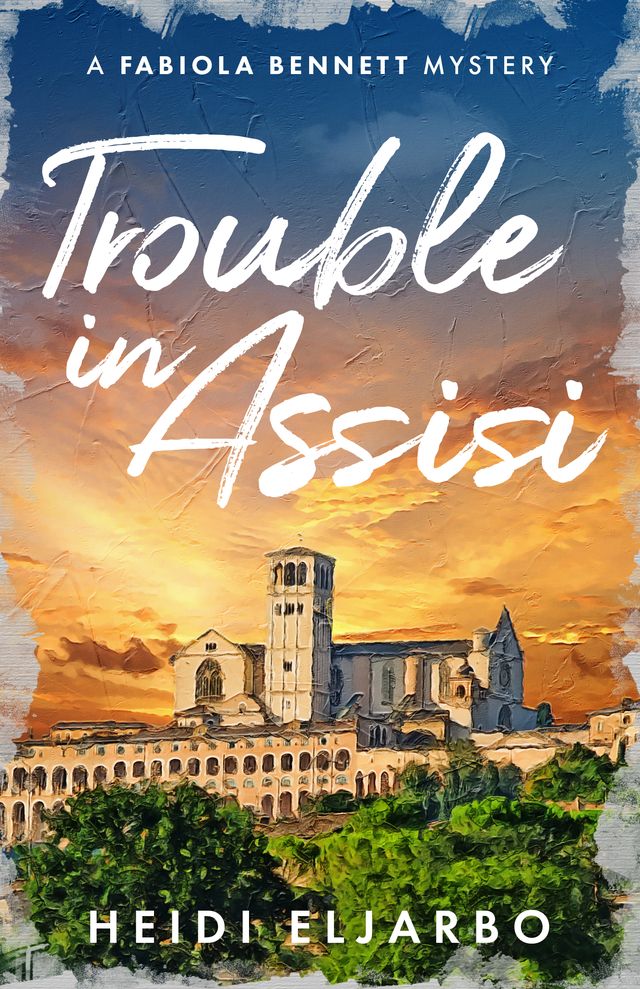
Guest Post: “Spotlight for ‘Trouble in Assisi’ by Heidi Eljarbo”

CJ1ceKcYI am pleased to welcome Heidi Eljarbo to my blog today to share a spotlight on her latest novel, “Trouble in Assisi.” I would like to thank The Coffee Pot Book Club and Heidi Eljarbo for allowing me to be part of this blog tour.
kCaxzjR0Blurb

Assisi, 1973

On art historian Fabiola Bennett’s first day in Assisi, a local gentleman takes her aside to ask for advice about a painting that has wondrously appeared in the basilica’s bell tower. 

So much for enjoying relaxing days filled with dining on pasta and gelato. 

Soon, Fabiola and her besties, Pippa and Cary, are thrown into a shrouded mystery and caught up in a whirlwind of intrigue, theft, lies, and attempted murder, all of which overshadows the postcard-like charm of the small, historic town. 

Rome, 1511

Life is going well for Teodoro Nicoletti. Since he was a young man in Florence, he has worked and learned alongside the most favored artist Raphael. 

When Pope Julius II commissions Raphael to paint several frescos in the reception rooms of the Vatican Palace, Teodoro follows his master to Rome and discovers firsthand the admiration and rivalry between Raphael and two other reigning artists: Michelangelo and Leonardo da Vinci. 

But the prickliest thorn in Teodoro’s side is his beloved Elisabetta’s father. The old man is determined to keep his youngest daughter from becoming Teodoro’s wife. 

Buy Links: 

This title is available to read on #KindleUnlimited. 

Universal Buy Link: https://books2read.com/u/4N5ZE6  

GyBUk4hoAuthor Bio: 

Heidi Eljarbo grew up in a home full of books, artwork, and happy creativity. She is the author of historical novels filled with courage, hope, mystery, adventure, and sweet romance during challenging times. She’s been named a master of dual timelines and often writes about strong-willed women of past centuries. 

Heidi now calls Norway home after living in Canada, six US states, Japan, Switzerland, and Austria. She lives with her husband on a charming island, enjoys walking in any weather, hugging her grandchildren, and has a passion for art and history. 

Her family’s chosen retreat is a mountain cabin, where they hike in the summer and ski the vast white terrain during winter. 


Heidi’s favorites are her family, God’s beautiful nature, and the word whimsical. 

Author Links: 

Website: https://www.heidieljarbo.com/ 

Twitter / X: https://x.com/HeidiEljarbo  

Facebook: https://www.facebook.com/authorheidieljarbo/ 

Instagram: https://www.instagram.com/authorheidieljarbo/ 

Pinterest: https://no.pinterest.com/heidieljarbo/ 

Book Bub: https://www.bookbub.com/profile/heidi-eljarbo 

Amazon Author Page: https://amazon.com/author/heidieljarbo 

Goodreads: https://www.goodreads.com/author/show/16984270.Heidi_Eljarbo 

Newsletter: https://www.heidieljarbo.com/newsletter 

Guest Post: “Researching Crime in Renaissance Venice” by Deborah Swift

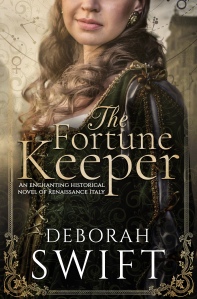
I am pleased to welcome Deborah Swift to my blog to share an article about researching crime in Renaissance Venice for her novel, The Fortune Keeper. I would like to thank Deborah Swift and The Coffee Pot Book Club for allowing me to be part of this blog tour.


One of the things I was aware of as soon as I started this novel, The Fortune Keeper, was that although not a crime novel, it would probably have several murders within its pages. This is because the whole series is about Giulia Tofana, who was renowned for poisoning men so that their wives could escape marital persecution.

Giulia Tofana became a legend and it is probable that she didn’t poison as many men as the rumors say, and that she was probably blamed for the crimes of others. One of the others suspected of her crimes was her stepdaughter Girolama. As she was to be featured in this book, it led me to look into the law in early modern Venice because I knew I would have to be aware of policing, punishment, and the mechanisms of the law.

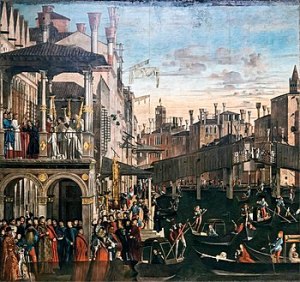
Accademia – Miracle of the Holy Cross at Rialto by Vittore Carpaccio

Renaissance Robbery
Venice was extremely wealthy in the Renaissance period, and vagabonds and thieves flooded into the city in search of easy pickings. In the picture above you can see the canal thronged with men dressed in rich clothing and ornament. The most common crimes in Venice were burglary and forgery, but it was by no means unusual for there to be murders over money and debts. The punishment for robbery was calculated based on the quantity of property taken. First offenders who stole goods worth less than one lira could get away with a whipping, but woe betide you if you stole something bigger. The penalty was the loss of an eye for goods valued between five to ten lire, and the noose awaited those brave enough to steal something worth more than forty lire.

Debt and Death
The law allowed anyone owed more than five lire de piccola to threaten and even kill the debtor to recoup their money, putting the onus firmly on the debtor, not the avenger. This tells us that money was the main driving force in Venetian society. But what about armed robbery or assault where no debt was owed? Most assaults were subject to a mere fine of twenty-five lire, or banishment from the city-state. If your crime was a crime that drew blood – sanguinem fecerit – then the punishment was up to the judging council. Venetian law had no such thing as ‘innocent until proven guilty’ at that time. The proof was largely circumstantial, and it relied on the judge and jury’s instinct regarding the guilt of the person involved.

Renaissance Lawkeepers
The Avogaria di Comun were a group equivalent to lawyers, though non-professional, drawn exclusively from the nobility. They acted as prosecutors for the state, giving evidence and arguing for punishments before the main judicial councils of Venice. Because of their status, their judgments were often influenced by their social position, and the personal axes they had to grind.

Execution and Mutilation
In this period it was still common for mutilations to take place, which had been traditional in medieval times. Cutting out the tongue for heresy, cutting off the thumb or fingers for pilfering. Courtesans regularly had their noses or faces cut. There was also the custom of cutting off the ‘offending’ part – this led to men who were convicted of dabbling in heresy or alchemy, or crimes against the Holy Roman Church having their hand cut off to remove the ‘devil’s instrument’. This kind of public ritual and humiliation was designed to bring public vengeance to the accused person and to reaffirm the values of the Church or state.

The ritual turned the execution into a purification of the city.
Few crimes brought down corporal or capital punishment. The types of corporal punishment used for the crimes of rape and assault were minor by today’s standards. As an example, for assault, out of 569 cases only fifteen involved mutilation of the criminal; and sixteen more involved some form of corporal discipline. For rape offenses, corporal punishment was even less significant, with twenty cases of discipline and only four of mutilation.


Maintaining law and order
On the streets, the main arbiters of law and order were the town guard, the vigili urbani, who acted as our police do now. Their job was to make sure masked men didn’t carry arms, that only noblemen wore swords, and to act as a preventative force as well as policing troublemakers.

Further up the ladder was the Council of Ten, a kind of secret police force whose job was to maintain order within the city-state of Venice. There was not much space in the city gaols of Venice due to the whole nature of its construction. For crimes of fraud, marital dispute, and affray, these men sat in judgment. It was unfeasible to keep men incarcerated for long because otherwise, the gaols would be full of minor offenders. Small fines and short gaol sentences were the usual punishments for common violence in Venice. When the crime crossed the line into something that was considered ‘against God’ or ‘against the reputation of Venice’ then ritual punishment could be relied upon to warn the populace about sinning against these bigger, less personal edifices.

Documents I found helpful in my research:
Law and Punishment in Early Renaissance Venice
Violence in Early Renaissance Venice – Guido Ruggiero
Banditry and Social Identity in the Republic of Venice – Sergio Lavarda
Authority and the Law in Renaissance Venice — G. Cozzi

xr:d:DAEbig1CmJo:257,j:33693903820,t:22082511

Blurb:

Count your nights by stars, not shadows ~ Italian Proverb

Winter in Renaissance Venice

Mia Caiozzi is determined to discover her destiny by studying the science of astronomy. But her stepmother Giulia forbids her to engage in this occupation, fearing it will lead her into danger. The ideas of Galileo are banned by the Inquisition, so Mia must study in secret.

Giulia’s real name is Giulia Tofana, renowned for her poison Aqua Tofana, and she is in hiding from the Duke de Verdi’s family who are intent on revenge for the death of their brother. Giulia insists Mia should live quietly out of public view. If not, it could threaten them all. But Mia doesn’t understand this, and rebels against Giulia, determined to go her own way.

When the two secret lives collide, it has far-reaching and fatal consequences that will change Mia’s life forever.

Set amongst opulent palazzos and shimmering canals, The Fortune Keeper is the third novel of adventure and romance based on the life and legend of Giulia Tofana, the famous poisoner.

‘Her characters are so real they linger in the mind long after the book is back on the shelf’
~ Historical Novel Society

NB This is the third in a series but can stand alone as it features a new protagonist. The other two books are available if reviewers want them.

Trigger Warnings:
Murder and violence in keeping with the era.

Buy Links:

This title is available to read on #KindleUnlimited.

Universal Link: https://mybook.to/FortuneKeeper

Audiobook Buy Links:

Kobo: https://www.kobo.com/gb/en/audiobook/fortune-keeper-the
Audio: https://www.audible.co.uk/pd/The-Fortune-Keeper-Audiobook/B0C63R95WM

Author Bio:

Deborah Swift is a USA TODAY bestselling author who is passionate about the past. Deborah used to be a costume designer for the BBC, before becoming a writer. Now she lives in an old English school house in a village full of 17th Century houses, near the glorious Lake District. Deborah has an award-winning historical fiction blog on her website http://www.deborahswift.com.

Deborah loves to write about how extraordinary events in history have transformed the lives of ordinary people, and how the events of the past can live on in her books and still resonate today.

The first in her series about the Renaissance poisoner Giulia Tofana, The Poison Keeper, was a winner of the Wishing Shelf Book of the Decade, a Coffee Pot Book Club Gold Medal, and the latest in her WW2 Secret Agent series, Operation Tulip, is coming soon.

Author Links:

Website: http://www.deborahswift.com
Twitter: https://twitter.com/swiftstory
Facebook: https://www.facebook.com/authordeborahswift/
Pinterest: https://www.pinterest.co.uk/deborahswift1/
Bookbub: https://www.bookbub.com/authors/deborah-swift
Amazon: http://author.to/DeborahSwift

Guest Post: “Spotlight for ‘Berengaria of Navarre, Queen of England, Lord of Le Mans’ by Gabrielle Storey”

Today, I am pleased to welcome Gabrielle Storey to share a blurb from her latest book, “Berengaria of Navarre, Queen of England, Lord of Le Mans.”

berengaria of navarreBlurb

Berengaria of Navarre, Queen of England, Lord of Le Mans’ is a biography of one of our least-known queens of medieval England. Wife of Richard the Lionheart, daughter-in-law of Eleanor of Aquitaine, and a participant of the Third Crusade, Berengaria sat at the crossroads of several major political figures and events of the twelfth and thirteenth centuries. Yet her story has received scant attention by historians and the public until now.

This biography, including material not previously discussed in English scholarship, brings a new light to Berengaria’s life, covering her journeys from Navarre, across Europe to Sicily, Cyprus, the Holy Land, and then to the Angevin domains in France. It shows how women exercised power in medieval Europe, and brings to the fore a greater understanding of the life of one of England’s most forgotten queens. Grounded in academic research and written for the interested reader, this biography gives a welcome insight into Berengaria as a woman, queen, widow, and lord.

Buy Link: https://www.routledge.com/Berengaria-of-Navarre-Queen-of-England-Lord-of-Le-Mans/Storey/p/book/9781032121475

Launch 20% discount code for purchases made through the Routledge website: EFLY01

Gabrielle StoreyAuthor Bio: 

Dr Gabrielle Storey is a historian of monarchy, gender, and sexuality. Her research interests include the exercise of power, rulership, and monarchs in the medieval West. She has featured on several podcasts including the BBC ‘You’re Dead To Me’ on Eleanor of Aquitaine and writes regularly for several history magazines including History Extra and Medieval World: Culture and Conflict.

She is currently working on her first non-fiction book for the wider public. Her first book, the academic and accessible biography of Berengaria of Navarre, is published with Routledge in June 2024.

You can find more about her work here: https://gabriellestorey.com/public-engagement/

Author Links:

Website: https://gabriellestorey.com/

X: https://twitter.com/GabbyStorey

Instagram: https://www.instagram.com/drgabbystorey/

Bluesky: https://bsky.app/profile/gabbystorey.bsky.social

Amazon Author Page: https://www.amazon.co.uk/stores/Gabrielle-Storey/author/B0CVSCZVFY

Goodreads: https://www.goodreads.com/author/show/30441642.Gabrielle_Storey