Guest Post: “What is an Angel?” by Justin Newland

The Mark of the Salamander Tour Banner 1I am pleased to welcome Justin Newland to my blog today to discuss his latest book, “The Mark of the Salamander.” I would like to thank The Coffee Pot Book Club and Justin Newland for allowing me to be part of this blog tour. 

My latest historical fiction novel, The Mark of the Salamander, has just been published. It’s the first title in a two-book series, The Island of Angels, which tells the epic story and secret history of England’s coming of age during the Elizabethan era.

While The Island of Angels is an intriguing title, this blog explores the question: ‘What is an angel?’ This is the definition from the Merriam-Webster dictionary: 

‘A spiritual being serving as a divine messenger and intermediary and often as a special protector of an individual or nation.’

This suggests that any nation has a spiritual protector or guardian. If so, where would these angels live? In the ground, or in places like the lakes, forests, and mountain ranges? Many monasteries, temples, and holy places are located on mountaintops and in remote places like deserts in the expectation that the angelic beings would rise out of the ground and grace their occupants with their presence. 

The definition also mentions the spiritual beings – the angels – as divine messengers. The angels of a nation are then custodial of the divine intention for that land and its people. The angels’ function then becomes to guide the people towards the fulfillment of that intention. 

Then how would the people of a nation know if what they were doing was aligned or natural to that divine intention? 

Well, if they were, the angels would supercharge what they were doing. For example, they would prompt them to greater exploits, exceptional discoveries, and the creation of finer art. They would urge the people to do things and perceive things, that were above and beyond what the people previously thought possible. Angels add charisma and most importantly, they yield a vision of the future. They add grace and offer healing to old wounds and new possibilities. Their presence would feel like a person had a hose pipe of water gushing into their back.  

Francis-Drake-oil-panel-engraving-Jodocus-HondiusIn 1578, Francis Drake set out from Plymouth with five ships to sail around the world. Until that point in history, England was a small, misty isle on the edge of continental Europe. Through Drake’s efforts, in that single voyage, he hauled England out of the dark ages and into a future in which England would become the hub of a new world of trade & communication. He single-handedly changed England’s self-view. 

How was this momentous event achieved? Was it with the added assistance of the Angels of the Island? Where would you look for evidence of angels in the history of a nation? Well, perhaps you’d start with the symbols of the land that have persisted through the ages, their myths and legends, and their constitutional elements, like the color and formation of its flag. In Elizabethan England, the flag was still a red cross on a white background (Scotland had yet to contribute the blue saltire to the Union Jack). 

Then there’s the heraldry of the nation. England’s royal coat of arms features its MedievalTudor Coat of Arms Semper Eadem Always the Same chivalric Order of the Garter. Established by King Edward III in 1348, the motto of the Most Noble Order is, ‘Honi Soit Qui Mal Y Pense,’ which means, ‘Evil be to he who thinks evil (of me).’

This is a huge clue to the nature and character of the land of England and its angels. It’s a powerful statement of defiance. The motto says that anything that comes into the land, that is not fitting, or of a lower order than the angels of the land, will get sent back to where it came from. In other words, repulse. In modern terms – return to sender. 

The Mark of the Salamander by Justin Newland - Front CoverBlurb:

1575.

Nelan Michaels is a young Flemish man fleeing religious persecution in the Spanish Netherlands. Settling in Mortlake outside London, he studies under Queen Elizabeth’s court astrologer, conjuring a bright future – until he’s wrongly accused of murder. 

Forced into the life of a fugitive, Nelan hides in London, before he is dramatically pressed into the crew of the Golden Hind.

Thrust into a strange new world on board Francis Drake’s vessel, Nelan sails the seas on a voyage to discover discovery itself. Encountering mutiny, ancient tribes, and hordes of treasure, Nelan must explore and master his own mystical powers – including the Mark of the Salamander, the mysterious spirit of fire. 

THE MARK OF THE SALAMANDER is the first in The Island of Angels series: a two-book saga that tells the epic story and secret history of England’s coming of age during the Elizabethan era. 

Buy Links:

Universal Link: https://books2read.com/u/38Yxzr 

Barnes and Noble: https://www.barnesandnoble.com/w/the-mark-of-the-salamander-justin-newland/1144122989?ean=2940186006305 

Waterstones: https://www.waterstones.com/book/the-mark-of-the-salamander/justin-newland/9781915853271 

Kobo: https://www.kobo.com/gb/en/ebook/the-mark-of-the-salamander 

WH Smith: https://www.whsmith.co.uk/products/the-mark-of-the-salamander-the-island-of-angels/justin-newland/paperback/9781915853271.html 

Saxo DK: https://www.saxo.com/dk/the-mark-of-the-salamander_bog_9781915853271 

UK Bookshop: https://uk.bookshop.org/p/books/the-mark-of-the-salamander-justin-newland/7448127?ean=9781915853271 

Wordery: https://wordery.com/mark-of-the-salamander-justin-newland-9781915853271?cTrk=MjAxNjg3MzE1fDY1NDE4MzM0N2QzYzA6MTo1OjY1NDE4MzE0ZGFjNTA4LjEwMTkzMjgzOjYxZWVjMzJj

Blackwells: https://blackwells.co.uk/bookshop/product/The-Mark-of-the-Salamander-by-Justin-Newland/9781915853271 

Foyles: https://www.foyles.co.uk/book/the-mark-of-the-salamander/justin-newland/9781915853271 

Justin Newland 1Author Bio:

JUSTIN NEWLAND’s novels represent an innovative blend of genres from historical adventure to supernatural thrillers and magical realism. His stories explore the themes of war and religion and speculate on the human’s spiritual place in the universe.

Undeterred by the award of a Doctorate in Mathematics from Imperial College, London, he conceived his debut novel, The Genes of Isis (Matador, 2018), an epic fantasy set under Ancient Egyptian skies. 

The historical thriller, The Old Dragon’s Head (Matador, 2018), is set in Ming Dynasty China in the shadows of the Great Wall. 

The Coronation (Matador, 2019) was another historical adventure and speculates on the genesis of the most important event in the modern world – the Industrial Revolution. 

The Abdication (Matador, 2021) is a mystery thriller in which a young woman confronts her faith in a higher purpose and what it means to abdicate that faith.

The Mark of the Salamander (Book Guild, 2023) is the first in a two-book series, The Island of Angels. Set in the Elizabethan era, it’s an epic tale of England’s coming of age. 

His work in progress is the second in the series, The Midnight of Eights, charting the uncanny coincidences that led to the repulse of the Spanish Armada. 

Author, speaker, and broadcaster, Justin appears on LitFest panels, talks to historical associations and libraries, and enjoys giving radio interviews and making podcasts. 

Born three days before the end of 1953, he lives with his partner in plain sight of the Mendip Hills in Somerset, England.

Author Links:

Website: https://www.justinnewland.com/ 

Twitter: https://twitter.com/JustinNewland53 

Facebook: https://www.facebook.com/justin.newland.author/

LinkedIn: https://www.linkedin.com/in/justin-newland-b393aa28/

Instagram: https://www.instagram.com/drjustinnewland/  

Book Bub: https://partners.bookbub.com/authors/4862998/edit 

Amazon Author Page: https://www.amazon.co.uk/stores/Justin-Newland/author/B06WRQVLT8 

Goodreads: https://www.goodreads.com/jnewland

Guest Post: “Spotlight for ‘How to Dress Like a Tudor’ by Judith Arnopp

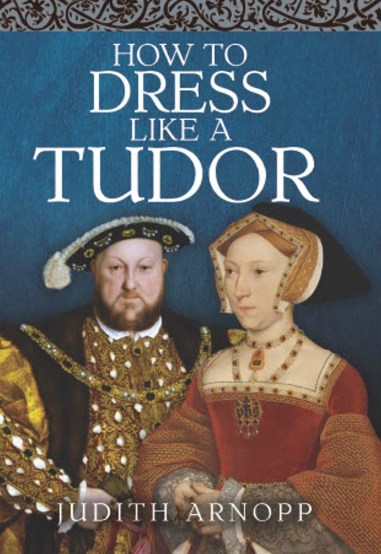
How To Dress Like A Tudor Tour BannerI am pleased to welcome Judith Arnopp to my blog today to share a blurb for her latest book, “How to Dress Like a Tudor.” I would like to thank Pen and Sword Books, The Coffee Pot Book Club, and Judith Arnopp for allowing me to be part of this blog tour. 

How To Dress Like A Tudor coverBlurb:

Have you ever hankered to dress like a Tudor lord or lady, or perhaps you prefer the status of goodwife, or costermonger, or even a bawd? 

For beginner historical reenactors, the path to authenticity can be bewildering and sometimes intimidating. Judith Arnopp uses her own experience, both as a historian and a medieval/Tudor lady, to make your own journey a little easier.

The author traces the transition of fashion from the relatively subtle styles popular at the court of Henry VII, through the carefully constructed royal grandeur of Henry VIII, Edward VI, and Mary I to the pinnacle of majesty and splendid iconography of Elizabeth I. 

In contrast to the magnificence of court come the ordinary folk who, subject to sumptuary laws and regulations, wore garments of a simpler cut and cloth – a strata of society that formed the back bone of Tudor England.

This brief history of 16th-century fashion examines clothing for both rich and poor, adult and child, and offers tips and tricks on how to begin to sew your first historically inspired garment, this book is aimed at helping the beginner learn How to Dress like a Tudor.

Buy Link:

Universal Buy Link: mybook.to/howtodress

Judith Arnopp at Pembroke CastleAuthor Bio:

Judith writes historical fiction set during the late medieval and Tudor periods. Her usual focus is on the women who lived close to the monarch, women like Margaret Beaufort, Elizabeth of York, and Mary Tudor but more recently has been writing from the perspective of Henry VIII himself. Her books are on Kindle, Audible, and Paperback.

You can find her fiction books here: http://author.to/juditharnoppbooks

She also writes non-fiction and her work is featured in many anthologies and online magazines. Her latest non-fiction, How to Dress like a Tudor published by Pen & Sword Books is available now. 

Judith is a founder member of a reenactment group The Fyne Company of Cambria, and began making Tudor costumes for herself, her husband, John, and other members of the group. It was this that inspired How to Dress Like a Tudor and she hopes to write more non-fiction Tudor history in the future.

Author Links:

Website: http://www.judithmarnopp.com

Twitter: https://twitter.com/JudithArnopp

Facebook: https://www.facebook.com/thetudorworldofjuditharnopp

LinkedIn: http://www.linkedin.com/in/judith-arnopp-ba999025

Instagram: https://www.instagram.com/tudor_juditharnopp/

Bluesky: https://bsky.app/profile/jarnopp.bsky.social 

Book Bub: https://www.bookbub.com/profile/judith-arnopp

Amazon Author Page: https://www.amazon.co.uk/Judith-Arnopp/e/B003CGLWLA/ 

Goodreads: https://www.goodreads.com/author/show/4088659.Judith_Arnopp

Guest Post: “The Dos and Don’ts of Tudor Men’s Dress – What to Wear in Sixteenth-Century England” by Toni Mount

I am pleased to welcome Toni Mount to share her advice about Tudor men’s fashion to promote her latest book, How to Survive in Tudor England. I would like to thank Toni Mount and Pen and Sword Books for allowing me to be part of this blog tour. 

In writing my new book How to Survive in Tudor England I realised how tricky it was to be fashionable during the sixteenth century: hard work and expensive for men and women. So here’s a taster of what was required for a man to get noticed at court.

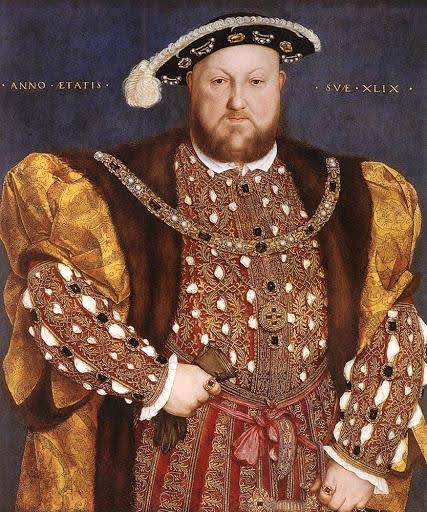
Henry VII favors long robes of fine cloth to show his wealth but his son, young Henry VIII, famed for his athletic, shapely legs, wears fitted hose and short robes so he can show off his best features. Now that the robe is so short, the flap that covers the join between the two separate legs of the hose [stockings] for modesty’s sake is now visible and Henry turns this into an asset by attaching a great codpiece to show off his virility. Since the courtiers take their fashion cues from the king, codpieces become a vital accessory. Henry is a well-muscled sporty young man but even so, his natural physique is accentuated by padding the shoulders of his doublet to extreme proportions. 

Henry VIIIHenry VIII wearing a padded doublet 

In this image, you can see the slashes in the sleeves of his doublet so that little puffs of his fine shirt can be pulled through. The doublet has a skirt or peplum, of varying length according to fashion, underneath which are hidden ties (‘points’) or hooks, to attach the breeches. 

The basics of men’s clothing is wearing layers. Next to your skin, you have a white linen shirt. This may be embroidered around the collar band. Katherine of Aragon introducebris ‘black-work’ embroidery from Spain and this becomes very fashionable, looking good on white linen. Later, the collar band is simply what your ruff is pinned onto, unless it has become a separate item by the time of your visit.

Breeches and hose come in a bewildering variety, going in and out of fashion almost weekly – another reason why a courtier’s wardrobe can empty his purse in no time, just trying to keep up. Here is a selection: round or French hose are short, full breeches ending anywhere between the upper thigh to just above the knee and excessively padded at the hips to accentuate your buttocks. These can make dancing or even walking elegantly quite difficult. Canions are tight-fitting tubes attached to the short version of the round hose to extend them to the knee. Below the knee, you wear stockings or ‘netherstocks’ held up with garters.

Whatever the style, the hose must be ‘paned’ – that is cut into narrow panels, joined at the waist and hem, with a colored lining showing between the panes. With so much padding and paning, you can understand why the codpiece is in decline, giving way to a modest buttoned or lace-up opening that doesn’t spoil the symmetry of your panes. Both your doublet and hose may also be decorated by ‘pinking’: slits cut in the fabric, in a pattern, with the coloured lining pulled through, as in Henry VIII’s time. One contemporary commentator of Elizabethan men’s fashion thought things had become quite ridiculous:  ‘Except it were a dog in a doublet you shall not see any so disguised as are my countrymen of England’, he wrote and Elizabethan clothes indeed disguise the wearer’s true physique more than the fashions of any other period. 

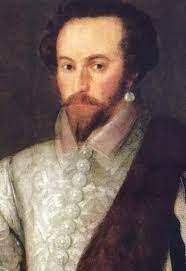
Sir Walter RaleighThe fashionable Sir Walter Raleigh

As you’ll see in the portrait of Sir Walter Raleigh [above], men also need to wear a bit of bling. Sir Walter has a single pearl earring, the sign of a truly fashionable man-about-town. Finger rings are a must.

Facial hair is also in vogue ever since Henry VIII grew a beard but at the Elizabethan court, the natural look isn’t enough. Once again, Sir Walter is a fine example to copy with his beard neatly trimmed to a point and his moustache curled. Set your ensemble with a short cape, fur-lined, and edged with a braid. This isn’t a practical cloak to keep you warm and dry but rather an accessory to be draped nonchalantly over one shoulder for that devil-may-care look that’s the height of fashion.

Footwear

No one of any significance goes without shoes. The pointy-toed, medieval styles go out of fashion almost as the first Tudor king sits on the throne. Rounded toes are the thing. But Henry VIII, maybe because he has broad feet, went further, creating a fashion for square toes. With more leather used to make the uppers, it’s also possible to have slashes to show off a contrasting inner lining, as with sleeves. However, these early Tudor styles are thin-soled and flat like their medieval predecessors but around 1500, somebody invents the ‘welt’ – a narrow strip of leather that goes around the shoe, in between the upper and the sole, making the shoe far more sturdy and able to withstand fancier shaping and decoration. 

King Henry is tall and impressive anyway but others who want to emulate him could do with a few extra inches in height and by the time of Elizabeth heeled shoes have been invented. At first, the heel is just a wedge of cork or wood fixed between the leather sole and the upper but soon these become proper heels and part of the sole. With so much innovation in the world of shoemaking, in 1579 the queen grants their coat-of-arms to the Guild of Cordwainers in London.

Women’s dainty dress shoes, called ‘pinsons’, now with heels and a more dainty tapered toe, can be of silk, velvet, or brocade often with bejeweled rosettes. Mid-century, most are slip-ons but lacing and buckles become increasingly fashionable. A pair of Tudor or Elizabethan shoes are made the same for both feet so there is no correct right or left shoe so they can be swapped over for more even wear. 

For outdoor wear, you can either put overshoes on to protect your indoor footwear, or you can have leather boots for walking and riding. Loose or tight-fitting, ‘gamaches’ are thigh-length high boots, and ‘buskins’ come to the calf.  

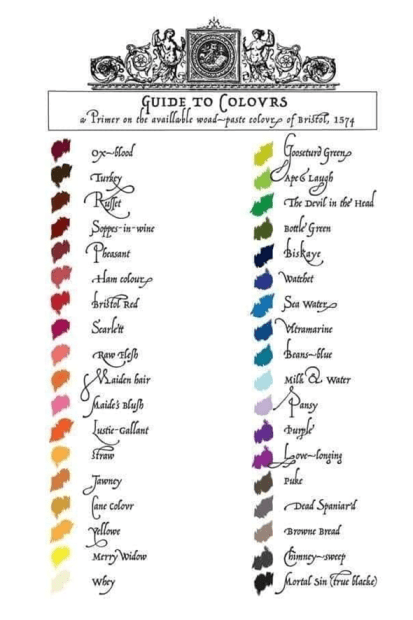
colour chartActs of Apparel 

In Henry VIII’s reign, realizing some of the up-and-coming wealthier gentry and merchants were wearing more sumptuous clothes than noblemen and courtiers, new laws are passed, termed Acts of Apparel, in 1509-10, 1514, 1515, and 1533. Europe has similar ideas but whereas their regulations tend to be drawn up by and apply only to individual towns, England’s laws come from Parliament and apply throughout the country, in theory, anyway.  

According to the 1509-10 Act against Wearing of Costly Apparel, only the king, the queen, the king’s mother (the act must have been first drawn up before Margaret Beaufort died in June 1509), along with the king’s brothers and sisters can wear cloth of purple silk or gold, while dukes and marquises can only use cloth of gold as linings of their coats and doublets. An earl and those of higher rank may wear sable fur, but those below may not. Certain imported furs can be worn by royal grooms and pages, university graduates, yeomen, and landowners whose estates bring in an income of at least £11 per annum. Barons and knights of the Order of the Garter (the highest-ranking knights) are permitted to wear woolen textiles manufactured abroad but, for those of lesser status, it’s a crime to wear imported cloth. The same applies to wearing clothes dyed with the most expensive crimson and blue dyes. 

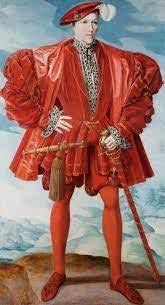
CrimsonToo much crimson dye?

Anyone who isn’t a lord’s son, a government servant, or a gentleman with an income from the land of at least £100 per annum is forbidden to wear velvet, satin, or damask, although, if their land is worth £20 or more, satin, damask or camlet may be used to line or trim their clothing but not for the main, visible body of the garment. 

The problem is, as it has been for centuries, more and more successful merchants are becoming richer than the aristocracy. Intermarriage makes matters even more complex. The nobility want to share in mercantile wealth and merchants yearn for titles and high status. The solution is for a lord’s penniless second and untitled son to wed the daughter of a rich merchant but where do their offspring stand on the social ladder? The children aren’t the sons and daughters of a lord and yet they can now afford to live in greater opulence than their paternal relatives who still have titles. No wonder the laws are flouted. 

An additional oddity concerns the way wealth is judged. Annual income from land is always regarded as having greater status than the same monetary income gained from trade. The sumptuary laws passed in the reign of King Edward III, in 1363, equated a landowner worth £200 a year to a merchant worth £1,000. These relative values are still maintained throughout the Tudor period. And there is another problem that becomes more acute in Henry VIII’s reign: that of people – and courtiers were some of the worst offenders – vying with their peers to be the most fashionable and expensively dressed and running up huge debts in the process. This situation leads to An Acte for Reformacyon of Excesse in Apparayle being passed in 1533:

…for the necessaire repressing avoiding and expelling of the inordinate excesse dailye more and more used in the sumptuous and costly araye and apparel accustomablye worne in this Realme, whereof hath ensued and dailie do chaunce suche sundrie high and notable inconveniences as to be the greate manifest an notorious detriment of the common Weale, the subvercion of good and politike order in knowledge and distinction of people according to their estates p[re]emyences dignities and degrees, and to the utter impoverysshement and undoyng of many inexpert and light persones inclined to pride moder of all vices…

Despite the declaration that these laws are intended to avoid the ‘notorious detriment of the common weal’, i.e. everyone, the legislation is aimed, as usual, at morally ‘light persons inclined to pride (mother of all vices)’. The laws also reiterate earlier attempts to mark out prostitutes from respectable women but in 1533 the earlier, medieval customs of what was considered respectable attire are enshrined in law for the first time, in particular, that a married woman must cover her hair – a ‘loose’ woman, i.e. one wearing her hair loose and uncovered is of easy virtue and up to no good. 

An excess of wool production led to an Act of Parliament in 1571, during the reign of Queen Elizabeth, to boost the sales of English woolen cloth. It becomes law that on Sundays and every official holiday all males over six years of age, except for the nobility and persons of degree, are to wear woolen caps on pain of a fine of three farthings (¾ of a penny) per day. Whether it works or not in practice, the act is repealed in 1597. In June 1574, Elizabeth issues the following statute from Greenwich Palace: 

The excess of apparel and the superfluity of unnecessary foreign wares thereto belonging… is grown to such an extremity that the decay of the whole realm is like to follow (by bringing into the realm such superfluities of silks, cloth of gold, silver, and other vain devices of so great cost as of necessity the moneys of the realm is yearly conveyed out of the same to answer the said excess) but also the undoing of a great number of young gentlemen seeking by show of apparel to be esteemed as gentlemen not only consume themselves, their goods, and lands which their parents left unto them, but also run into such debts as they cannot live out of danger of laws without attempting unlawful acts… [edited]

Despite the fact that the queen and everyone else understand the cost of trying to keep up with the latest fashions, no amount of law-making can prevent the young gallants from spending far beyond their means.

Another 1597 proclamation on the subject goes into minute detail. Only earls can wear cloth of gold or purple silk. No one under the degree of knight is allowed silk ‘netherstocks’ (long stockings) or velvet outer garments. A knight’s eldest son may wear velvet doublets and hose but his younger brothers can’t. A baron’s eldest son’s wife may wear gold or silver lace which is forbidden to women below her in the pecking order. Who is allowed to wear what is supposed to be strictly controlled as the queen’s subjects must know their place and dress accordingly so that no one can be misled. At least, that’s the theory but you can see that the laws are confusing and is it any wonder that people ignore them? Will you obey the law or wear fashionable clothes, no matter the cost?  

The frequency of acts and the huge number of laws passed proves that the authorities are losing the fight to keep the social distinctions, maintain morals and ethics, preserve the English economy against foreign imports, and restrain the excesses of fashion. However, a good many of the various sumptuary laws, dating back to as early as the fourteenth century, were still on the English statute books as recently as the 1800s, and, who knows, some may as yet remain, hidden in the dusty archives in the twenty-first century.

So this is an introduction of what to wear – or not – for the stylish courtier in the sixteenth century. If you wish to read about many interesting characters, places, food, and pastimes of the sixteenth century, my new book How to Survive in Tudor England will be published on 30th October 2023.  

Pen & Sword Book Cover / Jacket artwork

Blurb

Imagine you were transported back in time to Tudor England and had to start a new life there, without smartphones, internet, or social media. When transport means walking or, if you’re lucky, horseback, how will you know where you are or where to go? Where will you live and where will you work? What will you eat and what shall you wear? And who can you turn to if you fall ill or are mugged in the street, or God forbid if you upset the king? In a period when execution by beheading was the fate of thousands how can you keep your head in Tudor England? 

All these questions and many more are answered in this new guidebook for time-travelers: How to Survive in Tudor England. A handy self-help guide with tips and suggestions to make your visit to the 16th century much more fun, this lively and engaging book will help the reader deal with the new experiences they may encounter and the problems that might occur. 

Enjoy interviews with the celebrities of the day, and learn some new words to set the mood for your time-traveling adventure. Have an exciting visit but be sure to keep this book to hand.

Toni Mount cropToni Mount Biography

Toni Mount researches, teaches, and writes about history. She is the author of several popular historical non-fiction books and writes regularly for various history magazines. As well as her weekly classes, Toni has created online courses for http://www.MedievalCourses.com and is the author of the popular Sebastian Foxley series of medieval murder mysteries. She’s a member of the Richard III Society’s Research Committee, a costumed interpreter, and speaks often to groups and societies on a range of historical subjects. Toni has a Master’s Degree in Medieval Medicine, Diplomas in Literature, Creative Writing, European Humanities, and a PGCE. She lives in Kent, England with her husband.

Guest Post: Spotlight for “Historical Stories of Exile”

IG banner Exile partyI am pleased to welcome the authors of the latest anthology, “Historical Stories of Exile” to my blog today on a spotlight tour. I would like to thank The Coffee Pot Book Club and the authors of this anthology for allowing me to be part of this blog tour. 
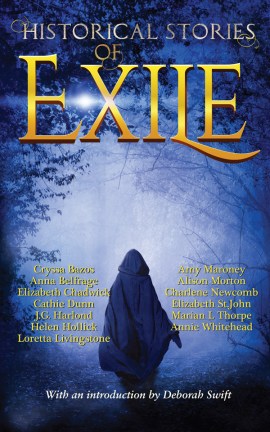
EXILE-Cover-flatBlurb:

Exile: a risky defiance, a perilous journey, a family’s tragic choice – or an individual’s final gamble to live. Exile: voluntary or enforced, a falling-out between friends, a lost first love, a prejudiced betrayal – or the only way to survive persecution?

In this historical fiction anthology, thirteen authors (they are not superstitious!) have written exclusive short stories on the theme of exile. Some are based on true history, others are speculative fiction. All mine the depths of human emotions: fear, hope, love, and the fortitude to survive.

Join an inspiring Anglo-Saxon queen of Wales, a courageous Norwegian falconer, and a family fleeing back in time to escape the prospect of a ruthless future. Oppose the law with the legendary Doones of Exmoor, or defy the odds with two brave WWII exiles. Meet a Roman apprehensively planning exile to preserve the ‘old ways’, and a real Swedish prince forcibly expelled in heart-wrenching circumstances. Thrill to a story based on the legend of Robin Hood, sail with a queen of Cyprus determined to regain her rightful throne; escape religious persecution, discover the heart-rending truth behind the settlement of Massachusetts, and experience the early years that would, eventually, lead to the founding of Normandy. Experience the stirring of first love, and as an exclusive treat special guest author, Elizabeth Chadwick reveals a tale about the 12th-century heiress, Isabelle de Clare, and the Greatest Knight of all time – William Marshal.

With an introduction by multi-award-winning author Deborah Swift, enjoy these tales of exile across the ages. Some are hopeful, some sad, some romantic, some tragic, but all explore the indomitable spirit of resolute, unforgettable characters.

Buy Links: 

This title is available to read on #KindleUnlimited

Universal Link: https://mybook.to/StoriesOfExile 
ALISON MORTON writes award-winning thrillers featuring tough but compassionate heroines. Her ten-book Roma Nova series is set in an imaginary European country where a remnant of the ancient Roman Empire has survived into the 21st century and is ruled by women who face conspiracy, revolution, and heartache but use a sharp lines in dialogue. Several of her novels have hit  #1 in Amazon US, UK, Canada and Australia. The latest, Julia Prima, plunges us back to AD 370 when the founders of Roma Nova met.

She blends her fascination for Ancient Rome with six years of military service and a life of reading crime, historical, and thriller fiction. On the way, she collected a BA in modern languages and an MA in history.

Alison now lives in Poitou in France, the home of Mélisende, the heroine of her two contemporary thrillers, Double Identity and Double Pursuit. Oh, and she’s writing the next Roma Nova story.

Website: https://www.alison-morton.com

AMY MARONEY studied English Literature at Boston University and worked for many years as a writer and editor of nonfiction. She lives in Oregon, U.S.A. with her family. When she’s not diving down research rabbit holes, she enjoys hiking, dancing, traveling, and reading. Amy is the author of The Miramonde Series, a bestselling historical mystery trilogy about a Renaissance-era female artist and the modern-day scholar on her trail. Amy’s award-winning historical adventure/romance series, Sea and Stone Chronicles, is set in medieval Rhodes and Cyprus.

An enthusiastic advocate for independent publishing, Amy is a member of the Alliance of Independent Authors and the Historical Novel Society.

Website: https://www.amymaroney.com/

ANNA BELFRAGE Had Anna been allowed to choose, she’d have become a time traveler. As this was impossible, she became a financial professional with three absorbing interests: history, romance, and writing. Anna always writes about love and has authored the acclaimed time-traveling series The Graham Saga, set in 17th-century Scotland and Maryland, as well as the equally acclaimed medieval series The King’s Greatest Enemy which is set in 14th century England. Anna is presently hard at work with her other medieval series, The Castilian Saga, which is set against the conquest of Wales. The third installment, Her Castilian Heart, was published in 2022, and the fourth and final one will be out in 2024. She has recently released Times of Turmoil, a sequel to her time travel romance, The Whirlpools of Time.

Website, http://www.annabelfrage.com 

ANNIE WHITEHEAD is an author, historian, and elected Fellow of the Royal Historical Society, and has written four award-winning novels set in Anglo-Saxon England. She has contributed to fiction and nonfiction anthologies and written for various magazines, has twice been a prize winner in the Mail on Sunday Novel Writing Competition, and won First Prize in the 2012 New Writer Magazine’s Prose and Poetry Competition. She was a finalist in the 2015 Tom Howard Prize for Nonfiction and was shortlisted for the Exeter Story Prize/Trisha Ashley Award 2021. 

She was the winner of the inaugural Historical Writers’ Association/Dorothy Dunnett Prize 2017 and is now a judge for that same competition. She has also been a judge for the HNS (Historical Novel Society) Short Story Competition.

Her nonfiction books are Mercia: The Rise and Fall of a Kingdom (Amberley Books) and Women of Power in Anglo-Saxon England (Pen & Sword). She has contributed to a new history of English Monarchs, Kings, and Queens: 1200 Years of English and British Monarchs (Hodder & Stoughton) and has signed a contract to write her third nonfiction book, to be published by Amberley Books in 2024.

Website: https://anniewhiteheadauthor.co.uk/

CATHIE DUNN writes historical fiction, mystery, and romance. The focus of her novels is on strong women through time. She has garnered awards and praise from reviewers and readers for her authentic description of the past. A keen Medievalist, she enjoys visiting castles and ruins, and reading about battles and political shenanigans of the times.

Cathie is a member of the Historical Novel Society, the Romantic Novelists’ Association, and the Alliance of Independent Authors. She also now runs The Coffee Pot Book Club, promoting historical fiction authors and their books.

Website: https://www.cathiedunn.com 

CHARLENE NEWCOMB writes historical fiction and science fiction. Her award-winning Battle Scars trilogy is set in the 12th century during the reign of Richard the Lionheart. Her writing roots are in the Star Wars Expanded Universe (aka Legends) where she published 10 short stories in the Star Wars Adventure Journal. Sci-fi space opera fans should check out Echoes of the Storm, her original novel published in 2020. She returned to medieval times with her novel Rogue in 2023. 

Website: https://charlenenewcomb.com

CRYSSA BAZOS is an award-winning historical fiction author and a 17th-century enthusiast. Her debut novel, Traitor’s Knot is the Medalist winner of the 2017 New Apple Award for Historical Fiction and a finalist for the 2018 EPIC eBook Awards for Historical Romance. Her second novel,  Severed Knot is a B.R.A.G Medallion Honoree and a finalist for the 2019 Chaucer Award. Rebel’s Knot, the third installment of the standalone series, Quest for the Three Kingdoms, is a B.R.A.G Medallion Honoree and 2021 Discovering Diamonds Book of the Year.

Website:  https://cryssabazos.com

DEBORAH SWIFT is a delver into archives, drinks too much tea, and loves antiques and old buildings. Her sturdy, stone-built house used to be the village primary school, and from her window, she has a view of a few 17th-century cottages, and behind those, green fields dotted with grazing sheep.

Historical fiction was a natural choice for Deborah as a writer because she always enjoyed the research aspect of design – poking about in archives and museums, not to mention the attraction of boned bodices and the excuse to visit old and interesting buildings.

She used to work as a set and costume designer for theatre and TV, so enjoys the research aspect of creating historical fiction. She likes to write about extraordinary characters set against the background of real historical events. In her books, Deborah likes to write about extraordinary characters set against the background of real historical events. Her first novel was The Lady’s Slipper which was shortlisted for the Impress Prize, and her book  The Poison Keeper, about the Renaissance poisoner Giulia Tofana, won the BookViral Millennium Award. She has written eighteen novels to date including two series set in WWII – her latest, The Shadow Network is due for release in early 2024.

Deborah lives in North Lancashire on the edge of the Lake District and divides her time between teaching and writing.

Website: https://deborahswift.com/

ELIZABETH CHADWICK New York Times bestselling author Elizabeth Chadwick lives in a cottage in the Vale of Belvoir in Nottinghamshire with her husband and their four terriers, Pip, Jack, Billy, and Little Ted. Her first novel, The Wild Hunt, won a Betty Trask Award and To Defy a King won the RNA’s 2011 Historical Novel Prize. She was also shortlisted for the Romantic Novelists’ Award in 1998 for The Champion, in 2001 for Lords of the White Castle, in 2002 for The Winter Mantle, and in 2003 for The Falcons of Montabard. Her sixteenth novel, The Scarlet Lion, was nominated by Richard Lee, founder of the Historical Novel Society, as one of the top ten historical novels of the last decade. She often lectures at conferences and historical venues, has been consulted for television documentaries, and is a member of the Royal Historical Society.

Website: https://elizabethchadwick.com/

ELIZABETH ST.JOHN’s critically acclaimed historical fiction novels tell the stories of her ancestors: extraordinary women whose intriguing kinship with England’s kings and queens brings an intimately unique perspective to Medieval, Tudor, and Stuart times.

Inspired by family archives and residences from Lydiard Park to the Tower of London, Elizabeth spends much of her time exploring ancestral portraits, diaries, and lost gardens. And encountering the occasional ghost. But that’s another story.

Living between California, England, and the past, Elizabeth is the International Ambassador for The Friends of Lydiard Park, an English charity dedicated to conserving and enhancing this beautiful centuries-old country house and park. As a curator for The Lydiard Archives, she is constantly looking for an undiscovered treasure to inspire her next novel.

Elizabeth’s books include her trilogy, The Lydiard Chronicles, set in 17th Century England during the Civil War, and her medieval novel, The Godmother’s Secret, which explores the mystery of the missing Princes in the Tower of London.

Website: http://www.elizabethjstjohn.com/

HELEN HOLLICK and her husband and adult daughter moved from north-east London in January 2013 after finding an eighteenth-century North Devon farmhouse through being a ‘victim’ on BBC TV’s popular Escape to The Country show. The thirteen-acre property was the first one she was shown – and it was love at first sight. She enjoys her new rural life, and has a variety of animals on the farm, including Exmoor ponies, dogs, cats, hens, ducks, and geese, and her daughter’s string of show jumpers.

First accepted for publication by William Heinemann in 1993 – a week after her fortieth birthday – Helen then became a USA Today Bestseller with her historical novel, The Forever Queen (titled A Hollow Crown in the UK) with the sequel, Harold the King (US: I Am the Chosen King), novels that explore the events that led to the Battle of Hastings in 1066. Her Pendragon’s Banner Trilogy is a fifth-century version of the Arthurian legend, and she also writes a pirate-based nautical adventure/fantasy series, The Sea Witch Voyages, where you can read more about Jesamiah Acorne, son of Charles St Croix – and the Doones.

Despite being impaired by the visual disorder of Glaucoma, she is also branching out into the quick read novella, ‘Cosy Mystery’ genre with the Jan Christopher Mysteries, set in the 1970s, with the first in the series, A Mirror Murder incorporating her, often hilarious, memories of working for thirteen years as a library assistant.

Her non-fiction books are Pirates: Truth and Tales and Life of a Smuggler. She also runs a news and events blog and a Facebook page for her village supports her daughter’s passion for horses and showjumping – and occasionally gets time to write… 

Website: https://helenhollick.net

J.G. HARLOND Secret agents, skulduggery, and crime that crosses continents.

British author of historical crime fiction, J.G. (Jane) Harlond writes award-winning, page-turning novels set in the mid-17th and mid-20th centuries. Each story weaves fictional characters into real events. She describes her WWII Bob Robbins Home Front Mysteries as a ‘cozy crime with a sinister twist’. Prior to becoming a full-time author, Jane taught English and World Literature in international colleges. She also wrote school textbooks for many years using her married name. 

Jane is married to a retired Spanish naval officer and they have a large, grown-up family living in various parts of Europe and the USA. After traveling widely (she has lived in or visited most of the places that feature in her novels) they are now settled near Málaga in Spain.

J.G. Harlond is a member of the British Crime Writers Association and the Dorothy Dunnett Society.

Website: http://author.to/JGHarlond

LORETTA LIVINGSTONE had no intention of writing anything but short stories or poetry, and especially not historical fiction. She stated it quite clearly on social media, only to suddenly find herself writing … historical fiction. Her debut novel, Out Of Time, set in the mythical Sparnstow Abbey, was shortlisted for the Historical Novel Society Indie Award in 2016, which stunned and elated her in equal measures.

It was supposed to be a one-off. It wasn’t. She went on to write two more stand-alone novels in the series; A Promise to Keep and Blossom on the Thorn. She had plans for more but has had ME for many years, and ill health has temporarily reined in her gallop. However, she intends to write again soon… 

Her other books include short story collections and poetry and can be found on Amazon.

Loretta is on Facebook: https://www.facebook.com/groups/217686418294125

MARIAN L. THORPE Taught to read at the age of three, words have been central to Marian’s life for as long as she can remember. A novelist, poet, and essayist, Marian has several degrees, none of which are related to writing. After two careers as a research scientist and an educator, she retired from salaried work and returned to writing things that weren’t research papers or reports.

Marian’s first published work was poetry, in small journals; her first novel was released in 2015. Her award-winning Empire’s Legacy series is historical fiction of another world, based to some extent on northern Europe after the decline of Rome.

In addition to her novels, Marian has read poetry, short stories, and nonfiction work at writers’ festivals and other juried venues.

Her other two passions in life are birding and landscape history, both of which are reflected in her books. Birding has taken her and her husband to all seven continents, but these days she’s mostly content to move between Canada and the UK.

Website: https://marianlthorpe.com/

Guest Post: “Excerpt from ‘Twelve Nights’ by Penny Ingham”

Twelve Nights Tour BannerToday, I am pleased to welcome Penny Ingham to my blog to share an excerpt from her novel, “Twelve Nights.” I would like to thank The Coffee Pot Book Club and Penny Ingham for allowing me to be part of this blog tour.

Excerpt

‘Poison,’ Stow mused. ‘A woman’s weapon, is it not?’ He turned, fixing his piggy eyes upon Magdalen. “Tell me, why did you poison John Wood?’

Magdalen felt suddenly ice-cold as if she had plunged into the Thames in January as if every last gasp of air had been driven from her lungs. All around her, the players erupted in cries of outraged indignation.

‘I – I did not poison John!’ Magdalen stammered. ‘He is – he was, like a brother to me.’

‘You knew him well?’

‘Well enough, sir.’

‘You were intimately acquainted?’

‘No! I swear on my life!’

But the constable had a bit between his teeth. ‘Was it a lover’s quarrel? Did he spurn you for another? What do they say? Hell hath no fury like a woman scorned.’

Magdalen was sinking deeper into the icy water, the glimmers of daylight above her head becoming fainter as she drifted down into the darkness. The players’ protests were growing louder and angrier by the minute but they sounded very far away. The constable banged the tip of his staff upon the boards, once, twice, three times, dragging her back to the surface of her unfolding nightmare.

‘I will have silence!’ Edmund Stow bellowed. ‘Tell me, Mistress Bisset, as his sister then, who were his enemies? Who bore him a grudge?’

Magdalen thought of Richard Cowley’s brawl with John earlier that day, the hatred in his eyes. Did he hate John enough to kill him? But she had no proof, and she knew she would never forgive herself if she falsely accused him. ‘Everyone liked John, sir. He didn’t have any enemies.’

‘Everyone has enemies,’ Stow replied. ‘You came to London from Hampshire, did you not?’ he added, eyeing her appraisingly. ‘You were raised on a farm. You understand plants, which will heal, and which will harm?’

Magdalen dug her fingernails into her palms, focussing on the pain rather than the panic threatening to overwhelm her. ‘I left Hampshire when I was eight years old. I have no knowledge of such things, sir.’

‘Don’t lie to me.’

‘I swear I am innocent, sir.’

‘Believe me, girl, the truth will be out.’ Edmund Stow glared at her for a long moment, perhaps hoping he might see into her very soul. She found herself staring back at him, held fast by his malevolent spell. When at last he released her from his gaze, her legs felt as wobbly as marrow jelly.

Stow’s eyes were sweeping across the stage, seeking a new target. They settled on Burbage and narrowed, taking aim. ‘It seems most likely John Wood was poisoned here at the Theatre.’

‘That is an outrageous accusation!’ Burbage shot back indignantly. ‘You cannot seriously believe one of us killed John?’

‘I believe whatever the evidence suggests, Master Burbage,’ Stow replied haughtily. ‘Tell me, what refreshments do you provide for the players?’

‘We have a pitcher of Malmsey in the ‘tiring house, and one cup.’ Burbage was visibly fighting to remain calm. ‘Before every performance, we share the cup and raise a toast. If someone had poisoned the wine, we would all be dead.’

‘Bring me the pitcher and the cup.’

Burbage glanced at Magdalen, but Stow shook his head. ‘No. She stays here. Send the boy.’

Peter soon returned with the pitcher and cup. Stow sniffed them both cautiously. ‘You have all drunk from this cup?’

The players nodded.

‘But you gave John a second drink, after the play had begun, didn’t you, Magdalen,’ Peter said brightly.

Stow’s beady eyes fixed upon Magdalen again. ‘Is this true?’

Magdalen opened her mouth but no words formed. Peter was right. She had offered John another drink, but only because he had looked so unwell. Will Kempe glared at Peter and rolled his eyes in disgust. Several other players shook their heads despairingly. Peter, suddenly comprehending the gravity of his careless words, fought back tears.

‘So, you do not deny giving the player another drink, Mistress Bisset?’ There was a gleam of triumph in the constable’s eye.

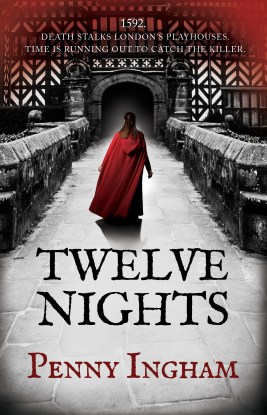
Twelve Nights coverBlurb:

1592. The Theatre, London.

When a player is murdered, suspicion falls on the wardrobe mistress, Magdalen Bisset, because everyone knows poison is a woman’s weapon. The coroner is convinced of her guilt. The scandal-pamphlets demonize her.

Magdalen is innocent, although few are willing to help her prove it. Only handsome Matthew Hilliard offers his assistance, but dare she trust him when nothing about him rings true?

With just two weeks until the inquest, Magdalen ignores anonymous threats to ‘leave it be’, and delves into the dangerous underworld of a city seething with religious and racial tension. As time runs out, she must risk everything in her search for the true killer – for all other roads lead to the gallows.

Buy Links:

This title is available to read on #KindleUnlimited.

Universal Link: https://books2read.com/u/bpYRlk

Penny Ingham 2Author Bio:

Penny has a degree in Classics, and a passion for archaeology – during the summer months, you will often find her on her ‘dig’ with a trowel in her hand. She has had a variety of jobs over the years, including ice cream seller, theatre PR, BBC local radio, and TV critic for a British Forces newspaper.

She has written four novels – ‘The King’s Daughter’ is the story of Aethelflaed, Lady of the Mercians. ‘The Saxon Wolves’ and ‘The Saxon Plague’ are set in the turbulent aftermath of Roman Britain. Her inspiration for Twelve Nights grew from her love of the theatre in general, and Shakespeare in particular.

Penny has two grown-up children and lives with her husband in Hampshire.

Author Links:

Website: Penny Ingham (wordpress.com)

Twitter: Penny Ingham (@pennyingham) / Twitter

Facebook: Penny Ingham Author Page | Facebook

Instagram: Penny Ingham (@penny.ingham) • Instagram photos and videos

Amazon Author Page: Amazon.co.uk: Penny Ingham: Books, Biography, Blogs, Audiobooks, Kindle

Goodreads: Penny Ingham (Author of The Saxon Wolves) | Goodreads

Guest Post: “Excerpt from ‘The Merchant’s Dilemma’ by Carolyn Hughes”

The Merchant's Dilemma Tour Banner

I am pleased to welcome Carolyn Hughes to my blog today to share an excerpt from her novel, “The Merchant’s Dilemma.” I would like to thank Carolyn Hughes and The Coffee Pot Book Club for allowing me to be part of this blog tour. 

From Chapter 2

Riccardo had found himself distracted most of the morning, even when in conversation with his client. It was fortunate there had been only one so, once they had shaken hands on an agreement, he was able to spend some time alone, walking and thinking through the situation, and what and how to tell Bea.

His heart swelled whenever he thought of her. It had never done so at the thought, or even sight, of Katherine. She was not an unattractive woman, but her nervous nature and seeming lack of interest in him discouraged him from even trying to love her. Even when he was lying next to her in bed, he had to steel himself to turn to face her. When he put out a hand to touch her breast, she would flinch, then when he rolled on top of her to complete the task – for “task” it did seem to be – Katherine would whimper, not with pleasure, he was certain, but with urgent longing for it to be over. It was scarcely surprising the so-called act of love with his wife was one he came to dread and even balk at. In truth, it was a wonder little Oliver had ever been conceived.

It had not been that way in those few months before his marriage when Bea had lived here with him. Their love-making had been full of delight and pleasure for them both. In that short time, he had grown to love her deeply. When he was obliged to marry Katherine, and effectively abandon the woman he adored, he had been distraught. He blamed himself, both then and now, for being the cause of Bea leaving Winchester. And, therefore, of the terrible events in Meonbridge that at length brought her back to the city, but as a homeless beggar. 

These past three months had been the happiest he could remember for a long while. His worry about Bea’s health aside, their easy, loving relationship – albeit they were sleeping apart until she was fully well – made each day one to look forward to. And to make his happiness complete surely Bea should no longer continue as his mistress, but become his wife.

Yet, marrying her would not be easy. For, if his father learned of Bea’s former life, he would refuse to sanction marriage to her and would almost certainly deny him his inheritance.

Finding himself in the cathedral precinct, Riccardo slipped into the building. At the main west entrance, scaffolding had been raised, and masons were dismantling some of the ancient stonework. He had heard that Bishop Edington had plans to alter the west end of the building, from the ancient Romanesque original to a more modern style. He looked forward to seeing their fine cathedral transformed into an even more magnificent monument to God, albeit he regretted the dust and noise that was the inevitable result. A result that would continue for many years.

But, despite the noise outside, inside was peaceful enough, if chilly, in stark contrast with the gentle warmth of the April day. He was not entirely alone: a few people, mostly aged women, were standing or kneeling before the high altar, mumbling prayers. He approached the altar too, but kept a distance. He dropped down onto one knee for a moment, then stood up again and, with bowed head, muttered a few prayerful words himself, asking for some sort of guidance in the awkward conversation he had ahead of him.

In truth, he did not feel he received an answer to his entreaty but hoped it might come to him if he thought the matter over a little further. Despite the coldness of the vast, high building, he made his way to the south transept, where there was a stone bench he could sit on for a while. 

He returned to thinking about his father. Would it matter if he was deprived of his inheritance? As the elder of the two Marchaunt sons, he was entitled to the principal Marchaunt estate and the greater proportion of his father’s wealth. Yet the money was not important, nor even the artifacts his father had acquired over the years, magnificent as many of them were. He had made such a success of his own business, he was more than prosperous enough to maintain a wife and family.

No, what really mattered had nothing to do with money.

His first concern was a matter of the heart. He really wanted to own Chilcumbe Hall, the splendid manor house a few miles outside the city. He had been looking forward to the time when he could raise his own children in the place where he and his brother spent such a happy childhood. How disappointing it would be if he lost that opportunity!

But the second concern was even more important. His father was much admired and respected amongst Winchester’s great and good. He had been a master of the guild, several times a city alderman, and was once elected mayor. Riccardo’s own success as a businessman was due partly to being his father’s son. If he was not his father’s principal heir – if he was known to have been cast aside – he would be disgraced, his standing in society ruined. 

There was so much to lose: not just the legacy, and his status as his father’s heir, but everything he had worked for, and even his authority to continue his career.

He closed his eyes a moment, contemplating what such a loss might mean. If all that happened, he supposed he could leave Winchester, and try to establish himself again elsewhere. But the prospect of doing that, at his age, was daunting. And not what he wanted.

Until three months ago, he had presumed he would at length find another wife, a woman from another respectable city family. Hopefully one with a pleasanter disposition than poor Katherine. But he had not been in any hurry. He had expected to find his bride himself, and would not approach his father for advice. Although he might have asked Mama if she knew of any suitable young women looking for a husband.

But that was all before he discovered Bea collapsed on his doorstep. Now, the only woman he wanted as his wife, and the mother to his children, was her. Yet, either marrying her or living with her in a sinful state, accepting their children would be illegitimate, would surely enrage his father. He would simply consider it unacceptable for his heir to sire children upon a woman such as Bea, whether or not they were legitimately man and wife. 

Riccardo sat upright and flexed his shoulders. His back was aching from the cold seeping from the stone bench up through his clothes. He pushed himself to his feet, ready to go home.

So, what was the answer? 

In truth, it was obvious, if disagreeable. He refused to give up Bea, but the consequences of losing his father’s favour were so serious, the only answer was to wait until the old man was no longer able to cast him aside.

He had to wait until his father died.

TMD-CoverBlurb

1362. Winchester. Seven months ago, accused of bringing plague and death from Winchester, Bea Ward was hounded out of Meonbridge by her former friends and neighbors. Finding food and shelter where she could, she struggled to make her way back to Winchester again.

Yet, once she arrived, she wondered why she’d come.

For her former lover – the love of her life – Riccardo Marchaunt, had married a year ago. And she no longer had the strength to go back to her old life on the streets. Frail, destitute, and homeless, she was reduced to begging. Then, in January, during a tumultuous and destructive storm, she found herself on Riccardo’s doorstep. She had no plan, beyond hoping he might help her, or at least provide a final resting place for her poor body.

When Bea awakes to find she’s lying in Riccardo’s bed once more, she’s thankful, thrilled, but mystified. But she soon learns that his wife died four months ago, along with their newborn son, and finds too that Riccardo loves her now as much as he ever did, and wants to make her his wife. But can he? And, even if he can, could she ever really be a proper merchant’s wife?

Riccardo could not have been more relieved to find Bea still alive when he thought he had lost her forever. She had been close to death but is now recovering her health. He adores her and wants her to be his wife. But how? His father would forbid such an “unfitting” match, on pain of denying him his inheritance. And what would his fellow merchants think of it? And their haughty wives?

Yet, Riccardo is determined that Bea will be his wife. He has to find a solution to his dilemma… With the help of his beloved mother, Emilia, and her close friend, Cecily, he hatches a plan to make it happen.

But even the best-laid plans sometimes go awry. And the path of love never did run smooth…

The Merchant’s Dilemma is a companion novel to the main series of MEONBRIDGE CHRONICLES, and continues the story of Bea and Riccardo after the end of the fourth Chronicle, Children’s Fate. It is a little more romantic and light-hearted than the other Chronicles but, if you’ve enjoyed reading about the lives of the characters of Meonbridge, you will almost certainly enjoy reading The Merchant’s Dilemma too!

Buy Links:

This title is available to read on #KindleUnlimited.

Universal Link: https://books2read.com/u/3RY7Yj 

Amazon UK: https://www.amazon.co.uk/Merchants-Dilemma-Meonbridge-Chronicles-Companion-ebook/dp/B0CJJKJFT6/ 

Amazon US: https://www.amazon.com/Merchants-Dilemma-Meonbridge-Chronicles-Companion-ebook/dp/B0CJJKJFT6/ 

Amazon AU: https://www.amazon.com.au/Merchants-Dilemma-Meonbridge-Chronicles-Companion-ebook/dp/B0CJJKJFT6/ 

Amazon CA: https://www.amazon.ca/Merchants-Dilemma-Meonbridge-Chronicles-Companion-ebook/dp/B0CJJKJFT6/ 

Carolyn Hughes authorAuthor Bio:

Carolyn Hughes has lived much of her life in Hampshire. With a first degree in Classics and English, she started working life as a computer programmer, then a very new profession. But it was technical authoring that later proved her vocation, word-smithing for many different clients, including banks, an international hotel group, and medical instruments manufacturers.

Although she wrote creatively on and off for most of her adult life, it was not until her children flew the nest that writing historical fiction took center stage. But why historical fiction? Serendipity!

Seeking inspiration for what to write for her Creative Writing Masters, she discovered the handwritten draft, beginning in her twenties, of a novel, set in 14th-century rural England… Intrigued by the period and setting, she realized that, by writing a novel set in the period, she’d be able to both learn more about the medieval past and interpret it, which seemed like a thrilling thing to do. A few days later, the first Meonbridge Chronicle, Fortune’s Wheel, was underway.

Six published books later (with more to come), Carolyn does now think of herself as a Historical Novelist. And she wouldn’t have it any other way…

Carolyn has a Master’s in Creative Writing from Portsmouth University and a PhD from the University of Southampton.

You can connect with Carolyn through her website http://www.carolynhughesauthor.com and social media.

Author Links:

Website: http://www.carolynhughesauthor.com 

Twitter: https://twitter.com/writingcalliope 

Facebook: https://www.facebook.com/CarolynHughesAuthor/ 

Book Bub: https://www.bookbub.com/profile/carolyn-hughes 

Amazon Author Page: https://www.amazon.co.uk/Carolyn-Hughes/e/B01MG5TWH1

Goodreads: https://www.goodreads.com/author/show/16048212.Carolyn_Hughes 

Guest Post: “Huguenot Refugees – Why so many fled France in the late 17th century” by Rosemary Hayes

The King's Command Tour Banner 1I am pleased to welcome Rosemary Hayes to my blog today as part of the blog tour for her latest novel, “The King’s Command: For God or Country.” I would like to thank Rosemary Hayes and The Coffee Pot Book Club for allowing me to be part of this tour. 

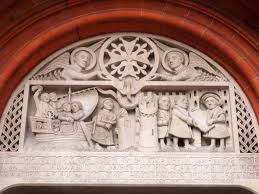
carving above Huguenot church in London

In the early 16th century, the reformist ideas of John Calvin and Martin Luther spread through France and many embraced their new Protestant doctrines. These French Reformists became known as the Huguenots. They believed that the Bible alone gave divine guidance, they rejected the authority of the Pope and the priesthood and they argued for separation of church and state.

John Calvin

All this directly challenged the authority of the Catholic church and led to bitter division between Catholics and Protestants, leading to the Wars of Religion which raged in France from 1562 until 1598. Hatred ran deep, armies were raised and atrocities were committed by both sides.

These wars were finally brought to an end through the actions of King Henry IV.

As a Huguenot, Henry was involved in the Wars of Religion and, while King of Navarre, led Protestant forces against the French royal army. When he succeeded to the French throne in 1589, he at first kept the Protestant faith –  the only French king to do so – but had to fight against the powerful Catholic League, which denied that he could wear the French crown as a Protestant. After several years of stalemate, he converted to Catholicism, reportedly saying “Paris is well worth a mass”!

henry-iv-of-france

Henry was a pragmatic politician, and he promulgated the Edict of Nantes (1598) which granted official tolerance to Protestantism, thereby effectively ending the Wars of Religion and, for eighty years or so, the Huguenots thrived. 

While the Edict of Nantes brought religious peace to France, some hard-line Catholics and Huguenots remained dissatisfied and in 1610 Henry was assassinated by a Catholic zealot. Henry was succeeded by his son Louis XIII.

Louis XIII and his Chief Minister, Cardinal Richelieu, were not at all tolerant of the Huguenots. They abhorred their growing influence and attacked their strongholds. 

300px-Siege_of_La_Rochelle_1881_Henri_Motte

After the capitulation of La Rochelle (the most important of the Huguenots’ strongholds) the Grace of Alais was signed in June 1629.  Although this reaffirmed the Edict of Nantes, it ordered that the Huguenot military organization should be broken up and the Huguenot fortresses destroyed. 

So, although the Huguenots continued to be allowed to practice their faith, their trades, and their professions, their position was considerably weakened by having no fortifications and no army.

When Louis XIII’s son, Louis IV, finally took control of his kingdom in 1661, he quickly set about reforming France according to his vision.

His vision included making France a wholly Catholic country.  His mantra was ‘One realm, one religion, one King’ and he swore to wipe out the ‘false religion’ of Protestantism once and for all. 

Many Huguenots could see the way the wind was blowing and quietly left France to find refuge in Protestant countries.

In France, the rights of Huguenots continued to be systematically eroded by Louis and his advisers, and the Edict of Nantes, which had protected them for so long, was finally revoked in 1685. At the time of the revocation, Huguenot pastors were given two weeks to leave the country or face death. However, their congregations were forbidden from leaving because Louis did not want to lose the skills of these hard-working and successful people.

Pressure continued to mount and Huguenots’ lives became impossible if they continued to be loyal to their faith. Unless they converted to Catholicism, they would forfeit their property, be unable to practice their professions or trades and their children would be forcibly removed from them to be brought up as Catholics. They were banned from holding gatherings, even in private, and their temples were destroyed.

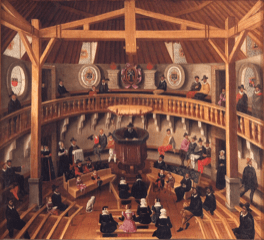
inside hugurnot temple

In many places, on the King’s orders, brutal soldiers were sent in to force households to convert and thousands did, to save their skins. 

Dragoon forcing huguenot to sign abduration paper

Some held out and suffered terribly, others tried to flee the country and were caught and punished, the men sent to row in the galleys in the Mediterranean (a death sentence) or executed, the women imprisoned and the children sent to be brought up in Catholic institutions.

Huguenot women in prison

There are stories of escape where fleeing Huguenots managed to elude their pursuers and make their way to other countries, but also horrific accounts of greedy sea captains taking money from them and then tossing them overboard, of tortures inflicted on those who refused to convert and of refugees hiding on board ships having noxious gas fed into their hiding places. There were plenty of financial rewards offered to those betraying Huguenots and to soldiers finding stowaways, with spies and informers everywhere.

Little wonder, then, that France was emptied of some of its most skilled citizens during these unsettled times. The Protestant countries to which the Huguenots fled were hugely enriched by their presence.  Doctors, lawyers, weavers, gold and silversmiths, clockmakers, lace makers, shoemakers, jewelers, glove makers, bookbinders, perfumers. These folk passed on their skills to those who gave them refuge and became valued citizens of their adopted countries.

My ancestors were a prosperous Huguenot family from Gascony and for the last two years, I have been researching what happened to them and how they escaped to London in 1692. My book ‘The King’s Command’ is very loosely based on their experience.

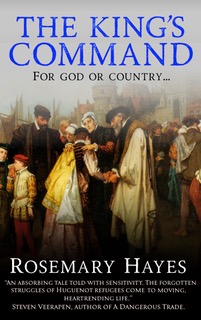
The King's Command - 92Blurb: 

16-year-old Lidie Brunier has everything; looks, wealth, health, and a charming suitor but there are dark clouds on the horizon. Lidie and her family are committed Huguenots and Louis XIV has sworn to stamp out this ‘false religion’ and make France a wholly Catholic country. Gradually Lidie’s comfortable life starts to disintegrate as Huguenots are stripped of all rights and the King sends his brutal soldiers into their homes to force them to become Catholics. Others around her break under pressure but Lidie and her family refuse to convert. With spies everywhere and the ever-present threat of violence, they struggle on. Then a shocking betrayal forces Lidie’s hand and her only option is to try and flee the country. A decision that brings unimaginable hardship, terror, and tragedy and changes her life forever.

‘One of the very best historical novels I have ever read’

Sandra Robinson, Huguenot Ancestry Expert

Buy Links: 

This title is available to read with #KindleUnlimited.

Universal Link: https://books2read.com/u/bW6zGG 

Amazon UK: https://www.amazon.co.uk/dp/B0CB4RH68S 

Amazon US: https://www.amazon.com/Kings-Command-God-Country-ebook/dp/B0CB4RH68S/ 

Amazon AU: https://www.amazon.com.au/Kings-Command-God-Country-ebook/dp/B0CB4RH68S/ 

Amazon CA: https://www.amazon.ca/Kings-Command-God-Country-ebook/dp/B0CB4RH68S/ 

rosemary-hayes-authorAuthor Bio:

Rosemary Hayes has written over fifty books for children and young adults. She writes in different genres, from edgy teenage fiction (The Mark), historical fiction (The Blue Eyed Aborigine and Forgotten Footprints), middle-grade fantasy (Loose Connections, The Stonekeeper’s Child and Break Out)  to chapter books for early readers and texts for picture books. Many of her books have won or been shortlisted for awards and several have been translated into different languages.

Rosemary has traveled widely but now lives in South Cambridgeshire. She has a background in publishing, having worked for Cambridge University Press before setting up her own company Anglia Young Books which she ran for some years. She has been a reader for a well-known authors’ advisory service and runs creative writing workshops for both children and adults.

Rosemary has recently turned her hand to adult fiction and her historical novel ‘The King’s Command’ is about the terror and tragedy suffered by the French Huguenots during the reign of Louis XIV.

Author Links:

Website: https://www.rosemaryhayes.co.uk 

Twitter: https://twitter.com/HayesRosemary 

Amazon Author Page: https://www.amazon.co.uk/Rosemary-Hayes/e/B00NAPAPZC 

Goodreads: https://www.goodreads.com/author/show/80106.Rosemary_Hayes 

Guest Post: “King’s Warrior” by James Gault

King's Warrior Tour Banner 1I am pleased to welcome James Gault to my blog to share a bit of information about his novel, “King’s Warrior.” I want to thank James Gault and The Coffee Pot Book Club for allowing me to be part of this blog tour. 
“King’s Warrior” is the third in a series about Owerd, a decent but unsophisticated 11th-century Briton who has struggled out of poverty by dint of courage and good fortune (“wyrd” if you will). The series came about by accident, initially intended as a single volume to bring Charles Kingsley’s classic novel “Hereward the Wake” into a more digestible form for the contemporary reader. That attempt proved impossible – one cannot, I found, tinker with a classic, however challenging its rather antiquated prose. Hence a new character set in the same period of a land beset by inequity, strife, and a Norman invasion. In this book Owerd, having already established his credentials as a loyal subject and “Sea Lord” returns to the role he fills best, that of warrior.

As with any other work of historical fiction, the bare bones are laid out by historical events, at least the events and their rationale as we know them. I have found it quite a challenge to reliably determine many such facts as they relate to late 11th century England and it has been said that recorded English history only began after 1066. We probably know more of the sayings of the sages of early China such as Confucius than we do of William the Conqueror. That is perhaps not surprising when we are addressing a monarch who spoke a Norman version of French, was barely literate in Latin, and gave up trying to learn English, the mother tongue of his subdued nation.

A degree of reliance must necessarily be placed upon the anonymous authors of The Anglo-Saxon Chronicles, compiled from around 890 AD. I have done so whilst acknowledging a degree of bias in that record and its seemingly undue focus on the appointments and subsequent demise of bishops. Nonetheless, that record has provided me with a wonderful basis for the ‘bare bones’ of the story and I am grateful to those monkish chroniclers.

I have much admiration for the authors of historical non-fiction and do not envy the inevitable peer scrutiny of their documented assertions of historical fact. I suspect many such authors, though, are acknowledged scholars in their field and have access to resources beyond me such as the Bodleian Library. Oh, such envy! I live in a small coastal town in SE Australia where the local library has a history section that goes back as far as WW-1 at best. I have been forced therefore to do much research on the internet – a risky and academically maligned source but of high utility to those such as myself. My old high school atlas has provided the wherewithal for most of the geographic elements of the tale, although much inadequate use of a magnifying glass has occasionally forced me back onto the Web.

I have been as careful as possible to align the story with the events and characters of the time. It is a work of fiction, though, and I gratefully acknowledge a certain leeway allowed for such works. Fiction does provide an opening for more conjecture and imaginative description of events and a certain subjective view of the characters. I have been occasionally harsh in my characterization of the Normans and somewhat less so of the Bretons. For William himself I have taken a relatively benign view, accepting his reputation for both cruelty and mercy in equal measure.

I would wish it otherwise but accept that there will be shortcomings in my research. I have, however, enjoyed that element of the writing task immensely. As other writers in the genre will know, a week’s research might well lead to a single paragraph of text. That can still be a satisfying return on investment.

King's Warrior coverBlurb:

In 11th-century England, King William achieved almost total domination of the English and turned his attention to Scotland. Owerd, possibly the last of the Britons to be deemed ‘lord’, faces powerful enemies from all quarters. He seems to hold the king’s favor by a thread, which only serves to encourage others to try and bring him down. 

Treachery abounds as he tries to juggle multiple roles and prove himself and his men worthy warriors for the Norman king. But will his lust for a woman finally prove his undoing?

Note from the author:

11th Century men and women were just as complex beings as we are today. Owerd, the main character in these chronicles is no different. In “King’s Warrior”, the third book of the series, he goes from violence (“…the air was filled with the clash of swords, angry shouts, and screams of the injured”) to compassion (“… Owerd had rarely if ever, made love as tenderly as he did with Runa that night”) in the space of a day.

Happiness, fear, disgust, anger, pride, and jealousy all play their part in Owerd’s character but what comes to the fore is courage, with perhaps a helping hand from fate – “wyrd” if you will.

Buy Links:

This title is available to read on #KindleUnlimited.

Universal Link: https://books2read.com/u/4A27gp 

Amazon UK: https://www.amazon.co.uk/gp/product/B0CC5VH6BM

Amazon US: https://www.amazon.com/gp/product/B0CC5VH6BM

Amazon AU: https://www.amazon.com.au/gp/product/B0CC5VH6BM

Amazon CA: https://www.amazon.ca/gp/product/B0CC5VH6BM

James GaultAuthor Bio:

James is a semi-retired Naval Captain with an abiding interest in storytelling and history. He has written a few contemporary fiction stories and a history text but lately has concentrated on historical fiction. He lives in a small coastal town in SE Australia – which provides quite a challenge when addressing medieval England with the aid of an old-school atlas.

Author Links:

Twitter: https://twitter.com/@ozjimg

Facebook: https://www.facebook.com/james.gault.9421/

Instagram: https://www.instagram.com/ozjimg/

Amazon Author Page: https://www.amazon.com/author/jgault

Guest Post: Spotlight for “Buccaneer: The Early Life and Crimes of Philip Rake” by Chris Thorndycroft

Buccaneer Blog Tour BannerI am pleased to welcome Chris Thorndycroft to my blog today to share a blurb for his novel, “Buccaneer: The Early Life and Crimes of Philip Rake.” Thank you, Chris Thorndycroft and The Coffee Pot Book Club, for allowing me to be part of this tour.

Buccaneer cover finalBlurb:
Bristol, 1713. When Philip Rake, pickpocket, smuggler, and scoundrel, is arrested and thrown in jail, he assumes he has a short walk to the gallows. But his father, a wealthy merchant who has remained a figure of mystery throughout his life, throws him a lifeline; he becomes an indentured man on an expedition to the East Indies led by his friend, Woodes Rogers.

Woodes Rogers is looking for Libertatia – the fabled pirate kingdom of the legendary buccaneer Henry Avery – and the treasure hoard rumoured to be hidden there. But Philip wants his freedom, and when he learns that there are men onboard who once sailed with Henry Avery and planned to take the treasure for themselves, he jumps ship and embarks upon a career of piracy.

Philip’s story takes him from the backstreets of Bristol to the sun-baked hills of Madagascar and on to the tropical islands of the Caribbean in a thrilling tale of adventure in which he rubs shoulders with some of the most notorious pirates of the age, including Blackbeard, Charles Vane, Anne Bonny, and Mary Read.

Buy Links:

This title will be available to read on #KindleUnlimited.

Universal Link: https://mybook.to/Buccaneer

Amazon UK: https://www.amazon.co.uk/dp/B0C9TWGMZJ/
Amazon US: https://www.amazon.com/dp/B0C9TWGMZJ/
Amazon CA: https://www.amazon.ca/dp/B0C9TWGMZJ/
Amazon AU: https://www.amazon.com.au/dp/B0C9TWGMZJ/

Chris ThorndycroftAuthor Bio:

Chris Thorndycroft’s writing career began with short horror stories which appeared in magazines and anthologies such as Dark Moon Digest and American Nightmare.

His first novel under his name was A Brother’s Oath, book one in the Hengest and Horsa trilogy, which deals with the beginning of Anglo-Saxon England. He has always had a passion for historical fiction, kindled at the age of six when he first saw Errol Flynn in The Adventures of Robin Hood (1938). His books are deeply grounded in real history but often reimagine legends such as King Arthur and Robin Hood, weaving them in with historical events.

He currently lives in Norway with his wife and two kids.

Social Media Links:

Website: https://christhorndycroft.wordpress.com/
Twitter: https://twitter.com/cthorndycroft
Facebook: https://www.facebook.com/ChrisThorndycroftAuthor/
Instagram: https://www.instagram.com/christhorndycroft/
TikTok: https://www.tiktok.com/@christhorndycroft
Amazon Author Page: https://www.amazon.co.uk/Chris-Thorndycroft/e/B015EQARZM
Goodreads: https://www.goodreads.com/author/show/8130216.Chris_Thorndycroft

Guest Post: “Turning the World to Stone” Excerpt by Kelly Evans

Turning the World to Stone Tour BannerI am pleased to welcome Kelly Evans to my blog today to share an excerpt from her novel, “Turning the World to Stone.” I want to thank Kelly Evans and The Coffee Pot Book Club for allowing me to be part of this blog tour. 
“I’m worried about the Holy Father.”

“All of Italy is.”

His lack of concern inflamed her already smouldering ire. “How can you be so unmoved? You know how serious our situation is.”

He replied with the same uninterested tone. “I’ll take care of it.”

Caterina’s pique overwhelmed her. “What? Like you have been? Emboldening our enemies and making new ones when we need friends right now?”

Girolamo glared at her, and Caterina felt slightly smug at finally pushing him into revealing himself. Mocking her tone, he lashed out. “What? Friends like your Bossi? Your closest advisor, always around to do your bidding.” He glanced around the room. “I’m surprised he’s not lurking in the shadows, waiting to whisper in your ear. I’ve often wondered if he whispers about himself and you and if my children are even mine.”

This was the best he could do? Insinuations? She was grateful Bossi wasn’t around to hear such slander.

Her husband went on. “Or friends like that little puttana, your lady? Where is she? She’s always sniffing around.” He glared at her with such disdain it felt like she’d been hit by him. “You need to mind your own business, arrogant Milanese whore that you are.”

Caterina stood, her body trembling. “How dare you?”

“I dare because I can. You have been too free with me, wife. You should watch yourself.” Girolamo moved his hand to his knife hilt threateningly but knocked over his glass of wine in the process. His face a deep red, he picked up the glass and threw it across the room before storming out.

As he exited the main door to the hall, Luisa entered through another just in time to see Caterina stare open-mouthed and then collapse on the floor. 

Turning the World to Stone coverBook Title and Author Name: 

Turning the World to Stone – The Life of Caterina Sforza Part One 1472 to 1488 

by Kelly Evans

Blurb:

Vilified by history, Caterina Sforza learned early that her life was not her own. Married at age ten, she was a pawn in the ever-changing political environment of Renaissance Italy.

Resigned to her life as a fifteenth-century wife, Caterina adapted to the role she was expected to play: raising and educating her children, helping the poor in her new home, and turning a blind eye to her husband’s increasingly shameful behaviour. But Fate had other plans for her, and soon Caterina’s path would be plagued by murder, betrayal, and heartbreak. 

“Could I write all, the world would turn to stone.”

Buy Links: 

This title is available to read on #KindleUnlimited.

Universal Link: https://mybook.to/Caterina

Amazon UK: https://www.amazon.co.uk/Turning-World-Stone-Caterina-Sforza/dp/1778022421

Amazon US: https://www.amazon.com/Turning-World-Stone-Caterina-Sforza-ebook/dp/B0C1HZHT93

Amazon CA: https://www.amazon.ca/Turning-World-Stone-Caterina-Sforza-ebook/dp/B0C1HZHT93

Amazon AU: https://www.amazon.com.au/Turning-World-Stone-Caterina-Sforza-ebook/dp/B0C1HZHT93

Kelly EvansAuthor Bio:

Born in Canada of Scottish extraction, Kelly Evans graduated in History and English, then moved to England, where she worked in the financial sector. While in London, Kelly continued her studies in history, concentrating on Medieval History, and travelled extensively through Eastern and Western Europe. 

Kelly is now back in Canada with her husband, Max, and a rescue cat. She writes full-time, focussing on illuminating little-known women in history with fascinating stories. When not working on her novels, Kelly writes Described Video scripts for visually impaired individuals, plays oboe, and enjoys old sci-fi movies. 

Social Media Links:

Website: https://www.kellyaevans.com

Twitter: https://twitter.com/ChaucerBabe

Facebook: https://www.facebook.com/kellyevansauthor

Instagram: https://www.instagram.com/kellyevansauthor/

Pinterest: https://www.pinterest.ca/kellyewrites/

Book Bub: https://www.bookbub.com/profile/kelly-evans

Amazon Author Page: https://www.amazon.com/stores/Kelly-Evans/author/B0187JGTOQ

Goodreads: https://www.goodreads.com/author/show/14335541.Kelly_Evans