Guest Post: “What was Life Like in ‘Northwick Priory’” by Carolyn Hughes

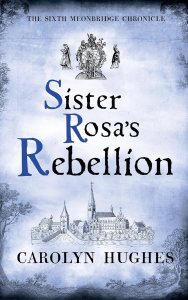
I am pleased to welcome Carolyn Hughes to my blog to share a guest post about her latest novel, Sister Rosa’s Rebellion. I would like to thank Carolyn Hughes and The Coffee Pot Book Club for allowing me to participate in this blog tour. 

The principal location for Sister Rosa’s Rebellion, the latest novel in my Meonbridge Chronicles series, set in medieval Hampshire, is a priory of nuns, although important plot threads in the novel are also, of course, still set in the community of fictional Meonbridge itself.  

However, the central focus of the storyline is the young woman who left Meonbridge at the end of the First Meonbridge Chronicle, Fortune’s Wheel, to become a nun in Northwick Priory. That young woman was Johanna de Bohun, the daughter of the lord and lady of Meonbridge, Sir Richard and Lady Margaret. The shameful motivation behind Johanna’s decision to sequester herself in the priory as Sister Rosa is the primary thread in the story of Sister Rosa’s Rebellion. For when, after fifteen years of contentment, Rosa’s life in the priory is turned upside down, the reason she became a nun is threatened to be revealed. 


In this post, I thought I’d share something of the background I’ve drawn upon to paint the picture of life for Sister Rosa and her sister nuns, discussing how I came up with my vision of Northwick Priory, and something of the daily pattern of life inside it. 


Northwick Priory is fictional, but, in my mind, it’s sited more or less where the real monastery of Southwick once stood, about nine miles from “Meonbridge” and six miles north of Portsmouth. In medieval times, Southwick Priory was reasonably well-endowed, with many manors, and was also a place of pilgrimage, until it was closed during Henry VIII’s Dissolution of the monasteries. But “Northwick” is relatively poor. Not struggling, as long as the prioress and treasuress can keep on top of their finances, but sufficiently close to the edge that a profligate prioress could easily bring the place to ruin… 


Not knowing already how a medieval priory might be laid out, I searched for examples online and found Cleeve Abbey, a ruin in Somerset, destroyed in the Dissolution, that is managed by English Heritage. Cleeve was a monastery, not a nunnery, but, in principle, the layout for both would, or could, be similar. Luckily for me, there’s a plan of the abbey on its web page, which I’ve used very loosely as the model for Northwick. 


As at Cleeve, Northwick has two floors, with the more private chambers upstairs and the “day” rooms downstairs. The dorter (the dormitory) is upstairs, with a flight of night stairs leading directly down to the chapel, making it easier for the nuns to access the chapnighttime night time offices. All the sisters, including the prioress, were supposed to sleep in the dorter, although, in Sister Rosa’s Rebellion, the fact that the prioress doesn’t is a matter for great concern! 


I imagine the dorter essentially as a long chamber furnished with rows of beds. Privacy wasn’t usual in any medieval environment, even in the grand homes of the gentry. Nonetheless, I’ve introduced a design aspect to Northwick’s dorter that was almost certainly not common in nunneries or monasteries: the inclusion of “cells” within the dorter chamber. I’ve read that, occasionally, the dorter might be partitioned into cells or cubicles, and it suited my purpose for the story of Sister Rosa’s Rebellion to allow this arrangement in Northwick. However, I’ve imagined Northwick’s cubicles as being separated by the flimsiest of partitions, so all the snuffling and snoring noises of the night-time dormitory would still intrude, even if each nun did enjoy a modicum of privacy. It was apparently really rare for a priory to have cells, in the sense of separate chambers, for monks or nuns to sleep in. 

 ,

At Northwick, I have other chambers upstairs, including the prioress’s own – where, in Sister Rosa’s Rebellion, she sleeps and eats, and also entertains both her favourites and visitors, quite contrary to the Rules of the Benedictine order. 


The ground floor of Northwick Priory is laid out more or less as at Cleeve. In the centre is the cloister, the great internal courtyard around which the nuns would take their exercise each day, with the chapel to the north of it and the frater (the refectory or dining hall, where all sisters were expected to eat) to the south. Off the sides of the cloister were various chambers, including the Chapter house, where the nuns met daily to hear readings from the order’s Rule, discuss any day-to-day decisions. 


Close to the frater would of course be the kitchens, either within the priory buildings, or perhaps in a separate building, for safety.  


Sited close to the chapel’s entrance was the sacristy, the room where the priest prepared for services, and where items used in services were,e kept and was therefore also the “office” of the sacrist. 


Outside the priory buildings, I’ve given Northwick a gatehouse much like the one at Cleeve, with upper floors. The infirmary was often sited away from the main buildings, presumably to keep infection confined. And there would be other domestic buildings, such as a bakehouse, a brewhouse, and a laundry, and of course, storehouses for various purposes. 


I hope you now have a feel for the layout of Northwick Priory, but what of life inside it? 


A nun’s day was very structured, arranged around the holy offices, the chapel services (also called the divine offices or the liturgy of the hours) that they were required to attend. The services, which consisted primarily of psalms, hymns, readings, and prayers, were held at fixed times. These canonical hours were not only the specified times for prayer, but also marked the times of day.  


Depending upon the time of year, they were broadly as follows:  


  • Matins: Midnight or sometime during the night  
  • Lauds: Dawn or 3 a.m. 
  • Prime: The first hour, about 6 a.m. 
  • Terce: The third hour, about 9 a.m. 
  • Sext: The sixth hour, about noon 
  • Nones: The ninth hour, about 3 p.m. 
  • Vespers: The “lighting of the lamps”, about 6 p.m. 
  • Compline: The last hour, just before retiring, around 9 p.m. 


After Prime, the nuns would usually hold their chapter meeting (mentioned above). Otherwise, between the services, they took their meals (breakfast, dinner, and supper), carried out their work, and in theory spent some time in reading and private study. 


I imagine meals were generally modest affairs for most (although, in Sister Rosa’s Rebellion, the prioress decides she can no longer stomach “modest” meals and demands more exotic food for herself). That’s not to say the ordinary nuns’ food was necessarily meagre or unappetizing. They had the resources of the home farm to call upon, and if it was well-managed, there was no reason why they shouldn’t have a varied and nourishing diet. In principle, according to the Benedictine Rule to which Northwick’s nuns adhere, meals were taken in silence or near silence, save for the nun who was reading from the Bible. However, it again suited my “authorly” purposes to relax the rule a little, so “quiet” is required in Northwick’s dorter rather than silence. 


As I said, in theory, time was set aside for reading scripture and private study. However, I understand that, by the fourteenth century, reading was no longer widespread – I’m not clear why – and even work occupied less time than it once had, as servants tended to do it.  


In a small nunnery like Northwick, most of the nuns would probably have a defined role. Although some of the nuns’ work might be menial, say, working in the kitchen, laundry, or garden, I believe it was more commonplace for servants to carry out these tasks, whilst the nuns themselves undertook administrative tasks. If you’d like to know more about the work of medieval nuns, look out for a post of mine called The working lives of medieval nuns, shared by other hosts on this blog tour. 
Blurb: 

How can you rescue what you hold most dear, when to do so you must break your vows?

1363. When Mother Angelica, the old prioress at Northwick Priory, dies, many of the nuns presume Sister Rosa, formerly Johanna de Bohun, of Meonbridge, will take her place. But Sister Evangelina, Angelica’s niece, believes the position is hers by right, and one way or another, she will ensure it is.

Rosa stands aside to avoid unseemly conflict, but is devastated when she sees how the new prioress is changing Northwick: from a place of humility and peace to one of indulgence and amusement, if only for the prioress and her favoured few. Rosa is terrified her beloved priory will be brought to ruin under Evangelina’s profligate and rapacious rule, but her vows of obedience make it impossible to rebel.

Meanwhile, in Meonbridge, John atte Wode, the bailiff, is also distraught by the happenings at Northwick. After years of advising the former prioress and Rosa on the management of their estates, Evangelina dismissed him, banning him from visiting Northwick again.

Yet, only months ago, he met Anabella, a young widow who fled to Northwick to escape her in-laws’ demands and threats, but is a reluctant novice nun. The attraction between John and Anabella was immediate, and he hoped to encourage her to give up the priory and become his wife. But how can he possibly do that now?

Can John rescue his beloved Anabella from a future he is certain she no longer wants? And can Rosa overcome her scruples, rebel against Evangelina’s hateful regime, and return Northwick to the haven it once was? 

Buy Links: 

Universal Buy Link: https://books2read.com/u/bWaYM0  

This title is available to read on #KindleUnlimited. 

Author Bio

CAROLYN HUGHES has lived much of her life in Hampshire. With a first degree in Classics and English, she started working life as a computer programmer, then a very new profession. But it was technical authoring that later proved her vocation, word-smithing for many different clients, including banks, an international hotel group, and medical instruments manufacturers. 

Although she wrote creatively on and off for most of her adult life, it was not until her children flew the nest that writing historical fiction took centre stage. But why historical fiction? Serendipity! 

Seeking inspiration for what to write for her Creative Writing Masters, she discovered the handwritten draft, begun in her twenties, of a novel, set in 14th-century rural England… Intrigued by the period and setting, she realised that, by writing a novel set in the period, she could learn more about the medieval past and interpret it, which seemed like a thrilling thing to do. A few days later, the first Meonbridge Chronicle, Fortune’s Wheel, was underway. 

Seven published books later (with more to come), Carolyn does now think of herself as a Historical Novelist. And she wouldn’t have it any other way… 

Author Links

Website: https://carolynhughesauthor.com  

Twitter: www.x.com/writingcalliope  

Facebook: www.facebook.com/CarolynHughesAuthor  

Bluesky: https://bsky.app/profile/carolynhughes.bsky.social  

Book Bub: https://www.bookbub.com/authors/carolyn-hughes  

Amazon Author Page: https://www.amazon.co.uk/stores/Carolyn-Hughes/author/B01MG5TWH1  

Goodreads: https://www.goodreads.com/author/show/16048212.Carolyn_Hughes 
Guest Post: “Audiobook Extract from ‘A Woman’s Lot’ by Carolyn Hughes

I am pleased to welcome Carolyn Hughes back to my blog to share an audiobook extract from her novel, “A Woman’s Lot.” I want to thank The Coffee Pot Book Club and Carolyn Hughes for allowing me to be part of this blog tour.
Audiobook Extract

The following link is the extract for the audiobook for “A Woman’s Lot” by Carolyn Hughes, narrated by Alex Lee. 

https://soundcloud.com/cathie-dunn/a-womans-lot-agnes-by-carolyn-hughes

Blurb: 

How can mere women resist the misogyny of men?

1352. In Meonbridge, a resentful peasant rages against Eleanor Titherige’s efforts to build up her flock of sheep. Susanna Miller’s husband, grown melancholy and ill-tempered, succumbs to idle gossip that his wife’s a scold. Agnes Sawyer’s yearning to be a craftsman is met with scorn. And the village priest, fearful of what he considers women’s “unnatural” ambitions, is determined to keep them firmly in their place. 

Many men hold fast to the teachings of the Church and fear the havoc the “daughters of Eve” might wreak if they’re allowed to usurp men’s roles and gain control over their own lives. 

Not all men in Meonbridge resist the women’s desire for change – indeed, they want it for themselves. Yet it takes only one or two misogynists to unleash the hounds of hostility and hatred… 

If you enjoy immersive historical fiction with a strong authentic feel, set in a time of change and challenge, especially for women, you’ll love A Woman’s Lot, the second MEONBRIDGE CHRONICLE. Find out for yourself if Meonbridge’s “unnatural” women stand up to their abusers! 

Praise: 

This book exceeded all my expectations. I did not read this story. I lived it!”  

~ The Coffee Pot Book Club 


“A treat for all the senses…totally true to its time and setting…”  

~ Being Anne  


I didn’t so much feel as if I were reading about medieval England as experiencing it first hand.” 

~ Linda’s Book Bag 


An absorbing account of the times.” 

~ Historical Novel Society 

Buy Link: 

Universal Buy Link: https://books2read.com/u/4jzKJY  

This title is available to read on #KindleUnlimited. 

Audiobook Links: 

Audible: https://buff.ly/4gw1xs3  

Audible UK: https://www.audible.co.uk/pd/A-Womans-Lot-Audiobook/B0DW4HR5HW  

Audible US: https://www.audible.com/pd/A-Womans-Lot-Audiobook/B0DW4FZLCZ  

Author Bio

Carolyn Hughes has lived much of her life in Hampshire. With a first degree in Classics and English, she started working as a computer programmer, which was a very new profession. But it was technical authoring that later proved her vocation, word-smithing for many different clients, including banks, an international hotel group, and medical instruments manufacturers. 

Although she wrote creatively on and off for most of her adult life, it was not until her children flew the nest that writing historical fiction took center stage. But why historical fiction? Serendipity! 

Seeking inspiration for what to write for her Creative Writing Masters, she discovered the handwritten draft, beginning in her twenties, of a novel, set in 14th-century rural England… 


Intrigued by the period and setting, she realized that, by writing a novel set in the period, she could learn more about the medieval past and interpret it, which seemed like a thrilling thing to do. A few days later, the first Meonbridge Chronicle, Fortune’s Wheel, was underway. 


Six published books later (with more to come), Carolyn does now think of herself as an Historical Novelist. And she wouldn’t have it any other way… 


Author Links


Website: https://carolynhughesauthor.com  

Twitter: https://x.com/writingcalliope  

Facebook: https://facebook.com/CarolynHughesAuthor  

Bluesky: https://carolynhughes.bsky.social  

Book Bub: https://www.bookbub.com/authors/carolyn-hughes 

Amazon Author Page: https://www.amazon.co.uk/stores/Carolyn-Hughes/author/B01MG5TWH1  

Goodreads: https://www.goodreads.com/author/show/16048212.Carolyn_Hughes  


Guest Post: “Excerpt from ‘The Merchant’s Dilemma’ by Carolyn Hughes”

The Merchant's Dilemma Tour Banner

I am pleased to welcome Carolyn Hughes to my blog today to share an excerpt from her novel, “The Merchant’s Dilemma.” I would like to thank Carolyn Hughes and The Coffee Pot Book Club for allowing me to be part of this blog tour. 

From Chapter 2

Riccardo had found himself distracted most of the morning, even when in conversation with his client. It was fortunate there had been only one so, once they had shaken hands on an agreement, he was able to spend some time alone, walking and thinking through the situation, and what and how to tell Bea.

His heart swelled whenever he thought of her. It had never done so at the thought, or even sight, of Katherine. She was not an unattractive woman, but her nervous nature and seeming lack of interest in him discouraged him from even trying to love her. Even when he was lying next to her in bed, he had to steel himself to turn to face her. When he put out a hand to touch her breast, she would flinch, then when he rolled on top of her to complete the task – for “task” it did seem to be – Katherine would whimper, not with pleasure, he was certain, but with urgent longing for it to be over. It was scarcely surprising the so-called act of love with his wife was one he came to dread and even balk at. In truth, it was a wonder little Oliver had ever been conceived.

It had not been that way in those few months before his marriage when Bea had lived here with him. Their love-making had been full of delight and pleasure for them both. In that short time, he had grown to love her deeply. When he was obliged to marry Katherine, and effectively abandon the woman he adored, he had been distraught. He blamed himself, both then and now, for being the cause of Bea leaving Winchester. And, therefore, of the terrible events in Meonbridge that at length brought her back to the city, but as a homeless beggar. 

These past three months had been the happiest he could remember for a long while. His worry about Bea’s health aside, their easy, loving relationship – albeit they were sleeping apart until she was fully well – made each day one to look forward to. And to make his happiness complete surely Bea should no longer continue as his mistress, but become his wife.

Yet, marrying her would not be easy. For, if his father learned of Bea’s former life, he would refuse to sanction marriage to her and would almost certainly deny him his inheritance.

Finding himself in the cathedral precinct, Riccardo slipped into the building. At the main west entrance, scaffolding had been raised, and masons were dismantling some of the ancient stonework. He had heard that Bishop Edington had plans to alter the west end of the building, from the ancient Romanesque original to a more modern style. He looked forward to seeing their fine cathedral transformed into an even more magnificent monument to God, albeit he regretted the dust and noise that was the inevitable result. A result that would continue for many years.

But, despite the noise outside, inside was peaceful enough, if chilly, in stark contrast with the gentle warmth of the April day. He was not entirely alone: a few people, mostly aged women, were standing or kneeling before the high altar, mumbling prayers. He approached the altar too, but kept a distance. He dropped down onto one knee for a moment, then stood up again and, with bowed head, muttered a few prayerful words himself, asking for some sort of guidance in the awkward conversation he had ahead of him.

In truth, he did not feel he received an answer to his entreaty but hoped it might come to him if he thought the matter over a little further. Despite the coldness of the vast, high building, he made his way to the south transept, where there was a stone bench he could sit on for a while. 

He returned to thinking about his father. Would it matter if he was deprived of his inheritance? As the elder of the two Marchaunt sons, he was entitled to the principal Marchaunt estate and the greater proportion of his father’s wealth. Yet the money was not important, nor even the artifacts his father had acquired over the years, magnificent as many of them were. He had made such a success of his own business, he was more than prosperous enough to maintain a wife and family.

No, what really mattered had nothing to do with money.

His first concern was a matter of the heart. He really wanted to own Chilcumbe Hall, the splendid manor house a few miles outside the city. He had been looking forward to the time when he could raise his own children in the place where he and his brother spent such a happy childhood. How disappointing it would be if he lost that opportunity!

But the second concern was even more important. His father was much admired and respected amongst Winchester’s great and good. He had been a master of the guild, several times a city alderman, and was once elected mayor. Riccardo’s own success as a businessman was due partly to being his father’s son. If he was not his father’s principal heir – if he was known to have been cast aside – he would be disgraced, his standing in society ruined. 

There was so much to lose: not just the legacy, and his status as his father’s heir, but everything he had worked for, and even his authority to continue his career.

He closed his eyes a moment, contemplating what such a loss might mean. If all that happened, he supposed he could leave Winchester, and try to establish himself again elsewhere. But the prospect of doing that, at his age, was daunting. And not what he wanted.

Until three months ago, he had presumed he would at length find another wife, a woman from another respectable city family. Hopefully one with a pleasanter disposition than poor Katherine. But he had not been in any hurry. He had expected to find his bride himself, and would not approach his father for advice. Although he might have asked Mama if she knew of any suitable young women looking for a husband.

But that was all before he discovered Bea collapsed on his doorstep. Now, the only woman he wanted as his wife, and the mother to his children, was her. Yet, either marrying her or living with her in a sinful state, accepting their children would be illegitimate, would surely enrage his father. He would simply consider it unacceptable for his heir to sire children upon a woman such as Bea, whether or not they were legitimately man and wife. 

Riccardo sat upright and flexed his shoulders. His back was aching from the cold seeping from the stone bench up through his clothes. He pushed himself to his feet, ready to go home.

So, what was the answer? 

In truth, it was obvious, if disagreeable. He refused to give up Bea, but the consequences of losing his father’s favour were so serious, the only answer was to wait until the old man was no longer able to cast him aside.

He had to wait until his father died.

TMD-CoverBlurb

1362. Winchester. Seven months ago, accused of bringing plague and death from Winchester, Bea Ward was hounded out of Meonbridge by her former friends and neighbors. Finding food and shelter where she could, she struggled to make her way back to Winchester again.

Yet, once she arrived, she wondered why she’d come.

For her former lover – the love of her life – Riccardo Marchaunt, had married a year ago. And she no longer had the strength to go back to her old life on the streets. Frail, destitute, and homeless, she was reduced to begging. Then, in January, during a tumultuous and destructive storm, she found herself on Riccardo’s doorstep. She had no plan, beyond hoping he might help her, or at least provide a final resting place for her poor body.

When Bea awakes to find she’s lying in Riccardo’s bed once more, she’s thankful, thrilled, but mystified. But she soon learns that his wife died four months ago, along with their newborn son, and finds too that Riccardo loves her now as much as he ever did, and wants to make her his wife. But can he? And, even if he can, could she ever really be a proper merchant’s wife?

Riccardo could not have been more relieved to find Bea still alive when he thought he had lost her forever. She had been close to death but is now recovering her health. He adores her and wants her to be his wife. But how? His father would forbid such an “unfitting” match, on pain of denying him his inheritance. And what would his fellow merchants think of it? And their haughty wives?

Yet, Riccardo is determined that Bea will be his wife. He has to find a solution to his dilemma… With the help of his beloved mother, Emilia, and her close friend, Cecily, he hatches a plan to make it happen.

But even the best-laid plans sometimes go awry. And the path of love never did run smooth…

The Merchant’s Dilemma is a companion novel to the main series of MEONBRIDGE CHRONICLES, and continues the story of Bea and Riccardo after the end of the fourth Chronicle, Children’s Fate. It is a little more romantic and light-hearted than the other Chronicles but, if you’ve enjoyed reading about the lives of the characters of Meonbridge, you will almost certainly enjoy reading The Merchant’s Dilemma too!

Buy Links:

This title is available to read on #KindleUnlimited.

Universal Link: https://books2read.com/u/3RY7Yj 

Amazon UK: https://www.amazon.co.uk/Merchants-Dilemma-Meonbridge-Chronicles-Companion-ebook/dp/B0CJJKJFT6/ 

Amazon US: https://www.amazon.com/Merchants-Dilemma-Meonbridge-Chronicles-Companion-ebook/dp/B0CJJKJFT6/ 

Amazon AU: https://www.amazon.com.au/Merchants-Dilemma-Meonbridge-Chronicles-Companion-ebook/dp/B0CJJKJFT6/ 

Amazon CA: https://www.amazon.ca/Merchants-Dilemma-Meonbridge-Chronicles-Companion-ebook/dp/B0CJJKJFT6/ 

Carolyn Hughes authorAuthor Bio:

Carolyn Hughes has lived much of her life in Hampshire. With a first degree in Classics and English, she started working life as a computer programmer, then a very new profession. But it was technical authoring that later proved her vocation, word-smithing for many different clients, including banks, an international hotel group, and medical instruments manufacturers.

Although she wrote creatively on and off for most of her adult life, it was not until her children flew the nest that writing historical fiction took center stage. But why historical fiction? Serendipity!

Seeking inspiration for what to write for her Creative Writing Masters, she discovered the handwritten draft, beginning in her twenties, of a novel, set in 14th-century rural England… Intrigued by the period and setting, she realized that, by writing a novel set in the period, she’d be able to both learn more about the medieval past and interpret it, which seemed like a thrilling thing to do. A few days later, the first Meonbridge Chronicle, Fortune’s Wheel, was underway.

Six published books later (with more to come), Carolyn does now think of herself as a Historical Novelist. And she wouldn’t have it any other way…

Carolyn has a Master’s in Creative Writing from Portsmouth University and a PhD from the University of Southampton.

You can connect with Carolyn through her website http://www.carolynhughesauthor.com and social media.

Author Links:

Website: http://www.carolynhughesauthor.com 

Twitter: https://twitter.com/writingcalliope 

Facebook: https://www.facebook.com/CarolynHughesAuthor/ 

Book Bub: https://www.bookbub.com/profile/carolyn-hughes 

Amazon Author Page: https://www.amazon.co.uk/Carolyn-Hughes/e/B01MG5TWH1

Goodreads: https://www.goodreads.com/author/show/16048212.Carolyn_Hughes 

Guest Post: “What Makes a Historical Novel Seem ‘Authentic’?” by Carolyn Hughes

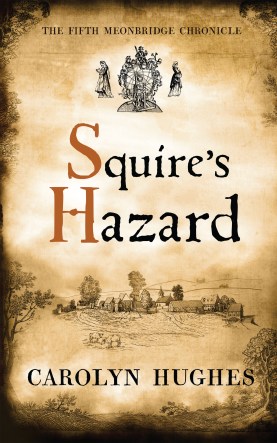
Squire's Hazard Tour BannerToday, I am pleased to welcome Carolyn Hughes to my blog to discuss the topic, “what makes a historical novel seem ‘authentic’” as part of the blog tour for her latest novel, “Squire’s Hazard,” the fifth book in her Meonbridge Chronicle series. Thank you, The Coffee Pot Book Club and Carolyn Hughes, for allowing me to be part of this blog tour. 
I love reading and writing historical fiction. My series of novels, The Meonbridge Chronicles, is set in fourteenth-century rural Hampshire. Though, the last three books, De Bohun’s Destiny, Children’s Fate, and Squire’s Hazard, do have scenes set elsewhere as well. The novels mostly focus on the lives of “ordinary people,” and in particular, the common people of fictional Meonbridge, though both De Bohun’s Destiny and Squire’s Hazard also depict the lives of the gentry too. But the novels are not about politics or war, or royals or heroes, but are rather the “everyday stories of country folk,” and my particular writing pleasure is trying to recreate their world in which readers can immerse themselves. 

And to make that world feel natural requires both “authenticity” and a little “strangeness,” so here are a few thoughts on how I try to achieve this…

Although my novels are not about “history,” history does provide the important factual context in which my characters’ fictional lives are set. The novels are set in a specific time, and each one follows on from the previous one after a two or three years gap. Mostly, what was going on in England as a whole is not important to the Chronicles’ stories. But that isn’t the case for Fortune’s Wheel, the first Chronicle, or the fourth one, Children’s Fate, where what we call the Black Death – plague – underlies the premise for the stories. In Children’s Fate, too, I describe a devastating storm that occurred in January 1363. I write about it because it emphasizes the horror that people had already been suffering in the previous months when the plague was killing children and young people when it must have seemed as if the world was coming to an end.

What was it like to live then? I enjoy depicting what we know or can deduce about how people lived – their homes, clothes, food, tools, and working practices – and showing everyday life as authentically as possible. Portraying the environment, in particular – people’s homes and their interactions with the world outside – can also help to give an authentic-seeming picture.

For example, in my depictions of peasants’ homes, I try to show how generally cramped, dark and smoky they were and, in bad weather, cold and damp. I don’t dwell on the unpleasantness but don’t shy away from it when required. Part of me thinks the grimness would be in our eyes rather than theirs. The Chronicles are told in the voices of the characters, not from the perspective of an omniscient narrator, and my feeling is that the people wouldn’t necessarily notice those things that we would find hard to cope with. Trying to put me into my characters’ shoes, to imagine the minutiae of their daily lives, is what I see so fascinating about writing about the past and what I hope contributes to that sense of authenticity.

Some readers might think I’m obsessed with the weather! Weather does play a big part in my novels, for it surely affected medieval people’s lives far more than it does ours (here in England, at any rate). If you owned only, at most, two sets of clothes, how miserable was it to work outdoors in the rain and come home all wet, with just a small hearth fire (no radiators or tumble dryer…)? Drying clothes must have been so difficult! No book has yet told me exactly what they did, so, putting myself in their shoes, I assume they arranged their clothes around the fire, on some sort of rack, perhaps, and that they possibly slept in their damp clothes – sometimes, anyway – to help dry them out. A pretty ghastly prospect! Yet what else could they do?

Depicting the physical aspects of daily life is important, but almost more important – and yet more difficult – is portraying the intangible aspects. Sexuality, religion, superstition, ideas, and sensibilities, in general, are trickier. The difficulty lies in transporting oneself as a writer into their very different mindsets. Fourteenth-century people must have been like us in many ways, yet also unlike us in many others, and tapping into those dissimilarities is a challenge and, perhaps, one of the principal points – and pleasures – of writing historical fiction.

For example, the Church was central to daily life: in prayers and oaths, influencing people’s view of their position in society, directing how they ran their lives to an extent that we would consider deeply interfering. The fourteenth century was also a world where what we consider natural (or man-made) disasters, such as ruinous weather, famine, and plague, were presumed to be God’s punishment for man’s sin. These aspects of life need to be portrayed in a way that shows the differences in people’s thinking, yet without making them seem alien – they were still individuals with ambitions and concerns, emotions and desires.

Historical fiction is sometimes criticized for failing to portray the past’s strangeness (the “foreign country”). Beyond religion and superstition are aspects of belief that modern readers are likely to find obscure or even bizarre: religious charms, relics, magic and spells, monsters, weird concepts, and seemingly fantastical happenings that today can be explained or dismissed. All of these were normal to people of the time, yet they need careful handling in a novel. “Magic and monsters” might have been part of a medieval person’s ordinary belief, but they are the opposite: we tend to consider them fantastical, not commonplace. And a danger of introducing such elements – however natural they might have been to a medieval mind – is that the novel might seem to the modern reader to be less historical fiction than fantasy. Achieving a sense of naturalness requires a balance between the authentic past and the skeptical present. This aspect of writing historical fiction makes it both a challenge and a pleasure. 

Squire-Final-working.inddBlurb:

How do you overcome the loathing, lust, and bitterness threatening you and your family’s honour?

It’s 1363, and in Steyning Castle, Sussex, Dickon de Bohun is enjoying life as a squire in the household of Earl Raoul de Fougère. Or he would be if it weren’t for Edwin de Courtenay, who’s making his life a misery with his bullying, threatening to expose the truth about Dickon’s birth.

At home in Meonbridge for Christmas, Dickon notices how grown-up his childhood playmate, Libby Fletcher, has become since he last saw her and feels the stirrings of desire. Libby, seeing how different he is, too, falls instantly in love. But as a servant to Dickon’s grandmother, Lady Margaret de Bohun, she could never be his wife.

Margery Tyler, Libby’s aunt, meeting her niece by chance and learns of her passion for young Dickon. Their conversation rekindles Margery’s long-held rancor against the de Bohuns, whom she blames for all the ills that befell her family, including her own servitude. For years she’s hidden her hunger for retribution, but she can no longer keep her hostility in check.

As the future Lord of Meonbridge, Dickon knows he must rise above de Courtenay’s loathing and intimidation and get the better of him. And, surely, he must master his lust for Libby so his own mother’s shocking history is not repeated? Of Margery’s bitterness, however, he has yet to learn…

Beset by the hazards these powerful and dangerous emotions bring, can young Dickon summon up the courage and resolve to overcome them?

Secrets, hatred, and betrayal, but also love and courage – Squire’s Hazard, the fifth MEONBRIDGE CHRONICLE.

Buy Links:

This book is available to read on #KindleUnlimited.

Universal Link: https://books2read.com/u/bW5yJz 

Amazon UK: https://www.amazon.co.uk/Squires-Hazard-Meonbridge-Chronicle-Chronicles-ebook/dp/B0BHKH1QB1/ 

Amazon US: https://www.amazon.com/Squires-Hazard-Meonbridge-Chronicle-Chronicles-ebook/dp/B0BHKH1QB1/ 

Amazon CA: https://www.amazon.ca/Squires-Hazard-Meonbridge-Chronicle-Chronicles-ebook/dp/B0BHKH1QB1/ 

Amazon AU: https://www.amazon.com.au/Squires-Hazard-Meonbridge-Chronicle-Chronicles-ebook/dp/B0BHKH1QB1/ 

The paperback is available at Amazon, Barnes & Noble, and Waterstones. 

Carolyn Hughes authorAuthor Bio:

CAROLYN HUGHES has lived much of her life in Hampshire. With a first degree in Classics and English, she started working life as a computer programmer, then a very new profession. But it was technical authoring that later proved her vocation, as she wrote and edited material, some fascinating, some dull, for an array of different clients, including banks, an international hotel group, and medical instruments manufacturers.

Having written creatively for most of her adult life, it was not until her children flew the nest several years ago that writing historical fiction took centre stage, alongside gaining a Master’s degree in Creative Writing from Portsmouth University and a Ph.D. from the University of Southampton.

Squire’s Hazard is the fifth MEONBRIDGE CHRONICLE, and more stories about the folk of Meonbridge will follow.

You can connect with Carolyn through her website http://www.carolynhughesauthor.com and on social media.

Social Media Links:

Website: http://www.carolynhughesauthor.com 

Twitter: https://twitter.com/writingcalliope 

Facebook: https://www.facebook.com/CarolynHughesAuthor/ 

Book Bub: https://www.bookbub.com/profile/carolyn-hughes 

Amazon Author Page UK: https://www.amazon.co.uk/Carolyn-Hughes/e/B01MG5TWH1/ 

Goodreads: https://www.goodreads.com/author/show/16048212.Carolyn_Hughes