Guest Post: “A Medieval Hospital, Ruined Roman Baths and Magnificent Apartments – Locations in ‘The Cameo Keeper’” by Deborah Swift

I am pleased to welcome Deborah Swift back to my blog today to share information about the real-life locations for her latest novel, “The Cameo Keeper.” I would like to thank Deborah Swift and The Coffee Pot Book Club for allowing me to participate in this blog tour.

Santo Spirito Hospital 

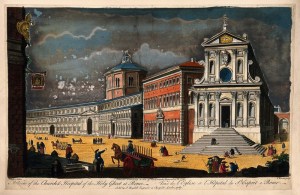
One of my characters, Jacopo Vanelli, is a surgeon, so he spends his time at the Santo Spirito Hospital in Rome. The ‘Holy Spirit’ hospital was founded in the Middle Ages and was recognised as one of Europe’s oldest and most advanced hospitals. Its remit included not only tending to the sick and the poor, but also taking in unwanted babies, abandoned children, and travellers who fell ill within the bustling heart of Rome. 

Within its grand Renaissance walls, was a museum, an apothecary shop, a public operating theatre and an orphanage run by nuns. The operating theatre became an influential centre for medical education — hosting lectures, dissections, and practical training sessions that drew aspiring doctors from across Italy and Europe.  

Here is the octagonal tower of the main building, below.  


The architecture of the hospital was striking, with vast wards, airy cloisters, and a famous spiral staircase designed to allow for the swift transfer of patients. Ornate chapels and frescoes adorned the interior, along with stained glass windows. It was seen as an extension of the Church, in what was considered the holiest city in the Western world. 

The Ruined Roman Baths  

By the 17th century, the once-magnificent Roman baths of the city stood as haunting reminders of Rome’s imperial past. Structures such as the Baths of Caracalla and the Baths of Diocletian, though partially collapsed and overgrown, continued to inspire awe with their towering arches and crumbling mosaics. Locals and visitors alike wandered amidst these grand ruins, imagining the bustling social life and sophisticated engineering that had filled these halls centuries before. 

This was an ideal place for lovers to meet, and two of my characters meet at the Baths of Caracalla. Mostly in decay, the stone was pillaged to build new buildings, but there was also a market in trinkets and souvenirs that went on there amongst the ruins. Artists and antiquarians flocked to the baths, sketching their weathered columns and broken statues, and imagining the naked bathers of centuries before. 

The Vatican Apartments 

One of my characters is the Pope’s sister-in-law, Donna Olimpia Maidalchini, a powerful and wealthy woman who dominated Roman life. Many of my scenes take place in the Vatican Apartments, which represent the heart of papal authority and splendour. These lavish chambers were home to the Pope and his closest advisors, serving as both living quarters but also the centre of Rome’s governance. The apartments showcased the best artistry of Renaissance and Baroque craftsmen. Daily life within the Vatican Apartments was a blend of solemn ritual and political intrigue, with cardinals, diplomats, and foreign dignitaries as regular visitors. 

The most celebrated rooms, such as the Raphael Rooms and the Sistine Chapel—already famed for Michelangelo’s ceiling—were objects of wonder and inspiration for all who visited. The Vatican Apartments thus stood not only as the spiritual and administrative core of the Catholic world, but also as a testament to Rome’s enduring patronage of the arts and its pivotal role in shaping the cultural legacy of the 17th century. 

Rome is a fabulous place to set a novel with many beautiful and atmospheric locations, and I hope I’ve used them all to advantage in The Cameo Keeper. 

Blurb: 

Rome 1644: A Novel of Love, Power, and Poison 


Remember tonight… for it is the beginning of always ― Dante Alighieri 


In the heart of Rome, the conclave is choosing a new Pope, and whoever wins will determine the fate of the Eternal City. 


Astrologer Mia and her fiancé Jacopo, a physician at the Santo Spirito Hospital, plan to marry, but the election result is a shock and changes everything. 

As Pope Innocent X takes the throne, he brings along his sister-in-law, the formidable Donna Olimpia Maidalchini, known as La Papessa – the female Pope. When Mia is offered a position as her personal astrologer, she and Jacopo find themselves on opposite sides of the most powerful family in Rome. 

Mia is determined to protect her mother, Giulia Tofana, a renowned poisoner. But with La Papessa obsessed with bringing Giulia to justice, Mia and Jacopo’s love is put to the ultimate test. 

As the new dawn of Renaissance medicine emerges, Mia must navigate the dangerous political landscape of Rome while trying to protect her family and her heart. Will she be able to save her mother, or will she lose everything she holds dear? 

For fans of “The Borgias” and “The Crown,” this gripping tale of love, power, and poison will keep you on the edge of your seat until the very end. 

Praise: 

‘historical fiction that is brisk, fresh and bristling with intrigue’
~ Bookmarked Reviews ★★★★★ 

Buy Link: 

Universal Buy Link: https://mybook.to/CameoKeeper  

Author Bio

Deborah Swift is the author of twenty novels of historical fiction.  

Her Renaissance novel in this series, The Poison Keeper, was recently voted Best Book of the Decade by the Wishing Shelf Readers Award. Her WW2 novel Past Encounters was the winner of the BookViral Millennium Award, and is one of seven books set in the WW2 era. 

Deborah lives in the North of England close to the mountains and the sea. 

Author Links

Website: www.deborahswift.com  

Instagram: https://www.instagram.com/deborahswiftauthor/ 

Twitter / X: https://twitter.com/swiftstory 

Facebook: https://www.facebook.com/authordeborahswift/ 

Pinterest: https://www.pinterest.co.uk/deborahswift1/ 


Guest Post: “Researching Crime in Renaissance Venice” by Deborah Swift

I am pleased to welcome Deborah Swift to my blog to share an article about researching crime in Renaissance Venice for her novel, The Fortune Keeper. I would like to thank Deborah Swift and The Coffee Pot Book Club for allowing me to be part of this blog tour.


One of the things I was aware of as soon as I started this novel, The Fortune Keeper, was that although not a crime novel, it would probably have several murders within its pages. This is because the whole series is about Giulia Tofana, who was renowned for poisoning men so that their wives could escape marital persecution.

Giulia Tofana became a legend and it is probable that she didn’t poison as many men as the rumors say, and that she was probably blamed for the crimes of others. One of the others suspected of her crimes was her stepdaughter Girolama. As she was to be featured in this book, it led me to look into the law in early modern Venice because I knew I would have to be aware of policing, punishment, and the mechanisms of the law.

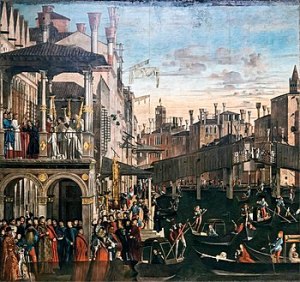
Accademia – Miracle of the Holy Cross at Rialto by Vittore Carpaccio

Renaissance Robbery
Venice was extremely wealthy in the Renaissance period, and vagabonds and thieves flooded into the city in search of easy pickings. In the picture above you can see the canal thronged with men dressed in rich clothing and ornament. The most common crimes in Venice were burglary and forgery, but it was by no means unusual for there to be murders over money and debts. The punishment for robbery was calculated based on the quantity of property taken. First offenders who stole goods worth less than one lira could get away with a whipping, but woe betide you if you stole something bigger. The penalty was the loss of an eye for goods valued between five to ten lire, and the noose awaited those brave enough to steal something worth more than forty lire.

Debt and Death
The law allowed anyone owed more than five lire de piccola to threaten and even kill the debtor to recoup their money, putting the onus firmly on the debtor, not the avenger. This tells us that money was the main driving force in Venetian society. But what about armed robbery or assault where no debt was owed? Most assaults were subject to a mere fine of twenty-five lire, or banishment from the city-state. If your crime was a crime that drew blood – sanguinem fecerit – then the punishment was up to the judging council. Venetian law had no such thing as ‘innocent until proven guilty’ at that time. The proof was largely circumstantial, and it relied on the judge and jury’s instinct regarding the guilt of the person involved.

Renaissance Lawkeepers
The Avogaria di Comun were a group equivalent to lawyers, though non-professional, drawn exclusively from the nobility. They acted as prosecutors for the state, giving evidence and arguing for punishments before the main judicial councils of Venice. Because of their status, their judgments were often influenced by their social position, and the personal axes they had to grind.

Execution and Mutilation
In this period it was still common for mutilations to take place, which had been traditional in medieval times. Cutting out the tongue for heresy, cutting off the thumb or fingers for pilfering. Courtesans regularly had their noses or faces cut. There was also the custom of cutting off the ‘offending’ part – this led to men who were convicted of dabbling in heresy or alchemy, or crimes against the Holy Roman Church having their hand cut off to remove the ‘devil’s instrument’. This kind of public ritual and humiliation was designed to bring public vengeance to the accused person and to reaffirm the values of the Church or state.

The ritual turned the execution into a purification of the city.
Few crimes brought down corporal or capital punishment. The types of corporal punishment used for the crimes of rape and assault were minor by today’s standards. As an example, for assault, out of 569 cases only fifteen involved mutilation of the criminal; and sixteen more involved some form of corporal discipline. For rape offenses, corporal punishment was even less significant, with twenty cases of discipline and only four of mutilation.


Maintaining law and order
On the streets, the main arbiters of law and order were the town guard, the vigili urbani, who acted as our police do now. Their job was to make sure masked men didn’t carry arms, that only noblemen wore swords, and to act as a preventative force as well as policing troublemakers.

Further up the ladder was the Council of Ten, a kind of secret police force whose job was to maintain order within the city-state of Venice. There was not much space in the city gaols of Venice due to the whole nature of its construction. For crimes of fraud, marital dispute, and affray, these men sat in judgment. It was unfeasible to keep men incarcerated for long because otherwise, the gaols would be full of minor offenders. Small fines and short gaol sentences were the usual punishments for common violence in Venice. When the crime crossed the line into something that was considered ‘against God’ or ‘against the reputation of Venice’ then ritual punishment could be relied upon to warn the populace about sinning against these bigger, less personal edifices.

Documents I found helpful in my research:
Law and Punishment in Early Renaissance Venice
Violence in Early Renaissance Venice – Guido Ruggiero
Banditry and Social Identity in the Republic of Venice – Sergio Lavarda
Authority and the Law in Renaissance Venice — G. Cozzi

xr:d:DAEbig1CmJo:257,j:33693903820,t:22082511

Blurb:

Count your nights by stars, not shadows ~ Italian Proverb

Winter in Renaissance Venice

Mia Caiozzi is determined to discover her destiny by studying the science of astronomy. But her stepmother Giulia forbids her to engage in this occupation, fearing it will lead her into danger. The ideas of Galileo are banned by the Inquisition, so Mia must study in secret.

Giulia’s real name is Giulia Tofana, renowned for her poison Aqua Tofana, and she is in hiding from the Duke de Verdi’s family who are intent on revenge for the death of their brother. Giulia insists Mia should live quietly out of public view. If not, it could threaten them all. But Mia doesn’t understand this, and rebels against Giulia, determined to go her own way.

When the two secret lives collide, it has far-reaching and fatal consequences that will change Mia’s life forever.

Set amongst opulent palazzos and shimmering canals, The Fortune Keeper is the third novel of adventure and romance based on the life and legend of Giulia Tofana, the famous poisoner.

‘Her characters are so real they linger in the mind long after the book is back on the shelf’
~ Historical Novel Society

NB This is the third in a series but can stand alone as it features a new protagonist. The other two books are available if reviewers want them.

Trigger Warnings:
Murder and violence in keeping with the era.

Buy Links:

This title is available to read on #KindleUnlimited.

Universal Link: https://mybook.to/FortuneKeeper

Audiobook Buy Links:

Kobo: https://www.kobo.com/gb/en/audiobook/fortune-keeper-the
Audio: https://www.audible.co.uk/pd/The-Fortune-Keeper-Audiobook/B0C63R95WM

Author Bio:

Deborah Swift is a USA TODAY bestselling author who is passionate about the past. Deborah used to be a costume designer for the BBC, before becoming a writer. Now she lives in an old English school house in a village full of 17th Century houses, near the glorious Lake District. Deborah has an award-winning historical fiction blog on her website http://www.deborahswift.com.

Deborah loves to write about how extraordinary events in history have transformed the lives of ordinary people, and how the events of the past can live on in her books and still resonate today.

The first in her series about the Renaissance poisoner Giulia Tofana, The Poison Keeper, was a winner of the Wishing Shelf Book of the Decade, a Coffee Pot Book Club Gold Medal, and the latest in her WW2 Secret Agent series, Operation Tulip, is coming soon.

Author Links:

Website: http://www.deborahswift.com
Twitter: https://twitter.com/swiftstory
Facebook: https://www.facebook.com/authordeborahswift/
Pinterest: https://www.pinterest.co.uk/deborahswift1/
Bookbub: https://www.bookbub.com/authors/deborah-swift
Amazon: http://author.to/DeborahSwift

Guest Post: Spotlight for “Historical Stories of Exile”

IG banner Exile partyI am pleased to welcome the authors of the latest anthology, “Historical Stories of Exile” to my blog today on a spotlight tour. I would like to thank The Coffee Pot Book Club and the authors of this anthology for allowing me to be part of this blog tour. 
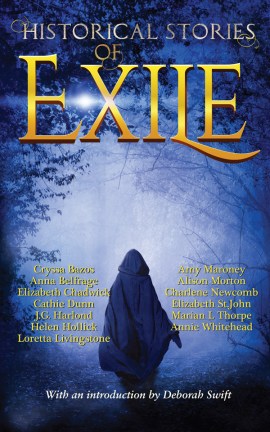
EXILE-Cover-flatBlurb:

Exile: a risky defiance, a perilous journey, a family’s tragic choice – or an individual’s final gamble to live. Exile: voluntary or enforced, a falling-out between friends, a lost first love, a prejudiced betrayal – or the only way to survive persecution?

In this historical fiction anthology, thirteen authors (they are not superstitious!) have written exclusive short stories on the theme of exile. Some are based on true history, others are speculative fiction. All mine the depths of human emotions: fear, hope, love, and the fortitude to survive.

Join an inspiring Anglo-Saxon queen of Wales, a courageous Norwegian falconer, and a family fleeing back in time to escape the prospect of a ruthless future. Oppose the law with the legendary Doones of Exmoor, or defy the odds with two brave WWII exiles. Meet a Roman apprehensively planning exile to preserve the ‘old ways’, and a real Swedish prince forcibly expelled in heart-wrenching circumstances. Thrill to a story based on the legend of Robin Hood, sail with a queen of Cyprus determined to regain her rightful throne; escape religious persecution, discover the heart-rending truth behind the settlement of Massachusetts, and experience the early years that would, eventually, lead to the founding of Normandy. Experience the stirring of first love, and as an exclusive treat special guest author, Elizabeth Chadwick reveals a tale about the 12th-century heiress, Isabelle de Clare, and the Greatest Knight of all time – William Marshal.

With an introduction by multi-award-winning author Deborah Swift, enjoy these tales of exile across the ages. Some are hopeful, some sad, some romantic, some tragic, but all explore the indomitable spirit of resolute, unforgettable characters.

Buy Links: 

This title is available to read on #KindleUnlimited

Universal Link: https://mybook.to/StoriesOfExile 
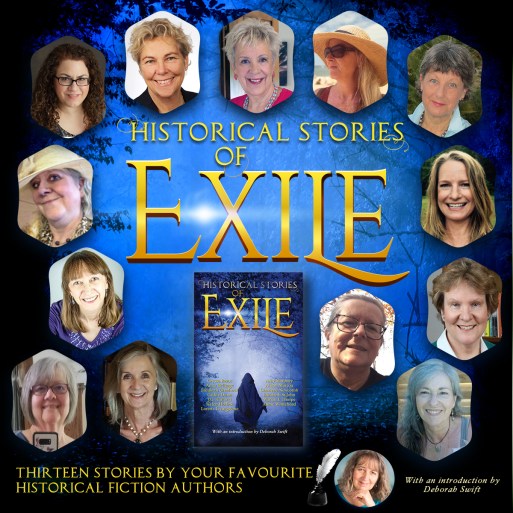
ALISON MORTON writes award-winning thrillers featuring tough but compassionate heroines. Her ten-book Roma Nova series is set in an imaginary European country where a remnant of the ancient Roman Empire has survived into the 21st century and is ruled by women who face conspiracy, revolution, and heartache but use a sharp lines in dialogue. Several of her novels have hit  #1 in Amazon US, UK, Canada and Australia. The latest, Julia Prima, plunges us back to AD 370 when the founders of Roma Nova met.

She blends her fascination for Ancient Rome with six years of military service and a life of reading crime, historical, and thriller fiction. On the way, she collected a BA in modern languages and an MA in history.

Alison now lives in Poitou in France, the home of Mélisende, the heroine of her two contemporary thrillers, Double Identity and Double Pursuit. Oh, and she’s writing the next Roma Nova story.

Website: https://www.alison-morton.com

AMY MARONEY studied English Literature at Boston University and worked for many years as a writer and editor of nonfiction. She lives in Oregon, U.S.A. with her family. When she’s not diving down research rabbit holes, she enjoys hiking, dancing, traveling, and reading. Amy is the author of The Miramonde Series, a bestselling historical mystery trilogy about a Renaissance-era female artist and the modern-day scholar on her trail. Amy’s award-winning historical adventure/romance series, Sea and Stone Chronicles, is set in medieval Rhodes and Cyprus.

An enthusiastic advocate for independent publishing, Amy is a member of the Alliance of Independent Authors and the Historical Novel Society.

Website: https://www.amymaroney.com/

ANNA BELFRAGE Had Anna been allowed to choose, she’d have become a time traveler. As this was impossible, she became a financial professional with three absorbing interests: history, romance, and writing. Anna always writes about love and has authored the acclaimed time-traveling series The Graham Saga, set in 17th-century Scotland and Maryland, as well as the equally acclaimed medieval series The King’s Greatest Enemy which is set in 14th century England. Anna is presently hard at work with her other medieval series, The Castilian Saga, which is set against the conquest of Wales. The third installment, Her Castilian Heart, was published in 2022, and the fourth and final one will be out in 2024. She has recently released Times of Turmoil, a sequel to her time travel romance, The Whirlpools of Time.

Website, http://www.annabelfrage.com 

ANNIE WHITEHEAD is an author, historian, and elected Fellow of the Royal Historical Society, and has written four award-winning novels set in Anglo-Saxon England. She has contributed to fiction and nonfiction anthologies and written for various magazines, has twice been a prize winner in the Mail on Sunday Novel Writing Competition, and won First Prize in the 2012 New Writer Magazine’s Prose and Poetry Competition. She was a finalist in the 2015 Tom Howard Prize for Nonfiction and was shortlisted for the Exeter Story Prize/Trisha Ashley Award 2021. 

She was the winner of the inaugural Historical Writers’ Association/Dorothy Dunnett Prize 2017 and is now a judge for that same competition. She has also been a judge for the HNS (Historical Novel Society) Short Story Competition.

Her nonfiction books are Mercia: The Rise and Fall of a Kingdom (Amberley Books) and Women of Power in Anglo-Saxon England (Pen & Sword). She has contributed to a new history of English Monarchs, Kings, and Queens: 1200 Years of English and British Monarchs (Hodder & Stoughton) and has signed a contract to write her third nonfiction book, to be published by Amberley Books in 2024.

Website: https://anniewhiteheadauthor.co.uk/

CATHIE DUNN writes historical fiction, mystery, and romance. The focus of her novels is on strong women through time. She has garnered awards and praise from reviewers and readers for her authentic description of the past. A keen Medievalist, she enjoys visiting castles and ruins, and reading about battles and political shenanigans of the times.

Cathie is a member of the Historical Novel Society, the Romantic Novelists’ Association, and the Alliance of Independent Authors. She also now runs The Coffee Pot Book Club, promoting historical fiction authors and their books.

Website: https://www.cathiedunn.com 

CHARLENE NEWCOMB writes historical fiction and science fiction. Her award-winning Battle Scars trilogy is set in the 12th century during the reign of Richard the Lionheart. Her writing roots are in the Star Wars Expanded Universe (aka Legends) where she published 10 short stories in the Star Wars Adventure Journal. Sci-fi space opera fans should check out Echoes of the Storm, her original novel published in 2020. She returned to medieval times with her novel Rogue in 2023. 

Website: https://charlenenewcomb.com

CRYSSA BAZOS is an award-winning historical fiction author and a 17th-century enthusiast. Her debut novel, Traitor’s Knot is the Medalist winner of the 2017 New Apple Award for Historical Fiction and a finalist for the 2018 EPIC eBook Awards for Historical Romance. Her second novel,  Severed Knot is a B.R.A.G Medallion Honoree and a finalist for the 2019 Chaucer Award. Rebel’s Knot, the third installment of the standalone series, Quest for the Three Kingdoms, is a B.R.A.G Medallion Honoree and 2021 Discovering Diamonds Book of the Year.

Website:  https://cryssabazos.com

DEBORAH SWIFT is a delver into archives, drinks too much tea, and loves antiques and old buildings. Her sturdy, stone-built house used to be the village primary school, and from her window, she has a view of a few 17th-century cottages, and behind those, green fields dotted with grazing sheep.

Historical fiction was a natural choice for Deborah as a writer because she always enjoyed the research aspect of design – poking about in archives and museums, not to mention the attraction of boned bodices and the excuse to visit old and interesting buildings.

She used to work as a set and costume designer for theatre and TV, so enjoys the research aspect of creating historical fiction. She likes to write about extraordinary characters set against the background of real historical events. In her books, Deborah likes to write about extraordinary characters set against the background of real historical events. Her first novel was The Lady’s Slipper which was shortlisted for the Impress Prize, and her book  The Poison Keeper, about the Renaissance poisoner Giulia Tofana, won the BookViral Millennium Award. She has written eighteen novels to date including two series set in WWII – her latest, The Shadow Network is due for release in early 2024.

Deborah lives in North Lancashire on the edge of the Lake District and divides her time between teaching and writing.

Website: https://deborahswift.com/

ELIZABETH CHADWICK New York Times bestselling author Elizabeth Chadwick lives in a cottage in the Vale of Belvoir in Nottinghamshire with her husband and their four terriers, Pip, Jack, Billy, and Little Ted. Her first novel, The Wild Hunt, won a Betty Trask Award and To Defy a King won the RNA’s 2011 Historical Novel Prize. She was also shortlisted for the Romantic Novelists’ Award in 1998 for The Champion, in 2001 for Lords of the White Castle, in 2002 for The Winter Mantle, and in 2003 for The Falcons of Montabard. Her sixteenth novel, The Scarlet Lion, was nominated by Richard Lee, founder of the Historical Novel Society, as one of the top ten historical novels of the last decade. She often lectures at conferences and historical venues, has been consulted for television documentaries, and is a member of the Royal Historical Society.

Website: https://elizabethchadwick.com/

ELIZABETH ST.JOHN’s critically acclaimed historical fiction novels tell the stories of her ancestors: extraordinary women whose intriguing kinship with England’s kings and queens brings an intimately unique perspective to Medieval, Tudor, and Stuart times.

Inspired by family archives and residences from Lydiard Park to the Tower of London, Elizabeth spends much of her time exploring ancestral portraits, diaries, and lost gardens. And encountering the occasional ghost. But that’s another story.

Living between California, England, and the past, Elizabeth is the International Ambassador for The Friends of Lydiard Park, an English charity dedicated to conserving and enhancing this beautiful centuries-old country house and park. As a curator for The Lydiard Archives, she is constantly looking for an undiscovered treasure to inspire her next novel.

Elizabeth’s books include her trilogy, The Lydiard Chronicles, set in 17th Century England during the Civil War, and her medieval novel, The Godmother’s Secret, which explores the mystery of the missing Princes in the Tower of London.

Website: http://www.elizabethjstjohn.com/

HELEN HOLLICK and her husband and adult daughter moved from north-east London in January 2013 after finding an eighteenth-century North Devon farmhouse through being a ‘victim’ on BBC TV’s popular Escape to The Country show. The thirteen-acre property was the first one she was shown – and it was love at first sight. She enjoys her new rural life, and has a variety of animals on the farm, including Exmoor ponies, dogs, cats, hens, ducks, and geese, and her daughter’s string of show jumpers.

First accepted for publication by William Heinemann in 1993 – a week after her fortieth birthday – Helen then became a USA Today Bestseller with her historical novel, The Forever Queen (titled A Hollow Crown in the UK) with the sequel, Harold the King (US: I Am the Chosen King), novels that explore the events that led to the Battle of Hastings in 1066. Her Pendragon’s Banner Trilogy is a fifth-century version of the Arthurian legend, and she also writes a pirate-based nautical adventure/fantasy series, The Sea Witch Voyages, where you can read more about Jesamiah Acorne, son of Charles St Croix – and the Doones.

Despite being impaired by the visual disorder of Glaucoma, she is also branching out into the quick read novella, ‘Cosy Mystery’ genre with the Jan Christopher Mysteries, set in the 1970s, with the first in the series, A Mirror Murder incorporating her, often hilarious, memories of working for thirteen years as a library assistant.

Her non-fiction books are Pirates: Truth and Tales and Life of a Smuggler. She also runs a news and events blog and a Facebook page for her village supports her daughter’s passion for horses and showjumping – and occasionally gets time to write… 

Website: https://helenhollick.net

J.G. HARLOND Secret agents, skulduggery, and crime that crosses continents.

British author of historical crime fiction, J.G. (Jane) Harlond writes award-winning, page-turning novels set in the mid-17th and mid-20th centuries. Each story weaves fictional characters into real events. She describes her WWII Bob Robbins Home Front Mysteries as a ‘cozy crime with a sinister twist’. Prior to becoming a full-time author, Jane taught English and World Literature in international colleges. She also wrote school textbooks for many years using her married name. 

Jane is married to a retired Spanish naval officer and they have a large, grown-up family living in various parts of Europe and the USA. After traveling widely (she has lived in or visited most of the places that feature in her novels) they are now settled near Málaga in Spain.

J.G. Harlond is a member of the British Crime Writers Association and the Dorothy Dunnett Society.

Website: http://author.to/JGHarlond

LORETTA LIVINGSTONE had no intention of writing anything but short stories or poetry, and especially not historical fiction. She stated it quite clearly on social media, only to suddenly find herself writing … historical fiction. Her debut novel, Out Of Time, set in the mythical Sparnstow Abbey, was shortlisted for the Historical Novel Society Indie Award in 2016, which stunned and elated her in equal measures.

It was supposed to be a one-off. It wasn’t. She went on to write two more stand-alone novels in the series; A Promise to Keep and Blossom on the Thorn. She had plans for more but has had ME for many years, and ill health has temporarily reined in her gallop. However, she intends to write again soon… 

Her other books include short story collections and poetry and can be found on Amazon.

Loretta is on Facebook: https://www.facebook.com/groups/217686418294125

MARIAN L. THORPE Taught to read at the age of three, words have been central to Marian’s life for as long as she can remember. A novelist, poet, and essayist, Marian has several degrees, none of which are related to writing. After two careers as a research scientist and an educator, she retired from salaried work and returned to writing things that weren’t research papers or reports.

Marian’s first published work was poetry, in small journals; her first novel was released in 2015. Her award-winning Empire’s Legacy series is historical fiction of another world, based to some extent on northern Europe after the decline of Rome.

In addition to her novels, Marian has read poetry, short stories, and nonfiction work at writers’ festivals and other juried venues.

Her other two passions in life are birding and landscape history, both of which are reflected in her books. Birding has taken her and her husband to all seven continents, but these days she’s mostly content to move between Canada and the UK.

Website: https://marianlthorpe.com/

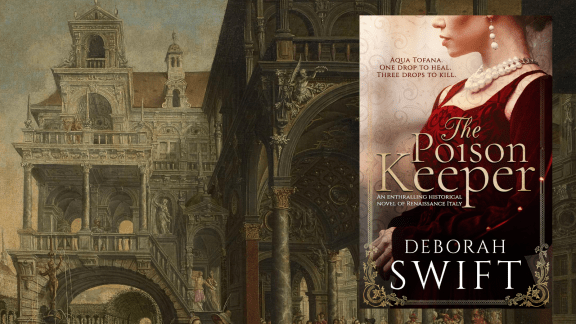
Guest Post: “The Inspiration Behind The Poison Keeper” by Deborah Swift

The Poison Keeper Tour BannerToday, it is my pleasure to welcome Deborah Swift to my blog to discuss the inspiration for her latest novel, The Poison Keeper. I would like to thank Deborah Swift and The Coffee Pot Book Club for allowing my blog to host a stop on this tour. 

Deborah Swift, The Poison Keeper Cover

I had enjoyed writing about Seville in A Divided Inheritance and was looking to find another setting where I could escape from the dull grey English winter. My husband suggested Italy and I remembered reading about Giulia Tofana, a notorious Renaissance poisoner, and the poison Aqua Tofana, named after her. I decided to investigate her a bit further to see if she would make a subject for a novel.

I was surprised to find that no one had written a novel about her in English, and so that made me even more determined. However, as soon as I started the research process I realized I was researching someone who was more of a myth than a real historical figure. Most of the information about her was from the 19th century, a good three hundred years since any proper record of her. Also, there were so many different dates associated with her life – for example, she is said by different sources to have been executed, to have escaped, and to have been bricked up behind a wall (!) – and her time of death was variously attributed to 1659, 1709 or 1730.

Antonio_de_Pereda_-_Allegory_of_Vanity_-_Google_Art_Project 1634

Three Generations of Poisoners

There were some peculiarities in the history and it soon became apparent that I was dealing not with one person, but with three – Theofania d’Adamo, her daughter Giulia Tofana and her daughter Girolamo Spara. In Italy at the time, women often took the contracted version of their mothers’ forenames as Christian names – hence Theofania = Tofana. I decided to focus on the middle generation because Giulia was the only one who escaped without execution as far as I could tell.

The one date that could be fixed by contemporary records was the death of Theofania who died on 12th July 1633. This concords with the first record of Aqua Tofana the poison named after Giulia Tofana, or more likely her mother Theofania, which was in 1632. This gave me a firm idea of the timescale for the book.

Naples 1572 Wikipedia 1024px-Braun_Napoli_HAAB

The enticing City of Naples

I was fascinated by the geography of Naples in the 17th Century – a city in the shadow of Mount Vesuvius that had erupted only two years earlier in 1631. The city was still recovering from those horrific events which included not only the eruption, with the city choked by dust and lava, but also by the earthquakes that preceded it and the devastating tsunami that followed it. I was able to use these events in my characters’ backstories. Society was sharply divided into rich and poor areas with glittering Palazzos and squalid slums. Corruption was rife both in the Church and in business.

The Camorra or Mafia

Powerful aristocratic families controlled the city through extortion and racketeering – this was the early inception of the mafia, known as the Camorra. The etymology is from Camo – boss, or head, and Morra – a type of gambling game popular in 17th Century Naples. This provided me with a subplot that I could use with my main male character and allowed me to create a strong antagonist, the Duke de Verdi, for my story.

Aqua Tofana wiki

Aqua Tofana – A deadly poison

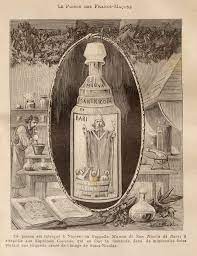
Aqua Tofana was supposed to kill by three drops in a drink or food. It was a colorless liquid, supposedly undetectable, but would cause death with similar symptoms to a wasting disease. The actual ingredients have never been confirmed, although many suspect arsenic to be the main ingredient. Naples was a city of alchemists and apothecaries, and the tradition of poison was well known in the city. There had been an epidemic of poisonings since the Borgias. This research area fascinated me, and I spent quite a few happy hours researching poisons in online libraries and through books.

The scope of the research was so interesting that the story soon grew into two books, and the sequel to The Poison Keeper, The Silkworm Keeper will be released soon. 

Thank you for hosting me!

NEW RELEASE 1(Blurb)

Naples 1633

Aqua Tofana – One drop to heal. Three drops to kill.

Giulia Tofana longs for more responsibility in her mother’s apothecary business, but Mamma has always been secretive and refuses to tell Giulia the hidden keys to her success. When Mamma is arrested for the poisoning of the powerful Duke de Verdi, Giulia is shocked to uncover the darker side of her trade.

Giulia must run for her life, and escapes to Naples, under the shadow of Mount Vesuvius, to the home of her Aunt Isabetta, a famous courtesan. But when Giulia hears that her mother has been executed, and the cruel manner of her death, she swears she will wreak revenge on the Duke de Verdi.

The trouble is, Naples is in the grip of Domenico, the Duke’s brother, who controls the city with the ‘Camorra’, the mafia. Worse, her Aunt Isabetta, under Domenico’s thrall, insists that she should be consort to him – the brother of the man she has vowed to kill.

Based on the legendary life of Giulia Tofana, this is a story of hidden family secrets, and how even the darkest desires can be vanquished by courage and love.

‘Her characters so real they linger in the mind long after the book is back on the shelf’ Historical Novel Society

Buy Links:

Is your book on Kindle Unlimited?  Yes

Universal Link (if you have it): mybook.to/PoisonKeeper

Amazon UK: https://www.amazon.co.uk/dp/B0928WPHMH

Amazon US: https://www.amazon.com/dp/B0928WPHMH

Amazon CA: https://www.amazon.ca/dp/B0928WPHMH

Amazon AU: https://www.amazon.com.au/dp/B0928WPHMH

DeborahSwift-1018Author Bio:

Deborah Swift lives in the north of England and is a USA Today bestselling author who has written fourteen historical novels to date. Her first novel, The Lady’s Slipper, set in 17th Century England, was shortlisted for the Impress Prize, and her WW2 novel Past Encounters was a BookViral Millennium Award winner. 

Deborah enjoys writing about ordinary people thrust into extraordinary circumstances, and most of her novels have been published in reading group editions. She holds an MA in Creative Writing from Lancaster University and is a mentor with The History Quill.

Social Media Links:

Website: http://www.deborahswift.com

Twitter: https://twitter.com/swiftstory

Facebook: https://www.facebook.com/authordeborahswift/

Instagram: https://www.instagram.com/deborahswiftauthor

Pinterest: https://www.pinterest.co.uk/deborahswift1/

Book Bub: https://www.bookbub.com/authors/deborah-swift

Amazon Author Page: http://author.to/DeborahSwift

Goodreads: https://www.goodreads.com/author/show/3297217.Deborah_Swift