Guest Post: “The Percies and the Battle of Shrewsbury” by Mercedes Rochelle

I am pleased to welcome Mercedes Rochelle back to my blog to share an article about the Percy family and the Battle of Shrewsbury as part of the blog tour for her novels The Usurper King and The Accursed King. I want to thank Mercedes Rochelle and The Coffee Pot Book Club for allowing me to be part of this blog tour.

The Percies were such a powerful force in the North they practically acted like rulers in their own kingdom. For much of Richard II’s reign and the beginning of Henry IV’s, Earl Henry Percy and his son, Sir Henry (nicknamed Hotspur) alternated between the wardenships of the East Marches and the West Marches toward Scotland. They were experienced in dealing with the tempestuous Scots, and their retainers were fiercely loyal. When Henry IV returned from exile and began his campaign that led to the throne, the Percies were his staunchest supporters; they provided a large portion of his army. Henry Percy was directly responsible for persuading King Richard to turn himself over to Henry Bolingbroke—the beginning of the end of Richard’s fall. 
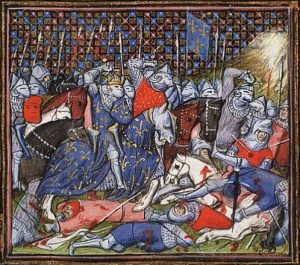
Caption: Froissart Chronicles by Virgil Master, Source: Wikimedia 

Naturally, this was not done out of sheer kindness. Henry Percy expected to be amply rewarded for his services, and at the beginning he was. But the king was uncomfortable about the potential threat of this overweening earl. He soon began to promote his brother-in-law, Ralph Neville the Earl of Westmorland as a counterbalance, chipping away at Percy’s holdings and jurisdictions. Additionally, the Percies felt that they were not being reimbursed properly for their expenses; by 1403 they claimed that the king owed them £20,000—over £12,000,000 in today’s money. But even with all this going on, it’s likely that the earl may have contained his discontent, except for the belligerence of his impetuous son.  

One possible catalyst was Hotspur’s refusal to turn over his hostages taken at the Battle of Homildon Hill. This battle was a huge win for the Percies in 1402, where so many leaders were taken—including the Earl of Douglas—that it left a political vacuum in Scotland for many years to come. Once he learned of this windfall, King Henry insisted that the Percies turn over their hostages to the crown. It was his right as king—even if it was against the code of chivalry— though his highhanded demand was probably not the wisest choice, considering the circumstances. There were many possible reasons he did so. He was desperately short of funds—as usual. It’s possible he may have wanted to retain the prisoners as a means of ensuring Scottish submission. Earl Henry agreed to turn over his hostages, but Hotspur absolutely refused to surrender Archibald Douglas, letting his father take the king’s abuse. One can only imagine that all was not well in the Percy household, either. 

There was more at stake. The king had just returned from a humiliating fiasco in Wales, where he had campaigned in response to the English defeat at Pilleth, where Edmund Mortimer was captured by the Welsh. Mortimer was the uncle of the eleven-year-old Earl of March, considered by many the heir-presumptive to the throne (and in Henry’s custody). Edmund was also the brother of Hotspur’s wife. By the time Henry demanded the Scottish hostages, it was commonly believed that the king had no intention of ransoming Mortimer; after all, he was safely out of the way and couldn’t champion his nephew’s cause. This rankled with Hotspur, and it is possible that he thought to use Douglas’s ransom money to pay for Mortimer’s release himself. 

Hotspur finally rode to London in response to the king’s demands, but he went without Douglas. Needless to say, this immediately provoked an argument. When Hotspur insisted that he should be able to ransom his brother-in-law, Henry refused, saying he did not want money going out of the country to help his enemies. Hotspur rebutted with, “Shall a man expose himself to danger for your sake and you refuse to help him in his captivity?” Henry replied that Mortimer was a traitor and willingly yielded himself to the Welsh. “And you are a traitor!” the king retorted, apparently in reference to an earlier occasion when Hotspur chose to negotiate with Owain Glyndwr rather than arrest him. Allegedly the king struck Percy on the cheek and drew his dagger. Of course, attacking the king was treason and Hotspur withdrew, shouting “Not here, but in the field!” All of this may be apocryphal, but it is certainly powerful stuff. 

The whole question of Mortimer’s ransom became moot when he decided to marry the daughter of Glyndwr and openly declare his change of loyalties on 13 December 1402. No one knows whether Hotspur’s tempestuous interview with King Henry happened before or after this event; regardless, a bare minimum of eight months passed before Shrewsbury. Were they planning a revolt all this time? It is likely that early in 1403 one or both of the Percies were in communication with the Welsh. Owain Glyndwr was approaching the apex of his power, and a possible alliance between him, Mortimer, and the Percies could well have been brewing. It would come to fruition later on as the infamous Tripartite Indenture (splitting England’s rule between them), but by then Hotspur was long dead. 

Caption: BnF MS Franc 81 fol. 283R Henry IV and Thomas Percy at Shrewsbury from Jean de Wavrin- Creative commons license 

No one has been able to satisfactorily explain just why the Percies revolted against Henry IV. Most of the evidence points to their self-aggrandizement. And looking at the three years following his coronation, it became evident that King Henry was not willing to serve as their puppet, nor was he willing to enhance their power at the expense of the crown. The Percies’ ambitions were thwarted by the king’s perceived ingratitude, and the consensus of modern historians is that they hoped to replace him with someone more easily manipulated. 

There was one more Percy involved in all this: Thomas, younger brother of Earl Henry and uncle to Hotspur. He was probably the most able—if the least flamboyant—member of the Percy clan in this period. From soldier to commander, Admiral of England to Ambassador, Captain of Calais, Justiciary of South Wales, he made it all the way to Steward of the Royal Household. And that wasn’t all. He was also Earl of Worcester, which almost made him an equal to his brother, the great Earl of Northumberland.  

His involvement in the Shrewsbury uprising was puzzling. He had much to lose and nothing to gain. Shakespeare notwithstanding, I don’t really think Thomas was the motivating force behind the rebellion that led to the Battle of Shrewsbury. It’s true that his fortunes were waning; the king had recently replaced him as Lieutenant of Wales with the sixteen-year-old Prince Henry. Whether the Percies won or lost the battle, there’s a better-than-even chance that he would rise and fall along with them, whether he participated in the rebellion or not. Was that enough to push him over the edge? I suspect that his affection for Hotspur had a lot to do with it, and in the end, it’s likely he couldn’t conceive of fighting against his own kin. Poor Thomas lost his head the day after the battle, paying a high price for his loyalty. 

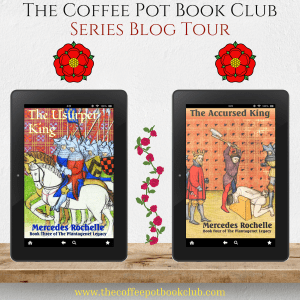
THE USURPER KING by Mercedes Rochelle 

Book 4 of The Plantagenet Legacy 

Blurb: 

From Outlaw to Usurper, Henry Bolingbroke fought one rebellion after another. First, he led his own uprising. Then he captured a forsaken king. Henry had no intention of taking the crown for himself; it was given to him by popular acclaim. Alas, it didn’t take long to realize that having the kingship was much less rewarding than striving for it. Only three months after his coronation, Henry IV had to face a rebellion led by Richard’s disgruntled favorites. Repressive measures led to more discontent. His own supporters turned against him, demanding more than he could give. The haughty Percies precipitated the Battle of Shrewsbury which nearly cost him the throne—and his life. 

To make matters worse, even after Richard II’s funeral, the deposed monarch was rumored to be in Scotland, planning his return. The king just wouldn’t stay down and malcontents wanted him back. 
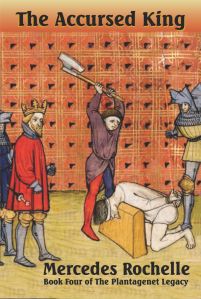
THE ACCURSED KING by Mercedes Rochelle 

Blurb: 

What happens when a king loses his prowess? 

The day Henry IV could finally declare he had vanquished his enemies, he threw it all away with an infamous deed. No English king had executed an archbishop before. And divine judgment was quick to follow. Many thought he was struck with leprosy—God’s greatest punishment for sinners. From that point on, Henry’s health was cursed and he fought doggedly on as his body continued to betray him—reducing this once great warrior to an invalid. 

Fortunately for England, his heir was ready and eager to take over. But Henry wasn’t willing to relinquish what he had worked so hard to preserve. No one was going to take away his royal prerogative—not even Prince Hal. But Henry didn’t count on Hal’s dauntless nature, which threatened to tear the royal family apart.

Buy Links: 

Universal Buy Links: 

The Usurper King: https://books2read.com/u/3nkRJ9  

The Accursed King: https://books2read.com/u/b5KpnG  

The Plantagenet Legacy Series Links: 

Amazon US Series Link 

Amazon UK Series Link 

All titles in the series are available to read on #KindleUnlimited. 
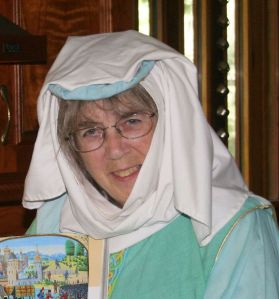
Author Bio

Mercedes Rochelle is an ardent lover of medieval history and has channeled this interest into fiction writing. She believes that good Historical Fiction, or Faction as it’s coming to be known, is an excellent way to introduce the subject to curious readers. 

Her first four books cover eleventh-century Britain and events surrounding the Norman Conquest of England. Her new project is called “The Plantagenet Legacy” taking us through the reigns of the last true Plantagenet King, Richard II, and his successors, Henry IV, Henry V, and Henry VI. She also writes a blog: HistoricalBritainBlog.com to explore the history behind the story.  

Born in St. Louis, MO, she received by BA in Literature at the University of Missouri St.Louis in 1979 then moved to New York in 1982 while in her mid-20s to “see the world”. The search hasn’t ended! 

Today she lives in Sergeantsville, NJ with her husband in a log home they had built themselves. 

Author Links

Website: https://mercedesrochelle.com/   

Twitter: https://x.com/authorrochelle  

Facebook: https://www.facebook.com/mercedesrochelle.net  

Book Bub:  https://www.bookbub.com/authors/mercedes-rochelle  

Amazon Author Page:  https://www.amazon.com/stores/Mercedes-Rochelle/author/B001KMG5P6  

Goodreads: https://www.goodreads.com/author/show/1696491.Mercedes_Rochelle

Biography: Richard Duke of York

richarddukeofyork-243x300Also known as Richard Plantagenet. (Born September 21, 1411- Died December 30, 1460). Son of Richard Earl of Cambridge and Anne Mortimer. Married to Cecily Neville. Father of Anne, Duchess of Exeter, Edward IV, King of England, Edmund, Earl of Rutland, Elizabeth, Duchess of Suffolk, Margaret, Duchess of Burgundy, George, Duke of Clarence, and Richard III, King of England. Richard Duke of York was the one who became Lord Protector to Henry VI, but when he didn’t get the respect he thought he deserved, challenged the king and claimed that he should be king, and started the Wars of the Roses.

Richard of York was born on 21 September 1411. He was the son of Richard, 3rd Earl of Cambridge, by his wife Anne de Mortimer, the daughter of Roger Mortimer, 4th Earl of March. Anne Mortimer was the great-granddaughter of Lionel, Duke of Clarence, the second surviving son of King Edward III. After the death in 1425 of Anne’s brother Edmund, the 5th Earl of March, this supplied Richard, of the House of York, with a claim to the English throne that was, under English law, arguably superior to that of the reigning House of Lancaster, descended from John of Gaunt, the third son of King Edward III. On his father’s side, Richard had a claim to the throne in a direct male line of descent from his grandfather Edmund, 1st Duke of York, fourth surviving son of King Edward III and founder of the House of York. Richard’s claim through his mother made him more eligible to be king than Henry VI, thus he adopted the last name “Plantagenet” in 1448 to mark his claim to the throne.

Richard’s mother is said to have died giving birth to him and his father was executed  in 1415 for his part in the Southampton plot that tried to remove Henry V from the throne and replace him with Edmund Mortimer. His father’s titles were forfeited, but not attainted, which meant that Richard at 4 years old, became his father’s heir. A few months later, Richard’s uncle Edward of Norwich, 2nd Duke of York, was slain at the Battle of Agincourt on October 25, 1415. Henry V decided to give the lands of the Duchy of York to Richard.

Richard was an orphan and he was considered property of the crown. His wardship was a very valued gift of the crown and it was granted to Ralph Neville, 1st Earl of Westmorland. Ralph Neville had a large family, 20 children who survived infancy,  with many daughters who needed husbands, so in 1424, Neville betrothed Richard to his daughter Cecily Neville. On February 2, 1425, Richard was created Duke of York, after his uncle Edmund Mortimer died. In October 1425, Ralph Neville died and his widow Joan Beaufort was given the wardship of Richard, which was even more valuable since Richard was now the Duke of York. On May 19, 1426 he was knighted at St Mary de Castro in Leicester by John, Duke of Bedford, the younger brother of King Henry V. In October 1429 or earlier, Richard and Cecily were married. York was there for Henry VI’s coronation on November 6, 1430 and he was also at Henry VI’s coronation in France when he became king of France on December 16, 1431. Finally, on May 12, 1432, York was finally given full control over his estates.

York was loyal to Henry VI and the Lancasters in the beginning. He worked with John Duke of Bedford, who was the English regent in France. Bedford died in 1435 and York took on the responsibility of being governor of France and Normandy from 1436 to 1437 and 1440 to 1445. At this time, York  was neutral in politics, but he seemed to have sided with Humphrey Duke of Gloucester in the idea of continuing the war with France. York wanted to apart of Henry VI’s council, but he was not allowed. On his return to England in 1450 York was seen as the opponent of the Duke of Somerset. He was as popular as Somerset was not and York had powerful allies in the Nevilles. In 1451, there was a claim in Parliament that York should be the next heir to the throne because the king did not have a son. This claim was not taken seriously and the one who proposed this was imprisoned.  

In 1452, York declared that he wanted to be the next heir to the throne so he summoned an army to march on London. It didn’t go well and York was placed on house arrest for two weeks and then he was forced to give an oath of allegiance to the king and promised that if he did want to pursue his claim, he would do it in a legal manner.

In the summer of 1453, York had lost all hope of becoming king and changing the government for the better as Margaret of Anjou became pregnant and the king’s half brother Edmund Tudor married Margaret Beaufort. Then in August of 1453, Henry VI had his first bout with mental illness reared its ugly head. He heard about the Battle of Castillon in Gascony, which ended the English hopes of winning the Hundred Years’ War, sending him into an unresponsive state. The Council decided to elect York as Lord Protector and one of the first things he did was to have Somerset arrested and placed in the Tower. In October of the same year, the son of Henry VI and Margaret of Anjou, Edward of Westminster Prince of Wales, was born dashing York’s chances of becoming the heir by peaceful means. York remained Lord Protector until 1455 when Henry VI recovered. Henry VI released Somerset and basically reversed every decision that York had made while he was Protector. This was the last straw for York.

York and his Neville allies, including Richard Neville, Duke of Warwick, marched to St. Albans where they faced off against Somerset and the Lancastrian forces that supported the king. Somerset was killed during the  First Battle of St Albans on May 22, 1455, and shortly after, the king had another bout of mental illness. York was declared Lord Protector yet again, but was removed from his post when the king recovered in 1456, but the king had accepted York and the Nevilles as an important part of the government. This reconciliation would not last long.

It was then that Margaret of Anjou took up her husband’s cause. She encouraged the new duke of Somerset Henry Beaufort to fight against York. The battlelines were being drawn. The Yorkists were led by Richard duke of York, Richard Neville earl of Salisbury and his son Richard Neville earl of Warwick. The Lancastrians were under Henry VI, but led by Margaret of Anjou, Somerset, and Henry Percy, third earl of Northumberland. In 1459, at the battle of Ludlow, the Lancastrians won and sent the Yorkists into hiding; however the Yorkists came back with a vengeance at the battle of Northampton.

In 1460 York officially declared his claim to the throne. After much discussion, it was agreed that after the king died, York and his sons would be the heirs to the throne, removing Edward of Westminster from the line of succession. Henry VI seemed to have been okay with this arrangement, but Margaret was beyond upset. She led the Lancastrian forces to face off against York at the battle of Wakefield on December 30, 1460. York and his son Edmund, Earl of Rutland, were killed in the battle. York was beheaded, his head was put on a spike wearing a paper crown and was displayed over Micklegate Bar at York.

Biography: King Henry V

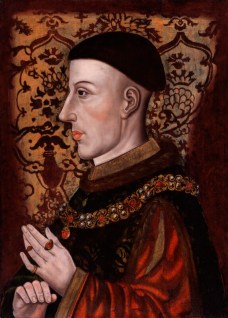
mw03074(Born September 16, 1387- Died August 31, 1422). Son of Henry IV and Mary de Bohun. Married to Katherine of Valois. He only had one son Henry VI.

Henry V was a soldier from birth. He did so much for his country, yet he died too soon, leaving his kingdom in the incapable hands of his baby son Henry VI.

At the age of fifteen, Henry V fought alongside his father against the Welsh rebels under Owain Glyn Dwr and the English rebels under Edmund Mortimer and Henry “Hotspur” Percy. Henry’s relationship with his father in the later years of Henry IV’s life was not great. The two argued about many issues, but it was mostly about the English involvement in France. Henry IV wanted to press his claim to the French throne while France was in the midst of a civil war between the Burgundians and the Armagnacs; Henry IV supported the Armagnacs while Henry V supported the Burgundians. This issue would never be resolved between them as Henry IV would die in 1413 and Henry V became king.

As king, Henry V desired to regain the lands in France that he believed was rightfully his, but unlike his father, he was able to get the full support of Parliament to do so. Henry V tried to negotiate with the French to regain all of the old Angevin Empire,  but when that failed, he invaded on August 11, 1415. On October 25, 1415, the Battle of Agincourt took place. Even though the French had the English outnumbered, the English had longbowmen. The French lost some 6,000 men whereas the English only lost 400 men.

Agincourt was a tremendous victory for the English, but the French refused to fall. Henry V gained support from Sigismund, the Holy Roman Emperor and John, duke of Burgundy and started a new campaign in August 1417. In the spring of 1419, Normandy fell to Henry V. In May 1420, Henry V signed the Treaty of Troyes with the Burgundians which recognized him and his heirs  as heir to the French throne. In order to cement this new alliance, he married the daughter of the French King Katherine of Valois.

Everything seemed right in Henry’s kingdom, but he still wanted to gain more French land. In 1421, he went back to France and was able to gain control of the Dauphin’s stronghold of Meaux in May 1422. Unfortunately, in the winter of 142, Henry V fell ill from dysentery and died on August 31, 1422. He left his kingdom in the hands of his infant son Henry VI. Even though Henry V’s reign was one of the shortest of any English king since the Norman Conquest, it was one of the most successful. England was in a position of power on the world stage thanks to the actions of Henry V.

Biography: King Henry IV (aka Henry Bolingbroke)

(Born April 3, 1367- Died March 20, 1413). Son of John of Gaunt and Blanche of mw03072Lancaster. Married to Mary de Bohun and Joan of Navarre. He had 7 children with Mary, including the future Henry V. He was the 1st king from the house of Lancaster.

Henry was the son of John of Gaunt and Blanche of Lancaster and was born at Bolingbroke Castle on April 3, 1367. Early in his life, he became one of the Lords Appellant who were opposed to the rule of Richard II. He stepped down from this role in 1389 and in 1390, went on his first adventure, journeying with the Teutonic Knights to Lithuania. Two years later, he went on a pilgrimage to Jerusalem. During this time, he visited numerous courts in Europe and was held in high regards. He was a handsome young man, but it was early in life where Henry’s ill health that plagued him during his reign started to appear.

Henry was a good person to help the king, however the only one who failed to realize this was Richard II. He banished Henry in 1398 for ten years, but when John of Gaunt died the following year and Henry became the next Duke of Lancaster, Richard II took all of his lands and banished him forever. This was the last straw for Henry. While Richard was occupied with unrest in Ireland, Henry took his chance and invaded England, forcing Richard to abdicate. The next one in line to the throne was Edmund Mortimer, earl of March, but he was only eight years old, so Parliament agreed that Henry would be a better choice to be king. His reign as Henry IV began on September 30, 1399.

However, not everyone was happy with Henry as king. Henry IV’s first rebellion that he had to deal with was by the earls of Kent, Salisbury and Huntingdon, just a month after he became king. Henry took care of this rebellion quickly and violently. It is also believed that this was around the same time that Henry ordered the death of Richard II. A few months after the first rebellion, Henry IV had to deal with a second rebellion in Wales, where Owain Glyn Dwr was declared Prince of Wales in September 1400. This revolt was quickly put down, but Owain evaded capture for several years, leading to guerrilla style warfare.

Owain’s supporters grew not only amongst Welsh barons, but English ones as well, including the Mortimers who were upset that Henry was king and not Edmund, who was Owain’s son in law after he married Owain’s daughter. Another supporter was Henry “Hotspur” Percy, the son of the earl of Northumberland who believed that he did not get the recognition that he deserved after he fought against the Scots. These forces came together and fought against Henry at the battle of Shrewsbury on July 21, 1403, where Henry defeated Hotspur easily and killed him. Henry was not going to let the rebel army get away and by 1408, they were all but eliminated.

Two years before this, in 1406, Henry IV took James I of Scotland hostage and his young heir was sent to France. James was in the English court for 17 years as a hostage and for that time, the relationships between England, Scotland and France were good. Things were looking up for Henry IV, except for his health. Starting in 1406, his health was in decline and there was a serious concern for his life. He tried to govern, but he became more reliant on his Parliament. In 1409, Henry’s son Prince Henry was made chancellor over Thomas Arundel, archbishop of Canterbury. Arundel returned in 1411 when Henry and his council were debating if he should step down in favor of Prince Henry, which Henry refused to do. Henry died in 1413 from some sort of wasting disease at the age of 45. His son Prince Henry would succeed him as Henry V.

Biography: King Richard II

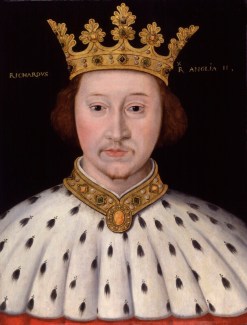
mw05302(Born January 6, 1367- Died on or about February 14, 1400). Son of Edward the Black Prince and Joan 4th Countess of Kent. Married to Anne of Bohemia and Isabella of Valois. He had no children.

Richard II was the second son of Edward the Black Prince, but when his older brother Edward died when Richard was three, Richard became second in line to the throne after his father. When Edward the Black Prince and Edward III died, Richard II became king at the tender age of 10. There was no formal regent that could help guide Richard II, but his uncle John of Gaunt did the best that he could, taking a more active political role.

Richard II and his government decided to start taxing the people with poll taxes to pay for the wars in France and the campaigns in Scotland. At first, they were tolerated, but then the people got mad. In June 1381, a man named Wat Tyler had enough and killed a tax collector and raised a force of around 100,000 to march against the king. When the two forces finally met, Wat Tyler was killed by the Lord Mayor of London William Walworth. Richard at the age of 14 stopped the Peasants’ Revolt by promising the people reforms that he, in the end,  did not fulfill the reforms.

He was the champion of England, but inside his court, things were more divisive. Richard II had two very close advisors, Robert de Vere earl of Oxford and Michael de la Pole. He granted favors upon the two men, causing anger in the court. Richard also sought military glory in Scotland, which ended up being a disaster. To top it all off in 1386, Richard made Robert de Vere duke of Ireland and Michael de la Pole was made a chancellor, without consulting Parliament first. This was the last straw for those who opposed Richard II. They decided to act. Five of his strongest opponents; Thomas duke of Gloucester,  the earl of Arundel, Thomas Beauchamp, the earl of Warwick, Thomas Mowbray, and Henry Bolingbroke the son of John of Gaunt, became known as the Lords Appellant. They took over the country and they tried to convince Richard to give up his courtiers.

He did comply for a little while, until he became of age. His first wife Anne of Bohemia died in 1394 from the plague, leaving Richard heartbroken. He married his second wife Isabella of Valois as part of a peace treaty with France, strengthening his position in his own country. He went after the Lords Appellant. Most of them were killed, except for Mowbray and Henry Bolingbroke. Mowbray was exiled for life while Henry was exiled for ten years. During his reign “The Canterbury Tales” by Geoffrey Chaucer was published and literature was on the rise.

In 1399, John of Gaunt died and instead of pardoning his son Henry Bolingbroke, Richard banished him for life. Richard left later that same year to quell the unrest in Ireland and Henry Bolingbroke took his chance to invade. Richard’s support dwindled and on August 19, 1399, Richard II forfeited to Henry and he was imprisoned in the Tower of London. The next in line for the throne, since Richard II had no children, was Edmund Mortimer earl of March, who was only 8 years old at the time. Parliament did not want a similar situation than the one that they were in, so they forced Richard II to abdicate and on September 29, 1399, Henry Bolingbroke became Henry IV. Richard II was moved to Pontefract Castle and on or around February 14, 1400, he died. Some believe that he starved to death as there was no evidence of a physical murder.

With Richard II’s abdication and Henry IV’s accession came the rise of the House of Lancaster.