Guest Post: “Excerpt from ‘The Will of God’ by Julian de la Motte”

I am pleased to welcome Julian de la Motte to my blog to share an excerpt from his novel, “The Will of God.” I would like to thank The Coffee Pot Book Club and Julian de la Motte for allowing me to be part of this blog tour.

Excerpt:

And so there had been, far more than a ‘little something’ in fact. Grandesmil was carrying in his panniers documents that entitled him to vast swathes of new lands in the Cotentin, and he was carrying in his head visions of the likely reaction to William’s death of certain of his more immediate family. And thus, to Robert, his eldest son: The boy had been with the King of France for four years now. Kept on a short leash and harboured by William’s greatest enemy, a boy caught in rebellion and open defiance of his father. To Robert, then, full pardon and restitution and the bestowing of the Duchy of Normandy for himself, but no Crown of England.

And thus, to Odo, his half-brother. A man so steeped in sin and villainy and treachery that he could no longer personally enjoy his former high estate. While he languished under close but comfortable confinement for his unchurchly crimes, the bounty of Kent, his bishopric of Bayeux, and a score of other properties and estates had gone, untasted by him and savoured by others. To Odo, then, forgiveness and a return of all his former glories and previous estate. To his problematic and scandalous second son William, called Rufus for his red hair and high complexion, the great prize of the Kingdom of England itself and all that it brought, good and bad. To Henry, his youngest and avaricious son, the sum of the weight of five thousand pounds of silver, to make of it what he would.

It was ever the fate of younger sons to make of themselves what they could. That, after all, was what the wild lands of Spain, of Italy, and Sicily and the possessions of the Byzantines were for, so that determined men with horses and swords could take and make of them what they could. But the strange and cold and calculating boy would not embark upon the world empty-handed.

Blurb: 

“Deus Lo Vult!” 

Gilles is the natural son of the Earl Waltheof, executed by William the Conqueror for supposed treachery. Raised in Normandy by Queen Matilda of England, Gilles is a young servant of Robert, Duke of Normandy, when the first call for a Holy War against the infidel and the liberation of Jerusalem is raised in Christendom. Along with thousands of others, inspired by a variety of motives, intense piety mixed with a sense of adventure and the prospects of richness, Gilles becomes a key and respected follower of the Duke of Normandy and travels through France and into Italy to the point of embarkation for Constantinople and the land of the Greeks. 

In this epic first phase of a long and gruelling journey, Gilles begins to discover a sense of his strengths and weaknesses, encounters for the first time the full might and strength of the Norman war machine and achieves his much coveted aim of knighthood, as well as a sense of responsibility to the men that he must now lead into battle. 

The Will of God is the literal translation of the Latin phrase “Deus Lo Vult,” a ubiquitous war cry and a commonly offered explanation of all the horrors and iniquities unleashed by the First Crusade of 1096 to 1099, when thousands of Europeans made the dangerous and terrifying journey to the Holy Land and the liberation of Jerusalem. It is the first of two books on the subject. 

Praise for The Will of God: 

“De la Motte has superpowers as a writer of historical fiction; he’s a warhorse of a writer bred to stun and trample the literary senses. You won’t stop turning the pages of The Will of God.”  

~ Charles McNair, Pulitzer Prize nominee and author of Land O’Goshen 

Buy Link: 

Universal Buy Link:  https://geni.us/uXe6u  

Author Bio

Julian de la Motte is a Londoner. He graduated from the University of Wales with a degree in Medieval History. He was further awarded a Master of Arts qualification in Medieval English Art from the University of York.  


He studied and taught in Italy for nearly four years before returning to the U.K. and a career as a teacher, teacher trainer, and materials designer before taking up a new role as the Director of Foreign Languages and of English as a Foreign Language. 


Married and with two grown-up children, He is now extensively involved in review writing and historical research, primarily on medieval history. 


The Will of God” [the first of two books on the subject of the First Crusade] is his third novel. 

Author Links

Website: www.historiumpress.com/julian-de-la-motte  

Facebook: https://www.facebook.com/julian.delamotteharrison.3  

Amazon Author Page: https://www.amazon.com/stores/author/B08XWMRPYK  

Goodreads: https://www.goodreads.com/author/list/20873400.julian_de_la_Motte  


Guest Post: “Excerpt from ‘ Try Before You Trust: To All Gentlewomen and Other Maids in Love’” by Constance Briones

I am pleased to welcome Constance Briones to my blog today to share an excerpt from her novel, “Try Before You Trust: To All Gentlewomen and Other Maids in Love.” I would like to thank Constance Briones and The Coffee Pot Book Club for allowing me to be part of this blog tour.

Excerpt:

On a brisk September morn in the ninth year of Queen Elizabeth’s reign, I arrived at the Bramwell House, the London estate of Lady Bramwell, a widowed baroness and my new mistress. The fiery hue of the red brick facade made the house seem indestructible as it stood bold and vibrant in the late morning sunlight on the bank of the Thames. I counted eight chimney stacks and forty mullioned windows with diamond-shaped glass and mused whether I would find friend or foe within. 


As I gazed at the gables and corner turrets, my sisters’ sweet laughter reverberated in the cool breeze that swept across my cheeks. How they twirled and giggled with delight when my mother promised that, like me, when they reach the age of eighteen, they too will venture from home to work for a grand lady, acquiring superior housewifery skills that would help them snag a well-bred gentleman. 


Blurb: 

What if Taylor Swift found herself penning songs about love in Elizabethan England when women were required to be chaste, obedient, and silent? 

Isabella Whitney, an ambitious and daring eighteen-year-old maidservant turned poet, sets out to do just that. Having risked reputation and virtue by allowing her passions for her employer’s aristocratic nephew to get the better of her, Isabella Whitney enters the fray of the pamphlet wars, a scurrilous debate on the merits of women. 


She’s determined to make her mark by becoming the first woman to write a poem defending women in love, highlighting the deceptive practices of the men who woo them. Her journey to publication is fraught with challenges as she navigates through the male-dominated literary world and the harsh realities of life in sixteenth-century London for a single woman. 

Loosely based on the life of Elizabethan poet Isabella Whitney, this is a compelling tale of a young woman’s resilience and determination to challenge the status quo and leave her mark in a world that was not ready for her. 

Buy Link: 

Universal Buy Link: https://books2read.com/u/3Jly0J  

Author Bio: 

Constance Briones has a Master’s in Woman’s History, which informs her writing. 

She first learned about the subject of her debut historical fiction novel, the sixteenth-century English poet Isabella Whitney, while doing research for her thesis on literacy and women in Tudor England. Isabella Whitney’s gusty personality to defy the conventions of her day, both in her thinking and actions, impressed Constance enough to imagine that she would make a very engaging literary heroine. 

As a writer, Constance is interested in highlighting the little-known stories of women in history. She is a contributing writer to Historical Times, an online magazine. When not writing, she lends her time as an educational docent for her town’s historical society. 

She contently lives in Connecticut with her husband and Maine coon sibling cats, Thor and Percy. 

Author Links

Facebook: www.facebook.com/constancebrionesauthor  

LinkedIn: www.linkedin.com/in/constance-briones-a55a9168 

Pinterest: www.pinterest.com/constancebrionesauthor  

Amazon Author Page: www.amazon.com/stores/author/B0CPX8T7CB/about 

Guest Post: “Excerpt from ‘The Agincourt King’ by Mercedes Rochelle”

PWIzRwyKI am pleased to welcome Mercedes Rochelle back to my blog to share an excerpt from her novel, “The Agincourt King.” I would like to thank Mercedes Rochelle and The Coffee Pot Book Club for allowing me to be part of this blog tour.
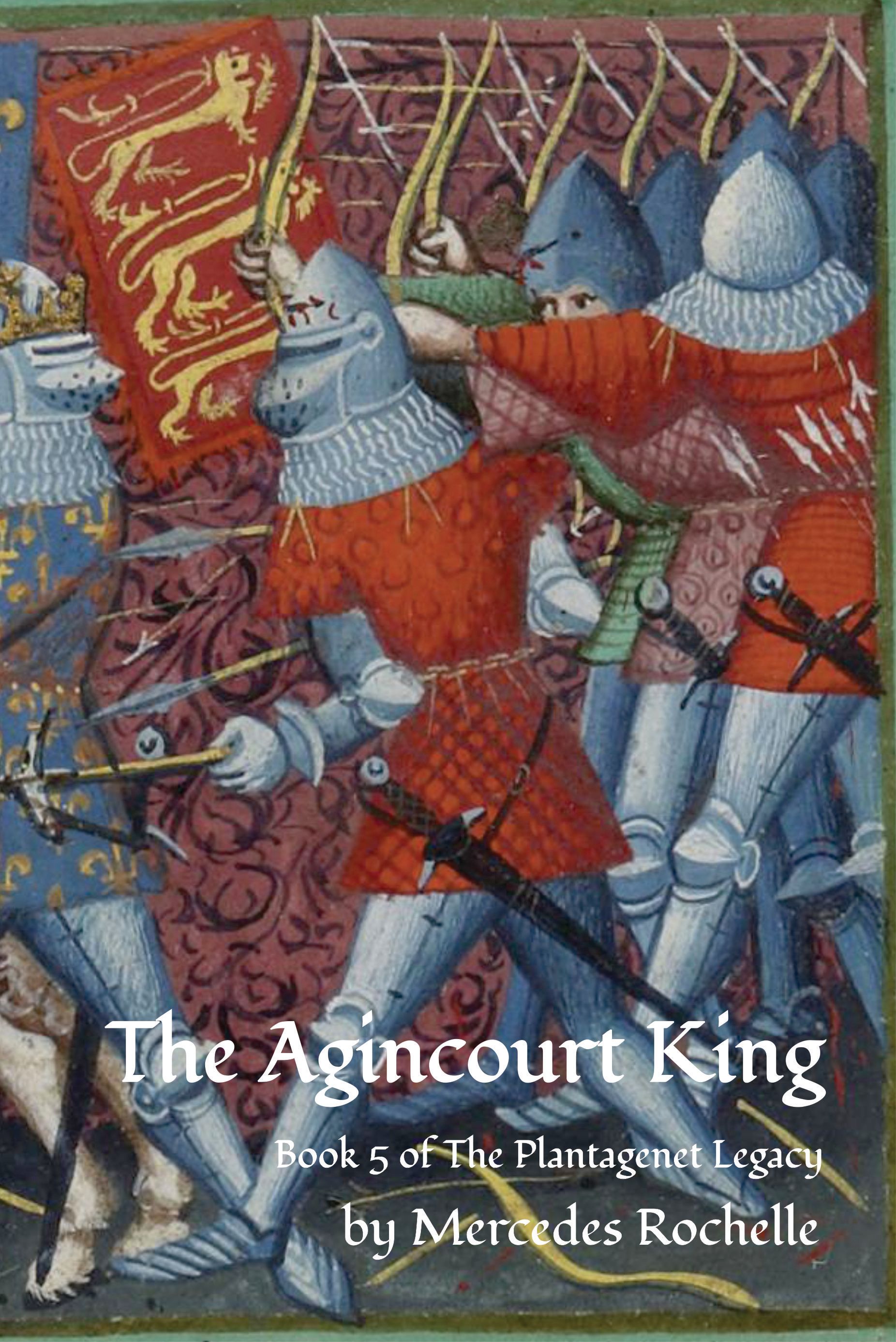
THE CABOCHIEN REVOLT IN PARIS 

There was no doubt that France was in turmoil. King Henry IV of England wasn’t even cold in his grave at Canterbury Cathedral when a fierce rebellion broke out in Paris. As usual, King Charles VI had sunk into insensibility and the city simmered uneasily, agitated by John the Fearless, the Duke of Burgundy. Private and public accusations were aimed against the king’s ministers, and the most threatened among them started to leave town for the safety of the provinces. But another consideration had arisen to complicate matters. Louis the Dauphin had reached his sixteenth year and was poised to take on the regency while his father was incapacitated. Already he was chafing under Burgundy’s authority… 

Although today Burgundy was in charge, he was concerned about Louis the Dauphin. To control the heir to the throne, he had arranged a marriage between Louis and his daughter Margaret. Unfortunately, the union was not working out. The lad showed a disturbing independence and tended to reject his wife whenever possible. It was time to teach him a good lesson.  

It didn’t take long to devise a plan. Duke John secretly conversed with Governor Jacqueville (who happened to be the chamberlain) and others of his household. As he conveniently withdrew, the citizens worked themselves into another frenzy under the urging of their governor. Jacqueville mounted a platform and held up his hands for attention. 

“I have a list of traitors the Dauphin harbours under his protection,” he shouted. “They seek to strip you of your rights and privileges. We must take them prisoner! See here, the Duke of Bar is your enemy, and the Dauphin’s chancellor Jehan de Vailly. We must arrest the queen’s brother Duke Louis of Bavaria, members of her household, and her ladies in waiting. I have the list here!”  

Jacqueville waved a paper over his head. He was about to say more when a burly citizen mounted the platform. The crowd cheered and he recognized this man, a well-known mischief-maker who was popular with the people. He was dressed as a common workman, with a swarthy face and hair that stuck up like a brush. He strutted across the platform like he owned the place. 

“I am Simon Caboche, to those who do not know me,” the newcomer called out to much laughter. “I am a skinner of the ParisBoucherie and leader of our butcher’s guild. Follow me to the Hôtel de Guyenne, where we will have a parley with the Dauphin.” He pulled out a white hood—chaperon—from under his belt. “All those who are with me, here is our badge!” And to the governor’s amazement, most of the Parisians had a white hood, too. Who was playing into whose hand?   

Giving Jacqueville a meaningful look, Caboche took charge and led a shouting mob to the Dauphin’s hôtel. By the time they reached the Rue St. Antoine, they were six thousand strong and growing. The men guarding the door didn’t even try to interfere. While the Parisians surrounded the hôtel, the leaders pushed their way inside.  

“Where is he?” bellowed Caboche at the first servant he saw. The man backed against the wall. “Where is the Dauphin?” 

The poor servant blubbered in terror, and Caboche growled at him before continuing down the hall. Two old women carrying linens were just coming out a door when the butcher pointed at them. “Take us to the Dauphin!” he demanded. Looking at each other, the servants froze. 

“Come, friends,” he said more gently. “We won’t hurt you. We need to speak to the Dauphin.” 

One of the women pursed her lips and then gave her bundle to her companion. Jerking her head, she led the intruders to the Dauphin’s private apartment. Nodding his thanks, Caboche shoved open the door with a slam, surprising Louis while he was conversing with the Duke of Bar. 

Louis sprang awkwardly to his feet. “What is the meaning of this?” he cried in an unsteady voice. Unfortunately, the Dauphin did not inspire confidence and he knew it. His short frame was overweight, heavy, and slow. He was already known for keeping late hours and general laziness. Fond of excessive jewellery and rich clothing, he relied on the trappings of royalty to sustain his fragile dignity.  

Caboche stepped forward, flanked by his closest associates. He did not remove his white hood. “Our most redoubted lord,” he said, his voice barely respectful, “I have come with my fellow Parisians, who require, for your welfare and your father’s, that you deliver up certain traitors who are now in your hôtel.”  

Recovering his nerve, the Dauphin was filled with anger. “This is absurd. What you demand is impossible. There are no traitors in this hôtel.”  

“That is not true. I see them right before me.” Caboche nodded toward his victims and some of his men leapt across the room, grabbing the Duke of Bar by the arm; others seized the Dauphin’s chancellor. While Louis turned around in apprehension, his wife screamed. She had thrown her arm around one of his valets, trying to hold him back from two of the butchers who yanked him loose. Another servant was thrown to the floor.  

“Stop this!” cried Louis.  

Caboche gave him a sideways grin. “If you are willing to give them up,” he said, “well and good. Otherwise, we will take them right before your face and punish them as they deserve.” 

“I command you to let them go!” shouted the Dauphin. “My affairs are none of yours.” 

Jacqueville stepped up beside the butcher. “Monseigneur, this is very much our business. You have been badly misled, and your behaviour is that of a spoiled young man. You are sorely in need of correction.” 

“Get out of my sight!” cried the Dauphin. “Guards, help me! Guards!” 

Alerted by the shouting, several of the Dauphin’s men rushed into the room and threw themselves onto the intruders, who enthusiastically fought back. But no sooner had the scuffle begun when the Duke of Burgundy pushed his way into the room, shouting for order. His own men bore halberds and quickly interceded, pushing the antagonists apart. The Cabochiens, as they already called themselves, grouped together, still hanging onto their prisoners.  

Louis whirled around, pointing at his father-in-law. “This is your doing,” he growled. “These are your men. One day you will regret this. I won’t always be under your thumb.” 

LgQJ75mEBlurb:  

From the day he was crowned, Henry V was determined to prove the legitimacy of his house. His father’s usurpation weighed heavily on his mind. Only a grand gesture would capture the respect of his own countrymen and the rest of Europe. He would follow in his great-grandfather Edward III’s footsteps, and recover lost territory in France. 

Better yet, why not go for the crown? Poor, deranged Charles VI couldn’t manage his own barons. The civil war between the Burgundians and Armagnacs was more of a threat to his country than the English, even after Henry laid siege to Harfleur. But once Harfleur had fallen, the French came to their senses and determined to block his path to Calais and destroy him. 

By the time the English reached Agincourt, they were starving, exhausted, and easy pickings. Or so the French thought. Little did they reckon on Henry’s leadership and the stout-hearted English archers who proved, once again, that numbers didn’t matter when God was on their side. 

Buy Links: 

This title is available to read on #KindleUnlimited. 

Universal Buy Link: https://books2read.com/u/mq70Ze  

0S8YcxEYAuthor Bio:  

Mercedes Rochelle is an ardent lover of medieval history and has channeled this interest into fiction writing. Her first four books cover eleventh-century Britain and events surrounding the Norman Conquest of England. The next series is called “The Plantagenet Legacy” and begins with the reign of Richard II.  

She also writes a blog: www.HistoricalBritainBlog.com to explore the history behind the story. Born in St. Louis, MO, she received by BA in Literature at the Univ. of Missouri St.Louis in 1979 then moved to New York in 1982 while in her mid-20s to “see the world”. The search hasn’t ended! 

Today she lives in Sergeantsville, NJ with her husband in a log home they had built themselves. 

Author Links

Website: https://mercedesrochelle.com/  

Blog:  https://historicalbritainblog.com/  

Twitter / X: https://x.com/authorrochelle  

Facebook:  https://www.facebook.com/mercedesrochelle.net  

Book Bub: https://www.bookbub.com/authors/mercedes-rochelle  

Amazon Author Page:  https://www.amazon.com/stores/Mercedes-Rochelle/author/B001KMG5P6  

Goodreads: https://www.goodreads.com/author/show/1696491.Mercedes_Rochelle  

Guest Post: “Excerpt from ‘A Splendid Defiance’ by Stella Riley”

A Splendid Defiance Tour BannerI am pleased to welcome Stella Riley to my blog today to share an excerpt from her novel, “A Splendid Defiance.” I would like to thank Stella Riley and the Coffee Pot Book Club for allowing me to be part of this blog tour.

Abby storms the castle

Considering that he had left his bed to dress hurriedly and come straight downstairs, the Captain’s room was remarkably tidy. A lot tidier, thought Abigail, with a faintly shocked sideways glance, than he was himself. It was also larger than she had expected, being situated at the top of the south-east turret and reached by means of a narrow spiral stair.

I shouldn’t be here, thought Abigail, in sudden panic.  Jonas will kill me if he finds out.

Justin deposited his sword in a corner.  Then, turning to pull the bedclothes into some semblance of order, he told her to sit down and demanded again to be informed what she wanted of him.

Abigail hovered and hesitated.

‘For God’s sake!’ exclaimed Justin, dropping irritably upon the bed and regarding her with acute disfavour.  ‘Sit down and stop being coy.  I’m not in the mood for it.’

She obeyed him rather quickly.  ‘I’m sorry.’

‘Don’t be sorry.  Just come to the point.’

His tone made this difficult but she did her best.

‘It’s my brother.  He was arrested in the Market Place this afternoon – but he didn’t do anything.  I mean, he wasn’t involved in the fighting in the way that others were.  So I came to ask you to please let him come home.’

Comprehension dawned slowly and the blurred gaze registered astonishment.

‘You mean he was taken for rioting?  No, no.  It’s too good to be true.’

Abigail stiffened.  ‘I’m afraid I don’t find it funny.’

The dark brows soared and his reply was deliberately blighting. 

‘My dear child, I’d be amazed if the members of your household found anything funny.  Quite apart from your religious persuasion, your appalling brother and his sour-faced wife are enough to kill anyone’s sense of humour.  However, if you’ve hauled me out of bed just to ask a favour for Jonas, I can only say that your nerve outstrips your intelligence.  To put it bluntly, I don’t care if he rots.’

Abigail dissected this remarkable speech before brushing it aside.

‘What has Jonas to do with it?  It isn’t him you’ve got.’  And then, staring at him, ‘Is that what you thought?’

‘Not being on intimate terms with your entire family, what else was I to think?’ he asked acidly.  ‘Well?’

‘I’m sorry.  I thought you’d realise …’ She paused.  ‘If it was Jonas, I wouldn’t be here.’

‘And I am supposed to know that because …?’  Captain Ambrose leaned back, brooding on her overfolded arms. ‘Mistress Radford.  My patience, as you may have noticed, is extremely limited and diminishing by the second. Will you please tell me, in plain language, just who the hell it is you came to rescue?’

A Splendid Defiance cover 2Blurb:

For two years England has been in the grip of the Civil War.  In Banbury, Oxfordshire, the Cavaliers hold the Castle, the Roundheads want it back and the town is full of zealous Puritans.

Consequently, the gulf between Captain Justin Ambrose and Abigail Radford, the sister of a fanatically religious shopkeeper, ought to be unbridgeable.

The key to both the fate of the Castle and that of Justin and Abigail lies in defiance.  But will it be enough?

A Splendid Defiance is a dramatic and enchanting story of forbidden love, set against the turmoil and anguish of the English Civil War.

Buy Link: 

Universal Buy Link:  https://books2read.com/u/bPzVNd

Stella RileyAuthor Bio:

Winner of four gold medals for historical romance and sixteen Book Readers’ Appreciation Medallions, Stella Riley lives in the beautiful medieval town of Sandwich in Kent.

She is fascinated by the English Civil Wars and has written six books set in that period. These, like the 7-book Rockliffe series, the Brandon Brothers trilogy, and, most recently The Shadow Earl, are all available in audio, performed by Alex Wyndham.

Stella enjoys travel, reading, theatre, Baroque music, and playing the harpsichord.  She also has a fondness for men with long hair – hence her 17th and 18th-century heroes.

Author Links:

Website: https://stellarileybooks.co.uk

Twitter: https://twitter.com/RileyStella

Facebook: https://www.facebook.com/stellariley.books

Instagram: https://www.instagram.com/stellarileybooks/

Pinterest: https://www.pinterest.co.uk/riley9631/stella-riley-books/

Book Bub:  https://www.bookbub.com/authors/stella-riley

Amazon Author Page: https://www.amazon.co.uk/Stella-Riley/e/B0034PB7UU/ 

Goodreads:  https://www.goodreads.com/book/show/40487661-a-splendid-defiance

Guest Post: “Excerpt and Recipe from the ‘Chateau de Verzat Series’ by Debra Borchert”

Chateau de Verzat Series BannerToday, I am pleased to welcome Debra Borchert to share an excerpt and a recipe from her series, “The Chateau de Verzat Series.” I want to thank Debra Borchert and The Coffee Pot Book Club for allowing me to be part of this tour. 

Her Own Legacy, Versailles, December 13, 1788

Joliette Meets Guillaume

Maman guided me toward a man so old, he could be my grandpapa. My arms tensed. She could not possibly think that old man appropriate. 

Papa strode toward us. “May I have your first dance, ma princesse?” 

Relief washed through me.

Maman frowned. “Bring her right back. She has many introductions.”

He took my hand and led me toward a group of dancers. 

“Merci, Papa,” I whispered.

He winked, led me to the lead position, and danced me about the Galerie. As the lead couple, we whirled with and between the dancers. Papa’s warm smile and strong leading steps relaxed me, and I enjoyed myself. He led me to greet the last couple. I turned to offer my hand to the next gentleman and his green eyes—bright as grapevines during bud break—startled me. 

I forgot the movement and faltered. I searched to locate Maman. Had she seen? She would have me dancing twelve hours a day after this. 

Without missing a beat, he rescued my wayward hand and adroitly led it to its next position. My hands grew moist inside my gloves. His steps and arms were strong, like Papa’s, but dancing with Papa had not made me breathless. The mirrors spun shards of light as he led me through the twisting rosettes. I dizzied as he returned me to Papa. Perspiration coated my face, and I fluttered my fan to dry it. 

The man wore a frock coat and breeches of pale lavender silk with tiny bouquets of violets—so delicate and fine I expected them to have a scent—embroidered along his cuffs and hem. His ensemble resembled that of our King, yet the silk puckered beneath the embroidery—the fabric was inferior. He was working hard to fit in at Court, yet every courtier would notice his black shoes—without red heels. He had not been presented. 

The allemande at an end, he turned to my father and bowed deeply. He unfurled from his bow and straightened to Papa’s height. “Comte de Verzat, I believe you are acquainted with my father, the Baron Pricaud?” 

Papa’s eyebrow rose. “Ah…oh, yes, you are…?”

“Guillaume Pricaud.” He bowed, again. “It is an honor to meet the man who produces the finest wines in France, if not the world, Monsieur le Comte.”

Finest in the world? I leaned closer. The sounds of conversations, laughter, music all faded. His eau de Cologne smelled woodsy with a hint of lime. 

Papa gave a tight smile. “May I present my daughter, Mademoiselle Joliette de Verzat?”

He bowed. My hand, of its own accord, sought his. As he held my fingers, his lips brushed my hand ever so gently. Damned protocol requiring gloves.

“Your mother’s beauty shines from within you, Mademoiselle.”

Words sat in my mouth like melting chocolate. I was supposed to thank him, but I could not summon a word. I held the fingers his lips had caressed.

“You remember my father, Comte?”

“We knew each other many years ago, when we were your age.”

Pricaud reached into his frock coat and withdrew a thick blue leather purse. “He asked me to deliver this.” With both his hands, he held it out to Papa. “My father wishes me to express his humble gratitude for your patience.”

Papa put up his hands. “Eh…that was so long ago. All is forgotten.”

“Not by my father.” He continued to present the purse.

Why did Papa refuse him? Pricaud’s demeanor, his manners, his tenacity, all impeccable. Neither of my parents could find fault with Pricaud. Nor could I. He never glanced at the emeralds at my neck. He knew of the Verzat legacy. Why had I not seen him at Court before?

“There is no need.” Papa shook his head.

Maman’s skirts brushed against mine. “Pardon, Monsieur.” 

Pricaud withdrew the purse and dropped into a deep bow.

Maman inserted herself between me and Monsieur Pricaud, but she did not extend her hand. “My daughter and I have been summoned by the Queen.” She held my elbow and drew me away. “Forgive us, please.”

Joliette’s Chilled Fresh Pea Soup

While living in France, Joliette never cooked—she was far too busy fermenting wine. But when she and Henri arrived in America, she longed for dishes made by her beloved Cook. Joliette remembered afternoons, sitting at Cook’s battered wooden table, shelling peas for Cook’s sweet and velvety Chilled Fresh Pea Soup. This recipe is based on Joliette’s memories and my experimentations. 

Serves 6–8 

Ingredients

2 cups fresh or frozen peas sea salt (optional)

1 cup water fruity white balsamic vinegar (optional)*

a few sprigs of fresh mint

Process 

  1. Simmer peas in water until peas are tender. 
  2. Keeping the broth, drain peas and allow to cool. 
  3. Using an immersion blender, blitz the peas with enough of the cooking liquid for a consistency and thickness you like.
  4. Add salt to taste. Chill. 
  5. Serve with a mint spear and a drizzle of a fruity white balsamic vinegar. 

Notes

  1. *My favorite fruity white balsamic vinegar is OMG!’s D’Anjou Pear White Balsamic Vinegar. See the Resources page.
  2. This soup freezes well.

Blurb:

HER_OWN_LEGACY_COVERHer Own Legacy:

A Woman Fights for Her Legacy as the French Revolution Erupts

Determined to inherit her family’s vineyard, Countess Joliette de Verzat defies society’s rules, only to learn of her illegitimate half-brother, the rightful heir. 

Her Own Revolution:HER_OWN_Revolution__FINAL_COVER

A Woman Forges a Treacherous Path to Save Hundreds from the Guillotine

If Geneviève Fouquier-Tinville had the same rights as a man, she wouldn’t have to dress like one. A suspenseful page-turner led by a renegade heroine whose compassion for innocent people leads to both loss and love.

Buy Links:

*Her Own Legacy will be only 0.99 in the UK, CA, and AU stores from March 5th – 15th, 2024!*

Universal Buy Links:  

Her Own Legacy: https://books2read.com/u/bWYod1 

Her Own Revolution: https://books2read.com/u/m0aJVl 

Series Buy Links:

US: https://www.amazon.com/gp/product/B0B9KN1536 

UK: https://www.amazon.co.uk/gp/product/B0B9KN1536 

Debra Borchert 1Author Bio:

Debra is the author of the Château de Verzat series that follows headstrong and independent women and the four hundred loyal families who protect a Loire Valley château and vineyard, and its legacy of producing the finest wines in France during the French Revolution. Her Own Legacy published in 2022, Her Own Revolution published in 2023, and Her Own War will be published in 2024. A passionate cook, she also wrote a companion cookbook to the series: Soups of Château de Verzat, A Culinary Tribute to the French Revolution, 2023.

A graduate of the Fashion Institute of Technology, she weaves her knowledge of textiles and clothing design throughout her historical fiction. She lives in the Pacific Northwest with her family and standard poodle, named after a fine French Champagne. 

Author Links:

Website: https://debraborchert.com/ 

Twitter: https://twitter.com/debraborchert 

Facebook: https://www.facebook.com/DebraBorchertAuthor/

LinkedIn: https://www.linkedin.com/in/debra-borchert-10b8305/

Instagram: https://www.instagram.com/debraborchertauthor/

Pinterest: https://www.pinterest.com/debraborchert/ 

Book Bub: https://www.bookbub.com/authors/debra-borchert

Amazon Author Page: https://www.amazon.com/stores/Debra-Borchert/author/B00CSW9MH0 

Goodreads: https://www.goodreads.com/author/show/7787729.Debra_Borchert

Guest Post: “Excerpt from ‘Twelve Nights’ by Penny Ingham”

Twelve Nights Tour BannerToday, I am pleased to welcome Penny Ingham to my blog to share an excerpt from her novel, “Twelve Nights.” I would like to thank The Coffee Pot Book Club and Penny Ingham for allowing me to be part of this blog tour.
Excerpt

‘Poison,’ Stow mused. ‘A woman’s weapon, is it not?’ He turned, fixing his piggy eyes upon Magdalen. “Tell me, why did you poison John Wood?’

Magdalen felt suddenly ice-cold as if she had plunged into the Thames in January as if every last gasp of air had been driven from her lungs. All around her, the players erupted in cries of outraged indignation.

‘I – I did not poison John!’ Magdalen stammered. ‘He is – he was, like a brother to me.’

‘You knew him well?’

‘Well enough, sir.’

‘You were intimately acquainted?’

‘No! I swear on my life!’

But the constable had a bit between his teeth. ‘Was it a lover’s quarrel? Did he spurn you for another? What do they say? Hell hath no fury like a woman scorned.’

Magdalen was sinking deeper into the icy water, the glimmers of daylight above her head becoming fainter as she drifted down into the darkness. The players’ protests were growing louder and angrier by the minute but they sounded very far away. The constable banged the tip of his staff upon the boards, once, twice, three times, dragging her back to the surface of her unfolding nightmare.

‘I will have silence!’ Edmund Stow bellowed. ‘Tell me, Mistress Bisset, as his sister then, who were his enemies? Who bore him a grudge?’

Magdalen thought of Richard Cowley’s brawl with John earlier that day, the hatred in his eyes. Did he hate John enough to kill him? But she had no proof, and she knew she would never forgive herself if she falsely accused him. ‘Everyone liked John, sir. He didn’t have any enemies.’

‘Everyone has enemies,’ Stow replied. ‘You came to London from Hampshire, did you not?’ he added, eyeing her appraisingly. ‘You were raised on a farm. You understand plants, which will heal, and which will harm?’

Magdalen dug her fingernails into her palms, focussing on the pain rather than the panic threatening to overwhelm her. ‘I left Hampshire when I was eight years old. I have no knowledge of such things, sir.’

‘Don’t lie to me.’

‘I swear I am innocent, sir.’

‘Believe me, girl, the truth will be out.’ Edmund Stow glared at her for a long moment, perhaps hoping he might see into her very soul. She found herself staring back at him, held fast by his malevolent spell. When at last he released her from his gaze, her legs felt as wobbly as marrow jelly.

Stow’s eyes were sweeping across the stage, seeking a new target. They settled on Burbage and narrowed, taking aim. ‘It seems most likely John Wood was poisoned here at the Theatre.’

‘That is an outrageous accusation!’ Burbage shot back indignantly. ‘You cannot seriously believe one of us killed John?’

‘I believe whatever the evidence suggests, Master Burbage,’ Stow replied haughtily. ‘Tell me, what refreshments do you provide for the players?’

‘We have a pitcher of Malmsey in the ‘tiring house, and one cup.’ Burbage was visibly fighting to remain calm. ‘Before every performance, we share the cup and raise a toast. If someone had poisoned the wine, we would all be dead.’

‘Bring me the pitcher and the cup.’

Burbage glanced at Magdalen, but Stow shook his head. ‘No. She stays here. Send the boy.’

Peter soon returned with the pitcher and cup. Stow sniffed them both cautiously. ‘You have all drunk from this cup?’

The players nodded.

‘But you gave John a second drink, after the play had begun, didn’t you, Magdalen,’ Peter said brightly.

Stow’s beady eyes fixed upon Magdalen again. ‘Is this true?’

Magdalen opened her mouth but no words formed. Peter was right. She had offered John another drink, but only because he had looked so unwell. Will Kempe glared at Peter and rolled his eyes in disgust. Several other players shook their heads despairingly. Peter, suddenly comprehending the gravity of his careless words, fought back tears.

‘So, you do not deny giving the player another drink, Mistress Bisset?’ There was a gleam of triumph in the constable’s eye.

Twelve Nights coverBlurb:

1592. The Theatre, London.

When a player is murdered, suspicion falls on the wardrobe mistress, Magdalen Bisset, because everyone knows poison is a woman’s weapon. The coroner is convinced of her guilt. The scandal-pamphlets demonize her.

Magdalen is innocent, although few are willing to help her prove it. Only handsome Matthew Hilliard offers his assistance, but dare she trust him when nothing about him rings true?

With just two weeks until the inquest, Magdalen ignores anonymous threats to ‘leave it be’, and delves into the dangerous underworld of a city seething with religious and racial tension. As time runs out, she must risk everything in her search for the true killer – for all other roads lead to the gallows.

Buy Links:

This title is available to read on #KindleUnlimited.

Universal Link: https://books2read.com/u/bpYRlk

Penny Ingham 2Author Bio:

Penny has a degree in Classics, and a passion for archaeology – during the summer months, you will often find her on her ‘dig’ with a trowel in her hand. She has had a variety of jobs over the years, including ice cream seller, theatre PR, BBC local radio, and TV critic for a British Forces newspaper.

She has written four novels – ‘The King’s Daughter’ is the story of Aethelflaed, Lady of the Mercians. ‘The Saxon Wolves’ and ‘The Saxon Plague’ are set in the turbulent aftermath of Roman Britain. Her inspiration for Twelve Nights grew from her love of the theatre in general, and Shakespeare in particular.

Penny has two grown-up children and lives with her husband in Hampshire.

Author Links:

Website: Penny Ingham (wordpress.com)

Twitter: Penny Ingham (@pennyingham) / Twitter

Facebook: Penny Ingham Author Page | Facebook

Instagram: Penny Ingham (@penny.ingham) • Instagram photos and videos

Amazon Author Page: Amazon.co.uk: Penny Ingham: Books, Biography, Blogs, Audiobooks, Kindle

Goodreads: Penny Ingham (Author of The Saxon Wolves) | Goodreads

Guest Post: “Excerpt from ‘The Merchant’s Dilemma’ by Carolyn Hughes”

The Merchant's Dilemma Tour Banner

I am pleased to welcome Carolyn Hughes to my blog today to share an excerpt from her novel, “The Merchant’s Dilemma.” I would like to thank Carolyn Hughes and The Coffee Pot Book Club for allowing me to be part of this blog tour. 

From Chapter 2

Riccardo had found himself distracted most of the morning, even when in conversation with his client. It was fortunate there had been only one so, once they had shaken hands on an agreement, he was able to spend some time alone, walking and thinking through the situation, and what and how to tell Bea.

His heart swelled whenever he thought of her. It had never done so at the thought, or even sight, of Katherine. She was not an unattractive woman, but her nervous nature and seeming lack of interest in him discouraged him from even trying to love her. Even when he was lying next to her in bed, he had to steel himself to turn to face her. When he put out a hand to touch her breast, she would flinch, then when he rolled on top of her to complete the task – for “task” it did seem to be – Katherine would whimper, not with pleasure, he was certain, but with urgent longing for it to be over. It was scarcely surprising the so-called act of love with his wife was one he came to dread and even balk at. In truth, it was a wonder little Oliver had ever been conceived.

It had not been that way in those few months before his marriage when Bea had lived here with him. Their love-making had been full of delight and pleasure for them both. In that short time, he had grown to love her deeply. When he was obliged to marry Katherine, and effectively abandon the woman he adored, he had been distraught. He blamed himself, both then and now, for being the cause of Bea leaving Winchester. And, therefore, of the terrible events in Meonbridge that at length brought her back to the city, but as a homeless beggar. 

These past three months had been the happiest he could remember for a long while. His worry about Bea’s health aside, their easy, loving relationship – albeit they were sleeping apart until she was fully well – made each day one to look forward to. And to make his happiness complete surely Bea should no longer continue as his mistress, but become his wife.

Yet, marrying her would not be easy. For, if his father learned of Bea’s former life, he would refuse to sanction marriage to her and would almost certainly deny him his inheritance.

Finding himself in the cathedral precinct, Riccardo slipped into the building. At the main west entrance, scaffolding had been raised, and masons were dismantling some of the ancient stonework. He had heard that Bishop Edington had plans to alter the west end of the building, from the ancient Romanesque original to a more modern style. He looked forward to seeing their fine cathedral transformed into an even more magnificent monument to God, albeit he regretted the dust and noise that was the inevitable result. A result that would continue for many years.

But, despite the noise outside, inside was peaceful enough, if chilly, in stark contrast with the gentle warmth of the April day. He was not entirely alone: a few people, mostly aged women, were standing or kneeling before the high altar, mumbling prayers. He approached the altar too, but kept a distance. He dropped down onto one knee for a moment, then stood up again and, with bowed head, muttered a few prayerful words himself, asking for some sort of guidance in the awkward conversation he had ahead of him.

In truth, he did not feel he received an answer to his entreaty but hoped it might come to him if he thought the matter over a little further. Despite the coldness of the vast, high building, he made his way to the south transept, where there was a stone bench he could sit on for a while. 

He returned to thinking about his father. Would it matter if he was deprived of his inheritance? As the elder of the two Marchaunt sons, he was entitled to the principal Marchaunt estate and the greater proportion of his father’s wealth. Yet the money was not important, nor even the artifacts his father had acquired over the years, magnificent as many of them were. He had made such a success of his own business, he was more than prosperous enough to maintain a wife and family.

No, what really mattered had nothing to do with money.

His first concern was a matter of the heart. He really wanted to own Chilcumbe Hall, the splendid manor house a few miles outside the city. He had been looking forward to the time when he could raise his own children in the place where he and his brother spent such a happy childhood. How disappointing it would be if he lost that opportunity!

But the second concern was even more important. His father was much admired and respected amongst Winchester’s great and good. He had been a master of the guild, several times a city alderman, and was once elected mayor. Riccardo’s own success as a businessman was due partly to being his father’s son. If he was not his father’s principal heir – if he was known to have been cast aside – he would be disgraced, his standing in society ruined. 

There was so much to lose: not just the legacy, and his status as his father’s heir, but everything he had worked for, and even his authority to continue his career.

He closed his eyes a moment, contemplating what such a loss might mean. If all that happened, he supposed he could leave Winchester, and try to establish himself again elsewhere. But the prospect of doing that, at his age, was daunting. And not what he wanted.

Until three months ago, he had presumed he would at length find another wife, a woman from another respectable city family. Hopefully one with a pleasanter disposition than poor Katherine. But he had not been in any hurry. He had expected to find his bride himself, and would not approach his father for advice. Although he might have asked Mama if she knew of any suitable young women looking for a husband.

But that was all before he discovered Bea collapsed on his doorstep. Now, the only woman he wanted as his wife, and the mother to his children, was her. Yet, either marrying her or living with her in a sinful state, accepting their children would be illegitimate, would surely enrage his father. He would simply consider it unacceptable for his heir to sire children upon a woman such as Bea, whether or not they were legitimately man and wife. 

Riccardo sat upright and flexed his shoulders. His back was aching from the cold seeping from the stone bench up through his clothes. He pushed himself to his feet, ready to go home.

So, what was the answer? 

In truth, it was obvious, if disagreeable. He refused to give up Bea, but the consequences of losing his father’s favour were so serious, the only answer was to wait until the old man was no longer able to cast him aside.

He had to wait until his father died.

TMD-CoverBlurb

1362. Winchester. Seven months ago, accused of bringing plague and death from Winchester, Bea Ward was hounded out of Meonbridge by her former friends and neighbors. Finding food and shelter where she could, she struggled to make her way back to Winchester again.

Yet, once she arrived, she wondered why she’d come.

For her former lover – the love of her life – Riccardo Marchaunt, had married a year ago. And she no longer had the strength to go back to her old life on the streets. Frail, destitute, and homeless, she was reduced to begging. Then, in January, during a tumultuous and destructive storm, she found herself on Riccardo’s doorstep. She had no plan, beyond hoping he might help her, or at least provide a final resting place for her poor body.

When Bea awakes to find she’s lying in Riccardo’s bed once more, she’s thankful, thrilled, but mystified. But she soon learns that his wife died four months ago, along with their newborn son, and finds too that Riccardo loves her now as much as he ever did, and wants to make her his wife. But can he? And, even if he can, could she ever really be a proper merchant’s wife?

Riccardo could not have been more relieved to find Bea still alive when he thought he had lost her forever. She had been close to death but is now recovering her health. He adores her and wants her to be his wife. But how? His father would forbid such an “unfitting” match, on pain of denying him his inheritance. And what would his fellow merchants think of it? And their haughty wives?

Yet, Riccardo is determined that Bea will be his wife. He has to find a solution to his dilemma… With the help of his beloved mother, Emilia, and her close friend, Cecily, he hatches a plan to make it happen.

But even the best-laid plans sometimes go awry. And the path of love never did run smooth…

The Merchant’s Dilemma is a companion novel to the main series of MEONBRIDGE CHRONICLES, and continues the story of Bea and Riccardo after the end of the fourth Chronicle, Children’s Fate. It is a little more romantic and light-hearted than the other Chronicles but, if you’ve enjoyed reading about the lives of the characters of Meonbridge, you will almost certainly enjoy reading The Merchant’s Dilemma too!

Buy Links:

This title is available to read on #KindleUnlimited.

Universal Link: https://books2read.com/u/3RY7Yj 

Amazon UK: https://www.amazon.co.uk/Merchants-Dilemma-Meonbridge-Chronicles-Companion-ebook/dp/B0CJJKJFT6/ 

Amazon US: https://www.amazon.com/Merchants-Dilemma-Meonbridge-Chronicles-Companion-ebook/dp/B0CJJKJFT6/ 

Amazon AU: https://www.amazon.com.au/Merchants-Dilemma-Meonbridge-Chronicles-Companion-ebook/dp/B0CJJKJFT6/ 

Amazon CA: https://www.amazon.ca/Merchants-Dilemma-Meonbridge-Chronicles-Companion-ebook/dp/B0CJJKJFT6/ 

Carolyn Hughes authorAuthor Bio:

Carolyn Hughes has lived much of her life in Hampshire. With a first degree in Classics and English, she started working life as a computer programmer, then a very new profession. But it was technical authoring that later proved her vocation, word-smithing for many different clients, including banks, an international hotel group, and medical instruments manufacturers.

Although she wrote creatively on and off for most of her adult life, it was not until her children flew the nest that writing historical fiction took center stage. But why historical fiction? Serendipity!

Seeking inspiration for what to write for her Creative Writing Masters, she discovered the handwritten draft, beginning in her twenties, of a novel, set in 14th-century rural England… Intrigued by the period and setting, she realized that, by writing a novel set in the period, she’d be able to both learn more about the medieval past and interpret it, which seemed like a thrilling thing to do. A few days later, the first Meonbridge Chronicle, Fortune’s Wheel, was underway.

Six published books later (with more to come), Carolyn does now think of herself as a Historical Novelist. And she wouldn’t have it any other way…

Carolyn has a Master’s in Creative Writing from Portsmouth University and a PhD from the University of Southampton.

You can connect with Carolyn through her website http://www.carolynhughesauthor.com and social media.

Author Links:

Website: http://www.carolynhughesauthor.com 

Twitter: https://twitter.com/writingcalliope 

Facebook: https://www.facebook.com/CarolynHughesAuthor/ 

Book Bub: https://www.bookbub.com/profile/carolyn-hughes 

Amazon Author Page: https://www.amazon.co.uk/Carolyn-Hughes/e/B01MG5TWH1

Goodreads: https://www.goodreads.com/author/show/16048212.Carolyn_Hughes 

Guest Post: “Origins of Anna of Cleves” by Heather R. Darsie

image002Today, I am pleased to welcome Heather R. Darsie to my blog to share an excerpt from her latest book, “Children of the House of Cleves: Anna and Her Siblings.” I would like to thank Heather R. Darsie and Amberley Publishing for allowing me to be part of this blog tour. \

Anna von der Mark and her siblings, deemed by their father to be known as being “of Cleves,” his family’s territory, came from a somewhat new line of ducal power. The Duchy of Cleves existed as a county for hundreds of years before becoming a duchy. From whom the dynasty descends is a bit of a mystery, but thankfully, they have a certain mythology to explain,

“The noble Von der Mark family traces their lineage from a princess named Beatrix and her hero, the mythical Swan Knight Elias Gral… Family lore held that …[it was] the [Roman] Orsini…arrived in Cleves …. Such tales of noble heritage were common in the Medieval to Early Modern period…

A family origin tale specific to the Von der Marks involves the young, beleaguered heiress Beatrix. Beatrix, heiress of Nijmegen and Cleves, married the legendary Swan Knight after he floated down the Rhine in his boat, pulled by a swan wearing a golden collar. At the time, according to legend, Beatrix was being aggressively pursued by her suitors. The Swan Knight, named Elias Gral, came to her rescue. He agreed to be Beatrix’s husband on the condition that she never ask about his origin. The couple was happily wed for some time and had three sons together. Beatrix convinced one of her sons to ask Elias about his background. Elias sorted what was going on and instantly disappeared. Beatrix died shortly after Elias’ disappearance.

…. Elias Gral … lived in the 8th century…, and served the Frankish leader Charles Martel. … Martel was imprisoned in Cologne around 714 by his stepmother Plectrude because Martel’s father died, and Plectrude wished for her son to be heir. Gral helped free Martel from prison in Cologne. In return, Martel raised the Bailiwick of Cleves to the status of county, creating Gral the first Count of Cleves.….

The Von der Mark dynasty, thought to have arisen from servants of the Grals, was established when Margaretha [of Cleves] married Count Adolf von der Mark. Through the right of Margaretha, Adolf and Margaretha’s children became counts and countesses of the combined Duchy of Cleves and County of Mark, simply called Cleves-Mark…

Margaretha’s and Count Adolf von der Mark’s son, also named Adolf, greatly expanded the territories under Cleves-Mark’s control. Adolf of Cleves-Mark had his own son, whom he also named Adolf. This second Adolf of Cleves-Mark was the last Count of Mark and first Duke of Cleves.… Duke Adolf … married Marie of Burgundy in 1406. Marie was a daughter of John the Fearless, and sister of Philip the Good. Marie was only about thirteen years old when she married Adolf. Marie did not move to Cleves until 1415, when she was around twenty-two years old.

Duke Adolf and Marie of Burgundy had a lasting impact on the court culture in Cleves. Marie popularized the concept of the Frauenzimmer, which is directly translated as, “women’s room”, but was more like a women’s shadow court of the main masculine court. Women occupied the offices necessary to administering the Frauenzimmer. …

Marie of Burgundy and Duke Adolf of Cleves-Mark had eight children together, all of whom lived to adulthood and married well. It is through Marie’s and Adolf’s children that Mary, Queen of Scots and Louis XII of France were related to Anna of Cleves and her siblings.”

Anna’s family was known to be very supportive of the Holy Roman Emperor throughout the 15th century and on into the 16th. Unfortunately, her brother Wilhelm’s unreasonable behavior

41A37E73-B422-4A02-98BB-38C4C023055CIf this excerpt piqued your interest, consider reading Children of the House of Cleves: Anna and Her Siblings, set for release in the UK on 15 June 2023 and in the US/Internationally on 12 September 2023. Can’t wait until September? The US Kindle version is released on 15 June, too! You might also like to read Heather R. Darsie’s biography on Anna of Cleves, the first researched and written from the German perspective, Anna, Duchess of Cleves: The King’s Beloved Sister. Links below.

Amazon UK

Children of the House of Cleves, Anna and Her Siblings hardcover (15 June 2023): https://www.amazon.co.uk/Children-House-Cleves-Anna-Siblings/dp/1445699427/ref=sr_1_1?crid=19OOEUO2EX5PV&keywords=heather+darsie&qid=1686571230&sprefix=heather+darsi%2Caps%2C190&sr=8-1

Children of the House of Cleves, Anna and Her Siblings Kindle (15 June 2023): https://www.amazon.co.uk/Children-House-Cleves-Anna-Siblings-ebook/dp/B0C74VTCR3/ref=tmm_kin_swatch_0?_encoding=UTF8&qid=1686571230&sr=8-1

Amazon US

Children of the House of Cleves, Anna and Her Siblings hardcover (12 September 2023): https://www.amazon.com/Children-House-Cleves-Anna-Siblings/dp/1445699427/ref=sr_1_1?crid=5K793F0IN117&keywords=heather+darsie&qid=1686571143&sprefix=heather+darsie%2Caps%2C87&sr=8-1

Children of the House of Cleves, Anna and Her Siblings Kindle (15 June 2023): https://www.amazon.com/Children-House-Cleves-Anna-Siblings-ebook/dp/B0C74VTCR3/ref=tmm_kin_swatch_0?_encoding=UTF8&qid=1686571143&sr=8-1

IMG_0659Heather R. Darsie works as an attorney in the US. Along with her Juris Doctorate, she has a BA in German, which was of great value in her research. She completed multiple graduate-level courses in Early Modern History, with her primary focus being the Holy Roman Empire under Charles V. She runs the website MaidensAndManuscripts.com and is a co-host of the Tudors Dynasty podcast.

Sources & Suggested Reading

Darsie, Heather R. Children of the House of Cleves: Anna and Her Siblings. Stroud: Amberley (2023).

Darsie, Heather R. Anna, Duchess of Cleves: The King’s Beloved Sister. Stroud: Amberley (2019).

Guest Post: “Excerpt from ‘Close Your Eyes- A Fairy Tale’ by Chris Tomasini

Close Your Eyes A Fairy Tale Tour BannerI am pleased to welcome Chris Tomasini to my blog today to share an excerpt from his novel, “Close Your Eyes- A Fairy Tale.” I would like to thank Chris Tomasini and The Coffee Pot Book Club for allowing me to be part of this tour. 

Tycho

The first year Tycho spent with us at Gora, he was like a child running frenzied through a kitchen full of Christmas delicacies. The gossip which arose about him was voluminous. I often sat in the castle kitchen, a mug of beer in my hand, listening to what the women said about the boy. What amused me most, as I watched them roll their eyes when his name was again mentioned in a less than lustrous light, was that they adored Tycho. They pretended they didn’t, not wishing to be teased, but I could see it in their eyes, in their rapt attention when the boy walked into a room, in their troubled breathing when he touched his hands to their shoulders or hair.

I don’t know what drew them to him, but it was much more than his youth and good looks. He was playful and irreverent, and the aura of foreign lands hung about him. Tycho could speak a dozen languages fluently, he could tell those magical stories, twinkle his eyes seemingly at will, and when they twinkled for you, it felt like you were sharing something with him, a sort of blissful astonishment at being alive.

It was also in the way he moved. Tycho eased through a room like a breeze across a field. He was around you; you raised your face to allow the wind to sweep close, and then he was gone, around a table, talking to someone else. He was here and there, here and gone, coming and going, a smile for you, a smile for someone else, and from watching him in the kitchen, in the dining hall, amongst crowds, I think what made him so sought after was that people felt a need to be alone with him, to possess him unreservedly, if only for a few short moments.

I have spoken, in the years since he left, to many people about Tycho. I asked the women why they chased him, why they desired him when he was unabashedly a scamp who was sleeping with every woman in the castle. I asked other of our friends why it felt such a privilege to be alone with him, and I think we all knew, unconsciously, that the road was not yet done with Tycho and that he had only been given to us for a short time.

Ahab has spoken to me of a Greek historian named Herodotus and of his fascination with a people named the Scythians, who lived around the Black Sea. Ahab thought that Tycho resembled these people, who did not live in cities or settle farms, but rather followed their herds of cattle across endless prairies, riding on wagons, carrying their tents with them. The Greek word for this way of life was aporia – to be a nomad, to be without a home, to be inaccessible to others.

I have been a child of the road. I lived that life for three years, and Ahab, with his delight in things ancient, things intellectual, did not grasp the fundamental difference between Tycho and the Scythians. To be a Scythian, I imagine, was to carry your life with you – your family, your belongings, your past, your history. But Tycho was a single boy, an orphan, alone upon a road.

The road forces you to decide if your destination is worth the hardship – making this decision is the traveler’s burden. But Tycho was more than a traveler. He was a wanderer who did not even have a destination. I think it was this sadness which many of us saw in the boy beneath the charm and the winning smile. We saw the sadness of a soul which would forever be in transit, which would never know a home, and which would forever be apart.

Close Your Eyes CoverBlurb:

Set in early 1400s Europe, Close Your Eyes is a sincere yet light-hearted and lustful ode to love. As Samuel, the court jester, struggles to describe why his friends, Agnieszka, the cook, and Tycho, the storyteller, fled the King of Gora’s service, he learns that love was the beating heart behind everything that happened in the castle. 

He learns as well that more ghosts than he knew of walked the midnight halls and that the spirit of Jeanne d’Arc haunted his friend and once slid into bed with Tycho, daring him to leave – to take to the cold roads of Europe, where he had once wandered orphaned and alone, and find his destiny there.

Buy Links:

Universal Link: https://books2read.com/u/4DJN6g 

Amazon UK: https://www.amazon.co.uk/dp/B09NRYXDM9

Amazon US: https://www.amazon.com/dp/B09NRYXDM9

Amazon CA: https://www.amazon.ca/Close-Your-Eyes-Fairy-Tale/dp/B09NRK3ZQH

Amazon AU: https://www.amazon.com.au/Close-Your-Eyes-Fairy-Tale/dp/B09NRK3ZQH

Chris Tomasini

Author Bio:

Chris Tomasini lives in Ontario, Canada. He has studied creative writing via Humber College’s “Correspondence Program in Creative Writing” and through the University of Toronto School of Continuing Studies. 

In the 1990s, Chris taught English as a Second Language and had stops in England, Poland, and Japan.

Since 2000, Chris has worked in bookstores, publishing, and libraries.

Chris is married with two children and can often be found (though not very easily) on a bicycle on country roads in central Ontario.

Social Media Links:

Website: http://www.christomasini.ca/

Instagram: https://www.instagram.com/chrisfindsthelight/

TikTok: https://www.tiktok.com/@chrisfindsthelight

Book Bub: https://www.bookbub.com/authors/chris-tomasini

Amazon Author Page: https://www.amazon.com/stores/author/B019NO9NO2

Goodreads: https://www.goodreads.com/author/show/14814659.Chris_Tomasini

Guest Post: Excerpt from “The King’s Inquisitor” by Tonya Ulynn Brown

The King's Inquisitor Tour BannerToday, I welcome Tonya Ulynn Brown to my blog to share an excerpt from her latest historical fiction novel, “The King’s Inquisitor.” I want to thank The Coffee Pot Book Club and Tonya Ulynn Brown for allowing me to be part of this blog tour. 

Sheepshearer held up his hand to silence the belligerent man. The king adjusted his seat but did not speak. Instead, Sheepshearer asked, “Where is this mark ye have found?” 

The offended man jerked the woman by the arm and pulled her hair up to expose her neck. “There,” he pointed with a stubby finger. James and I both leaned closer to get a better look at the mark. Sheepshearer stepped closer, taking out a small lens and holding it in front of his eye. He didn’t speak for a moment, then pulled a small leather pouch from inside his coat and walked to the table where we sat.  

I stared in fascination. I had never seen a witch pricker do his work. I admit that was one of the reasons I had agreed to accompany James this evening. I was intrigued at the method of determining who was a witch and who wasn’t.  

The witch pricker removed his coat, then untied a thin strap and unrolled the pouch. Inside were all manner of instruments. Needles of various lengths, pointed rods, some straight and some curved, several surgeon’s lancets with differing widths, a crude sort of pinching device, and a small rod with a severe hook on the end. I shivered as he selected his instrument of choice, then turned and faced the woman. 

“It looks like a lover’s mark to me,” I whispered to James. I eyed him to see if he understood my meaning. He was a recently married man, after all, but the queen was the only woman he had been with in his twenty-four years. She had performed her duty, but whether it had been with enjoyment was not something he had shared with even me.

“Perhaps,” he finally said. Yet, he did not move to stop Sheepshearer. I, on the other hand, shifted in my seat. I might have put a lover’s mark or two on a woman. I shuddered at the thought that any woman I had been with would be subjected to such treatment. Still, any woman worth her weight in ale would never allow a bruise to be discovered. Apparently, Geillis Duncan had no choice.  

He had chosen a straight blade. The likes of which a man would use to shave the hair from his face. Surely, he did not intend to filet her alive?

At the sight of the chosen instrument, Geillis, too, reacted. She tried to jerk her arm away from Seton, but he held fast. Curling her toes in an attempt to dig her bare feet into the wooden floor, she pushed against Seton, bowing her back and poking a boney elbow into his side. He almost lost hold of her until Sheepshearer motioned for Marley, who up until now had remained uninvolved in the shadows, to come forth and help restrain her.  

Once subdued, the woman stiffened her body, straight as a branding rod. There was no pleading, no entreating for mercy, nor cry of innocence. She simply stood, looking straight ahead. The darkness that had overshadowed her face earlier seemed to have settled into a permanent mien.   

The_Kings_Inquisitor_Book CoverBlurb

The queen of Scotland is dead. Her almoner’s son, William Broune, has fulfilled his father’s wish that he should serve the king, James VI, at court. William finds himself caught between loyalty to the king or loyalty to his conscience. As William is forced to serve as the king’s inquisitor in the North Berwick witch trials, he must make a decision. Will he do what the king asks and earn the wife, title, and prestige he has always desired, or will he let a bold Scottish lass influence him to follow his heart and do the right thing?

If William doesn’t make the right choice, he may be among the accused.

Trigger warnings: Some violent imagery.

Buy Links

This book is available to read on #KindleUnlimited.

Universal Link: https://books2read.com/u/4NjWD

Amazon UK: https://tinyurl.com/TheKingsInquisitorAmazonUK

Amazon US: https://tinyurl.com/TheKingsInquisitorAmazonUS

Amazon CA: https://tinyurl.com/TheKingsInquisitorAmazonCA

Amazon AU: https://tinyurl.com/TheKingsInquisitorAmazonAU

Barnes and Noble: https://www.barnesandnoble.com/w/the-kings-inquisitor-tonya-ulynn-brown/1141654694

Tonya_Ulynn_Brown PicAuthor Bio  

Tonya Ulynn Brown

Tonya Ulynn Brown is an elementary school teacher. She holds a Master’s degree in Teaching and uses her love of history and reading to encourage the same love in her students. Tonya finds inspiration in the historical figures she has studied, and in the places, she has traveled. Her interest in medieval and early modern British history influences her writing. She resides in rural southeastern Ohio, USA, with her husband, Stephen, two boys, Garren and Gabriel, and a very naughty Springer Spaniel. 

Social Media Links:

Website: http://www.tonyaubrown.com

Twitter: http://www.twitter.com/mrsbrownee2u

Facebook: http://www.facebook.com/tonyaubrown

LinkedIn: https://www.linkedin.com/in/tonya-littell-brown-4b58b0b1/

Instagram: http://www.instagram.com/tonyaubrown

Pinterest: http://www.pinterest.com/tonyaulynnbrown

BookBub: https://www.bookbub.com/authors/tonya-ulynn-brown

Amazon Author Page: https://tinyurl.com/AmazonAuthorTonyaUlynnBrown

Goodreads: https://tinyurl.com/GoodReadsAuthorTonyaUlynnBrown