Guest Post: “Ines de Castro” by Catherine Mathis

Today, I am pleased to welcome Catherine Mathis to my blog to discuss Ines de Castro, the main protagonist of her novel, “Ines,” the first book in her Queens of Portugal trilogy. I would like to thank The Coffee Pot Book Club and Catherine Mathis for allowing me to participate in this blog tour. 

Inês resides more in our imaginations than in fact. She lived, had children, and died. 

Her family came from Galicia, in the northwest of Spain, where the famous city of Santiago de Compostela is located. Her father was a powerful noble, Pedro Fernãndez de Castro. Her mother, a noblewoman of Portuguese antecedents, was the mistress of her father. Her birth was illegitimate, which narrowed many of the choices available in her social class. She had kings in her lineage. Her parents also had a son, Alvaro. It is recorded that Alvaro became a good friend of the Pedro in this tale. 

Some accounts say she was raised in Portugal, and others in Castile. Inés could have been a young woman serving in the court of Portugal. But the legend says she came from Castile with Constanza, who married Portugal’s Infante Pedro. Coming with Constanza feels more probable because they were cousins and knew each other. If the legend is true that she and Pedro fell in love quickly, then the odds fall on the side to say their first knowledge of each other was a sudden arrival at court, not her growing up there. 

What comes down in the legend is her blonde hair and long neck, neither particular markers of great beauty in medieval Portugal. Yet, she is held out as a beauty. In those days, a high forehead was greatly prized, so women plucked their hair to make their foreheads taller. Did Inês? Probably – what young woman does not follow current fashion?  

There are no paintings or drawings for most people at this time. Pedro did leave us with an incredible gift, their sarcophagi. He was instrumental in their design. This is how Pedro remembers Inês. 
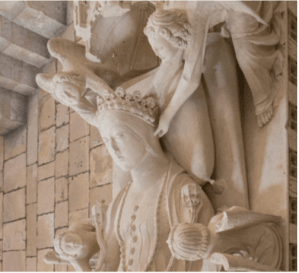
(Effigy of Inês. © Alcobaça Abbey, Portugal.) 

My underlying belief for Inês is that her beauty stems partly from appearance and partly from personality. I see her as easy to talk with, an attentive listener, and someone who gives you her full attention. She is loyal. She is determined. 

Most of all, Inês is true to herself. She is likely just 14- or 15-years old when she arrives on the scene. We know nothing of her years beforehand. I expect she could read and write as well as stitch and hunt, all skills of a medieval noblewoman. I believe that having suffered the shame of her birth, she desired the life of a legitimately married woman. She would eschew being mistress of any man, even the heir to the throne. Combine her marriage goal with her loyalty to her cousin Constanza, Pedro’s wife, and just sleeping with Pedro was out of the question. When you are marked young with an unfortunate circumstance, the power of motivation to alter the course of your life is strong. She will suffer for her choices, losing the trust of the king and being exiled. Repeatedly, the crown of Portugal throws obstacles in her way, and she perseveres. 

Then comes the day when Pedro plays his part. A widower, he holds out the promise of marriage. No one sees her as fit to be a queen. Of course, there is political intrigue involving her brothers. Life is never simple when you are in the orbit of the royal family. She loves children. She cares for her cousin’s children and her own with recorded affection. 

She is the glue of the story. In the novel, she is caught between two men, one whom she is unworthy to wed and one who repels her. When she rejects the king’s trusted adviser, Gonçalves, his hurt turns to jealous anger. “If I cannot have her, then no man can.” Who will the king trust, his son or his adviser? The choices she makes have dire consequences for our protagonist and antagonist.
Blurb:     

An heir to the throne, a gorgeous blonde lady-in-waiting, the king’s trusted advisor. When a father and son don’t understand each other, the son pays an outrageous price. 

Love, jealousy, loyalty, and revenge roil the court of 14th-century Portugal. 

In this engrossing launch to the Queens of Portugal trilogy, Catherine Mathis gives a fresh take on the tale of Pedro and Inês, Portugal’s real-life Romeo and Juliet. Pedro’s father would not have been king if not for his trusted advisor, Gonçalves. Once king, he wants no part in neighboring Castile’s royal convulsions, though his son, Pedro, befriends powerful Castilians. 

The all-consuming drive of the king is to ensure his line rules Portugal for centuries to come. He needs legitimate, strong heirs. The Infante Pedro loves a woman not deemed worthy to wear the crown as queen. Between father and son is Gonçalves, the king’s powerful, unquestioned counselor, who is a mentor to the son. Both Gonçalves and Pedro seek the attention of Inês. 

There is a horrific cost to winning the love of Inês. She will not release her grip on Pedro until he keeps the two sworn oaths he made to her. Can Pedro do the impossible to satisfy Inês? 

Inês is based on real people and events, exploring a cultural touchstone of Portuguese history. 

Praise for Inês: 

Mathis masterfully weaves emotional depth into the narrative, creating a deeply engaging experience that leaves a lasting impression and invites readers on an unforgettable journey through the grandeur and intrigue of Portugal’s past.
~ Mary Anne Yarde, The Coffee Pot Book Club 5* Review 

This exciting start to the Queens of Portugal trilogy describes the legendary love story of Pedro and Inês, and I was amazed at the excellent storytelling and how the author brings the courts to life. There is a lot of drama and intrigue, and the characters’ emotions are beautifully captured in this engrossing tale.
~ Readers’ Favorite 5* Review 


Buy Link: 

Universal Buy Link:   https://books2read.com/u/br8OBY  

Author Bio

Catherine Mathis was born in Berlin, the daughter of an American spy. As she grew up in Washington, D.C., her spy father turned into a drug enforcement agent. His career change wrecked any chance at high school popularity. She graduated from Sewanee | The University of the South with a degree in history focused on the medieval period. After a career in finance, she returned to her first love of medieval history to ‘Share Iberian Tales.’ Outside of writing, spare time joys are family, friends, reading, collecting folk/outsider art, and travel. 

Author Links

Website:  www.catherinemathis.com  

Facebook:   https://www.facebook.com/profile.php?id=100007239702480  

Instagram:  https://www.instagram.com/cmathisauthor/  

Amazon Author Page:  https://www.amazon.com/stores/Catherine-Mathis/author/B0F7FZHJ9T  

Goodreads:  https://www.goodreads.com/author/show/6987876.Catherine_Mathis 

Guest Post: “What was Life Like in ‘Northwick Priory’” by Carolyn Hughes

I am pleased to welcome Carolyn Hughes to my blog to share a guest post about her latest novel, Sister Rosa’s Rebellion. I would like to thank Carolyn Hughes and The Coffee Pot Book Club for allowing me to participate in this blog tour. 
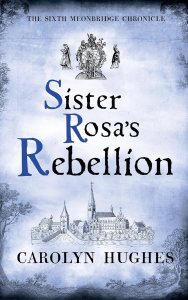
The principal location for Sister Rosa’s Rebellion, the latest novel in my Meonbridge Chronicles series, set in medieval Hampshire, is a priory of nuns, although important plot threads in the novel are also, of course, still set in the community of fictional Meonbridge itself.  

However, the central focus of the storyline is the young woman who left Meonbridge at the end of the First Meonbridge Chronicle, Fortune’s Wheel, to become a nun in Northwick Priory. That young woman was Johanna de Bohun, the daughter of the lord and lady of Meonbridge, Sir Richard and Lady Margaret. The shameful motivation behind Johanna’s decision to sequester herself in the priory as Sister Rosa is the primary thread in the story of Sister Rosa’s Rebellion. For when, after fifteen years of contentment, Rosa’s life in the priory is turned upside down, the reason she became a nun is threatened to be revealed. 


In this post, I thought I’d share something of the background I’ve drawn upon to paint the picture of life for Sister Rosa and her sister nuns, discussing how I came up with my vision of Northwick Priory, and something of the daily pattern of life inside it. 


Northwick Priory is fictional, but, in my mind, it’s sited more or less where the real monastery of Southwick once stood, about nine miles from “Meonbridge” and six miles north of Portsmouth. In medieval times, Southwick Priory was reasonably well-endowed, with many manors, and was also a place of pilgrimage, until it was closed during Henry VIII’s Dissolution of the monasteries. But “Northwick” is relatively poor. Not struggling, as long as the prioress and treasuress can keep on top of their finances, but sufficiently close to the edge that a profligate prioress could easily bring the place to ruin… 


Not knowing already how a medieval priory might be laid out, I searched for examples online and found Cleeve Abbey, a ruin in Somerset, destroyed in the Dissolution, that is managed by English Heritage. Cleeve was a monastery, not a nunnery, but, in principle, the layout for both would, or could, be similar. Luckily for me, there’s a plan of the abbey on its web page, which I’ve used very loosely as the model for Northwick. 


As at Cleeve, Northwick has two floors, with the more private chambers upstairs and the “day” rooms downstairs. The dorter (the dormitory) is upstairs, with a flight of night stairs leading directly down to the chapel, making it easier for the nuns to access the chapnighttime night time offices. All the sisters, including the prioress, were supposed to sleep in the dorter, although, in Sister Rosa’s Rebellion, the fact that the prioress doesn’t is a matter for great concern! 


I imagine the dorter essentially as a long chamber furnished with rows of beds. Privacy wasn’t usual in any medieval environment, even in the grand homes of the gentry. Nonetheless, I’ve introduced a design aspect to Northwick’s dorter that was almost certainly not common in nunneries or monasteries: the inclusion of “cells” within the dorter chamber. I’ve read that, occasionally, the dorter might be partitioned into cells or cubicles, and it suited my purpose for the story of Sister Rosa’s Rebellion to allow this arrangement in Northwick. However, I’ve imagined Northwick’s cubicles as being separated by the flimsiest of partitions, so all the snuffling and snoring noises of the night-time dormitory would still intrude, even if each nun did enjoy a modicum of privacy. It was apparently really rare for a priory to have cells, in the sense of separate chambers, for monks or nuns to sleep in. 

 ,

At Northwick, I have other chambers upstairs, including the prioress’s own – where, in Sister Rosa’s Rebellion, she sleeps and eats, and also entertains both her favourites and visitors, quite contrary to the Rules of the Benedictine order. 


The ground floor of Northwick Priory is laid out more or less as at Cleeve. In the centre is the cloister, the great internal courtyard around which the nuns would take their exercise each day, with the chapel to the north of it and the frater (the refectory or dining hall, where all sisters were expected to eat) to the south. Off the sides of the cloister were various chambers, including the Chapter house, where the nuns met daily to hear readings from the order’s Rule, discuss any day-to-day decisions. 


Close to the frater would of course be the kitchens, either within the priory buildings, or perhaps in a separate building, for safety.  


Sited close to the chapel’s entrance was the sacristy, the room where the priest prepared for services, and where items used in services were,e kept and was therefore also the “office” of the sacrist. 


Outside the priory buildings, I’ve given Northwick a gatehouse much like the one at Cleeve, with upper floors. The infirmary was often sited away from the main buildings, presumably to keep infection confined. And there would be other domestic buildings, such as a bakehouse, a brewhouse, and a laundry, and of course, storehouses for various purposes. 


I hope you now have a feel for the layout of Northwick Priory, but what of life inside it? 


A nun’s day was very structured, arranged around the holy offices, the chapel services (also called the divine offices or the liturgy of the hours) that they were required to attend. The services, which consisted primarily of psalms, hymns, readings, and prayers, were held at fixed times. These canonical hours were not only the specified times for prayer, but also marked the times of day.  


Depending upon the time of year, they were broadly as follows:  


  • Matins: Midnight or sometime during the night  
  • Lauds: Dawn or 3 a.m. 
  • Prime: The first hour, about 6 a.m. 
  • Terce: The third hour, about 9 a.m. 
  • Sext: The sixth hour, about noon 
  • Nones: The ninth hour, about 3 p.m. 
  • Vespers: The “lighting of the lamps”, about 6 p.m. 
  • Compline: The last hour, just before retiring, around 9 p.m. 


After Prime, the nuns would usually hold their chapter meeting (mentioned above). Otherwise, between the services, they took their meals (breakfast, dinner, and supper), carried out their work, and in theory spent some time in reading and private study. 


I imagine meals were generally modest affairs for most (although, in Sister Rosa’s Rebellion, the prioress decides she can no longer stomach “modest” meals and demands more exotic food for herself). That’s not to say the ordinary nuns’ food was necessarily meagre or unappetizing. They had the resources of the home farm to call upon, and if it was well-managed, there was no reason why they shouldn’t have a varied and nourishing diet. In principle, according to the Benedictine Rule to which Northwick’s nuns adhere, meals were taken in silence or near silence, save for the nun who was reading from the Bible. However, it again suited my “authorly” purposes to relax the rule a little, so “quiet” is required in Northwick’s dorter rather than silence. 


As I said, in theory, time was set aside for reading scripture and private study. However, I understand that, by the fourteenth century, reading was no longer widespread – I’m not clear why – and even work occupied less time than it once had, as servants tended to do it.  


In a small nunnery like Northwick, most of the nuns would probably have a defined role. Although some of the nuns’ work might be menial, say, working in the kitchen, laundry, or garden, I believe it was more commonplace for servants to carry out these tasks, whilst the nuns themselves undertook administrative tasks. If you’d like to know more about the work of medieval nuns, look out for a post of mine called The working lives of medieval nuns, shared by other hosts on this blog tour. 

Blurb: 

How can you rescue what you hold most dear, when to do so you must break your vows?

1363. When Mother Angelica, the old prioress at Northwick Priory, dies, many of the nuns presume Sister Rosa, formerly Johanna de Bohun, of Meonbridge, will take her place. But Sister Evangelina, Angelica’s niece, believes the position is hers by right, and one way or another, she will ensure it is.

Rosa stands aside to avoid unseemly conflict, but is devastated when she sees how the new prioress is changing Northwick: from a place of humility and peace to one of indulgence and amusement, if only for the prioress and her favoured few. Rosa is terrified her beloved priory will be brought to ruin under Evangelina’s profligate and rapacious rule, but her vows of obedience make it impossible to rebel.

Meanwhile, in Meonbridge, John atte Wode, the bailiff, is also distraught by the happenings at Northwick. After years of advising the former prioress and Rosa on the management of their estates, Evangelina dismissed him, banning him from visiting Northwick again.

Yet, only months ago, he met Anabella, a young widow who fled to Northwick to escape her in-laws’ demands and threats, but is a reluctant novice nun. The attraction between John and Anabella was immediate, and he hoped to encourage her to give up the priory and become his wife. But how can he possibly do that now?

Can John rescue his beloved Anabella from a future he is certain she no longer wants? And can Rosa overcome her scruples, rebel against Evangelina’s hateful regime, and return Northwick to the haven it once was? 

Buy Links: 

Universal Buy Link: https://books2read.com/u/bWaYM0  

This title is available to read on #KindleUnlimited. 

Author Bio

CAROLYN HUGHES has lived much of her life in Hampshire. With a first degree in Classics and English, she started working life as a computer programmer, then a very new profession. But it was technical authoring that later proved her vocation, word-smithing for many different clients, including banks, an international hotel group, and medical instruments manufacturers. 

Although she wrote creatively on and off for most of her adult life, it was not until her children flew the nest that writing historical fiction took centre stage. But why historical fiction? Serendipity! 

Seeking inspiration for what to write for her Creative Writing Masters, she discovered the handwritten draft, begun in her twenties, of a novel, set in 14th-century rural England… Intrigued by the period and setting, she realised that, by writing a novel set in the period, she could learn more about the medieval past and interpret it, which seemed like a thrilling thing to do. A few days later, the first Meonbridge Chronicle, Fortune’s Wheel, was underway. 

Seven published books later (with more to come), Carolyn does now think of herself as a Historical Novelist. And she wouldn’t have it any other way… 

Author Links

Website: https://carolynhughesauthor.com  

Twitter: www.x.com/writingcalliope  

Facebook: www.facebook.com/CarolynHughesAuthor  

Bluesky: https://bsky.app/profile/carolynhughes.bsky.social  

Book Bub: https://www.bookbub.com/authors/carolyn-hughes  

Amazon Author Page: https://www.amazon.co.uk/stores/Carolyn-Hughes/author/B01MG5TWH1  

Goodreads: https://www.goodreads.com/author/show/16048212.Carolyn_Hughes 

Guest Post: “King Matyas- The Raven King of Hungary” by Katerina Dunne

Today, I am pleased to welcome Katerina Dunne to my blog to share a bit of her research for her latest novel, “Return to the Eyrie.” I want to thank Katerina Dunne and The Coffee Pot Book Club for allowing me to be part of this blog tour.
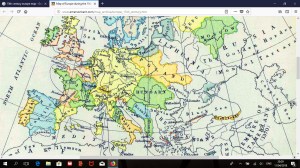
The history of medieval Hungary is fascinating, yet few in the English-speaking world know much about it. From nomadic tribes raiding across Europe in the 9th-10th century, the Hungarian conquerors settled in the Carpathian basin, converted to Christianity, and, together with the peoples they found already living there, created a powerful multi-ethnic and multi-lingual kingdom, which at its peak stretched from Southern Poland to the Adriatic Sea and from lower Austria to Central Romania as the below map demonstrates:

15th-century Europe map copied from
https://www.gifex.com/detail-en/2009-09-17-811/Europe-during-the-15th-Century.html

Return to the Eyrie (released in April 2024) is set during the second half of the 15th century (1470 to 1480) mostly in Transylvania and Belgrade, which were part of the medieval Kingdom of Hungary. The main characters are fictional, but they interact with real historical figures of the time and participate in real historical events. I have presented the heroine as a (fictional) member of two powerful baronial clans from Transylvania and Eastern Hungary.

The 15th century was a turbulent time for the Kingdom of Hungary due to internal conflict as well as the expansionist efforts of the Ottoman Empire towards the west and north. After the Ottoman conquest of Serbia and Bosnia, and the submission of Wallachia to the Sultan as a vassal state, Hungary became the last frontier holding back the Ottoman advance towards Central Europe.

The years between 1458 and 1490 were dominated by the figure of Mátyás (Matthias) Hunyadi, who became king aged fifteen in January 1458. His father was the formidable János Hunyadi, a lesser nobleman whose meteoric rise to power in the 1440s and early 1450s made him the most powerful baron in the kingdom. However, after his death, his enemies accused his eldest son, László, of treason. Under the influence of several barons who opposed the Hunyadi family, the King (also called László) arrested both Hunyadi’s sons in the spring of 1457. While he had László executed, he imprisoned fourteen-year-old Mátyás and many of their supporters.

When the King died in 1457 without an heir, the vacant throne was filled by Mátyás, following his mother’s and his uncle’s relentless campaign of negotiations, promises, bribes, and intimidation. The legend has it that the Royal Council deliberated in Buda Castle and made the public announcement while the crowds of lesser nobles stood literally on the river Danube, the waters of which had frozen solid.

But Mátyás was still held captive by the Bohemian king and Hussite leader, George of Podebrady. It took a large ransom to release Mátyás to his family, and the teenager was finally enthroned in February 1458. He could not be crowned though because the Hungarian Holy Crown was in the hands of the Holy Roman Emperor, Frederick III. How the crown had ended up there is another story—one of the most fascinating episodes in late medieval Hungarian history—which deserves separate attention. It took another four years and the astronomical sum of 80,000 gold florins to recover the crown. Mátyás was finally crowned with all the appropriate ceremony on 29 March 1464.

He became known as Mátyás Corvinus (nicknamed The Raven King because of the Hunyadi coat of arms, which depicted a raven with a golden ring in its beak) One of the most important rulers in 15th century Europe, he brought the Italian Renaissance and Humanism to Hungary, upgraded the royal palace in Buda, established the famous Corvina Library and was the patron of many scholars and artists. Due to the fact that he was a member of the nobility rather than of royal blood, he faced strong opposition both from inside Hungary and from abroad (Holy Roman Empire, Bohemia, and Poland) and he had to fight several wars to secure his grip on the throne. He kept a defensive stance towards the Ottomans, with relative success, and competed with them in his efforts to influence politics in neighboring Wallachia, Moldavia, and Bosnia.

Mátyás is well-known for keeping Prince Vlad III of Wallachia (Vlad the Impaler) imprisoned for several years before finally releasing him in 1475 to place him on the Wallachian throne as an ally.

Mátyás conquered Vienna in 1485 and was negotiating his possible future designation as Holy Roman Emperor when he died in April 1490.

He has since become the subject of many legends not only in Hungary but also in several neighboring Central European countries.

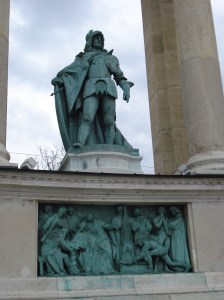
Statue of King Mátyás Hunyadi in Heroes’ Square Budapest (my photo)

King Mátyás plays a small but pivotal role in my novel, Return to the Eyrie. The heroine, Margit, is distantly related to him as her father (fictional character) was a third cousin of the king’s mother, Erzsébet Szilágyi.

Margit needs the King’s support to reclaim her inheritance, which was violently taken when she was a child by her close relatives.

Apart from being a historical adventure, the novel also addresses the issue of female inheritance. Despite her noble status, Margit could not inherit landed property from her father due to the strict inheritance laws in the Kingdom of Hungary. Noble daughters were only entitled to a monetary dowry when they married unless their husband was a commoner, in which case—ironically—they could inherit part of the land. So, according to the law, Margit’s land would pass to her closest male relative (her first cousin in this case).

However, a nobleman could invoke the custom of Prefection (Fiúsítás in Hungarian or praefectio in filium in Latin), whereby he could petition the King to “promote” his daughter to a son and therefore, allow her to inherit landed property. This would usually happen when there were no close male relatives, or in other exceptional cases. Margit’s father had sent such a petition to King Mátyás, but his relatives plotted against him. With an evil trick, they presented him as a traitor to the King’s eyes, had him murdered, and took over his land while Margit barely escaped with her life thanks to her father’s most loyal friend.

Blurb:
Honour, revenge, and the quest for justice.
Belgrade, Kingdom of Hungary, 1470:

Raised in exile, adolescent noblewoman Margit Szilágyi dreams of returning to her homeland of Transylvania to avenge her father’s murder and reclaim her stolen legacy. To achieve this, she must break the constraints of her gender and social status and secretly train in combat.
When the king offers her a chance at justice, she seizes it—even if it means disguising herself as a man to infiltrate the vultures’ nest that now occupies her ancestral ‘eyrie’.

Plagued by childhood trauma and torn between two passionate loves, Margit faces brutal battles, her murderous kin’s traps, and inner demons on her quest for vengeance. Only by confronting the past can she reclaim her honour—if she can survive long enough to see it through.

Return to the Eyrie is an epic coming-of-age tale of a young woman’s unwavering pursuit of justice and destiny in 15th-century Hungary.

Buy Link:
Universal Buy Link: https://books2read.com/u/bz8gJL

Author Bio:

Katerina Dunne is the pen name of Katerina Vavoulidou. Originally from Athens, Greece, Katerina has been living in Ireland since 1999. She has a degree in English Language and Literature from the University of Athens, an MA in Film Studies from University College Dublin, and an MPhil in Medieval History from Trinity College Dublin.

Katerina is passionate about history, especially medieval history, and her main area of interest is 13th to 15th-century Hungary. Although the main characters of her stories are fictional, Katerina uses real events and personalities as part of her narrative to bring to life the fascinating history of the medieval Kingdom of Hungary, a location and period not so well-known to English-speaking readers.

Return to the Eyrie (published April 2024) is the second book in the Medieval Hungary series, a sequel to Lord of the Eyrie (published in February 2022).

Author Links:

Website (publisher): https://www.thehistoricalfictioncompany.com/hp-authors/katerina-dunne
Facebook: https://www.facebook.com/profile.php?id=100076818802721
LinkedIn: https://www.linkedin.com/in/katerina-vavoulidou-07962a85/
Amazon Author Page: https://www.amazon.com/stores/Katerina-Dunne/author/B09R4P733K
Goodreads: https://www.goodreads.com/author/show/22196953.Katerina_Dunne