Guest Post: “Historical Background to ‘On a Sword’s Edge’ by JR Tomlin”

I am pleased to welcome JR Tomlin to my blog today to share a guest post for her latest novel, “On a Sword’s Edge.” I want to thank JR Tomlin and the Coffee Pot Book Club for allowing me to be part of this blog tour.

During the Viking Age, which ended sometime around 1050, the Norse conquered the Western and Northern Isles of Scotland as well as Caithness in the Northern Scottish mainland. That the Viking Age was over did not mean that the Norse turned around and sailed back to Norway.  

These islands and Caithness were part of Norse jarldoms which they had no intention of giving up. It hardly needs to be mentioned that as the Kingdom of Scotland grew stronger and more organized and gained control of most of what is now Scotland, this would lead to conflict. 

In 1222, Scotland’s King Alexander II subjugated Caithness with what appears to have been little opposition from the Norse. For a time, he was busy subjugating the hitherto semi-independent Argyll and dealing with a revolt in the always difficult region of Galloway. Then he would have turned back to pushing the Norse out of the Isles, but died suddenly, leading a force to the Hebrides. His seven-year-old son, also named Alexander, was the new King of Scots. 

Ecclesiastes 10:16 states with considerable truth: “Woe to you, land, when your king is a child, and your leaders start their parties in the morning!” There were fourteen years of regents squabbling and fighting for power. At several points, the young king and his queen, the daughter of the King of England, were held prisoner by one or another of the factions. However, regencies end eventually and when that one did, a determined young king meant to finish what his father had started. 

As soon as he reached his majority, King Alexander III sent negotiators to discuss the purchase by the Scots of the Western Isles. The King of Norway, King Haakon, was a formidable ruler who had subjugated both Greenland and Iceland. He had no interest in giving up any of the lands subjugated by the Norse. The negotiations quickly broke down. 

At about that time, and the date is vague but probably around 1260, the Stewarts of Dundonald took the Isle of Bute from the Norse. That Isle was essential in that it gave control over important shipping, so this was a serious blow. Faced with a growing threat to their control of those islands and the surrounding waters, King Haakon put together a fleet of more than a hundred warships and sailed first to Shetland and then to the Hebrides. 

King Alexander once more sent negotiators, but events prove he was also planning for invasion. Haakon sailed his fleet around Cape Wrath some four hundred miles south to the Firth of Clyde. He first subjugated Bute, retaking the Stewart’s Rothesay Castle, and sent ships up Loch Long and portaged them to Loch Lomond, ravaging the area. There was little opposition, possibly because King Alexander had already called up the levies. 

The main Norse fleet remained in the Firth of Clyde, just off the coast of Ayr. Whether he intended to attack Ayr itself is open to question, but merely taking Bute was not the end of his intentions. Whatever those intentions were, a particularly severe storm hit on the 1st of October in 1263, sinking several of Haakon’s ships and forcing some aground near the village of Largs. Which is the point at which the novel takes up. 

Blurb: 

Scotland. 1263. The scent of rain mingles with the smoke of campfires as word spreads: the Norse are coming… 

As tempers rise between King Alexander and the Norse King Haakon, at the center of it all is sixteen-year-old William Douglas, a squire in service to Sir John Stewart, Lord High Steward of Scotland. 

When Haakon’s fearsome fleet is espied approaching Scotland’s shores, carrying the greatest invasion force the Norse have ever mustered, the dread of battle settles over the land. Summoned to Ayr Castle, William joins the Scottish forces in a desperate defense. Now tasked with serving his newly knighted brother, Hugh, William has little time to dwell on the fear – or thrill – of his first real taste of war. 

And once the Norse’s menacing line of ships finally touches the shore, Scotland’s fate may rest on more than noble titles and knightly deeds— it’ll take the mettle of every soul on the ground for them to triumph. 

Set against the wind-swept coast of medieval Scotland, On a Sword’s Edge takes you right into the center of The Battle of Largs alongside a mere – yet fearless – squire. 

Buy Link: 

Universal Buy Link: https://books2read.com/u/3R7l8D  
Author Bio:

JR. Tomlin is the author of more than twenty historical novels, set for the most part in Scotland. Her love of that nation is traced from the stories of King Robert the Bruce and the Good Sir James her grandmother read to her when she was small to hillwalking through the Cairngorms where the granite hills have a gorgeous red glow under the setting sun. Later, her writing was influenced by the work of authors such as Alexander Dumas, Victor Hugo, and of course, Sir Walter Scott.

When JR isn’t writing, she enjoys spending time hiking, playing with her Westie, and killing monsters in computer games. In addition to having lived in Scotland, she has traveled in the US, Europe, and the Pacific Rim. She now lives in Oregon in the beautiful Pacific Northwest. 

Author Links

Website: https://www.jrtomlin.com  

Twitter: https://x.com/TomlinJeanne  

Bluesky: https://bsky.app/profile/jrtomlin.bsky.social  

Book Bub: https://www.bookbub.com/authors/j-r-tomlin  

Amazon Author Page: https://www.amazon.com/author/jrtomlin  

Goodreads: https://www.goodreads.com/author/show/4094154.J_R_Tomlin 


Guest Post: “Horse Breeds in the Middle Ages” by Rowena Kinread

The Scots of Dalriada Tour Banner 1Today, I am pleased to welcome Rowena Kinread to my blog as part of the blog tour for her novel, “The Scots of Dalriada.” I want to thank The Coffee Pot Book Club and Rowena Kinread for allowing me to be part of this blog tour.
In ‘The Scots of Dalriada’ Fergus hides in a horse breeding- and training- centre on Aran. Is it realistic that such studs existed in the early Middle Ages? The answer is yes!

Throughout this period, horses were rarely considered breeds, such as today we have the Clydesdale horse, Haflinger, or Lipizzaner, to name just three; but instead, they were defined by type, by describing their purpose or physical attributes.

Breeders practiced selective breeding, as opposed to certain bloodlines as usual today. For example, the destrier or war horse was required to be strong, fast, and agile. Horses that had already proved themselves in battle would be used to breed new generations.

Horses from this age differed in size and build to the modern horse. Generally speaking, they were much smaller. The average horse of the time was 12 to 14 hands (48 to 56 inches, 122 to 142 cm). The destrier was described in contemporary sources as ‘tall and majestic and with great strength’. It was frequently referred to as the ‘great horse’ because of its size and reputation. This was a subjective term by medieval standards, and the destrier would appear small to our modern eyes. In my novel, I name the height as 14.2 hands; this would be exceptionally tall in the day.

 In addition to selective breeding, training was also common. Kings would not have the time to train their horses themselves. It would take a minimum of two years to fully train a destrier. A lot of schooling is required to overcome a horse’s natural instinct to flee from noise, the smell of blood, and the confusion of combat. It must also learn to accept smoke and fire and any sudden movements.

For this reason, war horses were more expensive than normal riding horses, and destriers the most prized, but figures vary greatly from source to source. Destriers are given values ranging from seven times the price of an ordinary horse to seven hundred times. The Bohemian king Wenzel II rode a horse ‘valued at one thousand marks’ in 1298. At the other extreme, a 1265 French ordinance ruled that a squire could not spend more than twenty marks on a rouncey. Knights were expected to have at least one war horse (as well as riding horses and packhorses), with some records from the later Middle Ages showing knights bringing twenty-four horses on the campaign. Five horses were perhaps the standard.


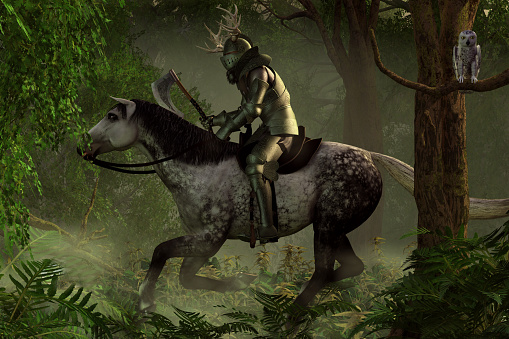
Image destrier
An armored medieval knight, axe in hand, and with a helmet decorated with antlers, rides his horse through a dense forest. 3D Rendering


Other horse ‘types’ in the Middle Ages:

  1. Palfreys = riding horses. The well-bred palfrey, which could equal a destrier in price, was popular with nobles and highly-ranked knights for riding, hunting, and ceremonial use. Ambling was a desirable trait in a palfrey, as the smooth gait allowed the rider to cover long distances quickly in relative comfort.
  2. cart horses or packhorses
  3. ‘Coursers’ were generally preferred for hard battles as they were light, fast, and strong. They were valuable but not as costly as the destrier. They were also used frequently for hunting.
  4. ‘Rouncey’ is a more general-purpose horse, which could be kept as a riding horse or trained for war. It was commonly used by squires, men-at-arms, or poorer knights. A wealthy knight would keep rounceys for his retinue. Sometimes the expected nature of warfare dictated the choice of horse; when a summons to war was sent out in England in 1327, it expressly requested rounceys for swift pursuit rather than destriers. Rounceys were sometimes used as pack horses but never as cart horses.
  5. ‘Jennet’ is a small horse first bred in Spain from Barb and Arabian bloodstock. Their quiet and dependable nature, as well as size, made them popular as riding horses for ladies; however, they were also used as cavalry horses by the Spanish.
  6. The ‘hobby’ was a lightweight horse, about 13 to 14 hands, developed in Ireland from Spanish or Libyan bloodstock. This type of quick and agile horse was popular for skirmishing and was often ridden by light cavalry known as Hobelars. Hobbies were used successfully by both sides during the Wars of Scottish Independence, with Edward I of England trying to gain an advantage by preventing Irish exports of horses to Scotland. Robert Bruce employed the hobby for his guerilla warfare and mounted raids, covering 60 to 70 miles a day.

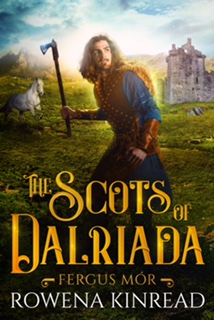
The Scots of Dalriada coverBlurb:

THREE BROTHERS

Fergus, Loarn, and Angus, Princes of the Dalriada, are forced into exile by their scheming half-brother and the druidess Birga One-tooth.

THREE FATES

Fergus conceals himself as a stable lad on Aran and falls helplessly in love with a Scottish princess, already promised to someone else. Loarn crosses swords against the Picts. Angus designs longboats.

TOGETHER A MIGHTY POWER

Always on the run, the brothers must attempt to outride their adversaries by gaining power themselves. Together they achieve more than they could possibly dream of.

Fergus Mór (The Great) is widely recognized as the first King of Scotland, giving Scotland its name and its language. Rulers of Scotland and England from Kenneth mac Alpín until the present time claim descent from Fergus Mór.

Full of unexpected twists and turns, this is a tale of heart-breaking love amidst treachery, deceit, and murder.

Buy Links:

Universal Link:   https://books2read.com/u/47VXAL 

Amazon UK: https://www.amazon.co.uk/gp/product/B0BS78THF3 

Amazon US: https://www.amazon.com/gp/product/B0BS78THF3 

Amazon CA: https://www.amazon.ca/gp/product/B0BS78THF3 

Amazon AU: https://www.amazon.com.au/gp/product/B0BS78THF3 

Rowena Kinread 1Author Bio:

Rowena Kinread grew up in Ripon, Yorkshire, with her large family and a horde of pets. Keen on traveling, her first job was with Lufthansa in Germany.

She began writing in the nineties. Her special area of interest is history. After researching her ancestry and finding family roots in Ireland with the Dalriada clan, particularly in this era. 

Her debut fiction novel titled “The Missionary” is a historical novel about the dramatic life of St. Patrick. It was published by Pegasus Publishers on Apr.29th, 2021, and has been highly appraised by The Scotsman, The Yorkshire Post, and the Irish Times.

Her second novel, “The Scots of Dalriada,” centres around Fergus Mór, the founder father of Scotland, and takes place in 5th century Ireland and Scotland. It is due to be published by Pegasus Publishers on Jan.26th, 2023.

The author lives with her husband in Bodman-Ludwigshafen, Lake Constance, Germany. They have three children and six grandchildren.

Social Media Links:

Website: https://www.rowena-kinread.com/ 

Twitter: https://twitter.com/RowenaKinread 

Facebook: https://www.facebook.com/rowena.strittmatter 

LinkedIn: https://www.linkedin.com/in/rowena-kinread-6b054b228/ 

Instagram: https://www.instagram.com/rowenakinread/