Guest Post: Spotlight for “Historical Stories of Exile”

IG banner Exile partyI am pleased to welcome the authors of the latest anthology, “Historical Stories of Exile” to my blog today on a spotlight tour. I would like to thank The Coffee Pot Book Club and the authors of this anthology for allowing me to be part of this blog tour. 
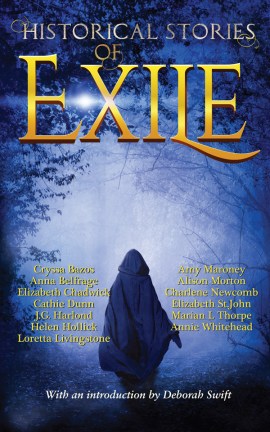
EXILE-Cover-flatBlurb:

Exile: a risky defiance, a perilous journey, a family’s tragic choice – or an individual’s final gamble to live. Exile: voluntary or enforced, a falling-out between friends, a lost first love, a prejudiced betrayal – or the only way to survive persecution?

In this historical fiction anthology, thirteen authors (they are not superstitious!) have written exclusive short stories on the theme of exile. Some are based on true history, others are speculative fiction. All mine the depths of human emotions: fear, hope, love, and the fortitude to survive.

Join an inspiring Anglo-Saxon queen of Wales, a courageous Norwegian falconer, and a family fleeing back in time to escape the prospect of a ruthless future. Oppose the law with the legendary Doones of Exmoor, or defy the odds with two brave WWII exiles. Meet a Roman apprehensively planning exile to preserve the ‘old ways’, and a real Swedish prince forcibly expelled in heart-wrenching circumstances. Thrill to a story based on the legend of Robin Hood, sail with a queen of Cyprus determined to regain her rightful throne; escape religious persecution, discover the heart-rending truth behind the settlement of Massachusetts, and experience the early years that would, eventually, lead to the founding of Normandy. Experience the stirring of first love, and as an exclusive treat special guest author, Elizabeth Chadwick reveals a tale about the 12th-century heiress, Isabelle de Clare, and the Greatest Knight of all time – William Marshal.

With an introduction by multi-award-winning author Deborah Swift, enjoy these tales of exile across the ages. Some are hopeful, some sad, some romantic, some tragic, but all explore the indomitable spirit of resolute, unforgettable characters.

Buy Links: 

This title is available to read on #KindleUnlimited

Universal Link: https://mybook.to/StoriesOfExile 
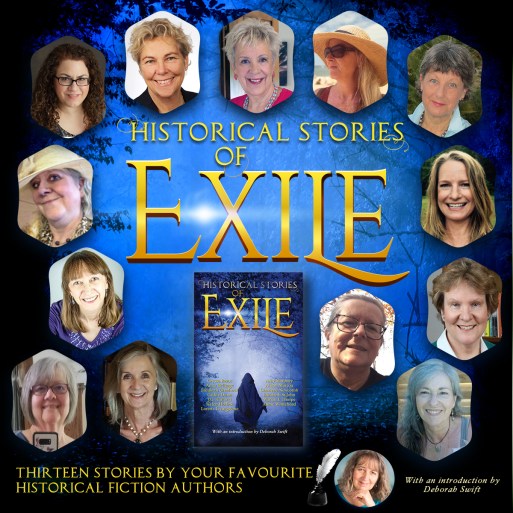
ALISON MORTON writes award-winning thrillers featuring tough but compassionate heroines. Her ten-book Roma Nova series is set in an imaginary European country where a remnant of the ancient Roman Empire has survived into the 21st century and is ruled by women who face conspiracy, revolution, and heartache but use a sharp lines in dialogue. Several of her novels have hit  #1 in Amazon US, UK, Canada and Australia. The latest, Julia Prima, plunges us back to AD 370 when the founders of Roma Nova met.

She blends her fascination for Ancient Rome with six years of military service and a life of reading crime, historical, and thriller fiction. On the way, she collected a BA in modern languages and an MA in history.

Alison now lives in Poitou in France, the home of Mélisende, the heroine of her two contemporary thrillers, Double Identity and Double Pursuit. Oh, and she’s writing the next Roma Nova story.

Website: https://www.alison-morton.com

AMY MARONEY studied English Literature at Boston University and worked for many years as a writer and editor of nonfiction. She lives in Oregon, U.S.A. with her family. When she’s not diving down research rabbit holes, she enjoys hiking, dancing, traveling, and reading. Amy is the author of The Miramonde Series, a bestselling historical mystery trilogy about a Renaissance-era female artist and the modern-day scholar on her trail. Amy’s award-winning historical adventure/romance series, Sea and Stone Chronicles, is set in medieval Rhodes and Cyprus.

An enthusiastic advocate for independent publishing, Amy is a member of the Alliance of Independent Authors and the Historical Novel Society.

Website: https://www.amymaroney.com/

ANNA BELFRAGE Had Anna been allowed to choose, she’d have become a time traveler. As this was impossible, she became a financial professional with three absorbing interests: history, romance, and writing. Anna always writes about love and has authored the acclaimed time-traveling series The Graham Saga, set in 17th-century Scotland and Maryland, as well as the equally acclaimed medieval series The King’s Greatest Enemy which is set in 14th century England. Anna is presently hard at work with her other medieval series, The Castilian Saga, which is set against the conquest of Wales. The third installment, Her Castilian Heart, was published in 2022, and the fourth and final one will be out in 2024. She has recently released Times of Turmoil, a sequel to her time travel romance, The Whirlpools of Time.

Website, http://www.annabelfrage.com 

ANNIE WHITEHEAD is an author, historian, and elected Fellow of the Royal Historical Society, and has written four award-winning novels set in Anglo-Saxon England. She has contributed to fiction and nonfiction anthologies and written for various magazines, has twice been a prize winner in the Mail on Sunday Novel Writing Competition, and won First Prize in the 2012 New Writer Magazine’s Prose and Poetry Competition. She was a finalist in the 2015 Tom Howard Prize for Nonfiction and was shortlisted for the Exeter Story Prize/Trisha Ashley Award 2021. 

She was the winner of the inaugural Historical Writers’ Association/Dorothy Dunnett Prize 2017 and is now a judge for that same competition. She has also been a judge for the HNS (Historical Novel Society) Short Story Competition.

Her nonfiction books are Mercia: The Rise and Fall of a Kingdom (Amberley Books) and Women of Power in Anglo-Saxon England (Pen & Sword). She has contributed to a new history of English Monarchs, Kings, and Queens: 1200 Years of English and British Monarchs (Hodder & Stoughton) and has signed a contract to write her third nonfiction book, to be published by Amberley Books in 2024.

Website: https://anniewhiteheadauthor.co.uk/

CATHIE DUNN writes historical fiction, mystery, and romance. The focus of her novels is on strong women through time. She has garnered awards and praise from reviewers and readers for her authentic description of the past. A keen Medievalist, she enjoys visiting castles and ruins, and reading about battles and political shenanigans of the times.

Cathie is a member of the Historical Novel Society, the Romantic Novelists’ Association, and the Alliance of Independent Authors. She also now runs The Coffee Pot Book Club, promoting historical fiction authors and their books.

Website: https://www.cathiedunn.com 

CHARLENE NEWCOMB writes historical fiction and science fiction. Her award-winning Battle Scars trilogy is set in the 12th century during the reign of Richard the Lionheart. Her writing roots are in the Star Wars Expanded Universe (aka Legends) where she published 10 short stories in the Star Wars Adventure Journal. Sci-fi space opera fans should check out Echoes of the Storm, her original novel published in 2020. She returned to medieval times with her novel Rogue in 2023. 

Website: https://charlenenewcomb.com

CRYSSA BAZOS is an award-winning historical fiction author and a 17th-century enthusiast. Her debut novel, Traitor’s Knot is the Medalist winner of the 2017 New Apple Award for Historical Fiction and a finalist for the 2018 EPIC eBook Awards for Historical Romance. Her second novel,  Severed Knot is a B.R.A.G Medallion Honoree and a finalist for the 2019 Chaucer Award. Rebel’s Knot, the third installment of the standalone series, Quest for the Three Kingdoms, is a B.R.A.G Medallion Honoree and 2021 Discovering Diamonds Book of the Year.

Website:  https://cryssabazos.com

DEBORAH SWIFT is a delver into archives, drinks too much tea, and loves antiques and old buildings. Her sturdy, stone-built house used to be the village primary school, and from her window, she has a view of a few 17th-century cottages, and behind those, green fields dotted with grazing sheep.

Historical fiction was a natural choice for Deborah as a writer because she always enjoyed the research aspect of design – poking about in archives and museums, not to mention the attraction of boned bodices and the excuse to visit old and interesting buildings.

She used to work as a set and costume designer for theatre and TV, so enjoys the research aspect of creating historical fiction. She likes to write about extraordinary characters set against the background of real historical events. In her books, Deborah likes to write about extraordinary characters set against the background of real historical events. Her first novel was The Lady’s Slipper which was shortlisted for the Impress Prize, and her book  The Poison Keeper, about the Renaissance poisoner Giulia Tofana, won the BookViral Millennium Award. She has written eighteen novels to date including two series set in WWII – her latest, The Shadow Network is due for release in early 2024.

Deborah lives in North Lancashire on the edge of the Lake District and divides her time between teaching and writing.

Website: https://deborahswift.com/

ELIZABETH CHADWICK New York Times bestselling author Elizabeth Chadwick lives in a cottage in the Vale of Belvoir in Nottinghamshire with her husband and their four terriers, Pip, Jack, Billy, and Little Ted. Her first novel, The Wild Hunt, won a Betty Trask Award and To Defy a King won the RNA’s 2011 Historical Novel Prize. She was also shortlisted for the Romantic Novelists’ Award in 1998 for The Champion, in 2001 for Lords of the White Castle, in 2002 for The Winter Mantle, and in 2003 for The Falcons of Montabard. Her sixteenth novel, The Scarlet Lion, was nominated by Richard Lee, founder of the Historical Novel Society, as one of the top ten historical novels of the last decade. She often lectures at conferences and historical venues, has been consulted for television documentaries, and is a member of the Royal Historical Society.

Website: https://elizabethchadwick.com/

ELIZABETH ST.JOHN’s critically acclaimed historical fiction novels tell the stories of her ancestors: extraordinary women whose intriguing kinship with England’s kings and queens brings an intimately unique perspective to Medieval, Tudor, and Stuart times.

Inspired by family archives and residences from Lydiard Park to the Tower of London, Elizabeth spends much of her time exploring ancestral portraits, diaries, and lost gardens. And encountering the occasional ghost. But that’s another story.

Living between California, England, and the past, Elizabeth is the International Ambassador for The Friends of Lydiard Park, an English charity dedicated to conserving and enhancing this beautiful centuries-old country house and park. As a curator for The Lydiard Archives, she is constantly looking for an undiscovered treasure to inspire her next novel.

Elizabeth’s books include her trilogy, The Lydiard Chronicles, set in 17th Century England during the Civil War, and her medieval novel, The Godmother’s Secret, which explores the mystery of the missing Princes in the Tower of London.

Website: http://www.elizabethjstjohn.com/

HELEN HOLLICK and her husband and adult daughter moved from north-east London in January 2013 after finding an eighteenth-century North Devon farmhouse through being a ‘victim’ on BBC TV’s popular Escape to The Country show. The thirteen-acre property was the first one she was shown – and it was love at first sight. She enjoys her new rural life, and has a variety of animals on the farm, including Exmoor ponies, dogs, cats, hens, ducks, and geese, and her daughter’s string of show jumpers.

First accepted for publication by William Heinemann in 1993 – a week after her fortieth birthday – Helen then became a USA Today Bestseller with her historical novel, The Forever Queen (titled A Hollow Crown in the UK) with the sequel, Harold the King (US: I Am the Chosen King), novels that explore the events that led to the Battle of Hastings in 1066. Her Pendragon’s Banner Trilogy is a fifth-century version of the Arthurian legend, and she also writes a pirate-based nautical adventure/fantasy series, The Sea Witch Voyages, where you can read more about Jesamiah Acorne, son of Charles St Croix – and the Doones.

Despite being impaired by the visual disorder of Glaucoma, she is also branching out into the quick read novella, ‘Cosy Mystery’ genre with the Jan Christopher Mysteries, set in the 1970s, with the first in the series, A Mirror Murder incorporating her, often hilarious, memories of working for thirteen years as a library assistant.

Her non-fiction books are Pirates: Truth and Tales and Life of a Smuggler. She also runs a news and events blog and a Facebook page for her village supports her daughter’s passion for horses and showjumping – and occasionally gets time to write… 

Website: https://helenhollick.net

J.G. HARLOND Secret agents, skulduggery, and crime that crosses continents.

British author of historical crime fiction, J.G. (Jane) Harlond writes award-winning, page-turning novels set in the mid-17th and mid-20th centuries. Each story weaves fictional characters into real events. She describes her WWII Bob Robbins Home Front Mysteries as a ‘cozy crime with a sinister twist’. Prior to becoming a full-time author, Jane taught English and World Literature in international colleges. She also wrote school textbooks for many years using her married name. 

Jane is married to a retired Spanish naval officer and they have a large, grown-up family living in various parts of Europe and the USA. After traveling widely (she has lived in or visited most of the places that feature in her novels) they are now settled near Málaga in Spain.

J.G. Harlond is a member of the British Crime Writers Association and the Dorothy Dunnett Society.

Website: http://author.to/JGHarlond

LORETTA LIVINGSTONE had no intention of writing anything but short stories or poetry, and especially not historical fiction. She stated it quite clearly on social media, only to suddenly find herself writing … historical fiction. Her debut novel, Out Of Time, set in the mythical Sparnstow Abbey, was shortlisted for the Historical Novel Society Indie Award in 2016, which stunned and elated her in equal measures.

It was supposed to be a one-off. It wasn’t. She went on to write two more stand-alone novels in the series; A Promise to Keep and Blossom on the Thorn. She had plans for more but has had ME for many years, and ill health has temporarily reined in her gallop. However, she intends to write again soon… 

Her other books include short story collections and poetry and can be found on Amazon.

Loretta is on Facebook: https://www.facebook.com/groups/217686418294125

MARIAN L. THORPE Taught to read at the age of three, words have been central to Marian’s life for as long as she can remember. A novelist, poet, and essayist, Marian has several degrees, none of which are related to writing. After two careers as a research scientist and an educator, she retired from salaried work and returned to writing things that weren’t research papers or reports.

Marian’s first published work was poetry, in small journals; her first novel was released in 2015. Her award-winning Empire’s Legacy series is historical fiction of another world, based to some extent on northern Europe after the decline of Rome.

In addition to her novels, Marian has read poetry, short stories, and nonfiction work at writers’ festivals and other juried venues.

Her other two passions in life are birding and landscape history, both of which are reflected in her books. Birding has taken her and her husband to all seven continents, but these days she’s mostly content to move between Canada and the UK.

Website: https://marianlthorpe.com/

Guest Post: “Excerpt from ‘Twelve Nights’ by Penny Ingham”

Twelve Nights Tour BannerToday, I am pleased to welcome Penny Ingham to my blog to share an excerpt from her novel, “Twelve Nights.” I would like to thank The Coffee Pot Book Club and Penny Ingham for allowing me to be part of this blog tour.

Excerpt

‘Poison,’ Stow mused. ‘A woman’s weapon, is it not?’ He turned, fixing his piggy eyes upon Magdalen. “Tell me, why did you poison John Wood?’

Magdalen felt suddenly ice-cold as if she had plunged into the Thames in January as if every last gasp of air had been driven from her lungs. All around her, the players erupted in cries of outraged indignation.

‘I – I did not poison John!’ Magdalen stammered. ‘He is – he was, like a brother to me.’

‘You knew him well?’

‘Well enough, sir.’

‘You were intimately acquainted?’

‘No! I swear on my life!’

But the constable had a bit between his teeth. ‘Was it a lover’s quarrel? Did he spurn you for another? What do they say? Hell hath no fury like a woman scorned.’

Magdalen was sinking deeper into the icy water, the glimmers of daylight above her head becoming fainter as she drifted down into the darkness. The players’ protests were growing louder and angrier by the minute but they sounded very far away. The constable banged the tip of his staff upon the boards, once, twice, three times, dragging her back to the surface of her unfolding nightmare.

‘I will have silence!’ Edmund Stow bellowed. ‘Tell me, Mistress Bisset, as his sister then, who were his enemies? Who bore him a grudge?’

Magdalen thought of Richard Cowley’s brawl with John earlier that day, the hatred in his eyes. Did he hate John enough to kill him? But she had no proof, and she knew she would never forgive herself if she falsely accused him. ‘Everyone liked John, sir. He didn’t have any enemies.’

‘Everyone has enemies,’ Stow replied. ‘You came to London from Hampshire, did you not?’ he added, eyeing her appraisingly. ‘You were raised on a farm. You understand plants, which will heal, and which will harm?’

Magdalen dug her fingernails into her palms, focussing on the pain rather than the panic threatening to overwhelm her. ‘I left Hampshire when I was eight years old. I have no knowledge of such things, sir.’

‘Don’t lie to me.’

‘I swear I am innocent, sir.’

‘Believe me, girl, the truth will be out.’ Edmund Stow glared at her for a long moment, perhaps hoping he might see into her very soul. She found herself staring back at him, held fast by his malevolent spell. When at last he released her from his gaze, her legs felt as wobbly as marrow jelly.

Stow’s eyes were sweeping across the stage, seeking a new target. They settled on Burbage and narrowed, taking aim. ‘It seems most likely John Wood was poisoned here at the Theatre.’

‘That is an outrageous accusation!’ Burbage shot back indignantly. ‘You cannot seriously believe one of us killed John?’

‘I believe whatever the evidence suggests, Master Burbage,’ Stow replied haughtily. ‘Tell me, what refreshments do you provide for the players?’

‘We have a pitcher of Malmsey in the ‘tiring house, and one cup.’ Burbage was visibly fighting to remain calm. ‘Before every performance, we share the cup and raise a toast. If someone had poisoned the wine, we would all be dead.’

‘Bring me the pitcher and the cup.’

Burbage glanced at Magdalen, but Stow shook his head. ‘No. She stays here. Send the boy.’

Peter soon returned with the pitcher and cup. Stow sniffed them both cautiously. ‘You have all drunk from this cup?’

The players nodded.

‘But you gave John a second drink, after the play had begun, didn’t you, Magdalen,’ Peter said brightly.

Stow’s beady eyes fixed upon Magdalen again. ‘Is this true?’

Magdalen opened her mouth but no words formed. Peter was right. She had offered John another drink, but only because he had looked so unwell. Will Kempe glared at Peter and rolled his eyes in disgust. Several other players shook their heads despairingly. Peter, suddenly comprehending the gravity of his careless words, fought back tears.

‘So, you do not deny giving the player another drink, Mistress Bisset?’ There was a gleam of triumph in the constable’s eye.

Twelve Nights coverBlurb:

1592. The Theatre, London.

When a player is murdered, suspicion falls on the wardrobe mistress, Magdalen Bisset, because everyone knows poison is a woman’s weapon. The coroner is convinced of her guilt. The scandal-pamphlets demonize her.

Magdalen is innocent, although few are willing to help her prove it. Only handsome Matthew Hilliard offers his assistance, but dare she trust him when nothing about him rings true?

With just two weeks until the inquest, Magdalen ignores anonymous threats to ‘leave it be’, and delves into the dangerous underworld of a city seething with religious and racial tension. As time runs out, she must risk everything in her search for the true killer – for all other roads lead to the gallows.

Buy Links:

This title is available to read on #KindleUnlimited.

Universal Link: https://books2read.com/u/bpYRlk

Penny Ingham 2Author Bio:

Penny has a degree in Classics, and a passion for archaeology – during the summer months, you will often find her on her ‘dig’ with a trowel in her hand. She has had a variety of jobs over the years, including ice cream seller, theatre PR, BBC local radio, and TV critic for a British Forces newspaper.

She has written four novels – ‘The King’s Daughter’ is the story of Aethelflaed, Lady of the Mercians. ‘The Saxon Wolves’ and ‘The Saxon Plague’ are set in the turbulent aftermath of Roman Britain. Her inspiration for Twelve Nights grew from her love of the theatre in general, and Shakespeare in particular.

Penny has two grown-up children and lives with her husband in Hampshire.

Author Links:

Website: Penny Ingham (wordpress.com)

Twitter: Penny Ingham (@pennyingham) / Twitter

Facebook: Penny Ingham Author Page | Facebook

Instagram: Penny Ingham (@penny.ingham) • Instagram photos and videos

Amazon Author Page: Amazon.co.uk: Penny Ingham: Books, Biography, Blogs, Audiobooks, Kindle

Goodreads: Penny Ingham (Author of The Saxon Wolves) | Goodreads

Guest Post: “Excerpt from ‘The Merchant’s Dilemma’ by Carolyn Hughes”

The Merchant's Dilemma Tour Banner

I am pleased to welcome Carolyn Hughes to my blog today to share an excerpt from her novel, “The Merchant’s Dilemma.” I would like to thank Carolyn Hughes and The Coffee Pot Book Club for allowing me to be part of this blog tour. 

From Chapter 2

Riccardo had found himself distracted most of the morning, even when in conversation with his client. It was fortunate there had been only one so, once they had shaken hands on an agreement, he was able to spend some time alone, walking and thinking through the situation, and what and how to tell Bea.

His heart swelled whenever he thought of her. It had never done so at the thought, or even sight, of Katherine. She was not an unattractive woman, but her nervous nature and seeming lack of interest in him discouraged him from even trying to love her. Even when he was lying next to her in bed, he had to steel himself to turn to face her. When he put out a hand to touch her breast, she would flinch, then when he rolled on top of her to complete the task – for “task” it did seem to be – Katherine would whimper, not with pleasure, he was certain, but with urgent longing for it to be over. It was scarcely surprising the so-called act of love with his wife was one he came to dread and even balk at. In truth, it was a wonder little Oliver had ever been conceived.

It had not been that way in those few months before his marriage when Bea had lived here with him. Their love-making had been full of delight and pleasure for them both. In that short time, he had grown to love her deeply. When he was obliged to marry Katherine, and effectively abandon the woman he adored, he had been distraught. He blamed himself, both then and now, for being the cause of Bea leaving Winchester. And, therefore, of the terrible events in Meonbridge that at length brought her back to the city, but as a homeless beggar. 

These past three months had been the happiest he could remember for a long while. His worry about Bea’s health aside, their easy, loving relationship – albeit they were sleeping apart until she was fully well – made each day one to look forward to. And to make his happiness complete surely Bea should no longer continue as his mistress, but become his wife.

Yet, marrying her would not be easy. For, if his father learned of Bea’s former life, he would refuse to sanction marriage to her and would almost certainly deny him his inheritance.

Finding himself in the cathedral precinct, Riccardo slipped into the building. At the main west entrance, scaffolding had been raised, and masons were dismantling some of the ancient stonework. He had heard that Bishop Edington had plans to alter the west end of the building, from the ancient Romanesque original to a more modern style. He looked forward to seeing their fine cathedral transformed into an even more magnificent monument to God, albeit he regretted the dust and noise that was the inevitable result. A result that would continue for many years.

But, despite the noise outside, inside was peaceful enough, if chilly, in stark contrast with the gentle warmth of the April day. He was not entirely alone: a few people, mostly aged women, were standing or kneeling before the high altar, mumbling prayers. He approached the altar too, but kept a distance. He dropped down onto one knee for a moment, then stood up again and, with bowed head, muttered a few prayerful words himself, asking for some sort of guidance in the awkward conversation he had ahead of him.

In truth, he did not feel he received an answer to his entreaty but hoped it might come to him if he thought the matter over a little further. Despite the coldness of the vast, high building, he made his way to the south transept, where there was a stone bench he could sit on for a while. 

He returned to thinking about his father. Would it matter if he was deprived of his inheritance? As the elder of the two Marchaunt sons, he was entitled to the principal Marchaunt estate and the greater proportion of his father’s wealth. Yet the money was not important, nor even the artifacts his father had acquired over the years, magnificent as many of them were. He had made such a success of his own business, he was more than prosperous enough to maintain a wife and family.

No, what really mattered had nothing to do with money.

His first concern was a matter of the heart. He really wanted to own Chilcumbe Hall, the splendid manor house a few miles outside the city. He had been looking forward to the time when he could raise his own children in the place where he and his brother spent such a happy childhood. How disappointing it would be if he lost that opportunity!

But the second concern was even more important. His father was much admired and respected amongst Winchester’s great and good. He had been a master of the guild, several times a city alderman, and was once elected mayor. Riccardo’s own success as a businessman was due partly to being his father’s son. If he was not his father’s principal heir – if he was known to have been cast aside – he would be disgraced, his standing in society ruined. 

There was so much to lose: not just the legacy, and his status as his father’s heir, but everything he had worked for, and even his authority to continue his career.

He closed his eyes a moment, contemplating what such a loss might mean. If all that happened, he supposed he could leave Winchester, and try to establish himself again elsewhere. But the prospect of doing that, at his age, was daunting. And not what he wanted.

Until three months ago, he had presumed he would at length find another wife, a woman from another respectable city family. Hopefully one with a pleasanter disposition than poor Katherine. But he had not been in any hurry. He had expected to find his bride himself, and would not approach his father for advice. Although he might have asked Mama if she knew of any suitable young women looking for a husband.

But that was all before he discovered Bea collapsed on his doorstep. Now, the only woman he wanted as his wife, and the mother to his children, was her. Yet, either marrying her or living with her in a sinful state, accepting their children would be illegitimate, would surely enrage his father. He would simply consider it unacceptable for his heir to sire children upon a woman such as Bea, whether or not they were legitimately man and wife. 

Riccardo sat upright and flexed his shoulders. His back was aching from the cold seeping from the stone bench up through his clothes. He pushed himself to his feet, ready to go home.

So, what was the answer? 

In truth, it was obvious, if disagreeable. He refused to give up Bea, but the consequences of losing his father’s favour were so serious, the only answer was to wait until the old man was no longer able to cast him aside.

He had to wait until his father died.

TMD-CoverBlurb

1362. Winchester. Seven months ago, accused of bringing plague and death from Winchester, Bea Ward was hounded out of Meonbridge by her former friends and neighbors. Finding food and shelter where she could, she struggled to make her way back to Winchester again.

Yet, once she arrived, she wondered why she’d come.

For her former lover – the love of her life – Riccardo Marchaunt, had married a year ago. And she no longer had the strength to go back to her old life on the streets. Frail, destitute, and homeless, she was reduced to begging. Then, in January, during a tumultuous and destructive storm, she found herself on Riccardo’s doorstep. She had no plan, beyond hoping he might help her, or at least provide a final resting place for her poor body.

When Bea awakes to find she’s lying in Riccardo’s bed once more, she’s thankful, thrilled, but mystified. But she soon learns that his wife died four months ago, along with their newborn son, and finds too that Riccardo loves her now as much as he ever did, and wants to make her his wife. But can he? And, even if he can, could she ever really be a proper merchant’s wife?

Riccardo could not have been more relieved to find Bea still alive when he thought he had lost her forever. She had been close to death but is now recovering her health. He adores her and wants her to be his wife. But how? His father would forbid such an “unfitting” match, on pain of denying him his inheritance. And what would his fellow merchants think of it? And their haughty wives?

Yet, Riccardo is determined that Bea will be his wife. He has to find a solution to his dilemma… With the help of his beloved mother, Emilia, and her close friend, Cecily, he hatches a plan to make it happen.

But even the best-laid plans sometimes go awry. And the path of love never did run smooth…

The Merchant’s Dilemma is a companion novel to the main series of MEONBRIDGE CHRONICLES, and continues the story of Bea and Riccardo after the end of the fourth Chronicle, Children’s Fate. It is a little more romantic and light-hearted than the other Chronicles but, if you’ve enjoyed reading about the lives of the characters of Meonbridge, you will almost certainly enjoy reading The Merchant’s Dilemma too!

Buy Links:

This title is available to read on #KindleUnlimited.

Universal Link: https://books2read.com/u/3RY7Yj 

Amazon UK: https://www.amazon.co.uk/Merchants-Dilemma-Meonbridge-Chronicles-Companion-ebook/dp/B0CJJKJFT6/ 

Amazon US: https://www.amazon.com/Merchants-Dilemma-Meonbridge-Chronicles-Companion-ebook/dp/B0CJJKJFT6/ 

Amazon AU: https://www.amazon.com.au/Merchants-Dilemma-Meonbridge-Chronicles-Companion-ebook/dp/B0CJJKJFT6/ 

Amazon CA: https://www.amazon.ca/Merchants-Dilemma-Meonbridge-Chronicles-Companion-ebook/dp/B0CJJKJFT6/ 

Carolyn Hughes authorAuthor Bio:

Carolyn Hughes has lived much of her life in Hampshire. With a first degree in Classics and English, she started working life as a computer programmer, then a very new profession. But it was technical authoring that later proved her vocation, word-smithing for many different clients, including banks, an international hotel group, and medical instruments manufacturers.

Although she wrote creatively on and off for most of her adult life, it was not until her children flew the nest that writing historical fiction took center stage. But why historical fiction? Serendipity!

Seeking inspiration for what to write for her Creative Writing Masters, she discovered the handwritten draft, beginning in her twenties, of a novel, set in 14th-century rural England… Intrigued by the period and setting, she realized that, by writing a novel set in the period, she’d be able to both learn more about the medieval past and interpret it, which seemed like a thrilling thing to do. A few days later, the first Meonbridge Chronicle, Fortune’s Wheel, was underway.

Six published books later (with more to come), Carolyn does now think of herself as a Historical Novelist. And she wouldn’t have it any other way…

Carolyn has a Master’s in Creative Writing from Portsmouth University and a PhD from the University of Southampton.

You can connect with Carolyn through her website http://www.carolynhughesauthor.com and social media.

Author Links:

Website: http://www.carolynhughesauthor.com 

Twitter: https://twitter.com/writingcalliope 

Facebook: https://www.facebook.com/CarolynHughesAuthor/ 

Book Bub: https://www.bookbub.com/profile/carolyn-hughes 

Amazon Author Page: https://www.amazon.co.uk/Carolyn-Hughes/e/B01MG5TWH1

Goodreads: https://www.goodreads.com/author/show/16048212.Carolyn_Hughes 

Guest Post: “Huguenot Refugees – Why so many fled France in the late 17th century” by Rosemary Hayes

The King's Command Tour Banner 1I am pleased to welcome Rosemary Hayes to my blog today as part of the blog tour for her latest novel, “The King’s Command: For God or Country.” I would like to thank Rosemary Hayes and The Coffee Pot Book Club for allowing me to be part of this tour. 

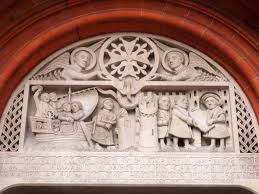
carving above Huguenot church in London

In the early 16th century, the reformist ideas of John Calvin and Martin Luther spread through France and many embraced their new Protestant doctrines. These French Reformists became known as the Huguenots. They believed that the Bible alone gave divine guidance, they rejected the authority of the Pope and the priesthood and they argued for separation of church and state.

John Calvin

All this directly challenged the authority of the Catholic church and led to bitter division between Catholics and Protestants, leading to the Wars of Religion which raged in France from 1562 until 1598. Hatred ran deep, armies were raised and atrocities were committed by both sides.

These wars were finally brought to an end through the actions of King Henry IV.

As a Huguenot, Henry was involved in the Wars of Religion and, while King of Navarre, led Protestant forces against the French royal army. When he succeeded to the French throne in 1589, he at first kept the Protestant faith –  the only French king to do so – but had to fight against the powerful Catholic League, which denied that he could wear the French crown as a Protestant. After several years of stalemate, he converted to Catholicism, reportedly saying “Paris is well worth a mass”!

henry-iv-of-france

Henry was a pragmatic politician, and he promulgated the Edict of Nantes (1598) which granted official tolerance to Protestantism, thereby effectively ending the Wars of Religion and, for eighty years or so, the Huguenots thrived. 

While the Edict of Nantes brought religious peace to France, some hard-line Catholics and Huguenots remained dissatisfied and in 1610 Henry was assassinated by a Catholic zealot. Henry was succeeded by his son Louis XIII.

Louis XIII and his Chief Minister, Cardinal Richelieu, were not at all tolerant of the Huguenots. They abhorred their growing influence and attacked their strongholds. 

300px-Siege_of_La_Rochelle_1881_Henri_Motte

After the capitulation of La Rochelle (the most important of the Huguenots’ strongholds) the Grace of Alais was signed in June 1629.  Although this reaffirmed the Edict of Nantes, it ordered that the Huguenot military organization should be broken up and the Huguenot fortresses destroyed. 

So, although the Huguenots continued to be allowed to practice their faith, their trades, and their professions, their position was considerably weakened by having no fortifications and no army.

When Louis XIII’s son, Louis IV, finally took control of his kingdom in 1661, he quickly set about reforming France according to his vision.

His vision included making France a wholly Catholic country.  His mantra was ‘One realm, one religion, one King’ and he swore to wipe out the ‘false religion’ of Protestantism once and for all. 

Many Huguenots could see the way the wind was blowing and quietly left France to find refuge in Protestant countries.

In France, the rights of Huguenots continued to be systematically eroded by Louis and his advisers, and the Edict of Nantes, which had protected them for so long, was finally revoked in 1685. At the time of the revocation, Huguenot pastors were given two weeks to leave the country or face death. However, their congregations were forbidden from leaving because Louis did not want to lose the skills of these hard-working and successful people.

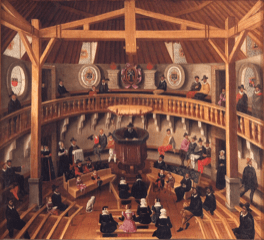
Pressure continued to mount and Huguenots’ lives became impossible if they continued to be loyal to their faith. Unless they converted to Catholicism, they would forfeit their property, be unable to practice their professions or trades and their children would be forcibly removed from them to be brought up as Catholics. They were banned from holding gatherings, even in private, and their temples were destroyed.

inside hugurnot temple

In many places, on the King’s orders, brutal soldiers were sent in to force households to convert and thousands did, to save their skins. 

Dragoon forcing huguenot to sign abduration paper

Some held out and suffered terribly, others tried to flee the country and were caught and punished, the men sent to row in the galleys in the Mediterranean (a death sentence) or executed, the women imprisoned and the children sent to be brought up in Catholic institutions.

Huguenot women in prison

There are stories of escape where fleeing Huguenots managed to elude their pursuers and make their way to other countries, but also horrific accounts of greedy sea captains taking money from them and then tossing them overboard, of tortures inflicted on those who refused to convert and of refugees hiding on board ships having noxious gas fed into their hiding places. There were plenty of financial rewards offered to those betraying Huguenots and to soldiers finding stowaways, with spies and informers everywhere.

Little wonder, then, that France was emptied of some of its most skilled citizens during these unsettled times. The Protestant countries to which the Huguenots fled were hugely enriched by their presence.  Doctors, lawyers, weavers, gold and silversmiths, clockmakers, lace makers, shoemakers, jewelers, glove makers, bookbinders, perfumers. These folk passed on their skills to those who gave them refuge and became valued citizens of their adopted countries.

My ancestors were a prosperous Huguenot family from Gascony and for the last two years, I have been researching what happened to them and how they escaped to London in 1692. My book ‘The King’s Command’ is very loosely based on their experience.

The King's Command - 92Blurb: 

16-year-old Lidie Brunier has everything; looks, wealth, health, and a charming suitor but there are dark clouds on the horizon. Lidie and her family are committed Huguenots and Louis XIV has sworn to stamp out this ‘false religion’ and make France a wholly Catholic country. Gradually Lidie’s comfortable life starts to disintegrate as Huguenots are stripped of all rights and the King sends his brutal soldiers into their homes to force them to become Catholics. Others around her break under pressure but Lidie and her family refuse to convert. With spies everywhere and the ever-present threat of violence, they struggle on. Then a shocking betrayal forces Lidie’s hand and her only option is to try and flee the country. A decision that brings unimaginable hardship, terror, and tragedy and changes her life forever.

‘One of the very best historical novels I have ever read’

Sandra Robinson, Huguenot Ancestry Expert

Buy Links: 

This title is available to read with #KindleUnlimited.

Universal Link: https://books2read.com/u/bW6zGG 

Amazon UK: https://www.amazon.co.uk/dp/B0CB4RH68S 

Amazon US: https://www.amazon.com/Kings-Command-God-Country-ebook/dp/B0CB4RH68S/ 

Amazon AU: https://www.amazon.com.au/Kings-Command-God-Country-ebook/dp/B0CB4RH68S/ 

Amazon CA: https://www.amazon.ca/Kings-Command-God-Country-ebook/dp/B0CB4RH68S/ 

rosemary-hayes-authorAuthor Bio:

Rosemary Hayes has written over fifty books for children and young adults. She writes in different genres, from edgy teenage fiction (The Mark), historical fiction (The Blue Eyed Aborigine and Forgotten Footprints), middle-grade fantasy (Loose Connections, The Stonekeeper’s Child and Break Out)  to chapter books for early readers and texts for picture books. Many of her books have won or been shortlisted for awards and several have been translated into different languages.

Rosemary has traveled widely but now lives in South Cambridgeshire. She has a background in publishing, having worked for Cambridge University Press before setting up her own company Anglia Young Books which she ran for some years. She has been a reader for a well-known authors’ advisory service and runs creative writing workshops for both children and adults.

Rosemary has recently turned her hand to adult fiction and her historical novel ‘The King’s Command’ is about the terror and tragedy suffered by the French Huguenots during the reign of Louis XIV.

Author Links:

Website: https://www.rosemaryhayes.co.uk 

Twitter: https://twitter.com/HayesRosemary 

Amazon Author Page: https://www.amazon.co.uk/Rosemary-Hayes/e/B00NAPAPZC 

Goodreads: https://www.goodreads.com/author/show/80106.Rosemary_Hayes 

Guest Post: “King’s Warrior” by James Gault

King's Warrior Tour Banner 1I am pleased to welcome James Gault to my blog to share a bit of information about his novel, “King’s Warrior.” I want to thank James Gault and The Coffee Pot Book Club for allowing me to be part of this blog tour. 
“King’s Warrior” is the third in a series about Owerd, a decent but unsophisticated 11th-century Briton who has struggled out of poverty by dint of courage and good fortune (“wyrd” if you will). The series came about by accident, initially intended as a single volume to bring Charles Kingsley’s classic novel “Hereward the Wake” into a more digestible form for the contemporary reader. That attempt proved impossible – one cannot, I found, tinker with a classic, however challenging its rather antiquated prose. Hence a new character set in the same period of a land beset by inequity, strife, and a Norman invasion. In this book Owerd, having already established his credentials as a loyal subject and “Sea Lord” returns to the role he fills best, that of warrior.

As with any other work of historical fiction, the bare bones are laid out by historical events, at least the events and their rationale as we know them. I have found it quite a challenge to reliably determine many such facts as they relate to late 11th century England and it has been said that recorded English history only began after 1066. We probably know more of the sayings of the sages of early China such as Confucius than we do of William the Conqueror. That is perhaps not surprising when we are addressing a monarch who spoke a Norman version of French, was barely literate in Latin, and gave up trying to learn English, the mother tongue of his subdued nation.

A degree of reliance must necessarily be placed upon the anonymous authors of The Anglo-Saxon Chronicles, compiled from around 890 AD. I have done so whilst acknowledging a degree of bias in that record and its seemingly undue focus on the appointments and subsequent demise of bishops. Nonetheless, that record has provided me with a wonderful basis for the ‘bare bones’ of the story and I am grateful to those monkish chroniclers.

I have much admiration for the authors of historical non-fiction and do not envy the inevitable peer scrutiny of their documented assertions of historical fact. I suspect many such authors, though, are acknowledged scholars in their field and have access to resources beyond me such as the Bodleian Library. Oh, such envy! I live in a small coastal town in SE Australia where the local library has a history section that goes back as far as WW-1 at best. I have been forced therefore to do much research on the internet – a risky and academically maligned source but of high utility to those such as myself. My old high school atlas has provided the wherewithal for most of the geographic elements of the tale, although much inadequate use of a magnifying glass has occasionally forced me back onto the Web.

I have been as careful as possible to align the story with the events and characters of the time. It is a work of fiction, though, and I gratefully acknowledge a certain leeway allowed for such works. Fiction does provide an opening for more conjecture and imaginative description of events and a certain subjective view of the characters. I have been occasionally harsh in my characterization of the Normans and somewhat less so of the Bretons. For William himself I have taken a relatively benign view, accepting his reputation for both cruelty and mercy in equal measure.

I would wish it otherwise but accept that there will be shortcomings in my research. I have, however, enjoyed that element of the writing task immensely. As other writers in the genre will know, a week’s research might well lead to a single paragraph of text. That can still be a satisfying return on investment.

King's Warrior coverBlurb:

In 11th-century England, King William achieved almost total domination of the English and turned his attention to Scotland. Owerd, possibly the last of the Britons to be deemed ‘lord’, faces powerful enemies from all quarters. He seems to hold the king’s favor by a thread, which only serves to encourage others to try and bring him down. 

Treachery abounds as he tries to juggle multiple roles and prove himself and his men worthy warriors for the Norman king. But will his lust for a woman finally prove his undoing?

Note from the author:

11th Century men and women were just as complex beings as we are today. Owerd, the main character in these chronicles is no different. In “King’s Warrior”, the third book of the series, he goes from violence (“…the air was filled with the clash of swords, angry shouts, and screams of the injured”) to compassion (“… Owerd had rarely if ever, made love as tenderly as he did with Runa that night”) in the space of a day.

Happiness, fear, disgust, anger, pride, and jealousy all play their part in Owerd’s character but what comes to the fore is courage, with perhaps a helping hand from fate – “wyrd” if you will.

Buy Links:

This title is available to read on #KindleUnlimited.

Universal Link: https://books2read.com/u/4A27gp 

Amazon UK: https://www.amazon.co.uk/gp/product/B0CC5VH6BM

Amazon US: https://www.amazon.com/gp/product/B0CC5VH6BM

Amazon AU: https://www.amazon.com.au/gp/product/B0CC5VH6BM

Amazon CA: https://www.amazon.ca/gp/product/B0CC5VH6BM

James GaultAuthor Bio:

James is a semi-retired Naval Captain with an abiding interest in storytelling and history. He has written a few contemporary fiction stories and a history text but lately has concentrated on historical fiction. He lives in a small coastal town in SE Australia – which provides quite a challenge when addressing medieval England with the aid of an old-school atlas.

Author Links:

Twitter: https://twitter.com/@ozjimg

Facebook: https://www.facebook.com/james.gault.9421/

Instagram: https://www.instagram.com/ozjimg/

Amazon Author Page: https://www.amazon.com/author/jgault

Guest Post: Spotlight for “Buccaneer: The Early Life and Crimes of Philip Rake” by Chris Thorndycroft

Buccaneer Blog Tour BannerI am pleased to welcome Chris Thorndycroft to my blog today to share a blurb for his novel, “Buccaneer: The Early Life and Crimes of Philip Rake.” Thank you, Chris Thorndycroft and The Coffee Pot Book Club, for allowing me to be part of this tour.

Buccaneer cover finalBlurb:
Bristol, 1713. When Philip Rake, pickpocket, smuggler, and scoundrel, is arrested and thrown in jail, he assumes he has a short walk to the gallows. But his father, a wealthy merchant who has remained a figure of mystery throughout his life, throws him a lifeline; he becomes an indentured man on an expedition to the East Indies led by his friend, Woodes Rogers.

Woodes Rogers is looking for Libertatia – the fabled pirate kingdom of the legendary buccaneer Henry Avery – and the treasure hoard rumoured to be hidden there. But Philip wants his freedom, and when he learns that there are men onboard who once sailed with Henry Avery and planned to take the treasure for themselves, he jumps ship and embarks upon a career of piracy.

Philip’s story takes him from the backstreets of Bristol to the sun-baked hills of Madagascar and on to the tropical islands of the Caribbean in a thrilling tale of adventure in which he rubs shoulders with some of the most notorious pirates of the age, including Blackbeard, Charles Vane, Anne Bonny, and Mary Read.

Buy Links:

This title will be available to read on #KindleUnlimited.

Universal Link: https://mybook.to/Buccaneer

Amazon UK: https://www.amazon.co.uk/dp/B0C9TWGMZJ/
Amazon US: https://www.amazon.com/dp/B0C9TWGMZJ/
Amazon CA: https://www.amazon.ca/dp/B0C9TWGMZJ/
Amazon AU: https://www.amazon.com.au/dp/B0C9TWGMZJ/

Chris ThorndycroftAuthor Bio:

Chris Thorndycroft’s writing career began with short horror stories which appeared in magazines and anthologies such as Dark Moon Digest and American Nightmare.

His first novel under his name was A Brother’s Oath, book one in the Hengest and Horsa trilogy, which deals with the beginning of Anglo-Saxon England. He has always had a passion for historical fiction, kindled at the age of six when he first saw Errol Flynn in The Adventures of Robin Hood (1938). His books are deeply grounded in real history but often reimagine legends such as King Arthur and Robin Hood, weaving them in with historical events.

He currently lives in Norway with his wife and two kids.

Social Media Links:

Website: https://christhorndycroft.wordpress.com/
Twitter: https://twitter.com/cthorndycroft
Facebook: https://www.facebook.com/ChrisThorndycroftAuthor/
Instagram: https://www.instagram.com/christhorndycroft/
TikTok: https://www.tiktok.com/@christhorndycroft
Amazon Author Page: https://www.amazon.co.uk/Chris-Thorndycroft/e/B015EQARZM
Goodreads: https://www.goodreads.com/author/show/8130216.Chris_Thorndycroft

Guest Post: “Turning the World to Stone” Excerpt by Kelly Evans

Turning the World to Stone Tour BannerI am pleased to welcome Kelly Evans to my blog today to share an excerpt from her novel, “Turning the World to Stone.” I want to thank Kelly Evans and The Coffee Pot Book Club for allowing me to be part of this blog tour. 
“I’m worried about the Holy Father.”

“All of Italy is.”

His lack of concern inflamed her already smouldering ire. “How can you be so unmoved? You know how serious our situation is.”

He replied with the same uninterested tone. “I’ll take care of it.”

Caterina’s pique overwhelmed her. “What? Like you have been? Emboldening our enemies and making new ones when we need friends right now?”

Girolamo glared at her, and Caterina felt slightly smug at finally pushing him into revealing himself. Mocking her tone, he lashed out. “What? Friends like your Bossi? Your closest advisor, always around to do your bidding.” He glanced around the room. “I’m surprised he’s not lurking in the shadows, waiting to whisper in your ear. I’ve often wondered if he whispers about himself and you and if my children are even mine.”

This was the best he could do? Insinuations? She was grateful Bossi wasn’t around to hear such slander.

Her husband went on. “Or friends like that little puttana, your lady? Where is she? She’s always sniffing around.” He glared at her with such disdain it felt like she’d been hit by him. “You need to mind your own business, arrogant Milanese whore that you are.”

Caterina stood, her body trembling. “How dare you?”

“I dare because I can. You have been too free with me, wife. You should watch yourself.” Girolamo moved his hand to his knife hilt threateningly but knocked over his glass of wine in the process. His face a deep red, he picked up the glass and threw it across the room before storming out.

As he exited the main door to the hall, Luisa entered through another just in time to see Caterina stare open-mouthed and then collapse on the floor. 

Turning the World to Stone coverBook Title and Author Name: 

Turning the World to Stone – The Life of Caterina Sforza Part One 1472 to 1488 

by Kelly Evans

Blurb:

Vilified by history, Caterina Sforza learned early that her life was not her own. Married at age ten, she was a pawn in the ever-changing political environment of Renaissance Italy.

Resigned to her life as a fifteenth-century wife, Caterina adapted to the role she was expected to play: raising and educating her children, helping the poor in her new home, and turning a blind eye to her husband’s increasingly shameful behaviour. But Fate had other plans for her, and soon Caterina’s path would be plagued by murder, betrayal, and heartbreak. 

“Could I write all, the world would turn to stone.”

Buy Links: 

This title is available to read on #KindleUnlimited.

Universal Link: https://mybook.to/Caterina

Amazon UK: https://www.amazon.co.uk/Turning-World-Stone-Caterina-Sforza/dp/1778022421

Amazon US: https://www.amazon.com/Turning-World-Stone-Caterina-Sforza-ebook/dp/B0C1HZHT93

Amazon CA: https://www.amazon.ca/Turning-World-Stone-Caterina-Sforza-ebook/dp/B0C1HZHT93

Amazon AU: https://www.amazon.com.au/Turning-World-Stone-Caterina-Sforza-ebook/dp/B0C1HZHT93

Kelly EvansAuthor Bio:

Born in Canada of Scottish extraction, Kelly Evans graduated in History and English, then moved to England, where she worked in the financial sector. While in London, Kelly continued her studies in history, concentrating on Medieval History, and travelled extensively through Eastern and Western Europe. 

Kelly is now back in Canada with her husband, Max, and a rescue cat. She writes full-time, focussing on illuminating little-known women in history with fascinating stories. When not working on her novels, Kelly writes Described Video scripts for visually impaired individuals, plays oboe, and enjoys old sci-fi movies. 

Social Media Links:

Website: https://www.kellyaevans.com

Twitter: https://twitter.com/ChaucerBabe

Facebook: https://www.facebook.com/kellyevansauthor

Instagram: https://www.instagram.com/kellyevansauthor/

Pinterest: https://www.pinterest.ca/kellyewrites/

Book Bub: https://www.bookbub.com/profile/kelly-evans

Amazon Author Page: https://www.amazon.com/stores/Kelly-Evans/author/B0187JGTOQ

Goodreads: https://www.goodreads.com/author/show/14335541.Kelly_Evans

Guest Post: “The War Wagon” by Griffin Brady

The Hussar's Duty Tour Banner 1Today, I am pleased to welcome Griffin Brady to my blog to share a guest post as part of the blog tour for her novel, “The Hussar’s Duty.” I would like to thank Griffin Brady and The Coffee Pot Book Club for allowing me to be part of this blog tour. 

War wagon, war fortress, rolling fortress, rolling stock, stock, wagon fort, mobile fortress, and tabor. These terms all mean the same thing. Until I did my research on the Battle of Cecora for The Hussar’s Duty, I wasn’t familiar with any of them. I came up to speed quickly because the war wagon played an essential role in the story.

When Poland’s Grand Hetman of the Crown, Stanisław Żółkiewski, first set out to meet the Ottomans on a battlefield just east of Cecora (modern-day Țuțora in Romania), he took 9,000 Polish troops with him. Despite his recruiting efforts, his force was less than he had hoped for, but he wasn’t concerned—he didn’t expect a clash. He was confident he and the Ottoman commander, Iskender Pasha, would negotiate without bloodshed, as they had done before. What Żółkiewski didn’t anticipate, however, was inaccurate intelligence that led to underestimating the enemy’s strength. Further complicating matters, Żółkiewski’s army was comprised largely of magnates’ private troops with their agendas, and he had great difficulty controlling them.

Żółkiewski had proved himself a brilliant strategic commander in the past, but he was now in his early seventies and poor health. Recognizing combat was imminent—and that a Tatar army had joined Ottoman ranks—Żółkiewski showed flashes of his genius when he struck upon employing the tabor at Cecora, harkening back to 15th-century Hussite victories. The battlefield’s open, flat ground lent itself well to the mobile fortresses, which could be used to devastating effect.

Image 2 War Wagon

The tabor was a square or rectangular arrangement of wagons equipped with guns and manned by soldiers, artillerymen, and crossbowmen/archers. Within the formation, surrounded by the wagons, a calvary was placed. The wagons were pulled by teams of horses arranged so they nearly touched the back of the wagon before them, creating a sort of impenetrable “chain.”

Tabor tactics were broken into two phases: defensive and counterattack. As the enemy advanced on the mobile fortress, they were fired upon until weakened. Then the counterattack began, and cavalry and infantry filed inside the wagon formation, engaging the demoralized troops.

Żółkiewski laid out a plan that involved two tabors. The tabors were each defended by 500-700 men and flanked each side of his main strike force. That strike force comprised five cavalry regiments, a mix of Polish winged hussars and light cavalry. The scale of his formation was massive, a whopping .68-.75 miles wide and .62 miles deep. It’s difficult for me to wrap my head around what it must have looked like!

For all its innovation, though, the scheme held several devastating flaws. First, rather than a wide, shallow formation, it compressed the regiments into tight columns, limiting their mobility. Second, the success of the mission depended on the tabor remaining intact. One breach and the entire formation would be compromised.

The battle began at noon on September 19, 1620. At first, the Poles succeeded in pushing the enemy back. However, the right tabor encountered a trench that caused it to swing to the right, opening a gap at its rear and exposing the central strike force. Though Żółkiewski had beefed up the sides and rear to counter any potential breach, it proved too little. Tatar horsemen swept in, overwhelming the trapped Polish cavalry and wreaking havoc.

The Poles fell back, abandoning the men in the compromised tabor. Sadly, most of those left behind were captured or killed. At the end of the day, Żółkiewski’s force was reduced by a third. Making matters worse, that night, Polish troops fled from camp in a mass crossing over the Prut River. Some made it to safety, but many drowned during the attempt or were captured by Tatars.

After days of failed negotiations with Iskender Pasha, with supplies rapidly depleting and morale plummeting among his remaining ranks, Żółkiewski decided to retreat. But how could he preserve his weakened army with the enemy poised to pursue? Enter the tabor once more in a different configuration.

This time, it was a single formation with six rows of wagons, in lines of one hundred each, placed behind tethered horses. The horses acted as battering ram and a shield to protect against Tatar arrows. Their grouping also prevented any of Żółkiewski’s men from escaping on horseback. The wagons in the lead were loaded with cannons and hook guns and protected by infantry and artillerymen. Beside the wagons marched three rows of hussar and other cavalry banners carrying loaded firearms. The rear was defended by more cannons and guns, along with additional infantry and the Lisowczycy (a Polish mercenary cavalry also known as the Lost Men or Forlorn Hope). The wounded and sick were placed on carts at the interior of the tabor.

The retreat began on September 29, ten days after the battle itself. The enemy pursuit began in earnest the following day (the enemy was either caught by surprise by the exodus and/or was too busy plundering the abandoned camp to go after the fleeing army). However, when the attacks did come, they were rebuffed without much consequence, despite the Poles being harangued daily. The tabor was doing its job. That’s not to say Żółkiewski’s troops weren’t under tremendous duress. Unable to dismantle the Poles’ formation, the enemy took to a scorched earth policy, burning fields and buildings in the Poles’ path, leaving no resources whatever. To avoid enemy encounters, Żółkiewski’s men marched at night, suffering from lack of sleep, food, and water. Despite the hardships, the army averaged an astonishing pace of seventeen miles per day (27.5 km). It was a mere six miles from Mohylów, a fortified Polish border town, on October 5 when they chose to stop and rest—despite Żółkiewski urging them on.

Image 3 Cecora_Death of Zolkiewski_1620

That ill-advised layover, along with several other critical errors in judgment, would cause an ensuing cascade of calamities during the night of October 5-6. Among other tragedies, Żółkiewski lost his life—and his head. Ultimately, only a few thousand of his original 9,000 troops made it back to Poland alive. Had he had better control, had his army remained disciplined and stuck to their formation, they would have likely crossed the border into safety that night. In the end, the tabor’s undoing was not its concept, formation, or parts. Its final failing came at the hands of human nature.

The Hussar's Duty CoverBlurb:

Poland’s most valiant winged hussar is called to fight in a campaign ripe for disaster. But he must also protect those he loves from jackals waiting to pounce. How does he choose between duty and devotion when death is on the line?

When Sultan Osman II sends Poland’s envoy packing, the Commonwealth must prepare for war against one of the largest armies the Ottomans have ever assembled. Tasked with repelling the invasion is Grand Hetman of the Crown Stanisław Żółkiewski, and he knows who to turn to: Jacek Dąbrowski, the Commonwealth’s most valiant Polish winged hussar.

Jacek has been idle far too long, and the call to arms is a siren’s song he can’t resist. But he has built a life far from the battlefield with his wife, Oliwia, and their children. If he pursues his quest for glory, who will safeguard them?

Oliwia knows her husband is restless. In fact, she’s been sending Jacek on cross-country errands for years in the hopes of quelling his lust for battle. When she realizes her efforts are futile, she resolves herself to letting him go—after hatching a scheme to accompany him.

Honor. Obligation. Devotion. These forces push and pull Jacek in different directions. His country needs him, but so does his family. Where does his duty lie? His choice will cause catastrophic ripples no matter which path he follows … and could very well bring the loss of his loved ones or his life.

Will the cost of defending the king and country prove too steep for this warrior?

This is a standalone continuation in The Winged Warrior Series.

Buy Links:

This title is available to read on #KindleUnlimited.

Universal Link: https://readerlinks.com/l/3336453

Amazon US: https://www.amazon.com/dp/B0C2VZ2963/

Amazon UK: https://www.amazon.co.uk/dp/B0C2VZ2963/

Amazon AU: https://www.amazon.com.au/dp/B0C2VZ2963/

Amazon CA: https://www.amazon.ca/dp/B0C2VZ2963/ 

Griffin Brady authorAuthor Bio:

Griffin Brady is an award-winning historical fiction author interested in the Polish Winged Hussars of the 16th and 17th centuries. She is a member of the Historical Novel Society and Rocky Mountain Fiction Writers. Her debut novel, The Heart of a Hussar, was a finalist for the 2021 Chaucer Early Historical Fiction Award and a 2021 Discovered Diamond.

The proud mother of three grown sons, she lives in Colorado with her husband. She is also an award-winning bestselling romance author who writes under the pen name G.K. Brady.

Social Media Links:

Website: https://www.griffin-brady.com/historical-fiction/

Twitter: https://twitter.com/griffbrady1588

Facebook: https://www.facebook.com/AuthorGriffinBrady

Book Bub: https://www.bookbub.com/profile/griffin-brady

Amazon Author Page: https://www.amazon.com/author/griffinbrady

Goodreads: https://www.goodreads.com/author/show/20675881.Griffin_Brady


Guest Post: “The Auld Alliance” by J R Tomlin

The Douglas Bastard Tour Banner 1Today, I am pleased to welcome J R Tomlin to my blog to share a guest post as part of the blog tour for her latest novel, “The Douglas Bastard / The Archibald the Grim Series.” I would like to thank J R Tomlin and The Coffee Pot Book Club for allowing me to be part of this blog tour. 

Many people think that Scotland always fought alone against the English conquest. This was partially true.

In 1290, civil war loomed after the death of Scotland’s seven-year-old queen, Margaret, the Maid of Norway. The Scots turned to what they thought was a friendly monarch, England’s King Edward I. (Sounds crazy, I know, but Scotland and England had been at peace for most of the 13th century). The Scottish government started looking for allies. Phillip IV had just declared England’s possession of Gascony forfeit, so an alliance between Scotland and France looked like a good idea. A Scottish embassy traveled to negotiate with King Phillip, and the Treaty of Paris was signed on October 24, 1295.

In the short term, the alliance was no protection for Scotland. Edward invaded Scotland in 1296, temporarily crushed resistance, stripped the King of Scots, John de Balliol, whom he had chosen, and temporarily ended any Scottish government. It was, in effect, a province of England. Three years later, England and France signed a treaty of perpetual peace, leaving Scotland on its own. In France’s defense, there was effectively no Scottish government for it to support.

As we all know, Scotland refused to remain crushed. Andrew de Moray led the resistance in the north of Scotland, and William Wallace, aided by Robert the Bruce and Sir William Douglas, raised an army in the south. They joined forces to defeat the English at the Battle of Stirling Bridge. De Moray was killed in that battle. Wallace had probably met with the King of France but received no French aid, and the Scottish resistance was once more crushed, ending with the execution of Wallace. 

Again, Scotland refused to stay crushed and rose once again under the leadership of King Robert the Bruce. But the Bruce had killed one of the Balliol (remember them?) inside a church. (I reject the idea that it was a planned ambush. The Bruce was too intelligent a man to plan to do something so stupid) The pope almost immediately excommunicated him and all of his followers. Luckily for him and Scotland, many Scottish bishops rejected the ex-communication based on English lies to the pope. But the effect was that the King of France would defy the pope by coming to the aid of a government under anathema. 

The war lasted a very long time, and it was not until In 1324 that Bruce’s nephew, Thomas Randolph, Earl of Moray, met the Pope in person at his court in Avignon. Randolph successfully persuaded Pope John to recognize Robert as King of Scots, a major diplomatic coup that allowed the French the option of renewing relations with Scotland. A new, largely precautionary, treaty between France and Scotland, again negotiated by the Earl of Moray, was signed two years later.

The following year, King Edward III signed a treaty recognizing Scotland’s independence and Robert the Bruce as the rightful King of Scots. That should have been the end of it. See me roll my eyes.

King Robert died in 1327, leaving his only son, then five years old, as king and Thomas Randolph as regent.

Edward III felt humiliated by his defeat in the field by a Scottish army led by Sir James Douglas and Thomas Randolph and by having had to sign a peace treaty with Scotland. He backed John Balliol’s claim to the throne of Scotland and repudiated the peace treaty. Randolph died on his way to fight the invasion by Balliol, which the English king secretly backed. So now, that treaty with France would have some use.

At first, the defense against the invasion went badly. Many leading nobles were killed at the Battle of Dupplin Moor, including the new Guardian and thousands of Scottish troops. Although Balliol was then driven from Scotland by a later attack by the Scots, King Edward openly invaded. Soon most of Scotland was in English hands, with only a few castles holding out, and a majority of Scottish nobles, at least for a time, swore fealty to the English and their pretender. 

Now Scotland needed that ally.  In the winter of 1332, King Phillip dispatched a flotilla of ten ships to aid the Scots, but they were blown off course in a storm and never arrived. In the spring of 1334, £1000 came from France to be distributed to the Scottish defenders along with an offer of sanctuary to young King David, his queen, and members of his court. David or Moravia, Bishop of Moray and determined defender of Scottish independence, founded the Scots College of the University of Paris in 1333. He had to have been in Scotland at the time and may have had some influence on France.

The situation in Scotland was desperate enough that the Scots accepted the offer. In May 1334, King David and Queen Joanna arrived in France, along with their confessors, tutors in arts and arms, the king’s sisters, the Douglas children, the late regent’s sons, other children of Scottish nobles, and a number of clerics and nobles. They were given Château Gaillard as a residence. The French regularly sent supplies to Scotland and paid an annual pension of £2000 for the upkeep of King David’s court in exile. In June 1339, William Douglas, Lord of Liddesdale, visited King David in France and returned to Scotland, taking with him Arnoul d’Audrehen in command of 200 French troops and several ships, which aided in the attack on and capture of Perth. I have some doubt that Scotland as a kingdom would have survived without this ongoing aid.

In 1346, Edward overwhelmed French forces at the Battle of Crécy. Two months later, David II of Scotland was captured at the Battle of Neville’s Cross in response to a request from the French to attack England in order to force King Edward to return home; King David invaded England. The English captured him at the disastrous Battle of Neville’s Cross. However, the French continued to supply money and some troops to distract King Edward from his war in France, sending substantial funds and about sixty knights to aid in the capture of Berwick. Berwick was quickly lost, but it distracted Edward, who led a large army to ravage southern Scotland. William Douglas, later 1st Earl of Douglas, took part in that and, the following year, led 200 men-at-arms and forty knights to fight with the French at the Battle of Poitiers.

Battle of Poitiers - public domain

For a time, France was so battered as to have no funds for sending to Scotland, and Scotland’s King David I took peace with England as a policy. Even after King Robert II’s accession and the treaty’s renewal, neither nation saw any effects. It was in the following century that thousands of Scots once more went to the defense of Scotland. The Earl of Douglas’s son, the Earl of Wigtoun, and the Earl of Buchan helped the French defeat the English at the Battle of Baugé in 1421. It was a turning point in the Hundred Years’ War. King Charles VII granted Douglas the Duchy of Touraine, the first foreigner to be granted a dukedom in France. On May 8, 1429, Scots fought with Joan of Arc in the relief of Orléans, where legend has it bagpipes played Marche des Soldats de Robert Bruce as she entered the city.

England’s War of the Roses reduced the danger to both Scotland and France, at least for a time, but sometimes for good but often for bad, very bad; the Auld Alliance went on until James VI of Scotland, heir to the throne of England, repudiated it to strengthen his ties with England.

That, however, did not end the strong cultural ties between Scotland and France. The Scots’ language absorbed many French words. The ties with France could be seen in Scottish architecture, such as at Bothwell and Kildrummy Castle, built on French models. Many Scots who fought for France stayed to become citizens eventually. Scottish poets, bishops, and authors studied in France for centuries and brought the French influence home with them. The founder of Scotland’s first university, Bishop Henry Wardlaw, studied in France. So if you study there, you are benefiting from the Auld Alliance.

Cover - The Douglas BastardBlurb:

Young Archibald, the Black Douglas’s bastard son, returns from exile to a Scotland ravaged by war. The war-hardened Knight of Liddesdale will teach him what he must learn. And with danger on every side, he must learn to sleep with one eye open and a claymore in his hand because even their closest ally may betray them…

Buy Links:

The Douglas Bastard:

Universal Link:  https://books2read.com/u/4AAwdp 

Amazon UK: https://www.amazon.co.uk/dp/B0968X5V3Y 

Amazon US: https://www.amazon.com/dp/B0968X5V3Y 

Cover - Trust and TreasonAmazon CA: https://www.amazon.ca/dp/B0968X5V3Y 

Amazon AU: https://www.amazon.com.au/dp/B0968X5V3Y

Barnes and Noble: https://www.barnesandnoble.com/w/the-douglas-bastard-a-historical-novel-of-scotland-j-r-tomlin/1140930069 

Kobo: https://www.kobo.com/ebook/the-douglas-bastard

iBooks: https://books.apple.com/us/book/id1606972264 

Google Play: https://play.google.com/store/books/details/J_R_Tomlin_The_Douglas_Bastard?id=AM12EAAAQBAJ

Archibald the Grim Series on Amazon:

Amazon UK: https://www.amazon.co.uk/dp/B0BDW1VJ61 

Amazon US:  https://www.amazon.com/dp/B0BDW1VJ61 

BIM-BLD224477 - © - Steve Smith

Author Bio:

J R Tomlin is the author of twenty historical novels.

Her historical novels are mainly set in Scotland. You can trace her love of that nation to the stories of Robert the Bruce and the Black Douglas that her grandmother read her when she was small and to her hillwalking through the Scottish Cairngorms, where the granite mountains have a gorgeous red glow under the setting sun.

In addition to having lived in Scotland, she has traveled in the US, mainland Europe, and the Pacific Rim. She now lives in Oregon.

Social Media Links:

Website: http://www.jrtomlin.com  

Twitter: https://twitter.com/TomlinJeanne 

Book Bub: https://www.bookbub.com/profile/j-r-tomlin 

Amazon Author Page: https://www.amazon.com/stores/J.R.-Tomlin/author/B002J4ME1S

Goodreads: https://www.goodreads.com/author/show/4094154.J_R_Tomlin

Guest Post: “Alternate Endings Anthology” by Historical Writers Forum Spotlight

Alternate Endings Tour BannerToday, I am pleased to welcome the Historical Writers Forum to my blog to promote their latest novel, “Alternate Endings Anthology.” I would like to thank The Coffee Pot Book Club and the Historical Writers Forum for allowing me to be part of this blog tour. 

Alternate Endings coverBlurb: 

We all know the past is the past, but what if you could change history?

We asked eight historical authors to set aside the facts and rewrite the history they love. The results couldn’t be more tantalizing.

What if Julius Caesar never conquered Gaul?

What if Arthur Tudor lived and his little brother never became King Henry VIII?

What if Abigail Adams persuaded the Continental Congress in 1776 to give women the right to vote and to own property?

Dive into our collection of eight short stories as we explore the alternate endings of events set in ancient Rome, Britain, the United States, and France.

An anthology of the Historical Writers Forum.

Buy Links:

This title is available to read on #KindleUnlimited.

Universal Link:  https://mybook.to/AltEnd 

Amazon UK: https://www.amazon.co.uk/dp/B0BKC33GFX 

Amazon US: https://www.amazon.com/Alternate-Endings-Short-Anthology-Historical-ebook/dp/B0BKC33GFX/ 

Amazon CA: https://www.amazon.ca/dp/B0BKC33GFX 

Amazon AU: https://www.amazon.com.au/dp/B0BKC33GFX 

Author Bios:

Samantha WilcoxsonSamantha Wilcoxson

Samantha Wilcoxson is an author of emotive biographical fiction and strives to help readers connect with history’s unsung heroes. She also writes nonfiction for Pen & Sword History.

Samantha loves sharing trips to historic places with her family and spending time by the lake with a glass of wine. Her most recent work is Women of the American Revolution, which explores the lives of 18th-century women, and she is currently working on a biography of James Alexander Hamilton.

Sharon Bennett ConnollySharon Bennett Connolly

Historian Sharon Bennett Connolly is the best-selling author of five non-fiction history books, with a new release coming soon.

A Fellow of the Royal Historical Society, Sharon has studied history academically and just for fun – and has even worked as a tour guide at a castle. She writes the popular history blog, http://www.historytheinterestingbits.com. 

Sharon regularly talks about women’s history; she is a feature writer for All About History magazine, and her TV work includes Australian Television’s ‘Who Do You Think You Are?’

Cathie DunnCathie Dunn

Cathie Dunn writes historical fiction, mystery, and romance. The focus of her historical fiction novels is on strong women through time.

She loves researching for her novels, delving into history books, and visiting castles and historic sites

Cathie’s stories have garnered awards and praise from reviewers and readers for their authentic descriptions of the past.

Karen HeenanKaren Heenan

As an only child, Karen Heenan learned early that boredom was the enemy. Shortly after, she discovered perpetual motion and has rarely been seen holding still since.

She lives in Lansdowne, PA, just outside Philadelphia, where she grows much of her own food and makes her own clothes. She is accompanied on her quest for self-sufficiency by a very patient husband and an ever-changing number of cats. 

One constant: she is always writing her next book.

Salina B BakerSalina Baker

Salina Baker is a multiple award-winning author and avid student of Colonial America and the American Revolution. 

Her lifelong passion for history and all things supernatural led her to write historical fantasy. Reading, extensive traveling, and graveyard prowling with her husband keep that passion alive. 

Salina lives in Austin, Texas.

Virginia CrowVirginia Crow

Virginia Crow is an award-winning Scottish author who grew up in Orkney and now lives in Caithness.

Her favorite genres to write are fantasy and historical fiction, sometimes mixing the two. Her academic passions are theology and history, her undergraduate degree in the former and her postgraduate degree in the latter, and aspects of these frequently appear within her writings.

When not writing, Virginia is usually to be found teaching music. She believes wholeheartedly in the power of music, especially as a tool of inspiration, and music often plays when she writes. Her life is governed by two spaniels, Orlando and Jess, and she enjoys exploring the Caithness countryside with these canine sidekicks.

She loves cheese, music, and films but hates mushrooms.

Elizabeth K CorbettElizabeth K Corbett

Elizabeth K. Corbett is an author, book reviewer, and historian who has recently published a short story, “Marie Thérèse Remembers.” She is working on her debut novel, a gothic romance set in Jacksonian America.

When she is not writing, she teaches academic writing, something she is very passionate about. She believes in empowering students to express themselves and speak their truth through writing. Additionally, she is a women’s historian who studies the lives of women in eighteenth and nineteenth-century North America. Mostly, she is fascinated by the lives of the lesser-known women in history.

A resident of gorgeous coastal New Jersey, she takes inspiration from local history to write her historical fiction. She is an avid reader who adores tea and coffee.

Stephanie ChurchillStephanie Churchill

After serving time as a corporate paralegal in Washington, D.C., then staying home to raise her children, Stephanie Churchill stumbled upon writing, a career path she never saw coming.

As a result of writing a long-winded review of the book Lionheart, Stephanie became fast friends with its New York Times best-selling author, Sharon Kay Penman, who uttered the fateful words, “Have you ever thought about writing?” 

Stephanie’s books are filled with action and romance, loyalty and betrayal. Her writing takes on a cadence that is sometimes literary, sometimes genre fiction, relying on deeply-drawn and complex characters while exploring the subtleties of imperfect people living in a gritty, sometimes dark world.

She lives in the Minneapolis area with her husband, two children, and two dogs while trying to survive the murderous intentions of a Minnesota winter.

Michael RossMichael Ross

Best-selling author Michael Ross is a lover of history and great stories.

He’s a retired software engineer turned author with three children and five grandchildren, living in Newton, Kansas, with his wife of forty years. He was born in Lubbock, Texas, and still loves Texas.

Michael attended Rice University as an undergraduate and Portland State University for his graduate degree. He has degrees in computer science, software engineering, and German. In his spare time, Michael loves to go fishing, riding horses, and play with his grandchildren, who are currently all under six years old. 

Connect with the Historical Writers Forum:

Twitter: https://twitter.com/HistWriters 

Facebook: https://www.facebook.com/profile.php?id=100063689944203