
 Today, I am pleased to welcome Katerina Dunne to my blog to share a bit of her research for her latest novel, “Return to the Eyrie.” I want to thank Katerina Dunne and The Coffee Pot Book Club for allowing me to be part of this blog tour.
The history of medieval Hungary is fascinating, yet few in the English-speaking world know much about it. From nomadic tribes raiding across Europe in the 9th-10th century, the Hungarian conquerors settled in the Carpathian basin, converted to Christianity, and, together with the peoples they found already living there, created a powerful multi-ethnic and multi-lingual kingdom, which at its peak stretched from Southern Poland to the Adriatic Sea and from lower Austria to Central Romania as the below map demonstrates:

15th-century Europe map copied from
https://www.gifex.com/detail-en/2009-09-17-811/Europe-during-the-15th-Century.html
Return to the Eyrie (released in April 2024) is set during the second half of the 15th century (1470 to 1480) mostly in Transylvania and Belgrade, which were part of the medieval Kingdom of Hungary. The main characters are fictional, but they interact with real historical figures of the time and participate in real historical events. I have presented the heroine as a (fictional) member of two powerful baronial clans from Transylvania and Eastern Hungary.
The 15th century was a turbulent time for the Kingdom of Hungary due to internal conflict as well as the expansionist efforts of the Ottoman Empire towards the west and north. After the Ottoman conquest of Serbia and Bosnia, and the submission of Wallachia to the Sultan as a vassal state, Hungary became the last frontier holding back the Ottoman advance towards Central Europe.
The years between 1458 and 1490 were dominated by the figure of Mátyás (Matthias) Hunyadi, who became king aged fifteen in January 1458. His father was the formidable János Hunyadi, a lesser nobleman whose meteoric rise to power in the 1440s and early 1450s made him the most powerful baron in the kingdom. However, after his death, his enemies accused his eldest son, László, of treason. Under the influence of several barons who opposed the Hunyadi family, the King (also called László) arrested both Hunyadi’s sons in the spring of 1457. While he had László executed, he imprisoned fourteen-year-old Mátyás and many of their supporters.
When the King died in 1457 without an heir, the vacant throne was filled by Mátyás, following his mother’s and his uncle’s relentless campaign of negotiations, promises, bribes, and intimidation. The legend has it that the Royal Council deliberated in Buda Castle and made the public announcement while the crowds of lesser nobles stood literally on the river Danube, the waters of which had frozen solid.
But Mátyás was still held captive by the Bohemian king and Hussite leader, George of Podebrady. It took a large ransom to release Mátyás to his family, and the teenager was finally enthroned in February 1458. He could not be crowned though because the Hungarian Holy Crown was in the hands of the Holy Roman Emperor, Frederick III. How the crown had ended up there is another story—one of the most fascinating episodes in late medieval Hungarian history—which deserves separate attention. It took another four years and the astronomical sum of 80,000 gold florins to recover the crown. Mátyás was finally crowned with all the appropriate ceremony on 29 March 1464.
He became known as Mátyás Corvinus (nicknamed The Raven King because of the Hunyadi coat of arms, which depicted a raven with a golden ring in its beak) One of the most important rulers in 15th century Europe, he brought the Italian Renaissance and Humanism to Hungary, upgraded the royal palace in Buda, established the famous Corvina Library and was the patron of many scholars and artists. Due to the fact that he was a member of the nobility rather than of royal blood, he faced strong opposition both from inside Hungary and from abroad (Holy Roman Empire, Bohemia, and Poland) and he had to fight several wars to secure his grip on the throne. He kept a defensive stance towards the Ottomans, with relative success, and competed with them in his efforts to influence politics in neighboring Wallachia, Moldavia, and Bosnia.
Mátyás is well-known for keeping Prince Vlad III of Wallachia (Vlad the Impaler) imprisoned for several years before finally releasing him in 1475 to place him on the Wallachian throne as an ally.
Mátyás conquered Vienna in 1485 and was negotiating his possible future designation as Holy Roman Emperor when he died in April 1490.
He has since become the subject of many legends not only in Hungary but also in several neighboring Central European countries.
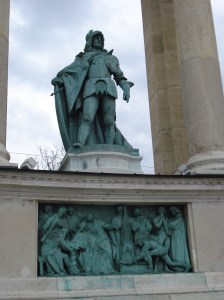
Statue of King Mátyás Hunyadi in Heroes’ Square Budapest (my photo)
King Mátyás plays a small but pivotal role in my novel, Return to the Eyrie. The heroine, Margit, is distantly related to him as her father (fictional character) was a third cousin of the king’s mother, Erzsébet Szilágyi.
Margit needs the King’s support to reclaim her inheritance, which was violently taken when she was a child by her close relatives.
Apart from being a historical adventure, the novel also addresses the issue of female inheritance. Despite her noble status, Margit could not inherit landed property from her father due to the strict inheritance laws in the Kingdom of Hungary. Noble daughters were only entitled to a monetary dowry when they married unless their husband was a commoner, in which case—ironically—they could inherit part of the land. So, according to the law, Margit’s land would pass to her closest male relative (her first cousin in this case).
However, a nobleman could invoke the custom of Prefection (Fiúsítás in Hungarian or praefectio in filium in Latin), whereby he could petition the King to “promote” his daughter to a son and therefore, allow her to inherit landed property. This would usually happen when there were no close male relatives, or in other exceptional cases. Margit’s father had sent such a petition to King Mátyás, but his relatives plotted against him. With an evil trick, they presented him as a traitor to the King’s eyes, had him murdered, and took over his land while Margit barely escaped with her life thanks to her father’s most loyal friend.
 Blurb:
Honour, revenge, and the quest for justice.
Belgrade, Kingdom of Hungary, 1470:
Raised in exile, adolescent noblewoman Margit Szilágyi dreams of returning to her homeland of Transylvania to avenge her father’s murder and reclaim her stolen legacy. To achieve this, she must break the constraints of her gender and social status and secretly train in combat.
When the king offers her a chance at justice, she seizes it—even if it means disguising herself as a man to infiltrate the vultures’ nest that now occupies her ancestral ‘eyrie’.
Plagued by childhood trauma and torn between two passionate loves, Margit faces brutal battles, her murderous kin’s traps, and inner demons on her quest for vengeance. Only by confronting the past can she reclaim her honour—if she can survive long enough to see it through.
Return to the Eyrie is an epic coming-of-age tale of a young woman’s unwavering pursuit of justice and destiny in 15th-century Hungary.
Buy Link:
Universal Buy Link: https://books2read.com/u/bz8gJL
 Author Bio:
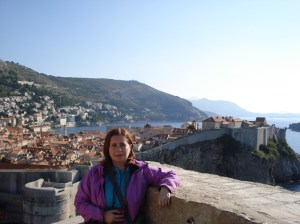
Katerina Dunne is the pen name of Katerina Vavoulidou. Originally from Athens, Greece, Katerina has been living in Ireland since 1999. She has a degree in English Language and Literature from the University of Athens, an MA in Film Studies from University College Dublin, and an MPhil in Medieval History from Trinity College Dublin.
Katerina is passionate about history, especially medieval history, and her main area of interest is 13th to 15th-century Hungary. Although the main characters of her stories are fictional, Katerina uses real events and personalities as part of her narrative to bring to life the fascinating history of the medieval Kingdom of Hungary, a location and period not so well-known to English-speaking readers.
Return to the Eyrie (published April 2024) is the second book in the Medieval Hungary series, a sequel to Lord of the Eyrie (published in February 2022).
Author Links:
Website (publisher): https://www.thehistoricalfictioncompany.com/hp-authors/katerina-dunne
Facebook: https://www.facebook.com/profile.php?id=100076818802721
LinkedIn: https://www.linkedin.com/in/katerina-vavoulidou-07962a85/
Amazon Author Page: https://www.amazon.com/stores/Katerina-Dunne/author/B09R4P733K
Goodreads: https://www.goodreads.com/author/show/22196953.Katerina_Dunne
 Adventures of a Tudor Nerd
Thanks so much for featuring Katerina Dunne today, with such an interesting post.
Take care,
Cathie xo
The Coffee Pot Book Club
LikeLike