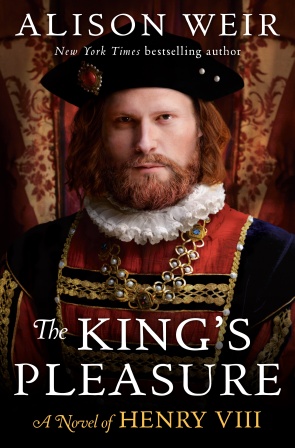
Book Review: “The King’s Pleasure: A Novel of Henry VIII” by Alison Weir

The King's PleasureWhen we think about the Tudor dynasty, we often focus on the women in King Henry VIII’s life and his children, at least when it comes to novels. Writing about this larger-than-life figure, this notorious king and controversial figure in English history, are usually considered ambitious. Few have attempted to write a book about the king’s entire reign, but Alison Weir has embarked on this endeavor in her latest novel, “The King’s Pleasure: A Novel of Henry VIII.”

I want to thank Ballantine Books and Net Galley for sending me a copy of this novel. I have not read many books about the reign of King Henry VIII, except for “The Autobiography of King Henry VIII” by Margaret George, so when I heard that Alison Weir was writing a novel about the titular king, I knew I had to read it.

Weir begins her novel with a moment that must have been difficult for young Prince Henry or Harry as he is referred to in this book. His brother died recently, and his beloved mother, Elizabeth of York, just died, leaving Henry as King Henry VII’s only heir. Henry does not have the best relationship with his father, but he now must fill the void as the heir apparent after Arthur died, leaving his young wife, Katherine of Aragon, a widow. When King Henry VII died, Henry became King Henry VIII and selected a woman he had fallen for to become his queen, Katherine of Aragon.

The bulk of this novel revolves around the relationships between Henry and his first two wives, Katherine of Aragon and Anne Boleyn. Weir is sympathetic toward Katherine of Aragon’s struggles, whereas her portrayal of Anne Boleyn may come across as a bit harsh. Jane Seymour is portrayed as a quiet and obedient queen, and Anna of Cleves’ focus is more on her looks and how Henry treated her more as a sister than a wife. Katherine Howard is someone Henry falls for hard and is devastated by her downfall, and Katherine Parr is the firebrand reformer who wants to heal Henry’s family at the end of his life.

Weir also touches on the complex political web that Henry was involved in, not just in England but European politics of the 16th century. We also see how Henry interacted with his children and how the emotional weight of all of his decisions weighed on him.

I think for how much of a challenge it is to write a novel about King Henry VIII, Alison Weir has done an admirable job in the king’s portrayal. I don’t necessarily agree with how some of the queens were portrayed, but I did enjoy this novel as a whole. I would suggest reading this novel before the Six Tudor Queens series to understand Henry’s perspective before his wives’ stories. If you have enjoyed the latest books about Henry VIII’s wives and his mother, Elizabeth of York, you should read “The King’s Pleasure: A Novel of Henry VIII” by Alison Weir.
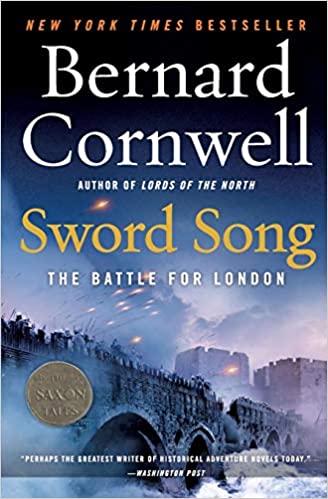
Book Review: “Sword Song”(Book Four of the Saxon Stories series) by Bernard Cornwell

sword songThe year is 855, and the country that one day will be known as England is relatively peaceful. The Danes have their kingdom in the north, while the Saxons, under King Alfred, rule Wessex in the south. Uhtred of Bebbanburg, a Saxon man raised by Danish warriors, lives with his wife Gisela and his children in Wessex, where he is sworn to protect Alfred and his family. It is a touchy alliance, but when rumors about a dead man speaking reach Uhtred’s home, he knows that he must pick up Serpent-Breath once again and make a choice that could change the direction of England as a whole. What do the dead man and new Viking invaders have in plan for Uhtred, and how will it affect Wessex and the rule of King Alfred? Another engaging adventure for Uhtred of Bebbanburg is book four of The Saxon Tales, “Sword Song” by Bernard Cornwell.

As someone who has grown to love the adventures of Uhtred of Bebbanburg, first from the TV show “The Last Kingdom” and now through the books, I wanted to continue the journey through the books. There is something so compelling about this Saxon world that Bernard Cornwell crafted with love and attention.

We join Uhtred and his men, Sihtric and Finan, on a night raid where they come across a brand new batch of Vikings. When Uhtred returns home, Aethelwold tells him how a dead man was brought back to life and says that he would be the King of Wessex and Uhtred would become King of Mercia. A far-fetched tale, but Uhtred decides that he must check it out, even if that means breaking his oath to Alfred. It is when he hears the dead man speak himself that he meets Haesten, and he hears about the Viking brothers Siegfried and Erik, who have lofty ambitions.

Meanwhile, in Alfred’s court, Alfred’s daughter Aethelflaed marries Aethelred of Mercia to form a strong alliance. It looks like it is a perfect match. Behind closed doors, Aethelred is abusive to Aethelflaed when Siegfried and Erik attack. Uhtred and Aethelred must reluctantly work together for the survival of Wessex and England as a whole.

Epic battles, twisted political ploys, and romance all intertwine in this novel as Uhtred works hard to fulfill his oath to Alfred. “Sword Song” is a bit slower in pace compared to the first three books in the series, but I see it as Cornwell showing that not every adventure with Uhtred is going to be fast-paced. There will be times when he has to negotiate and think methodically to ensure his mission is complete and no one he cares about will be harmed. It is a different side to Uhtred of Bebbanburg’s story, but it is one that I appreciate. If you have enjoyed the first three books in the Saxon Tales series, you need to read “Sword Song” by Bernard Cornwell.

Guest Post: “Spotlight for ‘A Matter of Faith’ by Judith Arnopp

Today, I am pleased to welcome Judith Arnopp to my blog to share the blurb from her latest novel, “A Matter of Faith.” I would like to thank Judith Arnopp and The Coffee Pot Book Club for allowing me to be part of this tour. 
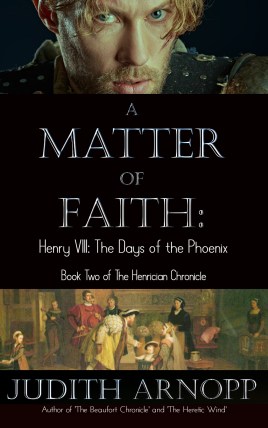
Blurb:

Finally free of Catherine of Aragon, Henry VIII is now married to Anne Boleyn and eagerly awaiting the birth of his son. In a court still reeling from the royal divorce and growing public resentment against church reform, Henry must negotiate widespread resentment toward Anne. He places all his hopes in a son to cement his Tudor bloodline, but his dreams are shattered when Anne is delivered of a daughter.

Burying his disappointment, Henry focuses on getting her with child again, but their marriage is volatile, and as Henry faces personal bereavement and discord at court, Anne’s enemies are gathering. When the queen miscarries a son, and Henry suffers a life-threatening accident, his need for an heir becomes critical. Waiting in the wings is Jane Seymour, a lady-in-waiting who offers the king comfort and respite from Anne’s fiery passions.

But, when Anne falls foul of her former ally, Thomas Cromwell, and the king is persuaded he has been made a cuckold, Henry strikes out, and the queen falls beneath the executioner’s sword, taking key players in Henry’s household with her. 

Jane Seymour, stepping up to replace the fallen queen, quickly becomes pregnant. Delighted with his dull but fertile wife, Henry’s spirits rise even further when the prince is born safely. At last, Henry has all he desires, but even as he celebrates, fate is preparing to deliver one more staggering blow. 

Henry, the once perfect Renaissance prince, is now a damaged middle-aged man, disappointed in those around him but most of all in himself. As the king’s optimism diminishes, his intractability increases and the wounded lion begins to roar.

Buy Links:

This title is available to read on #KindleUnlimited. 

Universal Link: http://mybook.to/amofaith 

Amazon UK: https://www.amazon.co.uk/dp/B0BWF2WL1Q 

Amazon US: https://www.amazon.com/dp/B0BWF2WL1Q 

Amazon CA: https://www.amazon.ca/dp/B0BWF2WL1Q 

Amazon AU: https://www.amazon.com.au/dp/B0BWF2WL1Q 

Author Bio: 

When Judith Arnopp began to write professionally, there was no question about which genre to choose. A lifelong history enthusiast and avid reader, Judith holds an honors degree in English and Creative writing and a Masters in Medieval Studies from the University of Wales, Lampeter. 

Judith writes both fiction and non-fiction, working full-time from her home overlooking Cardigan Bay in Wales, where she crafts novels based on the Medieval and Tudor periods. Her primary focus is on the perspective of historical women from all life roles, from prostitutes to queens, but she has recently turned her attention to Henry VIII himself.

Her novels include: 

A Matter of Conscience: Henry VIII, the Aragon Years. (Book one of The Henrician Chronicle)

A Matter of Faith: Henry VIII, the Years of the Phoenix (Book Two of The Henrician Chronicle)

The Beaufort Bride: (Book one of The Beaufort Chronicle)

The Beaufort Woman: (Book two of The Beaufort Chronicle)

The Kings Mother: (Book three of The Beaufort Chronicle)

The Heretic Wind: the life of Mary Tudor, Queen of England

A Song of Sixpence: The Story of Elizabeth of York

Intractable Heart: The Story of Katheryn Parr

The Kiss of the Concubine: A Story of Anne Boleyn

Sisters of Arden: on the Pilgrimage of Grace

The Winchester Goose: at the court of Henry VIII

The Song of Heledd: 

The Forest Dwellers

Peaceweaver

Her non-fiction articles feature in various historical anthologies and magazines, and an illustrated non-fiction book, How to Dress like a Tudor, will be published by Pen & Sword in 2023.

Social Media Links:

Website: https://www.judithmarnopp.com

Blog: http://juditharnoppnovelist.blogspot.co.uk/

Twitter: https://twitter.com/JudithArnopp

Facebook: https://www.facebook.com/thetudorworldofjuditharnopp

LinkedIn: https://www.linkedin.com/in/judith-arnopp-ba999025/

Instagram: https://www.instagram.com/tudor_juditharnopp/ 

Book Bub: https://www.bookbub.com/authors/judith-arnopp

Amazon Author Page: http://author.to/juditharnoppbooks 

Book Review: “Henry VIII’s Children: Legitimate and Illegitimate Sons and Daughters of the Tudor King” by Caroline Angus

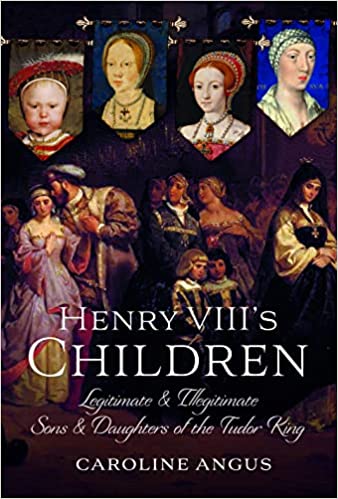
Henry VIII childrenWhen we think about the title royal children, images of children who get whatever they want, being spoiled with gems and gowns, and ruling kingdoms, they are married to create alliances. In that sense, it would define a life of luxury. However, for the children of King Henry VIII, luxury was not always in their dictionary. What was life like for the legitimate and illegitimate children of Henry VIII? Caroline Angus explores this question in her latest book, “Henry VIII’s Children: Legitimate and Illegitimate Sons and Daughters of the Tudor King.”
I want to thank Pen and Sword Books and NetGalley for sending me a copy of this book. I have read quite a few books about the children of Henry VIII, so when I saw the title, I was interested to see what new information Angus would provide in her book.

To understand why Henry VIII desired a large family, especially male heirs, Angus explores Henry’s childhood as the second son of Henry VII and Elizabeth of York. We then transition to the marriage of Henry and Katherine of Aragon and her multiple miscarriages until her beloved daughter Mary was born. After Mary, Angus explores the relationships of Henry VIII with Bessie Blount, Anne Boleyn, and Jane Seymour and his other children that were recognized as his own, Henry Fitzroy, Elizabeth, and Edward, respectively.

What I enjoyed in this book is the amount of information that Angus provided about not only Henry’s legitimate children but his illegitimate children, primarily the information about Henry Fitzroy. For so long, Henry Fitzroy was a footnote in the Henry VIII story, but it is so fascinating how much he relied on his eldest son even though he was illegitimate. Then, you have Mary’s upbringing compared to Elizabeth’s, and you see how much of a struggle it was to be a daughter of Henry VIII instead of a treasured son.

Angus also included a section about children who many questioned if they were indeed illegitimate children of the king, including the children of Mary Boleyn. She also included some Tudors I had never heard about, which was interesting to read about how their life experiences differed from their royal counterparts. The king’s legitimate and illegitimate children dealt with so much pain and suffering because of who their dear old dad was, and they all craved a little bit of his love in return.

Angus has done an excellent job telling the tales of the rather sad upbringings of the children of Henry VIII. A crown and a king as a father did not mean your life was a fairy tale. By understanding their childhoods, we can understand why the Tudor children became strong-willed leaders. If you want an excellent book that gives you a glimpse into what it meant to be a child of a monarch during the Tudor period, check out, “Henry VIII’s Children: Legitimate and Illegitimate Sons and Daughters of the Tudor King” by Caroline Angus.

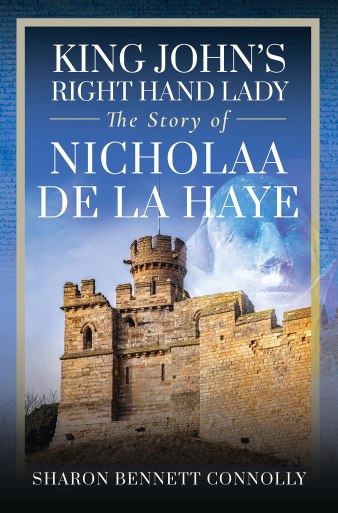
Book Review: “King John’s Right Hand Lady: The Story of Nicholaa de la Haye” by Sharon Bennett Connolly

Nicholaa de la HayeThe year is 1217, and Lincoln Castle is being attacked. King John is dead, and his son Henry III is now king, but chaos still reigns. Noblemen are fighting against each other, and amid this conflict is a woman in her sixties. She is used to the instability of England as she is not only the constable of the castle being besieged, but she has earned the right to be named the first female sheriff of England. She was a daughter, a wife, a mother, a widow, and someone the Plantagenets could depend on. The name of this remarkable woman is Nicholaa de la Haye, and her unbelievable story is told in Sharon Bennett Connolly’s latest book, “King John’s Right Hand Lady: The Story of Nicholaa de la Haye.”

I want to thank Pen and Sword Books and Net Galley for sending me a copy of this book. I remember first hearing the name Nicholaa de la Haye from one of Sharon Bennett Connolly’s other books, “Ladies of Magna Carta: Women of Influence in Thirteenth Century England.” I wanted to learn more about this woman, how she gained the trust of King John, and why she was not only a constable of Lincoln Castle but a sheriff for Lincolnshire.

To understand how Nicholaa de la Haye became the constable of Lincoln Castle, we have to explore the origins of the Haye family and their connection to the Plantagenets. Connolly tracks the family back to the Norman Conquest, but the main focus is on the direct family of Richard de la Haye and Matilda de Verdun, Nicholaa’s parents. The Haye family has a legacy and a deep sense of duty to protect the English royal family from invaders or rebels, which passed on to Nicholaa and her sisters as they were their father’s heiresses. With Richard de la Haye’s death, Nicholaa inherited his role as constable of Lincoln Castle.

Nicholaa de la Haye was married twice to William Fitz Erneis and Gerard de Camville, and she had several children. When her husbands were away or had died, Nicholaa could uphold her birthright as a constable. It was not an easy road, but she did have the backing of King John during the First Baron’s War. Connolly takes the time to explore how John became king, his connection with Nicholaa de la Haye, the Magna Carta crisis, and the First Baron’s War. Before his death, King John named Nicholaa the first female sheriff of England in charge of Lincolnshire. Finally, she had to deal with the siege of Lincoln Castle for three months in 1217, which was just a cherry on top of her whole life experience.

A strong, independent woman who lived a thrilling life and was willing to defend her home of Lincoln Castle even at the age of sixty, Nicholaa de la Haye was an unsung heroine of the thirteenth century. Connolly’s passion for telling Nicholaa’s tale of trials and tribulations exudes on every page. “King John’s Right Hand Lady: The Story of Nicholaa de la Haye” by Sharon Bennett Connolly is the perfect book for anyone who wants a story about the Plantagenets, King John, and the first female sheriff of England. A true triumph in exploring the life of a more hidden figure from the thirteenth century.

Book Review: “Catherine and Anne: Queens, Rivals, Mothers” by Owen Emmerson, Kate McCaffrey, and Alison Palmer

catherine and anneTwo women destined to be rivals for one man’s affection. One is the daughter of royalty, destined to become Queen of England since she was a baby. Her first husband died suddenly, and she married her brother-in-law, the young King Henry VIII. The other woman is the daughter of a family on the rise at court. She has been educated in courts abroad but has returned to her native England to serve the Queen of England, but King Henry VIII falls in love with this young woman. Catherine of Aragon and Anne Boleyn; are two women destined to be rivals, but a new museum exhibit uncovers these women’s similarities. In this corresponding book, “Catherine and Anne: Queens, Rivals, Mothers,” Owen Emmerson, Kate McCaffrey, and Alison Palmer share the latest academic research to understand better these two queens who dominated the 16th century.

This is not the first book I have read that corresponds with a new exhibit at Hever Castle. Last year, I read the book connected with the “Becoming Anne: Connections, Culture, Court” exhibit. Since I cannot visit Hever Castle in time to see this new exhibit, I wanted to read this book to support Hever Castle and the ongoing research to breathe new life into the times of the Tudors.

“Catherine and Anne: Queens, Rivals, Mothers” is a brand-new exhibit exploring the connection between Catherine of Aragon and Anne Boleyn, which is ongoing until November 10, 2023 (although the Book of Hours belonging to Catherine of Aragon will be available to view up until June 4, 2023). Emmerson, McCaffrey, and Palmer give their readers a quick overview of the lives of Catherine of Aragon and Anne Boleyn, including their education, their relationships with Henry VIII, and their daughters, before diving into the piece de resistance of the entire exhibit, the two Books of Hours belonging to the two queens respectively.

Hever Castle’s Assistant Curator, Dr. Kate McCaffrey, has uncovered the remarkable similarities between the Book of Hours owned by Catherine of Aragon (owned by the Morgan Library) and the Book of Hours once owned by Anne Boleyn, which is now located at Hever Castle. Not only were they created by the workshop of Hardouyn. They may have been made in the same workshop, but the differences in the decoration style and how they were used as worship tools show how unique the two queens were.

Although I can’t visit this exhibit, the illustrations and the new research provided an unexpected window into the past. I hope Kate McCaffrey will one day write a book exploring more of her research, as I would most definitely be interested in learning more about it. An informative and delightful little book, “Catherine and Anne: Queens, Rival, Mothers” by Owen Emmerson, Kate McCaffrey, and Alison Palmer, is a book for any Tudor fan.

Guest Post: “Horse Breeds in the Middle Ages” by Rowena Kinread

The Scots of Dalriada Tour Banner 1Today, I am pleased to welcome Rowena Kinread to my blog as part of the blog tour for her novel, “The Scots of Dalriada.” I want to thank The Coffee Pot Book Club and Rowena Kinread for allowing me to be part of this blog tour.
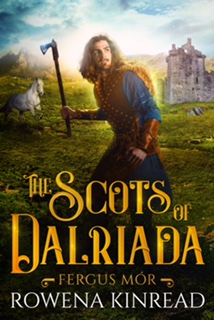
In ‘The Scots of Dalriada’ Fergus hides in a horse breeding- and training- centre on Aran. Is it realistic that such studs existed in the early Middle Ages? The answer is yes!

Throughout this period, horses were rarely considered breeds, such as today we have the Clydesdale horse, Haflinger, or Lipizzaner, to name just three; but instead, they were defined by type, by describing their purpose or physical attributes.

Breeders practiced selective breeding, as opposed to certain bloodlines as usual today. For example, the destrier or war horse was required to be strong, fast, and agile. Horses that had already proved themselves in battle would be used to breed new generations.

Horses from this age differed in size and build to the modern horse. Generally speaking, they were much smaller. The average horse of the time was 12 to 14 hands (48 to 56 inches, 122 to 142 cm). The destrier was described in contemporary sources as ‘tall and majestic and with great strength’. It was frequently referred to as the ‘great horse’ because of its size and reputation. This was a subjective term by medieval standards, and the destrier would appear small to our modern eyes. In my novel, I name the height as 14.2 hands; this would be exceptionally tall in the day.

 In addition to selective breeding, training was also common. Kings would not have the time to train their horses themselves. It would take a minimum of two years to fully train a destrier. A lot of schooling is required to overcome a horse’s natural instinct to flee from noise, the smell of blood, and the confusion of combat. It must also learn to accept smoke and fire and any sudden movements.

For this reason, war horses were more expensive than normal riding horses, and destriers the most prized, but figures vary greatly from source to source. Destriers are given values ranging from seven times the price of an ordinary horse to seven hundred times. The Bohemian king Wenzel II rode a horse ‘valued at one thousand marks’ in 1298. At the other extreme, a 1265 French ordinance ruled that a squire could not spend more than twenty marks on a rouncey. Knights were expected to have at least one war horse (as well as riding horses and packhorses), with some records from the later Middle Ages showing knights bringing twenty-four horses on the campaign. Five horses were perhaps the standard.


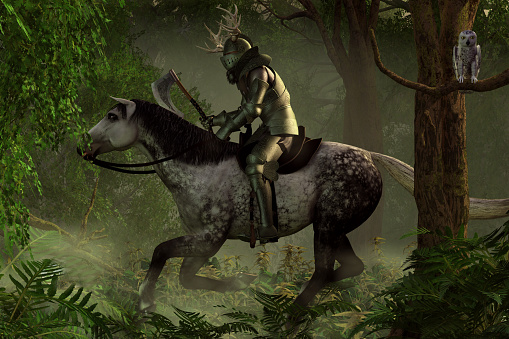
Image destrier
An armored medieval knight, axe in hand, and with a helmet decorated with antlers, rides his horse through a dense forest. 3D Rendering


Other horse ‘types’ in the Middle Ages:

  1. Palfreys = riding horses. The well-bred palfrey, which could equal a destrier in price, was popular with nobles and highly-ranked knights for riding, hunting, and ceremonial use. Ambling was a desirable trait in a palfrey, as the smooth gait allowed the rider to cover long distances quickly in relative comfort.
  2. cart horses or packhorses
  3. ‘Coursers’ were generally preferred for hard battles as they were light, fast, and strong. They were valuable but not as costly as the destrier. They were also used frequently for hunting.
  4. ‘Rouncey’ is a more general-purpose horse, which could be kept as a riding horse or trained for war. It was commonly used by squires, men-at-arms, or poorer knights. A wealthy knight would keep rounceys for his retinue. Sometimes the expected nature of warfare dictated the choice of horse; when a summons to war was sent out in England in 1327, it expressly requested rounceys for swift pursuit rather than destriers. Rounceys were sometimes used as pack horses but never as cart horses.
  5. ‘Jennet’ is a small horse first bred in Spain from Barb and Arabian bloodstock. Their quiet and dependable nature, as well as size, made them popular as riding horses for ladies; however, they were also used as cavalry horses by the Spanish.
  6. The ‘hobby’ was a lightweight horse, about 13 to 14 hands, developed in Ireland from Spanish or Libyan bloodstock. This type of quick and agile horse was popular for skirmishing and was often ridden by light cavalry known as Hobelars. Hobbies were used successfully by both sides during the Wars of Scottish Independence, with Edward I of England trying to gain an advantage by preventing Irish exports of horses to Scotland. Robert Bruce employed the hobby for his guerilla warfare and mounted raids, covering 60 to 70 miles a day.

The Scots of Dalriada coverBlurb:

THREE BROTHERS

Fergus, Loarn, and Angus, Princes of the Dalriada, are forced into exile by their scheming half-brother and the druidess Birga One-tooth.

THREE FATES

Fergus conceals himself as a stable lad on Aran and falls helplessly in love with a Scottish princess, already promised to someone else. Loarn crosses swords against the Picts. Angus designs longboats.

TOGETHER A MIGHTY POWER

Always on the run, the brothers must attempt to outride their adversaries by gaining power themselves. Together they achieve more than they could possibly dream of.

Fergus Mór (The Great) is widely recognized as the first King of Scotland, giving Scotland its name and its language. Rulers of Scotland and England from Kenneth mac Alpín until the present time claim descent from Fergus Mór.

Full of unexpected twists and turns, this is a tale of heart-breaking love amidst treachery, deceit, and murder.

Buy Links:

Universal Link:   https://books2read.com/u/47VXAL 

Amazon UK: https://www.amazon.co.uk/gp/product/B0BS78THF3 

Amazon US: https://www.amazon.com/gp/product/B0BS78THF3 

Amazon CA: https://www.amazon.ca/gp/product/B0BS78THF3 

Amazon AU: https://www.amazon.com.au/gp/product/B0BS78THF3 

Rowena Kinread 1Author Bio:

Rowena Kinread grew up in Ripon, Yorkshire, with her large family and a horde of pets. Keen on traveling, her first job was with Lufthansa in Germany.

She began writing in the nineties. Her special area of interest is history. After researching her ancestry and finding family roots in Ireland with the Dalriada clan, particularly in this era. 

Her debut fiction novel titled “The Missionary” is a historical novel about the dramatic life of St. Patrick. It was published by Pegasus Publishers on Apr.29th, 2021, and has been highly appraised by The Scotsman, The Yorkshire Post, and the Irish Times.

Her second novel, “The Scots of Dalriada,” centres around Fergus Mór, the founder father of Scotland, and takes place in 5th century Ireland and Scotland. It is due to be published by Pegasus Publishers on Jan.26th, 2023.

The author lives with her husband in Bodman-Ludwigshafen, Lake Constance, Germany. They have three children and six grandchildren.

Social Media Links:

Website: https://www.rowena-kinread.com/ 

Twitter: https://twitter.com/RowenaKinread 

Facebook: https://www.facebook.com/rowena.strittmatter 

LinkedIn: https://www.linkedin.com/in/rowena-kinread-6b054b228/ 

Instagram: https://www.instagram.com/rowenakinread/ 

Book Review: “Eleanor of Aquitaine: Queen of France and England, Mother of Empires” by Sara Cockerill

eleanor of aquitaineWhen we think of the infamous queens of England, some names come to mind, but one rises to the top for the number of black myths and influence surrounding her name: Eleanor of Aquitaine. The orphaned Duchess of Aquitaine, who married the future King Louis VII of France, went on the Second Crusades with her husband, survived battles and kidnappings, and ended up divorcing her first husband because she couldn’t give a male son. So, she married the young Count of Anjou, who would become the first king of the Plantagenet dynasty, King Henry II, who had a large family and split her time between England and France. Eleanor would eventually side with her sons, rebel against Henry, and spend 15 years in prison. A fire-cracker of a queen, but how many of the stories surrounding the titular queen are true? In her latest biography, “Eleanor of Aquitaine: Queen of France and England, Mother of Empires,” Sara Cockerill dives deep into the archives to tell the true story of this much-maligned queen of England and France.

I want to thank Amberley Publishing for sending me a copy of this book. I have enjoyed reading books about Eleanor of Aquitaine, and when I heard about this biography, I was fascinated. A few of my history friends have read this book and enjoyed it, so I wanted to see what the hype was about regarding this particular title.

Cockerill begins by showing what myths are typically associated with Eleanor of Aquitaine and how these myths have developed over time. She explains that Eleanor was a much more subdued queen than we imagined her to be and that her dive into the primary sources will show her readers the true Eleanor of Aquitaine. Cockerill then moves into the history of the Duchy of Aquitaine and Eleanor’s family, shaping her into the ruler and mother she would become.

The bulk of this book explores Eleanor of Aquitaine’s married life, first to King Louis VII of France and then to King Henry II of England. As Queen of France, Eleanor had two daughters, went on the Second Crusades, was kidnapped by pirates, and saw numerous battles. Eleanor’s reputation was blackened during the Crusades with the alleged Affair at Antioch. Still, Cockerill takes the time to go through the origins of each myth and show what might have happened according to the primary sources available. With the demise of the marriage of Eleanor and Louis VII, we see how Eleanor met Henry II and how her time as Queen of England was different than her time as Queen of France. We see her relationships with her sons and daughters and how her marriage with Henry went sour.

Most of the primary sources Sara Cockerill explores are charters that Eleanor of Aquitaine worked on as Duchess of Aquitaine and as Queen of France and England. This means it is more academic, and for casual history lovers, it can come across as a bit dry in some places. Overall, I found this a compelling retelling of Eleanor of Aquitaine’s story that gave me a lot to think about her and her time. Suppose you want a new biography that will present a fresh approach to the life and times of Eleanor of Aquitaine. In that case, I highly recommend you read “Eleanor of Aquitaine: Queen of France and England, Mother of Empires” by Sara Cockerill.

Guest Post: “Excerpt from ‘Close Your Eyes- A Fairy Tale’ by Chris Tomasini

Close Your Eyes A Fairy Tale Tour BannerI am pleased to welcome Chris Tomasini to my blog today to share an excerpt from his novel, “Close Your Eyes- A Fairy Tale.” I would like to thank Chris Tomasini and The Coffee Pot Book Club for allowing me to be part of this tour. 

Tycho

The first year Tycho spent with us at Gora, he was like a child running frenzied through a kitchen full of Christmas delicacies. The gossip which arose about him was voluminous. I often sat in the castle kitchen, a mug of beer in my hand, listening to what the women said about the boy. What amused me most, as I watched them roll their eyes when his name was again mentioned in a less than lustrous light, was that they adored Tycho. They pretended they didn’t, not wishing to be teased, but I could see it in their eyes, in their rapt attention when the boy walked into a room, in their troubled breathing when he touched his hands to their shoulders or hair.

I don’t know what drew them to him, but it was much more than his youth and good looks. He was playful and irreverent, and the aura of foreign lands hung about him. Tycho could speak a dozen languages fluently, he could tell those magical stories, twinkle his eyes seemingly at will, and when they twinkled for you, it felt like you were sharing something with him, a sort of blissful astonishment at being alive.

It was also in the way he moved. Tycho eased through a room like a breeze across a field. He was around you; you raised your face to allow the wind to sweep close, and then he was gone, around a table, talking to someone else. He was here and there, here and gone, coming and going, a smile for you, a smile for someone else, and from watching him in the kitchen, in the dining hall, amongst crowds, I think what made him so sought after was that people felt a need to be alone with him, to possess him unreservedly, if only for a few short moments.

I have spoken, in the years since he left, to many people about Tycho. I asked the women why they chased him, why they desired him when he was unabashedly a scamp who was sleeping with every woman in the castle. I asked other of our friends why it felt such a privilege to be alone with him, and I think we all knew, unconsciously, that the road was not yet done with Tycho and that he had only been given to us for a short time.

Ahab has spoken to me of a Greek historian named Herodotus and of his fascination with a people named the Scythians, who lived around the Black Sea. Ahab thought that Tycho resembled these people, who did not live in cities or settle farms, but rather followed their herds of cattle across endless prairies, riding on wagons, carrying their tents with them. The Greek word for this way of life was aporia – to be a nomad, to be without a home, to be inaccessible to others.

I have been a child of the road. I lived that life for three years, and Ahab, with his delight in things ancient, things intellectual, did not grasp the fundamental difference between Tycho and the Scythians. To be a Scythian, I imagine, was to carry your life with you – your family, your belongings, your past, your history. But Tycho was a single boy, an orphan, alone upon a road.

The road forces you to decide if your destination is worth the hardship – making this decision is the traveler’s burden. But Tycho was more than a traveler. He was a wanderer who did not even have a destination. I think it was this sadness which many of us saw in the boy beneath the charm and the winning smile. We saw the sadness of a soul which would forever be in transit, which would never know a home, and which would forever be apart.

Close Your Eyes CoverBlurb:

Set in early 1400s Europe, Close Your Eyes is a sincere yet light-hearted and lustful ode to love. As Samuel, the court jester, struggles to describe why his friends, Agnieszka, the cook, and Tycho, the storyteller, fled the King of Gora’s service, he learns that love was the beating heart behind everything that happened in the castle. 

He learns as well that more ghosts than he knew of walked the midnight halls and that the spirit of Jeanne d’Arc haunted his friend and once slid into bed with Tycho, daring him to leave – to take to the cold roads of Europe, where he had once wandered orphaned and alone, and find his destiny there.

Buy Links:

Universal Link: https://books2read.com/u/4DJN6g 

Amazon UK: https://www.amazon.co.uk/dp/B09NRYXDM9

Amazon US: https://www.amazon.com/dp/B09NRYXDM9

Amazon CA: https://www.amazon.ca/Close-Your-Eyes-Fairy-Tale/dp/B09NRK3ZQH

Amazon AU: https://www.amazon.com.au/Close-Your-Eyes-Fairy-Tale/dp/B09NRK3ZQH

Chris Tomasini

Author Bio:

Chris Tomasini lives in Ontario, Canada. He has studied creative writing via Humber College’s “Correspondence Program in Creative Writing” and through the University of Toronto School of Continuing Studies. 

In the 1990s, Chris taught English as a Second Language and had stops in England, Poland, and Japan.

Since 2000, Chris has worked in bookstores, publishing, and libraries.

Chris is married with two children and can often be found (though not very easily) on a bicycle on country roads in central Ontario.

Social Media Links:

Website: http://www.christomasini.ca/

Instagram: https://www.instagram.com/chrisfindsthelight/

TikTok: https://www.tiktok.com/@chrisfindsthelight

Book Bub: https://www.bookbub.com/authors/chris-tomasini

Amazon Author Page: https://www.amazon.com/stores/author/B019NO9NO2

Goodreads: https://www.goodreads.com/author/show/14814659.Chris_Tomasini

Book Review: “The Royal Diaries- Elizabeth I: Red Rose of the House of Tudor” by Kathryn Lasky

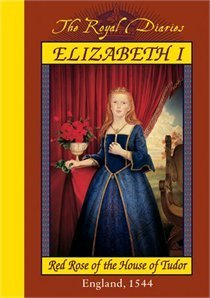
royal diaries elizabeth IWhat was the first book you read that excited you so much about the historical figure that you wanted to continue studying history? You would read any text you could get ahold of that mentioned their name, including encyclopedia entries. You have fond memories of that book and wish to reread it as an adult to see if it is still a great book with all its charms. I have noted numerous times that the book series that enticed me to study history was The Royal Diaries Series. The book that started my fascination with the Tudors was “The Royal Diaries- Elizabeth I: Red Rose of the House of Tudor” by Kathryn Lasky.

I first read this book and the Royal Diaries series in 6th grade/ middle school. I remember being utterly enraptured with the invisible princess Elizabeth and her struggle to be noticed by her family, especially her father, Henry VIII. Elizabeth was a strong and very intellectual princess; she became my historical heroine as a child. I would read anything about her and the Tudors, which fueled my desire to study history in college. When I started Adventures of a Tudor Nerd, I knew I wanted to get a copy of this novel to reread and review as a nod to my past.

This fictitious diary of Elizabeth I begins in 1544 and ends in 1547, covering a lot of changes in young Elizabeth’s life and the Tudor court. Her governess, Kat Champernowne (soon to be Ashley), gave Elizabeth the diary to record her thoughts after Queen Catherine Parr convinced her father, King Henry VIII, to allow Elizabeth to return to court. Elizabeth’s life has been rocky since her mother’s execution at her father’s command because, as this version of the tale goes, she was a witch.

Since this is a children’s book, the diary entries, as are the characterizations of the people around Princess Elizabeth at court, are very generic. Kat is paranoid about poisons, Henry VIII is old, fat, and has dramatic mood changes. Anne of Cleves is a kind soul with a thick accent and an unpleasant appearance. Mary is a manipulative person who treats Elizabeth horribly because she is the daughter of Anne Boleyn. Edward is a sickly child destined to become the next King of England, but many wonders if he will last that long. Robin Dudley is Elizabeth’s best friend who would rather have fun than study like his friend.

While rereading this novel, I found numerous historical inaccuracies I overlooked when I was younger because it was the first Tudor novel I had ever read. Of course, the target audience for this book and the series are children the author hopes will get interested in the story and start studying history. Still, it deserves a rewrite to incorporate correct historical facts.

Even though there were errors, I still am very fond of this book and The Royal Diaries series. Overall, this is a decent book and series for young readers who want to study history, especially royal history. If you have a young history lover who wants to learn more about Elizabeth I and her childhood in a fun way, you should have them read “The Royal Diaries- Elizabeth I: Red Rose of the House of Tudor” by Kathryn Lasky.