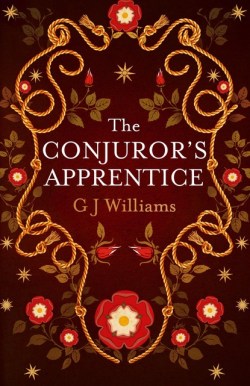
 I am pleased to welcome G.J. Williams to my blog today to share an excerpt from her latest novel, “The Conjuror’s Apprentice.” I want to thank G.J. Williams and The Coffee Pot Book Club for allowing me to be part of this blog tour.
John Dee stared at the letter, then at Cecil. ‘The letter must have been penned by someone who has sight of this household – and the same person who planted the letter on Jonas.’
The master of the house nodded and put his head in his hands, propelling Mildred to cross the room and put her hand on his shoulder. He glanced up and patted her fingers. ‘Are you quite sure what you read, my dear?’
‘Yes. You heard the words yourself. The letter is to someone who wants testimony of your movements. The scrivener speaks of your visits to Lady Elizabeth. Each one is listed. They even know you are due to visit her again this week.’ Her lips pinched together in anxiety. ‘They state that you hide a book of Elizabeth’s treachery to protect her.’ Mildred looked at John Dee. ‘Why would they make up such stories of us?’
But next to her, Cecil did not move. He kept staring at the wood of his desk, his brow crinkled in thought. A slight flush spread across his cheeks.
Margaretta shifted in her seat, the feelings rising inside her. Dread. Something you’ve done. A secret. You imagine being arrested. You are hiding something. She leaned forward, touched John Dee’s sleeve, and whispered, ‘Mae e’n cuddio rhywbeth.’ He hides something.
Cecil’s eyes darted to her. ‘I do not speak my forefathers’ tongue with ease. What did you say?’
Thank the Lord John Dee stepped in. ‘She says she must away to the kitchen and her chores soon.’ He leaned forward and dropped his voice to a cajoling purr. ‘Is there anything you have secreted, my friend? Better we know.’
Cecil sat up straight and cleared his throat. His wife’s fingers tightened on his shoulder as she looked down, beginning to frown. Her husband looked at the window as if searching for the right words. ‘I…I…hold a book belonging to the Lady Elizabeth. Nothing treasonous. Just her thoughts.’ He swallowed and looked to Dee, a faint beseeching in his eyes.
The room was silent.
Panic. Confusion. It is you, Lady Mildred. Anger.
John Dee leaned forward again, keeping the low, calm voice. ‘Where is this book?’
‘Mildred’s library. Well hidden among the religious texts.’ At this, Lady Cecil gave a short, sharp cry and snatched her hand away from her husband. She walked to the window and put her hands on the glass. They could see her kirtle move with her fearful breathing. Then she turned and faced him, her face pale and fixed in fury. ‘You brought secrets here and put us all in danger? Have your senses left you, husband?’ Her voice was slow and cold.
In an instant, he was on his feet, rebutting her challenge with indignation. ‘No, Mildred. I was showing loyalty to a fragile girl wracked with fears. She is under constant suspicion.
So, when she was summoned to court to attend her sister’s birthing, she dared not take it with her nor leave it behind. I am the only one she trusts. What could I do? Abandon her?’
‘And what is in this book, William?’ asked Dee.
‘Her thoughts on regency. She speaks of a fair rule; of religious tolerance rather than the burning we live with today; of making this land great again and not a puppet of Spain.’
Cecil dropped his head forward, and his voice fell to a murmur. ‘She speaks of a golden age in which men thrive, not fear life.’
Dee sighed. ‘So, she speaks of being queen.’ He waited until Cecil nodded. ‘So, with Mary expecting her own son to succeed her, it is a tome of treason.’ He gave a small laugh. ‘Making my conjuring look pale in comparison.’
Cecil bristled. ‘No. It is a volume of hope. The only treason lies with those who would put a Spanish prince as our ruler.’
He gave a low growl. ‘For the love of God, they circle court like hawks awaiting the death of Mary and her babe so they can grasp power while England mourns.’
John Dee opened his palms in question. ‘Mary herself made Philip King of England. Not a prince. Not her consort. A king.’
Cecil wheeled round. ‘Elizabeth is the rightful heir to the throne. Not a Spanish puppet of the Catholic Pope. A woman of true faith…Protestantism.’
‘So, if Elizabeth aspires to be queen, she is the single threat to the supporters of Philip.’ John Dee pointed an accusing finger. ‘And that book sets out her ambition.’ He paused. ‘That book will take her to the Tower and her death for treason… and someone in your household knows of it. They also know your involvement.’
From the window, Lady Cecil spoke. ‘And her treasonous book is in this house. And somebody knows it.’ She turned to look through the glass onto the bustling street below. ‘May God save us.’
 Blurb
Blurb
Born with the ability to hear thoughts and feelings when there is no sound, Margaretta Morgan’s strange gift sees her apprenticed to Doctor John Dee, a mathematician, astronomer, and alchemist. Using her secret link with the hidden side and her master’s brilliance, Margaretta faces her first murder mystery. Margaretta and Dee must uncover the evil bound to unravel the court of Bloody Mary.
The year is 1555. This is a time ruled by fear. What secrets await to be pulled from the water?
The Conjuror’s Apprentice takes real people and true events in 1555, into which G J Williams weaves a tale of murder and intrigue. Appealing to readers of crime and well-researched historical fiction alike, this is the first in a series which will follow the life, times, plots, and murders of the Tudor Court.
Trigger Warnings:
Descriptions of bodies and the injuries that brought about their death.
Threat of torture; description of man who has been tortured.
Buy Links
Amazon UK: https://www.amazon.co.uk/Conjurors-Apprentice-G-J-Williams/dp/1915194199
Waterstones
https://www.waterstones.com/book/the-conjurors-apprentice/g-j-williams/9781915194190
RedDoor
https://www.reddoorpress.co.uk/products/the-conjurors-apprentice?_pos=1&_sid=30c68d694&_ss=r
 Author Bio
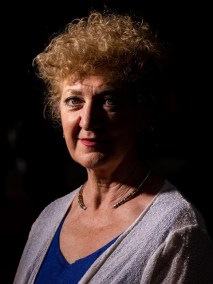
After a career as a business psychologist for city firms, G.J. Williams has returned to her first passion – writing tales of murder, mystery, and intrigue. Her psychology background, melded with a love of medieval history, draws her to the twists and turns of the human mind, subconscious powers, and the dark side of people who want too much.
She lives between Somerset and London in the UK and is regularly found writing on a train next to a grumpy cat and a bucket of tea.
Social Media Links:
Twitter: https://mobile.twitter.com/gjwilliams92

 A 16-year-old duchess, who lived a sheltered life, died in a remote villa after only being married to her husband, Alfonso Duke of Ferrera, for a mere year. Many suspect that she died of a fever, but there are rumors that her husband had her poisoned. Not much is known about Lucrezia de Medici, Duchess of Ferrara, except her marriage portrait and a brief mention of her in Robert Browning’s poem, “My Last Duchess.” Did she die of a fever, or was there a more sinister plot behind her demise? The mystery around her life and unexpected death have not been discussed much until now in Maggie O’Farrell’s latest novel, “The Marriage Portrait.”
 When one says “the Princes in the Tower,” a few images pop into our mind. Two young boys were killed in the Tower by their evil uncle, who would become King Richard III. At least, that is the image that the Tudors wanted the world to see, and for centuries, that story has often been told. However, as research has expanded into who Richard III was, the tale of these two boys and their ultimate fate has become even murkier with new suspects and the question of whether the boys were murdered. Elizabeth St. John decided to take on the mystery of the Princes of the Tower with her twist to the tale in her latest novel, “The Godmother’s Secret.”
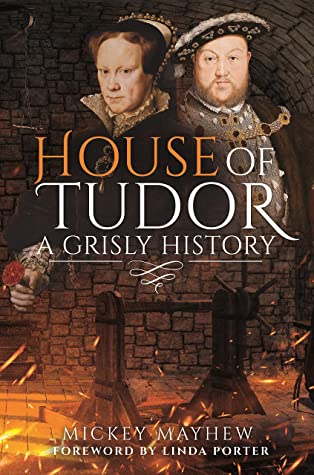 The glitzy, glamorous life of the Tudors portrayed in popular TV shows and novels mask the truth of this infamous dynasty. It is more bloody than what has been described. It is filled with grotesque executions, deadly diseases, bloody battles, and bloody battles. What happened to Richard III’s remains? What was Tudor torture like for those unfortunate victims? What were other devious tales at play in 16th-century Europe? Mickey Mayhew has worked hard to answer these questions by combining 45 of the most gruesome stories from this dynasty into one book, “The House of Tudor: A Grisly History.”
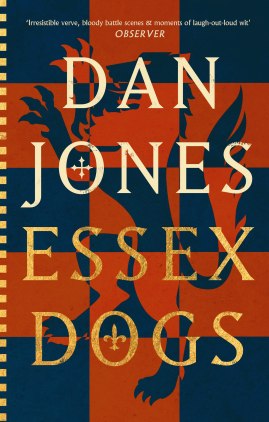 The year is 1346, and numerous English ships have landed on the shores of France. King Edward III, his son Edward of Woodstock, and his lords launched the first stage of what would be known as the Hundred Years’ War. Amongst the English royalty, nobility, and regular soldiers, are companies of men who came of their own accord for money and glory. One company of men consists of ten men known as the Essex Dogs, led by Loveday FitzTalbot. They are not like the other groups. They do not fight for money or glory; they fight for each other. In the horrors of war in a foreign land, can the Essex Dogs keep their promise and stay alive? Dan Jones introduces the world to these ten men and the early stage of the Hundred Years’ War in his first historical fiction novel, “Essex Dogs.”
 The world of someone close to a king, especially someone close to King Henry VIII, was full of hazards and great triumphs. All the glist and glamor of the Tudor court could not save them from the rage of the King. This could apply to anyone who fell during the reign of this infamous King, but none more so than his second wife and queen, Anne Boleyn. Much has been written about Anne Boleyn and her dramatic fall from grace, specifically the final month of her life, but what was she doing in her last year alive? Natalie Grueninger hopes to answer this question in her latest book, “The Final Year of Anne Boleyn.”
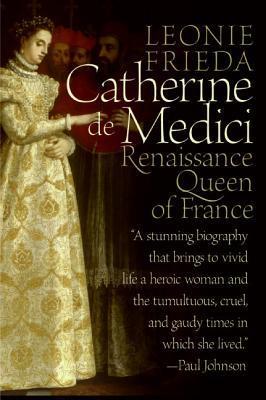 When we think about women rulers in the 16th century, some names, like Queen Mary I, Queen Elizabeth I, and Mary Queen of Scots, come to mind. However, another woman should be included in this list as her life helped keep the Valois dynasty alive and well in France, even though she was Italian by birth. Her name has been tainted with dark legends of poisoning, deadly incidents, and the infamous St. Bartholomew’s Day Massacre. This notorious queen was Catherine de Medici, and Leonie Frieda has chosen to shed some light on the myths and mysteries surrounding this misunderstood woman in her biography, “Catherine de Medici: Renaissance Queen of France.”
 Two women who served Anne Boleyn must deal with the ramifications of staying on opposite sides of the queen’s downfall. One is the next bride of King Henry VIII, who must give the king the son he desires or suffer the consequences. The other is a lady in waiting who holds a dark secret and a relic of the past that could be dangerous to both women. Many of us know the story of Jane Seymour, but is there more to the queen who was able to give King Henry VIII the son he desired? What about the mysterious Margery Horsman? What role did she play in Anne Boleyn’s and Jane Seymour’s inner circles? In her third book, “Keeper of the Queen’s Jewels,” Adrienne Dillard tells the tale of these women bonded by fate to work together to survive such a tumultuous time.
 Many actors and actresses have portrayed the lives of Henry VIII and his six wives in modern films and dramas. When asking Tudor nerds which Henry VIII stood out the most, the most popular response is Keith Michell in the 1970s BBC series, “The Six Wives of King Henry VIII.” I had not heard about this series until I started “Adventures of a Tudor Nerd.” Many people have wanted me to watch the series solely for the performance of Keith Michell, so when a coworker allowed me to borrow her DVD copy of the series, I finally decided it was time to tackle this legendary series.
 Medieval Europe was inundated with strong rulers and dominant figures who made a difference in how the policies of certain countries were formed. We tend to focus on the male figures, from kings to lords and rebels, when we study medieval European history. Still, the women in their lives significantly influenced how their countries were governed. Although many women stood by the side of their husbands and didn’t make much of an impact on European history, some women chose to stand out from the crowd and make a name for themselves. Rebecca Holdorph has chosen to highlight a handful of these dynamic women throughout medieval Europe in her book, “Women in the Medieval Court: Consorts and Concubines.”
 Adventures of a Tudor Nerd