
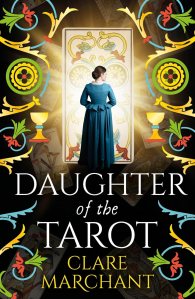
 A single deck of cards changed the fate of generations of women. The tarot cards, created in 16th-century Italy, will connect two women separated by centuries. One was a woman in 17th-century London, originally from Milan, who used the cards to rescue women from abusive relationships. The other is a woman from modern-day London starting her life anew when she comes across an old tarot card deck with a missing card. What began as a hunt for a missing card will connect the two women and change lives forever. The cards hold secrets to the past, but will they bring hope or disaster? This is the premise for Clare Marchant’s latest dual-timeline novel, “Daughter of the Tarot.”
I would like to thank Boldwood Books and Net Galley for sending me a copy of this novel. I recently read her novel, “The Shadow on the Bridge,” which I enjoyed, so when I saw this novel, it had such an intriguing description that I wanted to read it. I am not familiar with the history of tarot cards, and I have not read many novels set in the 17th century, so I was excited for a new adventure.
As this is a dual-timeline novel, there are two protagonists from two different periods: Portia from 17th-century England and Beatrice from 21st-century England. We begin in Milan in 1629, which has just been hit by the plague, where we are introduced to Portia and her baby daughter, Vittoria, who are struggling to survive. The next time we see Portia and Vittoria, iits 1644 and they are living in London. Vittoria is 15 years old, and Portia is using her talent with tarot cards to help those in need. What Vittoria does not know is that Portia uses her readings to help women escape abusive relationships by using the Devil’s Card as a message for the boatsman Jack, who is in love with Portia. Secrets and truths slowly begin to reveal themselves as someone from Portia’s past has come to London and may destroy her relationship with Vittoria.
In the modern storyline, we meet Beatrice, or Bea, who is starting a new life in London and is opening her own antiques shop. Bea has been avoiding her father and his new love interest since her mother died. She has the gift of reading tarot cards, and one day, she comes across an old deck of cards. The only problem is that it is missing a key card, the Devil’s Card. Bea and her landlord, Jack, search high and low for the missing card and find exactly what they are searching for, and some surprises.
It took me a while to get into this book as it was a slower pace than the previous novel that I read by Marchant. While I enjoyed the modern storyline, the 17th-century portion felt a bit slower, and it didn’t feel like the 17th century to me, but more like the 16th century. Overall, I think it was a decent novel with an interesting pair of protagonists. If you want a story about the 17th century with a unique premise, I recommend you read “Daughter of the Tarot” by Clare Marchant.
 One of the greatest threats to England during the reign of Elizabeth I was the Spanish Armada, under the orders of King Philip II of Spain. In the year 1587, the Spanish ships were spotted off the coast of Devon. Fear grips the country, but one woman is up to the task of keeping her beloved Dartington Hall and its inhabitants from harm. Roberda Chapernowne knows what it means to fight for those she loves and is willing to do it again while her husband, Gawen, is away in Ireland fighting for the Queen after he almost divorced Roberda. Roberda’s life turns upside down when Gawen returns home. Can they rekindle their relationship, or will they fall into despair and ruin? Rosemary Griggs concludes Roberda and Gawen Chapernowne’s stories in her latest novel, “Mistress of Dartington Hall.”
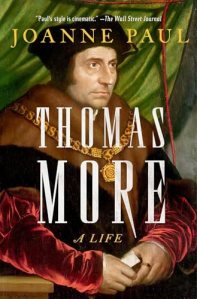 The year is 1535, and an educated scholar, father, writer, and the former Chancellor of England marches to his demise. His crime was staying silent on an issue that the King deemed extremely important: the idea that the King of England should be the Supreme Head of the Church of England, not the Pope. As a Catholic, Sir Thomas More does not agree with this decree and must die. How did one of the most prominent Tudor scholars of his age fall so quickly? Joanne Paul explores the rise and dramatic fall of this infamous Tudor figure in her latest biography, “Thomas More: A Life.”
 I am pleased to welcome Julian de la Motte to my blog to share an excerpt from his novel, “The Will of God.” I would like to thank The Coffee Pot Book Club and Julian de la Motte for allowing me to be part of this blog tour.
 Blurb:
 Blurb:
 Author Bio
 The year is 1599 in Rome, Italy. A young rich woman stands in front of an executioner’s block. She is a mother, a daughter, a sister, a lover, and a killer. Her victim was her father, a man who made her life and the lives of her family members a living hell. When she falls in love with one of her father’s spies, she believes that it is a way out. However, the path she chooses to embark on will bring deadly consequences. What is the truth surrounding this case, and is Beatrice Cenci a cold-blooded murderer or a victim looking for her freedom? Elizabeth Fremantle explores the life of Beatrice Cenci and the circumstances of this crime in her latest novel, “Sinners.”
 Today, I am pleased to welcome Julia Ibbotson back to my blog to share a blurb for her novel, “A Shape on the Air.” I would like to thank The Coffee Pot Book Club and Julia Ibbotson for allowing me to participate in this blog tour.
  Blurb:
 Author Bio
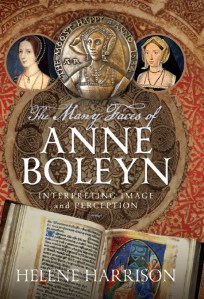 Anne Boleyn, a queen whose story has lived on for centuries. She was the woman who stood between Catherine of Aragon and King Henry VIII. Her daughter, Queen Elizabeth I, was her greatest legacy and her pride and joy. It was her untimely death due to charges that many believe were unfounded. We all have our image of the infamous queen, but how does that change when we switch the type of media we consume? Helen Harrison explores how our idea of Anne Boleyn changed over time in her latest book, “The Many Faces of Anne Boleyn: Interpreting Image and Perception.”
 In each era throughout history, we see how men and women adapt to the struggles and triumphs of the age. Take, for example, the 16th century, primarily in Tudor England. It was a time of great religious changes and dynamic rulers who would change the course of European history forever. While men had the most power, except for a handful of women, the majority of women struggled to survive each stage of life. So, what was life truly like for Tudor women? Elizabeth Norton explores this topic in her book, “The Lives of Tudor Women.”
 The 16th century was dominated by powerful women who left their indelible mark on European history. Take, for example, the aunt of Charles V, the Holy Roman Emperor. No, not Catherine of Aragon, the first wife of Henry VIII. I am talking about a woman who was the daughter of Emperor Maximilian I, was married three times, had no children, and helped raise her nephew Charles V, was an essential part of the Ladies’ Peace, taught Anne Boleyn how to live at court, and was a patroness of the arts and literature. Of course, I am talking about Margaret of Austria, the Governor of the Netherlands. A formidable woman who saw much change and chose to be part of politics, even though she was a woman. Her remarkable story is told in Rozsa Gaston’s novel, “Margaret of Austria: Governor of the Netherlands and Early 16th-Century Europe’s Greatest Diplomat.”
 Adventures of a Tudor Nerd