
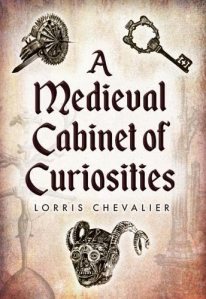
 When we think about how we study history, we often consider documents and chronicles that can provide us with dates and the stories of historical figures. However, this is only half the story. We can learn a great deal from the artifacts left behind. Each era left behind its treasure trove of trinkets for archaeologists and historians to discover and interpret their meanings and purposes. One of the most fascinating periods of history was medieval Europe, full of war, religious struggles, artwork, plagues, and technological advances. What types of artifacts were left behind from medieval Europe? Lorris Chevalier explores the trinkets and artifacts left behind in his book, “A Medieval Cabinet of Curiosities.”
I would like to thank Amberley Publishing for sending me a copy of this book. When I saw the concept for this book, it was intriguing. I was hoping that Chevalier would expand the medieval world to include Eastern Europe, Asia, South America, and perhaps Africa, as they don’t get a whole lot of attention when it comes to medieval studies and a more public history view. I wanted to learn something new.
Chevalier explains that this book explores fifty objects from the Viking Age to the end of the 16th century. These objects range from the religious and extraordinary to the most common articles of clothing. Each item has a unique story to share, which Chevalier discusses succinctly. His goal in this book is to break medieval stereotypes and show how diverse the medieval world was. A nice added feature of this book was that, instead of photographs of the artifacts, Chevalier included watercolor portraits at the end of each section to show what the artifact looked like.
I enjoyed this book for the new stories and characters that I got to meet along the way. These artifacts and stories were fresh and gave depth to the medieval period, even if he did bring up the Dark Ages a few times. I did have a few issues with the book. I did wish we had a wider range in medieval history, which covered more diverse stories than European medieval history. I also wish that the stories and artifacts were in more of a chronological order so readers can see the evolution of the medieval world. As it is written, it felt like it was a cluttered cabinet with no rhyme or reason to the organization, whereas I wanted something a bit more organized.
Overall, I found this quite a fascinating read. Chevalier is extremely knowledgeable about medieval Europe and these artifacts, no matter how obscure. If you want a book that tells the stories of medieval Europe through the trinkets left behind, I recommend you read “A Medieval Cabinet of Curiosities” by Lorris Chevalier.
 When we think about the most impactful women authors, we often think about writers like Agatha Christie, Mary Shelley, and Jane Austen. However, when it comes to religious texts, we have to go back in time centuries. We think about nuns like Bridget of Sweden and a mother of 14 children named Margery Kempe. Yet, we must include an anchorite who stayed in her cell for almost thirty years. Her book, Revelations of Divine Love, is considered the first great work of English prose, but many people are not familiar with the author until now. Janina Ramirez tells the story of Julian of Norwich and how impactful her book was in her book, “Julian of Norwich: A Very Brief History.”
 We all know the story of Romeo and Juliet. Two crazy kids in love, whose families hated each other they decided to make the ultimate sacrifice and die for each other. One of the greatest tragic love stories of all time. But what if it didn’t end in tragedy? What if Romeo and Juliet had their happy ending and had a large family? In this version of Verona, Romeo and Juliet have a large family, and their eldest daughter Rosaline is the most beautiful, headstrong girl in all of Verona. Unfortunately, Rosaline (Rosie) has got herself in quite a mess with an unwanted prince fiancé, a ghost who only she can see, and a murder investigation. Can Rosie solve the case and figure out her love life before things go horribly wrong? This is the premise of the second book of the Daughter of Montague series by Christina Dodd called “Thus with a Kiss I Die.”
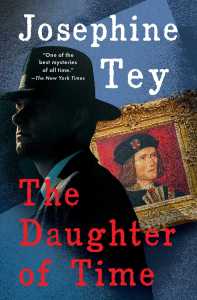 Have you ever read about a historical mystery that captivated you so much that you spent your available free time trying to solve the case? Who was the man in the iron mask? Were the casket letters real? Who built Stonehenge and why? And yet, one of the greatest mysteries in all of history revolves around two missing princes who were last seen in the Tower of London. Nearly five hundred years later, an inspector from Scotland Yard named Alan Grant decides to take on the case. Can the inspector solve the ultimate cold case? Josephine Tey tells the tale of the detective and the mystery of the Princes in the Tower in her most famous novel, “The Daughter of Time.”
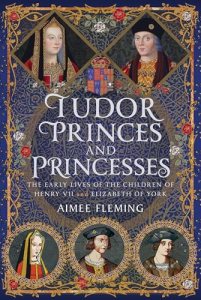 The year is 1485, and the last Plantagenet king, Richard III, is dead. The young man whose army defeated the king is Henry Tudor, and he is about to start a dynasty that will reshape world history forever. Henry Tudor, now King Henry VII, married the daughter of King Edward IV and Elizabeth Woodville, Elizabeth of York. Their marriage and their children would lay the foundation for the Tudor dynasty, but what was life like for the children who were the first generation of this remarkable dynasty? Aimee Fleming explores the lives of these royal siblings in her latest book, “Tudor Princes and Princesses: The Early Lives of the Children of Henry VII and Elizabeth of York.”
 I am pleased to welcome Heidi Eljarbo to my blog today to share the blurb for her novel, “The Dutch Muse.” I would like to thank The Coffee Pot Book Club and Heidi Eljarbo for allowing me to participate in this blog tour.
 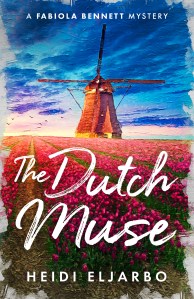 Blurb:
 Throughout history, women have had one major job: giving birth and raising future generations. Each new generation had different ways of dealing with childbirth and raising children, and the Tudors were no exception. While the Tudors lived in the 16th century, the joys and fears of being a mother were similar to those of the modern age. However, the way women approached different stages of life in the 16th century is unique compared to the ways of modern women. So, how did Tudor women approach motherhood? Stephanie Kline hopes to answer this question in her latest book, “Raising the Tudors: Motherhood in Sixteenth-Century England.”
 The Plantagenets, a dynasty that ruled England for over three hundred years. At least that is if you include the Lancastrian and Yorkist kings. Otherwise, the reign of the Plantagenets ended with Richard II being overthrown. So, how did the Plantagenets fall? How did wars, favoritism, and the plague factor into the fall? Helen Carr examines these questions and the rule of three kings over the fourteenth century in her latest book, “Sceptred Isle: A New History of the Fourteenth Century.”
 I am pleased to welcome Tony Riches to my blog to share a blurb for his latest novel, “Bess-Tudor Gentlewoman.” I would like to thank Tony Riches and The Coffee Pot Book Club for allowing me to participate in this blog tour.
 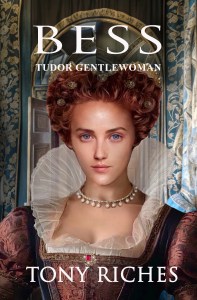 Blurb:
 Author Bio:
 When we think of the greatest writers of all time, we often think about novelists like Jane Austen and Agatha Christie. There is a playwright who we know quite well in our century, but he wrote during the sixteenth century; William Shakespeare, “the Bard.” He may have been a star in his own time and is seen as one of the greats in our era, but it took a while to get him to such a status. In fact, he was forgotten for quite some time, until the 18th century, when an unlikely group of women decided to save the bard from obscurity. The story of the Shakespeare Ladies Club, its members, and the women’s impact is told in Christine and Jonathan Hainsworth’s book, “The Shakespeare Ladies Club: The Forgotten Women Who Rescued the Bawdy Bard.”
 Adventures of a Tudor Nerd