
 The year 1120 was a horrible year for King Henry I. His only legitimate son William died when his ship, The White Ship, sank in the middle of the night. This tragedy left Henry with one option, his legitimate daughter Matilda, the former Holy Roman Empress, would become Queen of England, and her sons would continue the royal line. Unfortunately, Matilda’s throne was taken by Stephen of Blois, and now Matilda must join forces with her stepmother Her stepmother Adeliza has always stood by Matilda’s side. Still, when she remarries after Henry’s death, Adeliza struggles to support the rightful queen but stays loyal to her new husband, who supports Stephen. Matilda and Adeliza are caught in the middle of the Anarchy in Elizabeth Chadwick’s novel, “Lady of the English.”
We are introduced to Matilda at one of her lowest moments when her first husband, Holy Roman Emperor Henry V, dies, and she must go back to England. Her father, Henry I, has decided that Matilda will be his heiress, and she must marry again to secure his legacy if his current wife, Adeliza, cannot give him another heir. Matilda’s second husband is Geoffrey V Duke of Anjou, a braggart and is abusive towards his wife, even though she outranks him. It is a contentious relationship, but Matilda holds her head up high to try and make this arrangement work for her sons, Geffory, William, and the future Henry II.
Unfortunately for Adeliza, she cannot give her husband the heir he desires, which means that the greatest men in the land must swear oaths to honor Matilda as the next Queen of England. The plan is set, but when Henry I dies, Matilda is in France, so her cousin Stephen of Blois takes the opportunity to become the next King of England. Matilda is furious and decides to fight for her right to the English throne while Geoffrey is in Anjou, but then shifts her position that her eldest son, Henry II, will be the next King of England.
After Henry I’s death, Adeliza decides what is best for her is to live the rest of her life in a nunnery, but that is not her fate. A handsome young man named William D’Albini sweeps her off her feet and gives Adeliza the one thing she long desired, a family. Unfortunately, when Stephen becomes King of England, William D’Albini joins forces with the new king, while Adeliza stays loyal to her step-daughter and friend, Matilda.
This is my first time reading a novel by Elizabeth Chadwick, and I loved it so much. The way Chadwick blended elements of fiction with historical facts was nothing short of astounding. From battles to religious moments, politics to intimate moments, Chadwick brought the story of The Anarchy to life for a modern audience. Reading this novel felt like I was transported to 12th century England and showed where Henry II got his strength and determination to rule England. If you want a vivid and compelling novel about two dynamic women in the 12th century, I highly recommend reading “Lady of the English” by Elizabeth Chadwick.
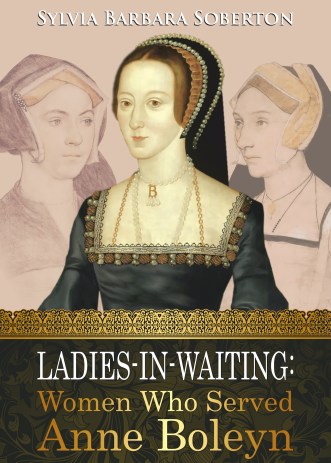 The story of Anne Boleyn and her rise and fall has been told throughout the centuries in numerous ways. With tales of this memorable monarch came rumors of what happened inside her court and the women who served her during her reign. We tend to look at her life through the lens of the men who interacted with Anne Boleyn at court, but what about the women who knew her? Stories of ladies-in-waiting selling the queen out and secret romances ran rampant throughout the centuries, but how much truth is in these tales? Sylvia Barbara Soberton explores these questions in her latest book, “Ladies-in-Waiting: Women Who Served Anne Boleyn.”
 Two queens; one a wife and the mother of kings and the other a virgin who had to fight for the right to rule her country independently. Two women who found friendship and a rivalry between each other with only a sea that divided them and religious discord to drive them apart. Catherine de Medici and Elizabeth I would define what it meant to be female rulers in the 16th century for France and England, respectively. The tales of Elizabeth I and Catherine de Medici have been covered in numerous books, but a joint biography of these two powerhouses is a rarity until now. Estelle Paranque demonstrates how both queens greatly affected each other’s lives in her latest book, “Blood, Fire & Gold: The Story of Elizabeth I and Catherine de Medici.”
 When we think about the more intimate moments in the medieval period of European history, a few misconceptions and myths come to mind, thanks to historical fiction and medieval movies. The idea that girls as young as twelve were married off to much older men was the norm, and there were such things as chastity belts. Everyone was filthy and smelled awful, so they only married in the spring when they would take their annual baths. And the brilliant idea that the wealthiest lords of the village were able to have their way with the bride on her wedding day. The latest book by Kathryn Warner, “Sex and Sexuality in Medieval England,” aims to eliminate these myths to reveal the truth of the intimate lives of those who lived during the medieval period.
 When we think about the men who surrounded King Henry VIII, a few names come to mind. Cranmer, More, Wolsey, and Wroithesley are just a few, but the man who is synonymous with the infamous king’s reign is Thomas Cromwell. The man who helped Henry get his divorce from Katherine of Aragon saw both the rise and fall of Anne Boleyn. He also assisted in the dissolution of the monasteries and brought reform to England with the break from the Roman Catholic Church. To modern audiences, it feels as if we know everything that there was to know about Thomas Cromwell’s public life, but what was he like in his private life when his friends and family surrounded him? Caroline Angus gives her readers an insight into Cromwell’s personal life in her latest book, “The Private Life of Thomas Cromwell.”
 One woman is torn between the loyalty to her birth family and the loyalty to her family by marriage. Now, this may sound like the story of Elizabeth of York, but alas, it is not. This story does take place in the fifteenth century, but it is the story of Elizabeth of York’s grandmother, “The Rose of Raby,” Cecily Neville. Born to the proud Neville family, who were proud Lancastrians, Cecily’s father, Ralph Neville, the Earl of Westmorland, arranged a marriage for his daughter to the young and ambitious Richard, Duke of York. She is now one of the most powerful women in England, but with power comes risks of ruin as Cecily has a secret that could be disastrous. War looms between the Red Roses of Lancaster and the White Roses of York, one that will transform English history forever, with Cecily caught in the middle. Her story is told in Joanna Hickson’s novel, “Red Rose, White Rose.”
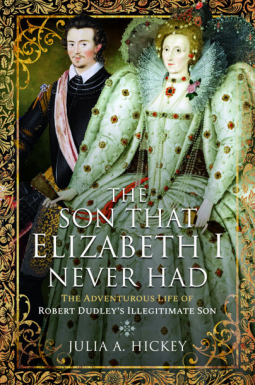 When we study the life of Queen Elizabeth I, the image of a virgin queen who never married tends to come to mind. Of course, she had a man who she favored above all others, Robert Dudley, but he married several times to Amy Robsart and Lettice Knollys. It was with Lettice Knollys that Robert Dudley was able to produce his heir, aptly named Robert Dudley Lord Denbigh, who unfortunately died at a young age. Robert Dudley was left without a legitimate heir, but he did have another son, albeit an illegitimate son, also named Robert Dudley. Julia A Hickey has decided to examine the life of the illegitimate Robert Dudley in her book, “The Son that Elizabeth I Never Had: The Adventurous Life of Robert Dudley’s Illegitimate Son.”
 When we think of those who made an impact in history, we tend to think of those who have been born to a married couple and therefore were considered legitimate children, especially when it comes to royal children. However, we know that illegitimate royal children, like William the Conqueror, greatly impacted history. Illegitimate royal children may have been barred from becoming king or queen of their respective countries of birth, but that does not mean they didn’t impact how their home country was governed. One of these children who affected politics during the Tudor dynasty was Arthur Plantagenet, the illegitimate son of Edward IV. In her latest book, “Arthur Plantagenet: Henry VIII’s Illegitimate Uncle,” she explores the life of this man who gives us extraordinary insight into the running of Calais and how Henry VIII treated other family members.
 Throughout history, there have been a select number of cases of monarchs becoming prisoners either in war or in times of peace. One of the most famous cases of a monarch’s imprisonment during the 16th century was the case of Mary Queen of Scots. While there have been many tales of her infamous imprisonment and execution, there has not been much attention to the men and woman who acted as Mary Queen of Scots’ jailers. Who were the men and woman Elizabeth I put in charge of guarding the Scottish queen while she was in England? What were the conditions of her imprisonment, and what were the castles and manors like when the queen arrived? Mickey Mayhew explores these questions in his book, “Imprisoning Mary Queen of Scots: The Men Who Kept the Stuart Queen.”
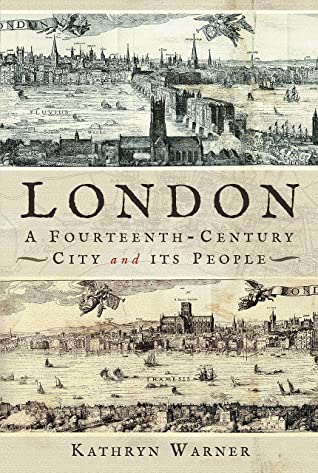 The city of London has been around for over two millennia, and with each passing century, it changes ever so slightly. From the Roman Londinium to medieval London, we see the city grow from a settlement of between 30,000 to 60,000 people to a bustling town of around 80,000 to 100,000 people. With growth comes changes to the city that would become the capital of England, and one of the most significant periods of transformation for the capital was during the fourteenth century. What was life like in fourteenth-century London for the average citizen of this sprawling city? Kathryn Warner attempts to answer this question in her latest nonfiction book, “London, A Fourteenth-Century City and its People.”
 Adventures of a Tudor Nerd