
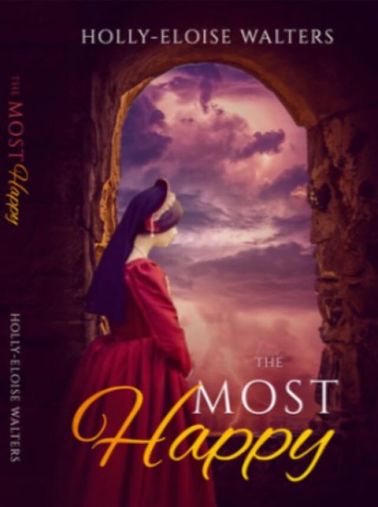
 The story of Anne Boleyn is one of love, triumph, and tragedy. Her tale has been told in many different ways in the several centuries since her execution by many different people. Except by Anne Boleyn herself. We never truly understood what it might have felt like when she went to court for the first time, what it must have felt like to have fallen in love with King Henry VIII. How she might have felt when she had her daughter and experienced her numerous miscarriages. The devastation she must have felt when she found out about Henry’s abusive side, his mistresses, and her ultimate demise. That is until now. In Holly-Eloise Walters’ debut novel, “The Most Happy”, Anne Boleyn tells her personal story, giving the readers a better understanding of the legend.
I would like to thank Holly- Eloise Walters for sending me a copy of her book to read and review. It can be nerve-wracking when you give someone your debut book to read and I am glad I got a chance to read it.
Normally with historical novels, we are introduced to the protagonist by being in their childhood home. That is not the direction that Walters takes as we are introduced to Anne Boleyn as she is in her lowest point, in the Tower waiting to be executed. She is alone, wishing that she could be saved, but knowing that she was going to die. Anne is firm in her love for Henry, even after all they have been through, but her one desire is to see her daughter Elizabeth “Lizzie” in this novel, again. It is in her darkest hour that she chooses to reflect on her life, which is the bulk of this book.
What Walters does extremely well is focused on the relationships that were central in Anne’s life. Obviously, the biggest relationship was the relationship between Anne and her husband King Henry VIII. To say that their relationship was complicated would be an understatement. They started off falling madly in love with one another, not caring who they hurt as long as they were together, but then it dissolved into a rather abusive relationship. Walters also touches on the relationships between Anne and her family. While I agree with how Anne’s relationships with her siblings George and Mary, I do not necessarily agree with how Walters portrays Anne’s relationship with her parents, but that is just a personal comment. This portrayal of Anne’s life is very raw and real, focusing on emotions and relationships.
The one real concern that I had when I was reading this particular novel was the lack of details about the locations and physical descriptions of the people, which can be a difficult thing to do. It was a tad difficult to visualize the people and the locations, but I believe that as Walters grows as an author, she will get better with her descriptions.
Overall, I think this was a very good debut novel. Walters obviously cares about telling Anne’s story through her eyes. It is a bit raw and rough around the edges, but where it shines is the portrayal of the relationships between Anne and those who were around her and were important in her life. You really feel sympathy for Anne Boleyn and heartache for her through Walters’ easy to follow writing style. This may be Walters’ first novel, but I do see potential in her writing. If you would like a new novel about Anne Boleyn from her perspective, I would recommend you read, “The Most Happy” by Holly-Eloise Walters.
 In the study of history, we tend to look at the beginning and the end of a battle and why they were fought. We rarely pay attention to the march that led to the battle, but when we do, there is a distinct reason why. One particular case is of Henry Tudor’s march to the Battle of Bosworth Field. It is a tale that started from his birth at Pembroke Castle to being an exile and then from an exile to being King of England. The story of how an exile became a king and founded the infamous Tudor dynasty deserves attention. Phil Carradice believed that it was time for the story of the first Tudor king and his march to destiny to be told in his latest book, “Following in the Footsteps of Henry Tudor: A Historical Journey From Pembroke to Bosworth”.
 When one thinks about women reformers during the time of the Tudors, certain women like Catherine Parr and Anne Aske come to mind. However, there was one who really should get more attention and her name is Katherine Willoughby. She was the last wife of Charles Brandon. Her mother was Maria de Salinas, a lady in waiting to Catherine of Aragon and a devout Catholic. Katherine knew all six of Henry VIII’s wives on a personal level and knew all of his children. She has often been seen as an afterthought; someone you associate with other people, but never a stand out herself. That is until now. Katherine Willoughby finally gets her time to shine in Tony Riches’ latest historical fiction novel and his conclusion to his Tudor trilogy, “Katherine-Tudor Duchess”.
 The 16th century was filled with extremely strong women who went on to shape European and world history forever. This was true for England and Scotland, two countries whose stories were intertwined by powerful women. The women who ruled these two countries during this time were women that those who study this time period know about; Lady Jane Grey, Mary I, Elizabeth I, and Mary Queen of Scots. There was one woman who knew all four of these women and lived for over 80 years: Bess of Hardwick, Countess of Shrewsbury. The story of these five women is told in Jill Armitage’s book, “Four Queens and a Countess: Mary Queen of Scots, Elizabeth I, Mary I, Lady Jane Grey and Bess of Hardwick: The Struggle for the Crown”.
 The children of King Henry VII and Elizabeth of York lived rather eventful and fascinating lives. We all know the stories of Prince Arthur, who tragically died, his younger brother Henry, who would become the notorious King Henry VIII, and Mary, who would become Queen of France and then marry the man she loved, Charles Brandon. The one sibling that many tend to forget about is Margaret Tudor, who would become the wife of King James IV and the mother of King James V and Margaret Douglas. Her love life was quite rocky, but she kept fighting for what she believed was right for her family and her adoptive country of Scotland. This remarkable woman didn’t receive much attention in her lifetime, but Melanie Clegg hopes that people today will know Margaret’s story. This is why she wrote this delightful biography of the Tudor princess turned Queen of Scotland, “Margaret Tudor: The Life of Henry VIII’s Sister”.
  There are many noble or royal families that truly were the backbone of the English society and that could help or hinder the monarchy. One such family was the Greys, who started as a baronial family and rose through the ranks by good marriages and staying loyal to those who were in power. Of course, when one rises high, there is also the risk of falling low spectacularly, which happens when Lady Jane Grey becomes Queen of England for a mere 9 days. The story of the house of Grey is complex, yet it has never been told in its entirety, until now. This extraordinary family saga is told in Melita Thomas’s latest book, “The House of Grey: Friends and Foes of Kings”.
  The study of the Tudors tends to focus on England as a country of focus, however the Tudors did affect other countries like Spain, France, and Scotland. Many know the story of Mary, Queen of Scots and her relationship with Elizabeth I, but many do not know the tale of her mother, Marie de Guise. Her tale is one of love for her family and her adoptive country of Scotland. It is of loyalty and strength to do what she believed was right. She was a sister, a daughter, a mother, a queen, and a regent of Scotland. Marie’s story tends to be overshadowed by her daughter’s tragic tale, until now. Her story is the main focus of Melanie Clegg’s latest biography, “Scourge of Henry VIII: The Life of Marie de Guise”.
 Words have a lot of power, especially when it comes to how we perceive historical figures. It can be through letters, chronicles, biographies, and this instance, through a couplet written by William Collynbourne in 1484. The couplet in question goes; “
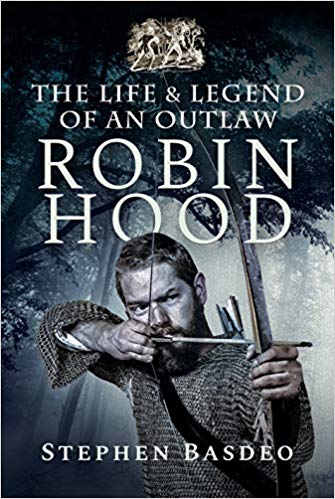 When one studies history, one comes across legends and myths that seem to transcend time itself. In England, there are two such legends. One, of course, is King Arthur and his Knights of the Round Table. The other is of a rogue and his band of merry men, who “stole from the rich and gave to the poor”. Of course, I am speaking of none other than Robin Hood. When exploring Robin Hood, tons of questions come to mind. Who was Robin Hood? Was Robin Hood an actual person? How did his legend change over time? Stephen Basdeo, an Assistant Professor of History at Richmond University, dives into discovering the truth about Robin Hood in his latest book, “Robin Hood: The Life and Legend of an Outlaw”.
 Henry VII winning at the Battle of Bosworth Field on August 22, 1485, is viewed as the beginning of the Tudor Dynasty. However, the story of the Tudor family goes back centuries in Wales. What we consider the story of the Tudors tends to start with a man named Owen Tudor, a servant, who fell in love and married the dowager Queen of England, Catherine of Valois. Quite a romantic tale, but how much of it is true? Were the Tudors simple folk or did they have a bigger role to play in their native Wales? What roles did Owen and his sons play in the Wars of the Roses? These questions and more are explored in Terry Breverton’s latest biography, “Owen Tudor: Founding Father of the Tudor Dynasty”.
 Adventures of a Tudor Nerd