
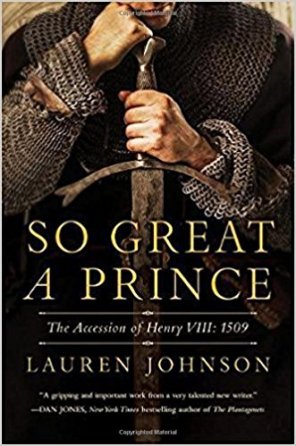
 There are some books that leave a very good impression on you. Books that even when you stop reading it and move to another, you keep thinking about it. For me, this is one of those books. “So Great a Prince: The Accession of Henry VIII 1509” by Lauren Johnson is a page turner, but not because of the main character Henry VIII, but because Johnson writes about how the average citizen was affected by the accession of Henry VIII.
Johnson breaks down the book into chapters based off of important days and times for medieval society: Lady Day, Easter, St. George’s Day, May, Midsummer, Lammas, All Saints and All Souls, Christmas, Plough Day, and Shrove. Unlike our modern calendar, Lady Day was the start of the new year which was on March 25th and for this book, its theme was new beginnings with the death of Henry VII.
Each chapter in this book not only has a specific day or time, but it has a theme such as religion, education, death/ illness and the judicial system. Johnson is able to give a new perspective on this time with the amount of research she had done to make this book possible. She tells the stories of the King and his court but she also tells the stories of the common person. Common people like Alice Middleton, the wife of a mercer who would later marry Thomas More, and John Rastell who was a coroner, had his own legal practice and a printer.
In this book, Johnson reminds us that 1509 may have been a big deal for the Tudor monarchy, but for the common people, it was just another year. Johnson makes this perfectly clear by saying:
Through the eyes of those who lived through it, we can experience the wealth of a world that was vibrant, vivid and exciting, where London streets fluttered with cloth-of-gold to welcome a new king, the shrines of Canterbury Cathedral groaned under the weight of precious stones and vast pageants played out the ideals and fears of communities across the country. A world of peace and of danger. Of prosperity and plague. A world that would be swept away during the course of its young king’s reign. (page 3)
Johnson is able to masterfully give us a snapshot into the world of the young king. I found myself so enthralled by this book. I felt like Johnson wrote this book in such a way that it feels like you could walk the streets of London during 1509. We all know the facts about this time from the perspective of the monarchy, but the monarchy was only one piece to the puzzle that is this time. This book was so educational and entertaining at the same time. Johnson is a new historian, but she is making a big impact with this book. If you really want to understand the world that the Tudors lived in from the commoner to the king, this is a definite must-read. It will be a book you want to read again and again.
 attention towards women like Elizabeth I, Isabella of Castile, Katherine of Aragon, Mary I and Catherine de Medici. These seemed like extraordinary examples of power that stretched the boundaries on what was right and acceptable for women of the time. That, however, couldn’t be further from the truth. In fact, the sixteenth century in Europe was filled with powerful women who do not get the attention that they deserve. In Sarah Gristwood’s book “Game of Queens: The Women who made Sixteenth- Century Europe”, we are shown that it really wasn’t the men who had control, but their wives and daughters.
 On September 8, 1560, a young woman’s body is discovered at Cumnor Place alone at the bottom of the stairs with her neck broken with no other marks on her body. This would have been declared an accidental death by normal people, however the woman was anything but a normal woman; this was the wife of Robert Dudley, Amy Robsart. It was because of who she was and who her husband was that people speculated that foul play was afoot.
  became the Master of the Horse for Elizabeth, Robert changed. He was at home less and Amy had to take over the household affairs. It is through letters that Amy wrote that Skidmore is able to paint a picture for us about how their household worked. The day that Amy died was very peculiar in the fact that she wanted to be left alone; her husband was with the Queen miles away. The original jury found that this was a case of accidental death, however Skidmore decided to take a deeper look into the case. He decided to explore the possibility of accidental death by stairs, the possibility of a medical explanation on why Amy could have fallen down the stairs, and he found the original coroner’s report, which portrays a different story. The amount of research Skidmore pours into this one accidental death is admirable. The one issue I have with the book is the fact that he describes the type of staircases and the details of the coroner’s report but he doesn’t show pictures of these things so it’s a bit hard to visualize what he is talking about.
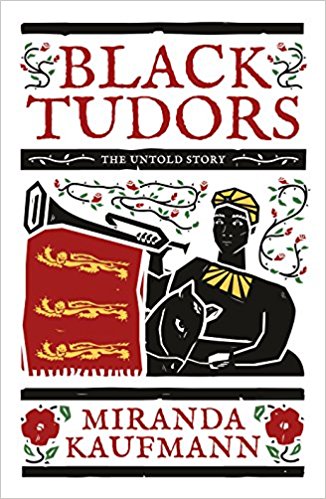 I have always enjoyed reading about the Tudor time period and learning new things about it. There have been some titles that have caught my eye and I have wanted to read for quite some time. This is one such books: “Black Tudors: The Untold Story” by Miranda Kaufmann.
 Adventures of a Tudor Nerd