
 When we think about the most impactful women authors, we often think about writers like Agatha Christie, Mary Shelley, and Jane Austen. However, when it comes to religious texts, we have to go back in time centuries. We think about nuns like Bridget of Sweden and a mother of 14 children named Margery Kempe. Yet, we must include an anchorite who stayed in her cell for almost thirty years. Her book, Revelations of Divine Love, is considered the first great work of English prose, but many people are not familiar with the author until now. Janina Ramirez tells the story of Julian of Norwich and how impactful her book was in her book, “Julian of Norwich: A Very Brief History.”
I have heard the name Julian of Norwich before in books about the 14th century and church history, but I didn’t know much about her life. I saw this book when I was preordering the latest book by Janina Ramirez, and so I decided to give it a try.
Since this is a short book, I will try to keep this review brief. Ramirez divided this biography into sections: the history and the legacy. In history, we as readers learn about Julian’s life from the limited sources that we have about her, as well as learning about how England and Europe changed during her lifetime. It was a chaotic period in the past with the Bubonic plague, the Hundred Years’ War, the Great Western Schism, the Peasants’ Revolt, and John Wycliffe. Let’s be honest, it’s a lot to deal with, but Julian was positive in her anchorite cell. Ramirez shows how complex yet hopeful and full of love Revelations of Divine Love is while showing the theological arguments Julian of Norwich makes in her work of prose. Finally, we get to see how Julian of Norwich’s story and her writing survived for centuries.
This was a delightful little nugget of a book that was extremely well researched, that shone a light on an obscure medieval woman writer. Reading this book gave me a new appreciation for medieval female authors. If you want to learn more about this remarkable woman, I suggest you read “Julian of Norwich: A Very Brief History” by Janina Ramirez.
 We all know the story of Romeo and Juliet. Two crazy kids in love, whose families hated each other they decided to make the ultimate sacrifice and die for each other. One of the greatest tragic love stories of all time. But what if it didn’t end in tragedy? What if Romeo and Juliet had their happy ending and had a large family? In this version of Verona, Romeo and Juliet have a large family, and their eldest daughter Rosaline is the most beautiful, headstrong girl in all of Verona. Unfortunately, Rosaline (Rosie) has got herself in quite a mess with an unwanted prince fiancé, a ghost who only she can see, and a murder investigation. Can Rosie solve the case and figure out her love life before things go horribly wrong? This is the premise of the second book of the Daughter of Montague series by Christina Dodd called “Thus with a Kiss I Die.”
 Have you ever read about a historical mystery that captivated you so much that you spent your available free time trying to solve the case? Who was the man in the iron mask? Were the casket letters real? Who built Stonehenge and why? And yet, one of the greatest mysteries in all of history revolves around two missing princes who were last seen in the Tower of London. Nearly five hundred years later, an inspector from Scotland Yard named Alan Grant decides to take on the case. Can the inspector solve the ultimate cold case? Josephine Tey tells the tale of the detective and the mystery of the Princes in the Tower in her most famous novel, “The Daughter of Time.”
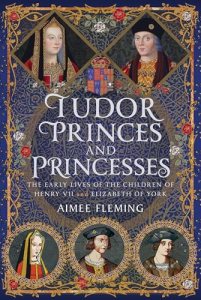 The year is 1485, and the last Plantagenet king, Richard III, is dead. The young man whose army defeated the king is Henry Tudor, and he is about to start a dynasty that will reshape world history forever. Henry Tudor, now King Henry VII, married the daughter of King Edward IV and Elizabeth Woodville, Elizabeth of York. Their marriage and their children would lay the foundation for the Tudor dynasty, but what was life like for the children who were the first generation of this remarkable dynasty? Aimee Fleming explores the lives of these royal siblings in her latest book, “Tudor Princes and Princesses: The Early Lives of the Children of Henry VII and Elizabeth of York.”
 Throughout history, women have had one major job: giving birth and raising future generations. Each new generation had different ways of dealing with childbirth and raising children, and the Tudors were no exception. While the Tudors lived in the 16th century, the joys and fears of being a mother were similar to those of the modern age. However, the way women approached different stages of life in the 16th century is unique compared to the ways of modern women. So, how did Tudor women approach motherhood? Stephanie Kline hopes to answer this question in her latest book, “Raising the Tudors: Motherhood in Sixteenth-Century England.”
 The Plantagenets, a dynasty that ruled England for over three hundred years. At least that is if you include the Lancastrian and Yorkist kings. Otherwise, the reign of the Plantagenets ended with Richard II being overthrown. So, how did the Plantagenets fall? How did wars, favoritism, and the plague factor into the fall? Helen Carr examines these questions and the rule of three kings over the fourteenth century in her latest book, “Sceptred Isle: A New History of the Fourteenth Century.”
 When we think of the greatest writers of all time, we often think about novelists like Jane Austen and Agatha Christie. There is a playwright who we know quite well in our century, but he wrote during the sixteenth century; William Shakespeare, “the Bard.” He may have been a star in his own time and is seen as one of the greats in our era, but it took a while to get him to such a status. In fact, he was forgotten for quite some time, until the 18th century, when an unlikely group of women decided to save the bard from obscurity. The story of the Shakespeare Ladies Club, its members, and the women’s impact is told in Christine and Jonathan Hainsworth’s book, “The Shakespeare Ladies Club: The Forgotten Women Who Rescued the Bawdy Bard.”
 Everyone knows the story of William Shakespeare—the famed poet, actor, and playwright who revolutionized English literature forever. There have been a series of debates about whether or not Shakespeare truly wrote the plays or someone else did. Well, what if a group of women employed William Shakespeare as a sort of spokesperson for their plays? Can this group of women survive to write another day? This is the premise of DJ Nix’s novel. “The Shakespeare Secret.”
 The island we know as England is on the cusp of the 10th century. King Alfred is dead, and his son Edward now rules. The kingdom of Wessex is still standing strong, and it looks like the Danes are behaving themselves and keeping the peace, for now. Unfortunately, things are not going smoothly for Uhtred of Bebbanburg. He gets into a bit of mischief and becomes a target of Cnut Longsword, the Viking leader, all while trying to fight for his right to rule his beloved Bebbanburg. Can Lord Uhtred survive his latest adventure, or will his Saxon allies save him in the nick of time? This is the premise of Uhtred’s latest adventure, “The Pagan Lord,” Book 7 in the Saxon Stories series by Bernard Cornwell.
 Miguel de Cervantes, the author of Don Quixote, lived quite an interesting life. He was a poet, soldier, war hero, prisoner, husband, brother, uncle, father, and author. His writing might portray a man of honor and dignity, but his home life was messy. You see, Miguel was married, but his daughter was not the daughter of his wife, Catalina de Salazar. His daughter, Isabel, was illegitimate, and when her mother died, Miguel decided the best possible solution was to invite Isabel to live with his sisters and his niece. What’s the worst that could happen? Martha Batiz explores the women’s lives connected to Miguel de Cervantes in her debut novel, “A Daughter’s Place.”
 Adventures of a Tudor Nerd