Blog Update: 500,000 Views! Thank You All So Much!

Hey my fellow history nerds!

I know this is not the kind of post that you normally see on the blog; it’s usually something you will see on the Facebook page, but this was such a big milestone that I felt like it warranted a blog post. 

As you can tell from the title of the post, Adventures of a Tudor Nerd has officially crossed over 500,000 views, which is insane to think about. Seven years ago, when I started after I was a guest author for Rebecca Larson’s blog, Tudor Dynasty. It was a lot of fun, but Rebecca said that I should try writing my own history blog. I wasn’t sure what I could write about since all I am passionate about are history and books, so I decided to give history book blogging a try and post book reviews.

And the rest was history.

I wasn’t sure if anyone would be interested in what I had to say when it came to history books, but you guys have been such an amazing community. I started with the Tudors because that was the dynasty that I felt the most comfortable discussing, but as time has gone on, I have added even more periods of the past; the Anglo-Saxons and the Vikings, the Plantagenets and the wider medieval world, the Wars of the Roses, the Tudors, and most recently the Stuarts. It’s been fun to share my thoughts on books with all of you, but I also believe that authors should be able to promote their books on my blog through guest post, to bring things full circle. Finally, I enjoy talking about TV shows and movies that I have watched and want to rant about, as well as poetry that I find profound. 

I have been blown away by the amount of love and support that I have received over the years. I am just a history nerd with a love for the past and books. Thank you all so much for being part of this crazy, amazing adventure. To the publishers and authors I have worked with, thank you for allowing me to read some truly amazing books, and thank you for becoming mycolleagues and friends. 

This has been such an unbelievable journey so far, and I can’t wait to continue to embark on even more history adventures.

Keep on taking your own history adventures and never stop learning from the past.

Here’s to more history adventures!

-Heidi

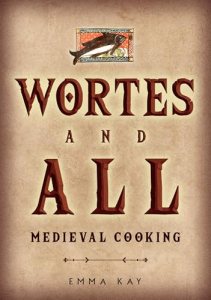
Book Review: “Wortes and All: Medieval Cooking” by Emma Kay

History is not just dates and conflicts with men and women sprinkled in, so we can learn a lesson. It’s not just births, conflicts, triumphs, marriages, and deaths. The people of the past are similar to us in so many ways, and it is through the field of study known as Living History or Experimental Archeology that we can understand the past through a more hands-on approach. One of the most popular methods of studying living history is cooking recipes from the past. But one must wonder how our tastes and understanding of the benefits of food change over time. Emma Kay takes the question of how eating and drinking changed over the medieval period in England and explores it in her book, “Wortes and All: Medieval Cooking.”

I would like to thank Amberley Publishing for sending me a copy of this book. The study of Living History/Experimental Archeology has been an area of interest for me for a couple of years now, especially cooking, as it gives the past a bit more substance. When I heard about this book, it was a compelling concept to me, and I wanted to read it and see if Kay would provide new insight into this field of study.

This book is broken down into chapters where different foods are highlighted: soups and stews, bread and dough, meat, fish, sauces, dairy, eggs, fruits, vegetables, sweet treats, and drinks. Each chapter explores these topics through the early medieval period (4th-13th centuries) and the later medieval period (14th-16th centuries). While we do have manuscripts that have recipes written down, Kay also highlights leechdoms, which are medical remedies or medicinal tomes. She also explores how the theory of the four humors affected the diets of those living in the medieval world.

What I appreciate about this book is the diverse resources that she compiled for her research. It is not just English cookbooks and manuscripts, but Anglo-Saxon tomes on medicine, Scandinavian sagas, French cookbooks, and even Middle Eastern manuscripts. It shows how interconnected the medieval world was, even with all the conflicts and distances between nations. Kay goes a step further by including not only the original recipes in their original languages, but also her translations and even images of her recreating the recipes.

Overall, I did enjoy this book and the information that was provided. I learned quite a lot of new information about cooking and drinking in the medieval world, but part of me wishes it were a bit longer, as this is only about a hundred pages. I think I will explore other books written by Emma Kay. If you want a book that explores how the culinary arts changed over the medieval period, I recommend you read “Wortes and All: Medieval Cooking” by Emma Kay.

Book Review: “Nothing Proved” by Janet Wertman

A princess born to a king and his second wife lost her title and legitimacy when her father decided that her mother, Anne Boleyn, needed to die. Elizabeth Tudor knows the meaning of resilience as she survived her childhood during her father King Henry VIII’s reign. Now that her father is dead  Elizabeth is at the mercy of her half-siblings Edward and Mary, plus any scheming man who wants to marry her and get closer to the crown. Can Elizabeth survive her siblings’ reigns or is she destined to be locked in the Tower to await her ultimate fate like her mother? Janet Wertman explores the life of Elizabeth Tudor in her latest series Regina and the first novel, “Nothing Proved” explores Elizabeth’s turbulent adolescence. 

I would like to thank Janet Wertman for sending me a copy of this novel. I have always been a big fan of novels about Elizabeth I and so when I heard that Wertman was writing another Tudor series all about Elizabeth I, I jumped at the chance to read it.

From an early age, Elizabeth Tudor swore she would never marry, especially after seeing how her mother Anne Boleyn, and her numerous stepmothers were treated by her father. Now her father King Henry VIII is dead, her brother Edward VI is King of England, and she is separated from the stepmother that she loved Katherine Parr after several unwanted incidents with Katherine’s husband Thomas Seymour. Elizabeth never got to see her beloved stepmother again and Thomas has his eyes on marrying Elizabeth or possibly taking control of the king. Bad mistakes on both parts, but it does not mean that Elizabeth is safe from scandal as Edward’s council believes that Elizabeth was involved in the plot against the king.

Elizabeth may have survived Edward’s reign, but her step-sister Mary’s reign is a different case. Mary is a devout Catholic who does not trust Elizabeth. She believes that Elizabeth is part of the plots to overthrow Mary and become the next queen of England. These accusations are dangerous and will place Elizabeth in the Tower. Luckily, Elizabeth is not alone as she has her ladies in waiting as well as friends like Robert Dudley and William Cecil, who is the second protagonist in this novel. It was a nice touch to add William Cecil’s point of view because he rarely gets a starring role in historical fiction novels so it was interesting to see his perspective on matters leading up to the moment Elizabeth becomes queen.

I found this an enjoyable novel that explored Elizabeth’s adolescent years which were some of her most turbulent. We can see her signature resilience and the formation of her close-knit circle of allies and friends that will become so important during her reign. If you are a fan of Elizabethan novels,  I think you will  thoroughly enjoy, “Nothing Proved” book one in the Regina series by Janet Wertman.

Guest Post: “Spotlight for ‘Oscar’s Tale’ by Chris Bishop”

I am pleased to welcome Chris Bishop to my blog today to share a spotlight for his novel, “Oscar’s Tale.” I want to thank Chris Bishop and The Coffee Pot Book Club for allowing me to participate in this blog tour.

Blurb: 

Oscar’s Tale is that of a Saxon boy who sets out to find and rescue his father who has been taken by Viking slavers.  

The story begins in 877, just prior to the Viking attack on Chippenham in which King Alfred was routed. Against this backdrop, Oscar is obliged to set out on his all but impossible quest and quickly becomes embroiled in all that’s going on in Wessex at this turbulent time, culminating in him playing a small but important part in the battle at Edington. 

But this is not just a story about blood thirsty battles and fearsome warriors, it’s about a boy struggling to live up to his father’s reputation as a warrior and trying to find his place in a dangerous and uncertain world. For that, he is forced to confront many dangers and earn the respect of others who are far above his station. Along the way he also finds love – albeit at a cost far higher than most would have been willing to pay. 


‘For is it not the wish of every man that his son will achieve more in life than he did?’ 

Buy Link:

Universal Buy Link: https://books2read.com/u/bwQQ99  

Author Bio 

Chris was born in London in 1951. After a successful career as a Chartered Surveyor, he retired to concentrate on writing, combining this with his lifelong interest in Anglo Saxon history. 

His first novel, Blood and Destiny, was published in 2017 and his second, The Warrior with the Pierced Heart, in 2018 followed by The Final Reckoning in 2019 and Bloodlines in 2020.  Together they form a series entitled The Shadow of the Raven, the fifth and final part of which – The Prodigal Son was published in 2023. 


Chris has published numerous blogs about various aspects of Anglo Saxon history and is a member of the Historical Writers’ Association. 


Author Links


Website:

www.chrisbishopauthor.com  

Twitter:

https://x.com/CBishop_author  

Goodreads:

https://www.goodreads.com/author/show/207271.Chris_Bishop  

Book Review: “Royal Renegades: The Children of Charles I and the English Civil Wars” by Linda Porter

Throughout history, many civil wars have altered the course of the history of the countries where they occurred. While we think about the American Civil War, the French Revolution, and the Wars of the Roses, another civil war often overlooked outside of England is the English Civil Wars. A series of conflicts between the Parliamentarians and the Royalists led to the execution of King Charles I and the rise of the English Republic under Oliver Cromwell. We often view the conflict from either Charles’ or Oliver’s perspective, but we have to consider the family that Charles left behind. How did the English Civil Wars mold the children of Charles I and his Catholic Queen Henrietta Maria? Linda Porter explores the lives of the royal children in her book, “Royal Renegades: The Children of Charles I and the English Civil Wars.”

I am a relative novice when it comes to the Stuart dynasty, especially the English Civil Wars. I have seen Linda Porter’s books but have not read any of them yet. I like a challenge so when I saw this book, I decided to give it a try.

Before we explore the lives of the children of Charles I and Henrietta Maria, we must understand how their relationship began in the 1620s. A Protestant English king married a French Catholic princess, the daughter of King Henry IV of France and Marie de Medici. To say that the English did not like having a Catholic queen would be an understatement. Charles I and Maria had nine children in total, but only five would survive into adulthood; Charles II, Princess Mary, James II, Prince Henry, and Henriette Anne. It is through the lives of these five children that we can get a grasp of what kind of impact Charles I’s decisions had on his family as the English Civil Wars took place.

The most difficult part of this book for me was understanding the conflict of the English Civil Wars themselves as it was not an area that I normally study. I think Porter does an admirable job of explaining the causes of the English Civil Wars and how Charles and his family dealt with the anti-royalist resentment. We see the children and Henrietta Maria escape to other countries like France and the Netherlands by any means necessary while Charles I stayed behind. Porter shows her audience that Charles I was a good father until his execution on January 30, 1649. The death of Charles I left a mark on his children. Charles II and James II would have to bid their time and fight for their right to rule after Oliver and Richard Cromwell with a few scandals mixed in. Henriette Anne and Mary would get used to married life with their husbands Philippe Duke of Orleans and William II of Orange respectively.

This is a story of a resilient family who fought for what they believed in, even if it meant that their father died in the process and their country hated them for a time. It is a story of how love and endurance brought the monarchy back from the brink to survive another few centuries. I now want to dive deeper into the Stuart dynasty and read more books by Porter. If you are like me and you want to learn more about the Stuarts and the English Civil Wars, I recommend you read, “Royal Renegades: The Children of Charles I and the English Civil Wars” by Linda Porter.

Book Review: “The Tudor Queens’ Midwife” by Brigitte Barnard

Throughout history, the true defining feature of a good queen was whether or not she could give birth to a male heir and a spare to keep the dynasty going. No dynasty relied heavily on the pregnancy of a queen and a male heir than the Tudor dynasty of England. While we tend to focus on the women who wear the crown and give birth to the potential heir, another stands beside her during the entire process; the royal midwife. Not much attention has been given to the royal midwife until now. Brigitte Barnard explores the life of a royal midwife and her daughter who work to help Queen Katherine of Aragon in her novel, “The Tudor Queens’ Midwife.”

I want to thank The Coffee Pot Book Club and Brigitte Barnard for sending me a copy of this book. When I read the description of this book for a blog tour that I was invited to join, it was an appealing concept. I like reading novels where the royal family takes a back seat, so seeing a novel about a royal midwife was different and I wanted to read it. 

In the glittering court of Henry VIII and Katherine of Aragon, Sarah Menendez the midwife and her daughter Faith must deal with the dangers of childbirth. Through dealing with miscarriages and stillbirths, Sarah and Faith help the queen in any way they can. But this mother and daughter have a secret. While serving Katherine of Aragon, the Spanish Catholic queen, they are not Catholic or Protestant. They are Jews who were exiled from their native Spain after the Inquisition that was put in place due to Katherine’s mother.

Throughout this novel, we witness Sarah and Faith helping Katherine of Aragon up to the Great Matter and other noble women and working women alike. Some of the women found the joys of motherhood while others paid the ultimate sacrifice to bring new life into the world. We also get to see the bond between Sarah and Faith and how fortune’s wheel continues to turn even for normal men and women. I also enjoyed the fact that we got to experience what life might be like for a Jewish family living in England when religion was a hot topic and the Jews had been banned from England for centuries.

 I enjoyed this novel. It was a fresh take on the Tudor era in England that explores what it might have been like to be a Jewish midwife when Katherine of Aragon was queen. As a debut, I think Barnard does a good job of creating believable characters and great scenarios. I am looking forward to her next novel and I hope she continues telling the story of these midwives. If you want a novel that is full of secrecy, religious conflict, and a loving family, I would suggest you read, “The Tudor Queens’ Midwife” by Brigitte Barnard.

Blurb: 

In the glamorous, glittering, and dangerous court of King Henry VIII and his queen Katherine of Aragon, the desperate desire for a healthy male heir overshadows all. Plagued by a series of miscarriages the queen is left grappling with the weight of her singular duty to provide a son for the Crown. Amidst this turmoil, the queen turns to Sarah Menendez, the most highly skilled midwife in England. Sarah, exiled from her homeland and concealing her true identity must serve the queen and battle her deepest fears. As Sarah strives to save the queen from the perils of childbirth, the specter of her past threatens to unravel the carefully crafted identity Sarah has created for herself and her young daughter. 

  In a world where power, politics, and religion collide, Sarah finds herself entangled in a web of intrigue and deadly danger. The fate of the queen’s unborn child, the survival of the midwife and her daughter, and the stability of the kingdom hang in the balance. Sarah Menendez must employ all of her skills, cunning, and courage to protect those she holds dear as well as the life of the queen and her unborn child. 

The Tudor Queens’ Midwife is a gripping tale of secrecy, sacrifice, and religious turmoil amongst the most opulent courts the world has ever seen.  

Buy Link: 

Universal Buy Link: https://books2read.com/u/4jzxyk  

Author Bio

Brigitte Barnard is an amateur historian of Renaissance English history and an author of the trilogy The Tudor Queens’ Midwife, of which the first book in the series is available. She is currently writing a non-fiction book about Tudor midwifery for Pen and Sword Publishing House.  

Brigitte is a former homebirth midwife, and she lives at home with her husband and four children. She also raises Cavalier King Charles Spaniels.  

Author Links

Website: http://thetudormidwife.com/  

Twitter: https://x.com/TheTudorMidwife  

Instagram: https://www.instagram.com/thetudormidwife

Guest Post: “The Spanish Armada” by Justin Newland

I am pleased to welcome Justin Newland to my blog today to share some background information about his novel,  The Midnight of Eights. I want to thank The Coffee Pot Book Club and Justin Newland for allowing me to be part of this blog tour.

This guest post relates to the historical background of my novel, The Midnight of Eights. The genesis of any single historical event is always multiple, a combine compound of different influences, some obvious, some subtle, So, in this short space, the best I can do is paint some broad brush strokes.  

The novel culminates in the repulse of the Spanish Armada, but what led to King Philip of Spain’s fatal decision to build and dispatch a fleet of 130 warships to invade England in 1588 AD?  

Let’s start in 1556. That was when Charles V, the Holy Roman Emperor and King of Spain, abdicated and passed his territories to his son, Philip, who inherited the Netherlands. The Dutch were mostly Protestant but were now under the control of a Catholic monarch. Philip sent the Duke of Alba to suppress any revolt and impose Catholic rule.  

In England in 1570, the Protestant Queen Elizabeth suppressed the Catholic-inspired Northern rebellion and for her troubles was excommunicated by Pope Pius V. In a Papal Bull entitled Regnans in Excelsis, he declared her to be a heretic and “the pretended Queen of England and the servant of crime.” Significantly for English Catholics, the Pope released all of her subjects from any allegiance to her and excommunicated any that obeyed her. 

In December 1585, Elizabeth and the Privy Council finally responded to the Dutch call for help, and the Queen sent English troops and vessels to support their resistance.  

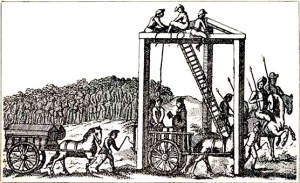
The Papal Bull persuaded many English Catholics to plot against Elizabeth. One was Sir Francis Throckmorton, a Catholic noble. He planned to depose Elizabeth and replace her with Mary, Queen of Scots. Mary, the Queen’s cousin, was Catholic, and a distant heir to the English throne. Francis Walsingham, the Queen’s spymaster, with the help of Nelan Michaels, the hero of the novel The Midnight of Eights, uncovered his plot and had Throckmorton executed at Tyburn in London in July 1584. The Tyburn Tree, a nickname for the gallows at Tyburn, was a prominent site for public executions in London and was given the chilling epithet, ‘the tree that was never green.’ 
Anthony Babington was the next English Catholic noble to attempt to depose Elizabeth and replace her with Mary. But when her letters to Babington were intercepted by Walsingham’s spies, proving her involvement to depose Elizabeth, Mary, Queen of Scots, was tried and executed in 1587. For King Philip, Mary’s death was the tipping point. He decided to despatch the Armada and bring England and its heretic Queen to heel once and for all.  

During the fleet preparations in Cadiz, Philip ordered his admirals to search for women on board the ships and remove them, so that God’s will prevailed.  

In April 1588, the Pope blessed the Armada emblem, the Madonna, and all the Spanish mariners watched in holy awe as it fluttered high on the masts of the galleons, galleasses, and supply ships.  

The Armada was not just a fleet of ships. As far as the Spanish were concerned, it was primarily a holy instrument to remove evil from the world.  

Justin Newland  

18th March 2025 

Photo #1: Pope Pius V, courtesy of Wikipedia  

Photo #2: The Tyburn Tree, courtesy of Wikipedia  

Blurb:

1580-Nelan Michaels docks at Plymouth after sailing around the world aboard the Golden Hind. He seeks only to master his mystical powers – the mark of the salamander, that mysterious spirit of fire – and reunite with his beloved Eleanor.  

After delivering a message to Francis Walsingham, he’s recruited into the service of the Queen’s spymaster, where his astral abilities help him to predict and thwart future plots against the realm. 

But in 1588, the Spanish Armada threatens England’s shores. 

So how could the fledgling navy of a small, misty isle on the edge of mainland Europe repulse the greatest fleet in the world? 

Was the Queen right when she claimed it was divine intervention, saying, ‘He blew with His winds, and they were scattered!’? 

Or was it an entirely different intervention – the extraordinary conjunction of coincidences that Nelan’s astral powers brought to bear on that fateful Midnight of Eights? 

Buy Links: 

Universal Buy Link: https://mybook.to/TheMidnightofEights  

Author Website (where buyer can enter a dedication): https://www.justinnewland.com/the-midnight-of-eights~193  

Wordery (for free UK delivery): https://wordery.com/the-midnight-of-eights-justin-newland-9781835740330   

Barnes and Noble (US): https://www.barnesandnoble.com/w/the-midnight-of-eights-justin-newland/1146325263?ean=2940185990643  

Waterstones (UK): https://www.waterstones.com/book/the-midnight-of-eights/justin-newland/9781835740330  

Kobo (International): https://www.kobo.com/gb/en/ebook/the-midnight-of-eights  

Saxo (DK): https://www.saxo.com/dk/the-midnight-of-eights_bog_9781835740330  

Kindle Unlimited:  

https://www.amazon.co.uk/Midnight-Eights-Justin-Newland-ebook/dp/B0D9Y7YRDG   

Author Bio

Justin Newland’s novels represent an innovative blend of genres from historical adventure to supernatural thriller and magical realism.  

Undeterred by the award of a Maths Doctorate, he conceived his debut novel, The Genes of Isis (ISBN 9781789014860, Matador, 2018), an epic fantasy set under Ancient Egyptian skies.  

His second book, The Old Dragon’s Head (ISBN 9781789015829, Matador, 2018), and is set in Ming Dynasty China in the shadows of the Great Wall.  

Set during the Great Enlightenment, The Coronation (ISBN 9781838591885, Matador, 2019) speculates on the genesis of the most important event in the modern world – the Industrial Revolution.  

The Abdication (ISBN 9781800463950, Matador, 2021) is a mystery thriller in which a young woman confronts her faith in a higher purpose and what it means to abdicate that faith. 

The Mark of the Salamander (ISBN 9781915853271, Book Guild, 2023), is the first in a two-book series, The Island of Angels. Set in the Elizabethan era, it tells the epic tale of England’s coming of age.  

The latest is The Midnight of Eights (ISBN 9781835740 330, Book Guild, 2024), the second in The Island of Angels series, which charts the uncanny coincidences of time and tide that culminated in the repulse of the Spanish Armada.  

His work in progress is The Spirit of the Times which explores the events of the 14th Century featuring an unlikely cast of the Silk Road, Genghis Khan, the Black Plague, and a nursery rhyme that begins ‘Ring a-ring a-roses’.  

Author, speaker, and broadcaster, Justin gives talks to historical associations and libraries, appears on LitFest panels, and enjoys giving radio interviews. He lives with his partner in plain sight of the Mendip Hills in Somerset, England. 

Author Links

Website: https://www.justinnewland.com/ 

Twitter: https://x.com/JustinNewland53  

Facebook: https://www.facebook.com/justin.newland.author/ 

LinkedIn: https://www.linkedin.com/in/justin-newland-b393aa28/  

Instagram: https://www.instagram.com/drjustinnewland/ 

Book Bub: https://www.bookbub.com/authors/justin-newland  

Goodreads: https://www.goodreads.com/jnewland  

Amazon Author Page: https://www.amazon.co.uk/stores/Justin-Newland/author/B06WRQVLT8  

Book Review: “Bitter Greens” by Kate Forsyth

For centuries, fairy tales have entertained and taught lessons to those young and young at heart. One of the most memorable stories was the tale of Rapunzel, the maiden a witch kidnapped because her parents stole a Rapunzel plant from her while Rapunzel’s mother was pregnant. For years, Rapunzel languished in a Tower, her hair growing exponentially until a rogue/ prince climbs her hair and rescues the damsel in distress. The witch dies and Rapunzel and her hero live happily ever after. At least, that is how the story has been passed down to us throughout the centuries, but where did the story come from and how are the stories of three women from different generations and countries connected? Kate Forsyth weaves together the stories of three women and their fates into one delightful novel called, “Bitter Greens.”

I want to thank Allison & Busby and Net Galley for sending me a copy of this novel. When I am not reading historical fiction or nonfiction, I do enjoy reading fairy tales retold, so when I heard about this novel and how it would explore the origins of the story of Rapunzel, it was intriguing to me.

Forsyth breaks down her novel into three separate narratives based on the lives of three women. We begin with Charlotte-Rose de la Force, a woman who weaves stories on a whim at the court of the Sun King Louis XIV. Charlotte is the person who gave the Rapunzel story some of the main characteristics that we are familiar with from the Italian origin story by Giambattista Basile. Her life choices have caused the king to send Charlotte to exile in a convent. It is in the convent that Charlotte meets Soeur Seraphina and she learns the story of Margherita and Selena Leonelli.

Margherita is the daughter of a mask maker and his wife. When she turns 7, a sorceress named La Strega Bella tells her parents that it is time to pay for their crime of stealing bitter greens. La Strega Bella wants to raise Margherita as her child, so she kidnaps Margherita, changes her name to Petrosinella, and places her in a convent. When Margherita turns 12, she is taken from the convent, placed in a tower, and given her characteristically long hair.

The question is why did La Strega Bella take Margherita from her parents just to put her in a tower with such long hair? It is through Selena Leonelli’s story that we can discover the truth about La Strega Bella. A woman who had to survive in the dark days of the plague in the early 16th century when her family died, she learned how to use spells and the power of plants from a woman named Sibillia. Life was not always fair for Selena, but then she met a man named Tiziano, who we know as Titian, and she inspired his art. Selena is afraid of growing old and wants to stay young forever, so she comes up with a dark and twisted plan.

This novel is dark and full of tragedies, love, and adventures. While I did enjoy reading it, there were a few historical inaccuracies, such as the plague doctor uniform was not introduced until the 17th century, not the 16th century. If you want a dark version of a fairy tale retold with a historical twist, I think you will enjoy “Bitter Greens” by Kate Forsyth.

Book Review: “Crown and Sceptre: A New History of the British Monarchy from William the Conqueror to Elizabeth II” by Tracy Borman

England’s history is centuries old, full of colorful characters and change galore. What truly defines the history of England is the monarchy, which has lasted over a thousand years. Over 40 kings and queens left their distinct marks on the history of this proud island nation. While some could maintain the crown with no issues, others had to fight to earn the crown, and a few even died for the crown. While there has been a plethora of books and novels written about individual monarchs and their impacts on the history of England, only a select few have chosen to take the arduous task of telling the story of the British Monarchy from its origins to the modern-day. One such historian who has chosen the latter is Tracy Borman in her book, “Crown and Sceptre: A New History of the British Monarchy from William the Conqueror to Elizabeth II.”
I have been a fan of Tracy Borman and her writing for many years now. She has a way of making history come alive, so when I heard about this book, it was something I knew I wanted to read. I usually don’t read books like this because in the past, I have not been interested in the Stuarts and Hanoverians, but as I have begun to dive more into the Stuarts, I think it was the perfect time to read this book.

Borman begins with a brief introduction to the early kings of England, the Anglo-Saxon kings, to show how different it was from the Norman kings. She has divided the book into sections to highlight the different dynasties; Norman, Plantagenet, Lancaster, York, Tudor, Stuart, Hanoverian, and Windsor. Within each section is a mini-biography of each ruler during that dynasty. While there is not a whole lot of new information, it does give the reader a taste of what each reign was like.

As someone who usually reads about the Normans, Plantagenets, and Tudors, it was a nice review of the basic facts of the kings and queens during this span of history. Reading about the Stuarts, Hanoverians, and Windsors was something different for me and I thoroughly enjoyed it. It made me interested in studying the Stuarts and the Windsors, but I am on the fence about the Hanoverians. What is remarkable about the story is that the monarchy of England could have toppled at any point and did for a few years before it was restored, and continues to this day for over a thousand years.

Overall, I found this an interesting introductory read into the different dynasties that have shaped the English monarchy and the history of England. If you want new research about the individual monarchs, this might not be the book for you. However, if you want a great introductory book on the history of the British monarchy, I highly suggest you read, “Crown and Sceptre: A New History of the British Monarchy from William the Conqueror to Elizabeth II” by Tracy Borman.

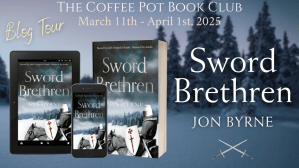
Guest Post: “Research of the Locations Featured in Sword Brethren” by Jon Byrne

I am pleased to welcome Jon Byrne to my blog today to share information about his research for the locations in his novel Sword Brethren.  I would like to thank The Coffee Pot Book Club and Jon Byrne for allowing me to participate in this blog tour.
Detailed research is important for all writers – but for those writing historical fiction, it is vital. While much can be gained by researching information on the internet or reading books on the subject, one of the best things for me is the chance to visit the locations depicted in the book. Sometimes it is only by going to a place that you can really get a feel for how it might have been. Having said that, all of the places depicted in Sword Brethren have changed so much over the last 800 years that it is still difficult to imagine how a location would have looked so long ago, especially as there is so little remaining from this period. 

The story begins in Cranham, a fictional village in East Anglia in England, located somewhere between Bury St Edmunds and Thetford. I traveled the area a few years ago, visiting the local castles like Framlingham and Orford, as well as the village of Lavenham – one of the best-preserved medieval villages in England. This helped to get an idea of what the area might have been like in the High Middle Ages, but even here most of the buildings date from the late medieval and Tudor periods.  

One of the places that I found particularly helpful was Eye Castle – originally a motte and bailey fortress built during the reign of King William I. This is even earlier than the timeframe of the book, which made it far more relevant, but the castle is ruined, and a house was built on the motte in 1844, which has since decayed and collapsed. Nevertheless, the fictional village and castle of Cranham would not have been dissimilar. 

Lübeck, in northern Germany, is now a UNESCO World Heritage Site and the location for approximately a third of the book. I spent a very satisfying weekend walking the cobbled streets and visiting the historical sites it has to offer – made considerably easier for me because at the time I lived in Berlin, which is only 280 km (approx. 170 miles) away.  


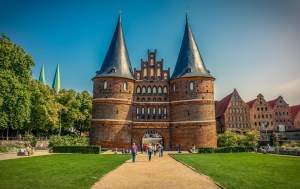
Caption: The Holsten Gate in Lübeck (built between 1464 to 1478). On the right can be seen some of the buildings of the Salzspeicher – a row of historic salt warehouses. On the left, the spires of St Mary’s Church (Marienkirche) pokes above the trees. 

Founded in the mid-12th century, Lübeck became known as the Queen of the Hanseatic League (originally a powerful trading network of merchant communities in Northern Germany) and was the main point of departure for the Northern Crusades. Unfortunately, most of the late medieval buildings that the city is famous for – the Holsten Gate (Ger. Holstentor), St Mary’s Church (Ger. Marienkirche), St Peter’s Church (Ger. Petrikirche), the Salzspeicher (salt warehouses) and the famous brick-built gable houses – were not constructed at the time of this book. Only the cathedral that still stands (Ger. Dom zu Lübeck) existed in the early 13th century, and it was under construction, although it has been modified many times since and was almost completely destroyed in the Second World War. Much of the half-island that today makes up the old town was undeveloped and prone to flooding in the period of the book. The Holstenbrücke (Holsten Bridge) was first mentioned in 1216 but it is conceivable that a bridge existed beforehand. This would have been constructed from wood. 

One of the highlights of researching Sword Brethren was a week-long trip I spent in Latvia with my family. We were based in Riga, which is a fascinating city that I would recommend anyone visit. Again, most of the architecture is later than the events in my book. In the early 13th century, Riga was made almost entirely of wood (including the churches), and despite being the largest city in the eastern Baltic at this time, it was little more than a village when compared to cities in Western and Central Europe. 

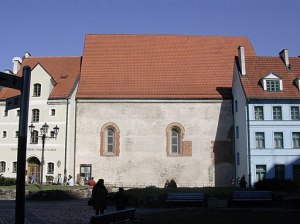
One of the first buildings made of stone in Riga was the original St George’s Castle, the first headquarters of the Livonian Brothers of the Sword, an order of warrior-monks, similar to the Knights Templar, who were formed to protect the fledgling German colony. It is the oldest surviving stone building in Riga. The only part still surviving is the chapel, now used by the Latvian Museum of Decorative Arts and Design. 

(Wikimedia Commons):  

Caption: St George’s Chapel – the oldest stone building in Riga and the original headquarters of the Livonian Brothers of the Sword.  

Outside of Riga, the only buildings that still remain from the period of the book are the stone castles built by the Brothers of the Sword and the Livonian Order of the Teutonic Knights that followed them. Most of these are either ruins or in various states of repair. Many of these castles were built on the banks of the River Daugava (Ger. Düna) by the German settlers and crusaders, using the river to improve their defenses. Sadly, today many are submerged beneath the waters of the Daugava that engulfed them when the Riga Hydroelectric Power Plant was built. 

Nevertheless, two castles that remain in good condition lie northeast of Riga, only 23 miles or so from each other. The first is at Sigulda (Ger. Segewold), which was first constructed in 1207 and later rebuilt into a convent-type fortress. From its elevated position on a steep slope above the Gauja River, you can see another castle at Turaida across the water, built on the remains of an old pagan hillfort. It is a beautiful location, with the thick forest around it, and it gives a good flavor of how it might have felt to live here in the early 13th century. 


 Turaida castle (Ger. Treiden) (taken by author):  

Caption: The view from Sigulda castle. 

The second castle, one of the best preserved in all of Latvia, is at Cēsis (Ger. Wenden). This is a huge castle, much of it still complete, with several relatively intact towers and walls. This is the castle that later became the main seat of the Brothers of the Sword and the Teutonic Order afterward. It is an impressive fortress that features more in the next book of the series, Soldier of Christ

 (taken by author):  

Caption: Cēsis castle – probably the best-preserved castle in Latvia from the early 13th century 

However, it is only possible to learn a certain amount from visiting sites in the book personally. The bulk of research – for me at least, is reading some of the excellent books and research papers concerning the Northern Crusades. 

The principal first-hand source is The Chronicle of Henry of Livonia, which was written by a priest, Henricus des Lettis, probably around 1229. The chronicle deals with events in the eastern Baltic between 1180 to 1226. Hardly surprisingly, it is written from the German point of view and describes the role of the Latin Church in colonizing and spreading Christianity to the local pagan tribes.  

His chronicle is a highly detailed account, rich in human history, and he provides eye-witness testimony of the events at this time, depicting not only the military campaigns but interesting facts about the local people themselves. This is particularly valuable as there is practically no other first-hand evidence of the events of the early Christian settlement in what is now Latvia and Estonia. 

Blurb:

1242- After being wounded in the Battle on the Ice, Richard Fitz Simon becomes a prisoner of Prince Alexander Nevsky of Novgorod. Alexander, intrigued by his captive’s story, instructs his scholar to assist Richard in writing about his life. 

Richard’s chronicle begins in 1203 when his training to be a knight is disrupted by treachery. He is forced to flee England for Lübeck, where he begins work for a greedy salt merchant. After an illicit love affair, his new life is thrown into turmoil, and he joins the Livonian Brothers of the Sword as they embark on imposing the will of God on the pagans of the eastern Baltic. Here, he must reconcile with his new life of prayer, danger, and duty – despite his own religious doubts, with as many enemies within the fortified commandery as the wilderness outside. However, when their small outpost in Riga is threatened by a large pagan army, Richard is compelled to make a crucial decision and fight like never before. 

Buy Links:  

Universal Ebook Buy Link: https://books2read.com/u/boVKlV  

Barnes and Noble: https://www.barnesandnoble.com/w/sword-brethren-jon-byrne/1146519606?ean=2940184429601 

Waterstones: https://www.waterstones.com/book/sword-brethren/jon-byrne/9781835740798 

Author Bio

Jon Byrne, originally from London, now lives with his German family by a lake in Bavaria with stunning views of the Alps. As well as writing, he works as a translator for a local IT company and occasionally as a lumberjack.  

He has always been fascinated by history and has studied the Medieval world for over twenty years, building up a comprehensive library of books. In his research, he has traveled to all of the locations mentioned in the book (East Anglia, Bremen, Lübeck, Latvia, etc).  

Sword Brethren (formerly Brothers of the Sword) made it to the shortlist of the Yeovil Literary Prize 2022 and the longlist of the prestigious Grindstone International Novel Prize 2022. It is the first book in The Northern Crusader Chronicles

Author Links

Website: https://www.jonbyrnewriter.com/ 

Facebook: https://www.facebook.com/JonByrneAuthor 

Amazon Author Page: https://www.amazon.co.uk/stores/Jon-Byrne/author/B0DJC6PL8D 

Goodreads: https://www.goodreads.com/author/show/52458339.Jon_Byrne