 Today, I am pleased to welcome Katerina Dunne to my blog to share a bit of her research for her latest novel, “Return to the Eyrie.” I want to thank Katerina Dunne and The Coffee Pot Book Club for allowing me to be part of this blog tour.
The history of medieval Hungary is fascinating, yet few in the English-speaking world know much about it. From nomadic tribes raiding across Europe in the 9th-10th century, the Hungarian conquerors settled in the Carpathian basin, converted to Christianity, and, together with the peoples they found already living there, created a powerful multi-ethnic and multi-lingual kingdom, which at its peak stretched from Southern Poland to the Adriatic Sea and from lower Austria to Central Romania as the below map demonstrates:
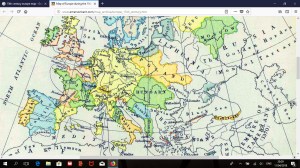
15th-century Europe map copied from
https://www.gifex.com/detail-en/2009-09-17-811/Europe-during-the-15th-Century.html
Return to the Eyrie (released in April 2024) is set during the second half of the 15th century (1470 to 1480) mostly in Transylvania and Belgrade, which were part of the medieval Kingdom of Hungary. The main characters are fictional, but they interact with real historical figures of the time and participate in real historical events. I have presented the heroine as a (fictional) member of two powerful baronial clans from Transylvania and Eastern Hungary.
The 15th century was a turbulent time for the Kingdom of Hungary due to internal conflict as well as the expansionist efforts of the Ottoman Empire towards the west and north. After the Ottoman conquest of Serbia and Bosnia, and the submission of Wallachia to the Sultan as a vassal state, Hungary became the last frontier holding back the Ottoman advance towards Central Europe.
The years between 1458 and 1490 were dominated by the figure of Mátyás (Matthias) Hunyadi, who became king aged fifteen in January 1458. His father was the formidable János Hunyadi, a lesser nobleman whose meteoric rise to power in the 1440s and early 1450s made him the most powerful baron in the kingdom. However, after his death, his enemies accused his eldest son, László, of treason. Under the influence of several barons who opposed the Hunyadi family, the King (also called László) arrested both Hunyadi’s sons in the spring of 1457. While he had László executed, he imprisoned fourteen-year-old Mátyás and many of their supporters.
When the King died in 1457 without an heir, the vacant throne was filled by Mátyás, following his mother’s and his uncle’s relentless campaign of negotiations, promises, bribes, and intimidation. The legend has it that the Royal Council deliberated in Buda Castle and made the public announcement while the crowds of lesser nobles stood literally on the river Danube, the waters of which had frozen solid.
But Mátyás was still held captive by the Bohemian king and Hussite leader, George of Podebrady. It took a large ransom to release Mátyás to his family, and the teenager was finally enthroned in February 1458. He could not be crowned though because the Hungarian Holy Crown was in the hands of the Holy Roman Emperor, Frederick III. How the crown had ended up there is another story—one of the most fascinating episodes in late medieval Hungarian history—which deserves separate attention. It took another four years and the astronomical sum of 80,000 gold florins to recover the crown. Mátyás was finally crowned with all the appropriate ceremony on 29 March 1464.
He became known as Mátyás Corvinus (nicknamed The Raven King because of the Hunyadi coat of arms, which depicted a raven with a golden ring in its beak) One of the most important rulers in 15th century Europe, he brought the Italian Renaissance and Humanism to Hungary, upgraded the royal palace in Buda, established the famous Corvina Library and was the patron of many scholars and artists. Due to the fact that he was a member of the nobility rather than of royal blood, he faced strong opposition both from inside Hungary and from abroad (Holy Roman Empire, Bohemia, and Poland) and he had to fight several wars to secure his grip on the throne. He kept a defensive stance towards the Ottomans, with relative success, and competed with them in his efforts to influence politics in neighboring Wallachia, Moldavia, and Bosnia.
Mátyás is well-known for keeping Prince Vlad III of Wallachia (Vlad the Impaler) imprisoned for several years before finally releasing him in 1475 to place him on the Wallachian throne as an ally.
Mátyás conquered Vienna in 1485 and was negotiating his possible future designation as Holy Roman Emperor when he died in April 1490.
He has since become the subject of many legends not only in Hungary but also in several neighboring Central European countries.
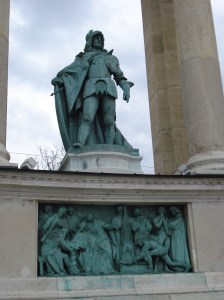
Statue of King Mátyás Hunyadi in Heroes’ Square Budapest (my photo)
King Mátyás plays a small but pivotal role in my novel, Return to the Eyrie. The heroine, Margit, is distantly related to him as her father (fictional character) was a third cousin of the king’s mother, Erzsébet Szilágyi.
Margit needs the King’s support to reclaim her inheritance, which was violently taken when she was a child by her close relatives.
Apart from being a historical adventure, the novel also addresses the issue of female inheritance. Despite her noble status, Margit could not inherit landed property from her father due to the strict inheritance laws in the Kingdom of Hungary. Noble daughters were only entitled to a monetary dowry when they married unless their husband was a commoner, in which case—ironically—they could inherit part of the land. So, according to the law, Margit’s land would pass to her closest male relative (her first cousin in this case).
However, a nobleman could invoke the custom of Prefection (Fiúsítás in Hungarian or praefectio in filium in Latin), whereby he could petition the King to “promote” his daughter to a son and therefore, allow her to inherit landed property. This would usually happen when there were no close male relatives, or in other exceptional cases. Margit’s father had sent such a petition to King Mátyás, but his relatives plotted against him. With an evil trick, they presented him as a traitor to the King’s eyes, had him murdered, and took over his land while Margit barely escaped with her life thanks to her father’s most loyal friend.
 Blurb:
Honour, revenge, and the quest for justice.
Belgrade, Kingdom of Hungary, 1470:
Raised in exile, adolescent noblewoman Margit Szilágyi dreams of returning to her homeland of Transylvania to avenge her father’s murder and reclaim her stolen legacy. To achieve this, she must break the constraints of her gender and social status and secretly train in combat.
When the king offers her a chance at justice, she seizes it—even if it means disguising herself as a man to infiltrate the vultures’ nest that now occupies her ancestral ‘eyrie’.
Plagued by childhood trauma and torn between two passionate loves, Margit faces brutal battles, her murderous kin’s traps, and inner demons on her quest for vengeance. Only by confronting the past can she reclaim her honour—if she can survive long enough to see it through.
Return to the Eyrie is an epic coming-of-age tale of a young woman’s unwavering pursuit of justice and destiny in 15th-century Hungary.
Buy Link:
Universal Buy Link: https://books2read.com/u/bz8gJL
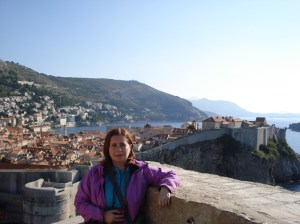 Author Bio:
Katerina Dunne is the pen name of Katerina Vavoulidou. Originally from Athens, Greece, Katerina has been living in Ireland since 1999. She has a degree in English Language and Literature from the University of Athens, an MA in Film Studies from University College Dublin, and an MPhil in Medieval History from Trinity College Dublin.
Katerina is passionate about history, especially medieval history, and her main area of interest is 13th to 15th-century Hungary. Although the main characters of her stories are fictional, Katerina uses real events and personalities as part of her narrative to bring to life the fascinating history of the medieval Kingdom of Hungary, a location and period not so well-known to English-speaking readers.
Return to the Eyrie (published April 2024) is the second book in the Medieval Hungary series, a sequel to Lord of the Eyrie (published in February 2022).
Author Links:
Website (publisher): https://www.thehistoricalfictioncompany.com/hp-authors/katerina-dunne
Facebook: https://www.facebook.com/profile.php?id=100076818802721
LinkedIn: https://www.linkedin.com/in/katerina-vavoulidou-07962a85/
Amazon Author Page: https://www.amazon.com/stores/Katerina-Dunne/author/B09R4P733K
Goodreads: https://www.goodreads.com/author/show/22196953.Katerina_Dunne

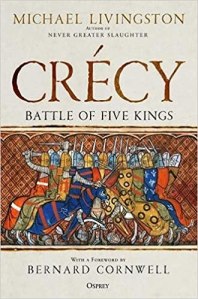 The year is 1346 and war has just begun between France and England. This conflict would be known as the Hundred Years War, which lasted over 116 years and ended in failure for the English. However, some glorious moments like Agincourt gave the English cause to celebrate, but none more so than the Battle of Crecy. It was a colossal battle between five European kings, leaving countless dead on the field without many long-term rewards. So how did the French and English armies meet on the field of Crecy and what truly happened? Michael Livingston dives deep into the archives and archaeological research to tell the truth of this famous battle in his book, “Crecy: Battle of Five Kings.”
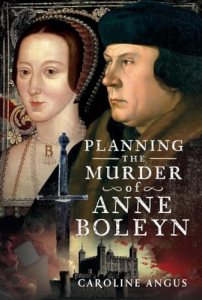 The 16th century was filled with tales of remarkable women. Still, one of the most defining figures of the century was a woman of noble birth who the King of England fell in love with and decided that he was going to divorce his first wife of over twenty years to marry her. The Great Matter caused a great scandal across Europe, however, it was a love match that would not last long. The relationship between Henry VIII and his second wife Anne Boleyn would turn volatile and in the end, Anne and the men around her would be executed. We often blame Anne Boleyn’s death at the foot of Henry VIII’s right-hand man Thomas Cromwell, but who was behind the death of this famous queen? Caroline Angus has chosen to re-examine the case to find out who was truly responsible for the fall of this famous queen in her latest book, “Planning the Murder of Anne Boleyn.”
 Weddings are supposed to be happy occasions to unite two families through the bonds of love, at least in our more modern sense of the ceremony. However, in the past, weddings were ceremonies that would unite families through contracts to create powerful alliances—hardly a romantic endeavor. One of the grandest weddings of the 16th century was meant to unite France, which led to bloodshed between Catholics and Huguenots. Minou Joubert and her family are invited to the wedding of Marguerite de Valois and Henri of Navarre in Paris, but the decision to attend the lavish event leads her family on a path full of tears and heartbreak. The story of the Joubert family’s struggle to fight for the faith they strongly believe in and to unite their broken family is masterfully told in Kate Mosse’s novel, “The City of Tears.”
 The year is 1517, and Florence is experiencing great change. No longer is it a grand republic that it once was; instead, it is under the control of the Medici family. They ruthlessly controlled Florence, especially Pope Leo X, who was born Giovanni di Lorenzo de’ Medici. The people suffer as the Medici become increasingly wealthy, but a band of misfits and thieves plan to give some power back to the people with one of the greatest heists of 16th century Italy. Can they survive as a group when revelations from the past and dangers lurk around every corner? The adventure with this ragtag team of thieves as they fight for Florence is explored in Caitlin Schneiderhan’s novel, “Medici Heist.”
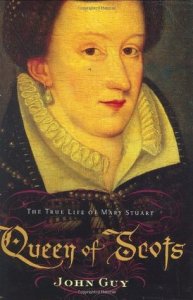 Women rulers in the past have either been praised or pushed down. They are either seen as ideal women or power-hungry villains. One such figure who suffered the worst from having her image raked through the mud for centuries was Mary Stuart, known throughout history as Mary, Queen of Scots. The Queen of Scotland who was married three times, was once the Queen of France, the mother of the future King of both England and Scotland, accused of having a hand in her second husband’s murder, plotted to overthrow Elizabeth I, and was executed for treason. Her story is well known, but what does the archival information tell us about Mary Stuart? John Guy scoured the archives to find the truth about this queen and presented his research in his biography, “Queen of Scots: The True Life of Mary Stuart.”
 As humans, we love a good love story. Tales of courtships, grand confessions of love, over-the-top weddings, and marriages that last decades. These seem like high expectations, especially when we compare these expectations to royal courtships of the past. The majority of royals married and they were more focused on political matches instead of love. However, few chose a different path altogether, they decided to be single. One of the most famous monarchs with a single status was Queen Elizabeth I of England, the Virgin Queen So why did Elizabeth stay single throughout her reign, and how did she navigate her numerous suitors? Carol Ann Lloyd tries to answer these questions in her latest book, “Courting the Virgin Queen: Queen Elizabeth I and Her Suitors.”
 I am pleased to welcome Constance Briones to my blog today to share an excerpt from her novel, “Try Before You Trust: To All Gentlewomen and Other Maids in Love.” I would like to thank Constance Briones and The Coffee Pot Book Club for allowing me to be part of this blog tour.
 Blurb:
 Author Bio:
  When we think about the great female minds of the 16th century, we often think about those closest to the throne. Women of privilege who were destined to rule or to be a queen consort in a far-off land where their education would be imperative for the success or failure of their respective dynasty. However, some women did not live a life of glitz and glamor and received an equally impressive education. One such woman was the daughter of the great statesman Sir Thomas More, Margaret More Roper. Her remarkable story is told in the debut book by Aimee Fleming, “The Female Tudor Scholar and Writer: The Life and Times of Margaret More Roper.”
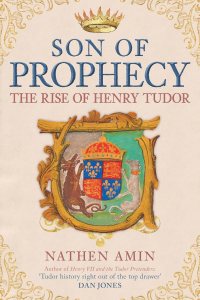 The date is August 22, 1485, and a young man stands in the middle of a battlefield. He has done what seemed nigh impossible, he defeated the last Plantagenet king Richard III to become the new King of England. His heritage makes this man unique and qualified to start a new dynasty. His mother’s family the Beauforts have been explored quite heavily by historians and authors alike. They see this victory as a change in English history whereas his father’s family sees it as a sign of something deeper. To the Tudors and Henry’s fellow Welshmen, it is the fulfillment of a centuries-old prophecy. So who were Henry Tudor’s ancestors and what did it mean for Henry to be the titular Son of Prophecy? Nathen Amin tells the remarkable story of the Tudors and how their struggles and triumphs led to Henry Tudor taking the throne in his latest book, “ Son of Prophecy: The Rise of Henry Tudor.”
 Adventures of a Tudor Nerd