
 I am pleased to welcome S.P. Somtow to my blog today to share a snippet from his latest novel, “Imperatix.” I would like to thank S.P. Somtow and The Coffee Pot Book Club for allowing me to be part of this blog tour.
Have another brain,” said the Emperor, feeding me Himself.
“Divinitas,” I said, “how many peacocks does it take to make such a platter?”
“Wonderful!” said Himself. “Poppaea never takes an interest in how the world runs. For her, the brains just appear by magic. The answer to question is — why — we have our own, private little — to coin a word — pavonarium. Would you like to see peacocks — a veritable ocean of peacocks — more bird-brains than even in the Senate?” He clapped his hands, dropping a brain onto the grass, though Hercules quickly disposed of it. “Come!”
He took me by the hand and started to pull me in toward the far side of the garden, where there was a fountain cunningly designed like a pair of dolphins. I turned to look at the Lady Poppaea, terrified that I would soon be alone with the God.
“This could be your fortune,” she said to me. “You’ve insulted, you’ve appeased. Now, Sporus, you must seduce.”
 Blurb:
Captured by pirates and sold to a Roman aristocrat as a sex slave, Sporus attracted the attention of no less a personage than the Emperor Nero, ruler of the known world. Would-be poet, patron of the arts, aesthete, and brutal autocrat, the Divine Nero saw in the boy a startling resemblance to the Empress Poppaea – and made him an empress as well.
Suetonius, Tacitus, and other Roman historians have given tantalizing glimpses into the incredible life story of the boy who became twice an empress to two emperors and was condemned to die in the arena by a third.
In this meticulously researched trilogy, World Fantasy Award-winning author S.P. Somtow lays bare the darkest secrets of Imperial Rome – its triumphs and its nadirs, its beauty and its cruelty. Through this chaos, a contorted mirror of our contemporary world, this figure of Sporus moves, all too knowing yet all too innocent, providing a worm’s eye view of one of the wildest periods in ancient history.
Imperatrix, the second volume of the tale, takes us into the heart of the Imperial palace with all its intrigue, depravity, and splendor.
Buy Links:
This title is available to read on #KindleUnlimited.
Universal Buy Link: https://books2read.com/u/mV2EaJ
 Author Bio:
Once referred to by the International Herald Tribune as ‘the most well-known expatriate Thai in the world,’ Somtow Sucharitkul is no longer an expatriate since he has returned to Thailand after five decades of wandering the world. He is best known as an award-winning novelist and a composer of operas.
Born in Bangkok, Somtow grew up in Europe and was educated at Eton and Cambridge. His first career was in music and in the 1970s, his first return to Asia, he acquired a reputation as a revolutionary composer, the first to combine Thai and Western instruments in radical new sonorities. Conditions in the arts in the region at the time proved so traumatic for the young composer that he suffered a major burnout, emigrated to the United States, and reinvented himself as a novelist.
His earliest novels were in the science fiction field and he soon won the John W. Campbell for Best New Writer as well as being nominated for and winning numerous other awards in the field. But science fiction was not able to contain him and he began to cross into other genres. In his 1984 novel Vampire Junction, he injected a new literary inventiveness into the horror genre, in the words of Robert Bloch, author of Psycho, ‘skillfully combining the styles of Stephen King, William Burroughs, and the author of the Revelation to John.’ Vampire Junction was voted one of the forty all-time greatest horror books by the Horror Writers’ Association.
In the 1990s Somtow became increasingly identified as a uniquely Asian writer with novels such as the semi-autobiographical Jasmine Nights and a series of stories noted for a peculiarly Asian brand of magic realism, such as Dragon’s Fin Soup, which is currently being made into a film directed by Takashi Miike. He recently won the World Fantasy Award, the highest accolade given in the world of fantastic literature, for his novella The Bird Catcher.
Returning to Thailand in 2001, he became artistic director of Opera Siam and has had more than a dozen operas produced around the world including The Snow Dragon and The Silent Prince, which premiered in the United States, Helena Citronova, an opera set during the Holocaust, and the ten-part DasJati: Ten Lives of the Buddha.
In the last few years, he has made a return to writing novels with the Nero and Sporus trilogy and the young adult series, Club X.
In 2021 the film he produced and wrote, The Maestro: Symphony of Terror received over forty awards at international festivals, and in 2023 the Thai government officially elevated him to the status of National Artist.
Read S.P. Somtow’s interview on Literary Titan about Imperatrix at https://literarytitan.com/2024/01/21/the-core-of-innocence/.
Author Links:
Website: www.somtow.com
Twitter: www.twitter.com/somtow
Facebook: www.facebook.com/somtow
Instagram: www.instagram.com/somtow
Book Bub: https://www.bookbub.com/profile/s-p-somtow
Amazon Author Page: https://www.amazon.com/stores/author/B000APBJXC
Goodreads: https://www.goodreads.com/author/show/81037.S_P_Somtow
 The royal dynasties of English history are some of the most popular in European history. We have the Normans, the Angevins, the Plantagenets, who occupied the throne for 300 years, the Scottish Stuarts who saw religious change and political upheaval, the haughty Hanovers, and the current Windsor dynasty. However, one dynasty that has captured the imagination of history nerds for centuries has been the tumultuous Tudors. In book two of Peter Ackroyd’s “The History of England: Tudors,” he explores the stories that made the Tudor dynasty so infamous.
 Today, I am pleased to welcome Linda Lappin to my blog to share a snippet from her novel, “Signatures in Stone.”I would like to thank The Coffee Pot Book Club and Linda Lappin for allowing me to be part of this blog tour.
 Blurb:
 Author Bio:
 Civil wars, clashes between cousins, are known to be full of battles between men on foot and horseback, with their eyes set on the throne of their desired country. Many stories of civil wars tend to leave out the women who often were left on the sidelines, ready to pick up the pieces. The story of the Anarchy is a bit different than other civil wars as one of the main figures was not a man, but Empress Matilda, the daughter of King Henry I and the rightful heiress of England facing off against the man who stole the throne from her, her cousin, King Stephen. However, it was not just Empress Matilda who defined what it meant to be a woman during the Anarchy. In her latest book, “Women of the Anarchy,” Sharon Bennett Connolly tells the stories of the mothers, sisters, and wives who defined this turbulent period that saw the end of one dynasty and the beginning of another.
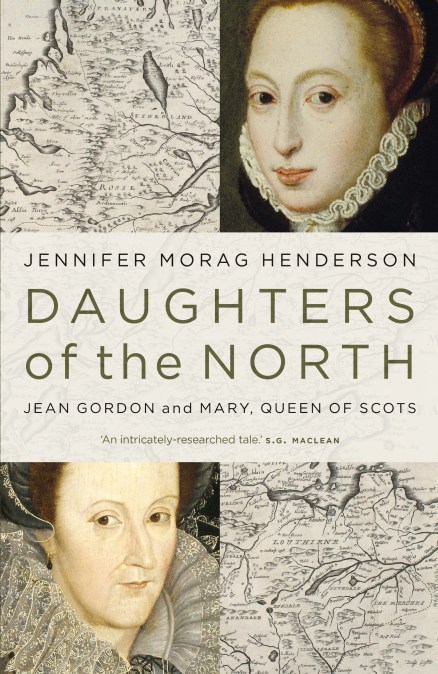 In the late 16th/ early 17th centuries, Scotland was chaotic and full of dynamic characters near or on the throne. People like Mary of Guise, Mary Queen of Scots, Lord Darnley, Earl of Bothwell, the four Maries, and James VI/I show how turbulent the Scottish court was to those around it. However, the stories of those who lived outside the court system and tried their best to maintain control of the country for their monarch tend to fade into obscurity. Take for example the story of Jean Gordon. A noblewoman who was married three times; to James Hepburn, Earl of Bothwell, Alexander Gordon, Earl of Sutherland, and her true love, Alex Ogilive. Jean’s story is full of heartaches, clashing clans, religious squabbles, and loyalty to one’s family, which is told in Jennifer Morag Henderson’s book, “Daughters of the North: Jean Gordon and Mary, Queen of Scots.”
 Castles, the monuments of medieval times, are buildings that hold many tales. Tales of sieges and sorrow, triumphs and tribulations. Through the centuries, their stones and foundations held many secrets. Some of the stories are famous, but most are hidden in the shadows of time and are hidden in ruins. Although castles exist in numerous countries and are centuries old, the castles of medieval England tell a story of a country facing turmoil and changing European and world history forever. Malcolm Hislop, a historian and researcher who specializes in architecture and archaeology, has written a single book exploring every medieval castle and its original architecture entitled, “A Guide to the Medieval Castles of England.”
 Greenwich Palace is a Tudor palace full of glamour, intrigue, and murder. A musician has been found murdered in the chambers of the current wife of King Henry VIII, Anne Boleyn. Only one person can solve this crime while protecting the royal family. No, he is not a knight or a lawyer, but a fool. No, an actual fool or jester of the court of Henry VIII, Will Somers. A man who is loyal to his king Henry VIII, but can he save his second wife from the murderer lurking in the shadows? Jeri Westerson’s Will Somers follows the clues to uncover the truth to protect those who are the most important to him in book two of A King’s Fool Mystery series, “The Twilight Queen.”
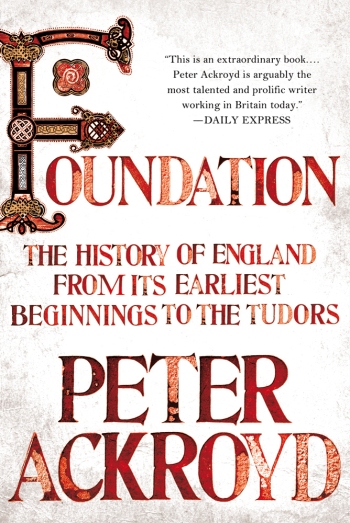 England is a nation that is rich in history and conflicts galore. Through the centuries, England has seen so much change. Many of us know the stories of the medieval and the Tudor kings and queens of England, covered in numerous books, but Peter Ackroyd has taken this concept a step forward. Ackroyd embarked on an epic quest to chronicle the history of England from its prehistoric origins to the modern age. In “Foundation: The History of England From Its Earliest Beginnings to the Tudors,” Peter Ackroyd begins his epic journey into the past to explore the origins of English history.
 A life of luxury from birth, destined to be crowned King or Queen of England. This is what we often think life must have been like for royal heirs who reached the ultimate destination of a crown and a throne. However, the stories of those who failed to reach the throne are mired in tragedy and heartache. The question of royal succession in England is a complex issue, especially when the heir to the throne dies unexpectedly, leaving doubts on whether a dynasty will survive through blood or dissolve in conflict. How did the deaths of these potential rulers radically transform the fabric of English history as a whole and what can their lives tell us about what kind of rulers they might have been? Ashley Mantle hopes to answer all of these questions and more in his latest book, “Uncrowned: Royal Heirs Who Didn’t Take the Throne.”
 I am pleased to welcome Justin Newland to my blog today to discuss his latest book, “The Mark of the Salamander.” I would like to thank The Coffee Pot Book Club and Justin Newland for allowing me to be part of this blog tour.
  In 1578, Francis Drake set out from Plymouth with five ships to sail around the world. Until that point in history, England was a small, misty isle on the edge of continental Europe. Through Drake’s efforts, in that single voyage, he hauled England out of the dark ages and into a future in which England would become the hub of a new world of trade & communication. He single-handedly changed England’s self-view.
  chivalric Order of the Garter. Established by King Edward III in 1348, the motto of the Most Noble Order is, ‘Honi Soit Qui Mal Y Pense,’ which means, ‘Evil be to he who thinks evil (of me).’
 Blurb:
 Author Bio:
 Adventures of a Tudor Nerd