 Today, I am pleased to welcome Carolyn Hughes to my blog to discuss the topic, “what makes a historical novel seem ‘authentic’” as part of the blog tour for her latest novel, “Squire’s Hazard,” the fifth book in her Meonbridge Chronicle series. Thank you, The Coffee Pot Book Club and Carolyn Hughes, for allowing me to be part of this blog tour.
I love reading and writing historical fiction. My series of novels, The Meonbridge Chronicles, is set in fourteenth-century rural Hampshire. Though, the last three books, De Bohun’s Destiny, Children’s Fate, and Squire’s Hazard, do have scenes set elsewhere as well. The novels mostly focus on the lives of “ordinary people,” and in particular, the common people of fictional Meonbridge, though both De Bohun’s Destiny and Squire’s Hazard also depict the lives of the gentry too. But the novels are not about politics or war, or royals or heroes, but are rather the “everyday stories of country folk,” and my particular writing pleasure is trying to recreate their world in which readers can immerse themselves.
And to make that world feel natural requires both “authenticity” and a little “strangeness,” so here are a few thoughts on how I try to achieve this…
Although my novels are not about “history,” history does provide the important factual context in which my characters’ fictional lives are set. The novels are set in a specific time, and each one follows on from the previous one after a two or three years gap. Mostly, what was going on in England as a whole is not important to the Chronicles’ stories. But that isn’t the case for Fortune’s Wheel, the first Chronicle, or the fourth one, Children’s Fate, where what we call the Black Death – plague – underlies the premise for the stories. In Children’s Fate, too, I describe a devastating storm that occurred in January 1363. I write about it because it emphasizes the horror that people had already been suffering in the previous months when the plague was killing children and young people when it must have seemed as if the world was coming to an end.
What was it like to live then? I enjoy depicting what we know or can deduce about how people lived – their homes, clothes, food, tools, and working practices – and showing everyday life as authentically as possible. Portraying the environment, in particular – people’s homes and their interactions with the world outside – can also help to give an authentic-seeming picture.
For example, in my depictions of peasants’ homes, I try to show how generally cramped, dark and smoky they were and, in bad weather, cold and damp. I don’t dwell on the unpleasantness but don’t shy away from it when required. Part of me thinks the grimness would be in our eyes rather than theirs. The Chronicles are told in the voices of the characters, not from the perspective of an omniscient narrator, and my feeling is that the people wouldn’t necessarily notice those things that we would find hard to cope with. Trying to put me into my characters’ shoes, to imagine the minutiae of their daily lives, is what I see so fascinating about writing about the past and what I hope contributes to that sense of authenticity.
Some readers might think I’m obsessed with the weather! Weather does play a big part in my novels, for it surely affected medieval people’s lives far more than it does ours (here in England, at any rate). If you owned only, at most, two sets of clothes, how miserable was it to work outdoors in the rain and come home all wet, with just a small hearth fire (no radiators or tumble dryer…)? Drying clothes must have been so difficult! No book has yet told me exactly what they did, so, putting myself in their shoes, I assume they arranged their clothes around the fire, on some sort of rack, perhaps, and that they possibly slept in their damp clothes – sometimes, anyway – to help dry them out. A pretty ghastly prospect! Yet what else could they do?
Depicting the physical aspects of daily life is important, but almost more important – and yet more difficult – is portraying the intangible aspects. Sexuality, religion, superstition, ideas, and sensibilities, in general, are trickier. The difficulty lies in transporting oneself as a writer into their very different mindsets. Fourteenth-century people must have been like us in many ways, yet also unlike us in many others, and tapping into those dissimilarities is a challenge and, perhaps, one of the principal points – and pleasures – of writing historical fiction.
For example, the Church was central to daily life: in prayers and oaths, influencing people’s view of their position in society, directing how they ran their lives to an extent that we would consider deeply interfering. The fourteenth century was also a world where what we consider natural (or man-made) disasters, such as ruinous weather, famine, and plague, were presumed to be God’s punishment for man’s sin. These aspects of life need to be portrayed in a way that shows the differences in people’s thinking, yet without making them seem alien – they were still individuals with ambitions and concerns, emotions and desires.
Historical fiction is sometimes criticized for failing to portray the past’s strangeness (the “foreign country”). Beyond religion and superstition are aspects of belief that modern readers are likely to find obscure or even bizarre: religious charms, relics, magic and spells, monsters, weird concepts, and seemingly fantastical happenings that today can be explained or dismissed. All of these were normal to people of the time, yet they need careful handling in a novel. “Magic and monsters” might have been part of a medieval person’s ordinary belief, but they are the opposite: we tend to consider them fantastical, not commonplace. And a danger of introducing such elements – however natural they might have been to a medieval mind – is that the novel might seem to the modern reader to be less historical fiction than fantasy. Achieving a sense of naturalness requires a balance between the authentic past and the skeptical present. This aspect of writing historical fiction makes it both a challenge and a pleasure.
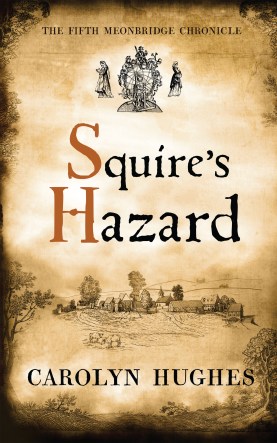 Blurb:
How do you overcome the loathing, lust, and bitterness threatening you and your family’s honour?
It’s 1363, and in Steyning Castle, Sussex, Dickon de Bohun is enjoying life as a squire in the household of Earl Raoul de Fougère. Or he would be if it weren’t for Edwin de Courtenay, who’s making his life a misery with his bullying, threatening to expose the truth about Dickon’s birth.
At home in Meonbridge for Christmas, Dickon notices how grown-up his childhood playmate, Libby Fletcher, has become since he last saw her and feels the stirrings of desire. Libby, seeing how different he is, too, falls instantly in love. But as a servant to Dickon’s grandmother, Lady Margaret de Bohun, she could never be his wife.
Margery Tyler, Libby’s aunt, meeting her niece by chance and learns of her passion for young Dickon. Their conversation rekindles Margery’s long-held rancor against the de Bohuns, whom she blames for all the ills that befell her family, including her own servitude. For years she’s hidden her hunger for retribution, but she can no longer keep her hostility in check.
As the future Lord of Meonbridge, Dickon knows he must rise above de Courtenay’s loathing and intimidation and get the better of him. And, surely, he must master his lust for Libby so his own mother’s shocking history is not repeated? Of Margery’s bitterness, however, he has yet to learn…
Beset by the hazards these powerful and dangerous emotions bring, can young Dickon summon up the courage and resolve to overcome them?
Secrets, hatred, and betrayal, but also love and courage – Squire’s Hazard, the fifth MEONBRIDGE CHRONICLE.
Buy Links:
This book is available to read on #KindleUnlimited.
Universal Link: https://books2read.com/u/bW5yJz
Amazon UK: https://www.amazon.co.uk/Squires-Hazard-Meonbridge-Chronicle-Chronicles-ebook/dp/B0BHKH1QB1/
Amazon US: https://www.amazon.com/Squires-Hazard-Meonbridge-Chronicle-Chronicles-ebook/dp/B0BHKH1QB1/
Amazon CA: https://www.amazon.ca/Squires-Hazard-Meonbridge-Chronicle-Chronicles-ebook/dp/B0BHKH1QB1/
Amazon AU: https://www.amazon.com.au/Squires-Hazard-Meonbridge-Chronicle-Chronicles-ebook/dp/B0BHKH1QB1/
The paperback is available at Amazon, Barnes & Noble, and Waterstones.
 Author Bio:
CAROLYN HUGHES has lived much of her life in Hampshire. With a first degree in Classics and English, she started working life as a computer programmer, then a very new profession. But it was technical authoring that later proved her vocation, as she wrote and edited material, some fascinating, some dull, for an array of different clients, including banks, an international hotel group, and medical instruments manufacturers.
Having written creatively for most of her adult life, it was not until her children flew the nest several years ago that writing historical fiction took centre stage, alongside gaining a Master’s degree in Creative Writing from Portsmouth University and a Ph.D. from the University of Southampton.
Squire’s Hazard is the fifth MEONBRIDGE CHRONICLE, and more stories about the folk of Meonbridge will follow.
You can connect with Carolyn through her website http://www.carolynhughesauthor.com and on social media.
Social Media Links:
Website: http://www.carolynhughesauthor.com
Twitter: https://twitter.com/writingcalliope
Facebook: https://www.facebook.com/CarolynHughesAuthor/
Book Bub: https://www.bookbub.com/profile/carolyn-hughes
Amazon Author Page UK: https://www.amazon.co.uk/Carolyn-Hughes/e/B01MG5TWH1/
Goodreads: https://www.goodreads.com/author/show/16048212.Carolyn_Hughes

 When we think about royal relationships from the past, we do not associate them with love; it is more about cementing power. Princes and kings knew how much was at stake, so they tended to have wives for politics and produce legitimate heirs that would inherit their kingdoms. For matters of love and lust, kings and princes would have mistresses, either of noble birth or lower, on the side. These women have been deemed whores and homewreckers but is that a fair assessment of their legacies? Julia A. Hickey takes a closer look at these misunderstood mistresses in her latest book, “Medieval Royal Mistresses: Mischievous Women who Slept with Kings and Princes.”
 A 16-year-old duchess, who lived a sheltered life, died in a remote villa after only being married to her husband, Alfonso Duke of Ferrera, for a mere year. Many suspect that she died of a fever, but there are rumors that her husband had her poisoned. Not much is known about Lucrezia de Medici, Duchess of Ferrara, except her marriage portrait and a brief mention of her in Robert Browning’s poem, “My Last Duchess.” Did she die of a fever, or was there a more sinister plot behind her demise? The mystery around her life and unexpected death have not been discussed much until now in Maggie O’Farrell’s latest novel, “The Marriage Portrait.”
 When one says “the Princes in the Tower,” a few images pop into our mind. Two young boys were killed in the Tower by their evil uncle, who would become King Richard III. At least, that is the image that the Tudors wanted the world to see, and for centuries, that story has often been told. However, as research has expanded into who Richard III was, the tale of these two boys and their ultimate fate has become even murkier with new suspects and the question of whether the boys were murdered. Elizabeth St. John decided to take on the mystery of the Princes of the Tower with her twist to the tale in her latest novel, “The Godmother’s Secret.”
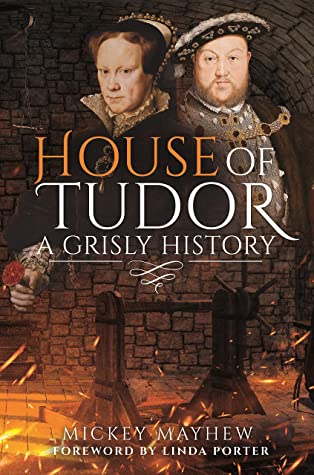 The glitzy, glamorous life of the Tudors portrayed in popular TV shows and novels mask the truth of this infamous dynasty. It is more bloody than what has been described. It is filled with grotesque executions, deadly diseases, bloody battles, and bloody battles. What happened to Richard III’s remains? What was Tudor torture like for those unfortunate victims? What were other devious tales at play in 16th-century Europe? Mickey Mayhew has worked hard to answer these questions by combining 45 of the most gruesome stories from this dynasty into one book, “The House of Tudor: A Grisly History.”
 I am pleased to welcome G.J. Williams to my blog today to share an excerpt from her latest novel, “The Conjuror’s Apprentice.” I want to thank G.J. Williams and The Coffee Pot Book Club for allowing me to be part of this blog tour.
  Blurb
Blurb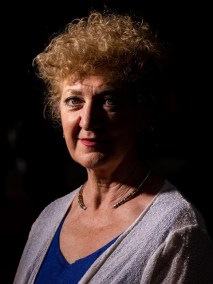 Author Bio
 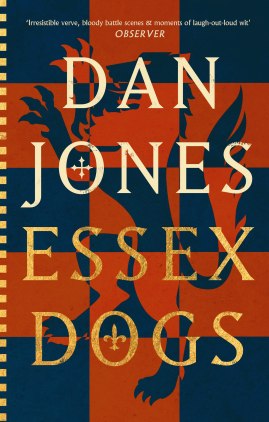 The year is 1346, and numerous English ships have landed on the shores of France. King Edward III, his son Edward of Woodstock, and his lords launched the first stage of what would be known as the Hundred Years’ War. Amongst the English royalty, nobility, and regular soldiers, are companies of men who came of their own accord for money and glory. One company of men consists of ten men known as the Essex Dogs, led by Loveday FitzTalbot. They are not like the other groups. They do not fight for money or glory; they fight for each other. In the horrors of war in a foreign land, can the Essex Dogs keep their promise and stay alive? Dan Jones introduces the world to these ten men and the early stage of the Hundred Years’ War in his first historical fiction novel, “Essex Dogs.”
 The world of someone close to a king, especially someone close to King Henry VIII, was full of hazards and great triumphs. All the glist and glamor of the Tudor court could not save them from the rage of the King. This could apply to anyone who fell during the reign of this infamous King, but none more so than his second wife and queen, Anne Boleyn. Much has been written about Anne Boleyn and her dramatic fall from grace, specifically the final month of her life, but what was she doing in her last year alive? Natalie Grueninger hopes to answer this question in her latest book, “The Final Year of Anne Boleyn.”
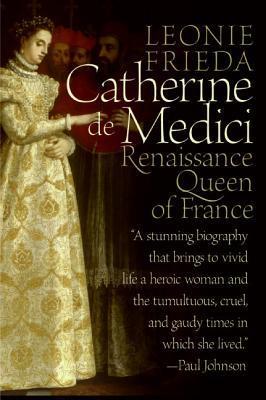 When we think about women rulers in the 16th century, some names, like Queen Mary I, Queen Elizabeth I, and Mary Queen of Scots, come to mind. However, another woman should be included in this list as her life helped keep the Valois dynasty alive and well in France, even though she was Italian by birth. Her name has been tainted with dark legends of poisoning, deadly incidents, and the infamous St. Bartholomew’s Day Massacre. This notorious queen was Catherine de Medici, and Leonie Frieda has chosen to shed some light on the myths and mysteries surrounding this misunderstood woman in her biography, “Catherine de Medici: Renaissance Queen of France.”
 Two women who served Anne Boleyn must deal with the ramifications of staying on opposite sides of the queen’s downfall. One is the next bride of King Henry VIII, who must give the king the son he desires or suffer the consequences. The other is a lady in waiting who holds a dark secret and a relic of the past that could be dangerous to both women. Many of us know the story of Jane Seymour, but is there more to the queen who was able to give King Henry VIII the son he desired? What about the mysterious Margery Horsman? What role did she play in Anne Boleyn’s and Jane Seymour’s inner circles? In her third book, “Keeper of the Queen’s Jewels,” Adrienne Dillard tells the tale of these women bonded by fate to work together to survive such a tumultuous time.
 Adventures of a Tudor Nerd