
 A man who wants to get ahead in any royal court must have an impeccable background and a willingness to serve his monarch no matter the obstacles thrown their way. It takes an extraordinary man who doesn’t have a pristine background to make it in the ruthless world of a royal court, but some men made names for themselves. One such man was an adventurer, a poet, an explorer, and a courtier. He came from humble beginnings and rose to prominence to become known as one of the last true Elizabethans. The man was Sir Walter Raleigh, and his story is told in Tony Riches’ latest novel, “Raleigh: Tudor Adventurer.”
I want to thank Tony Riches for sending me a copy of this novel. I have enjoyed his previous books in his Elizabethan series on Sir Francis Drake and Robert Devereux Earl of Essex, so I was thrilled when a new story about Sir Walter Raleigh was announced. I previously read a novel about Sir Walter Raleigh’s mother this year, so I was looking forward to an adventure with her son.
Walter Raleigh began his career as a law student who was not passionate about the law. He is ambitious and eventually attracts the attention of Queen Elizabeth I herself; it is in her court that he becomes a courtier and, finally, her Captain of the Guard. His dream was to set sail on the open seas with his brother. He finally gets his chance to sail the high seas, but it is not as glamorous as he envisioned, but he is hooked on the thrill of the adventure.
Some look down on Raleigh because he is not part of a noble family, but he rose through the ranks to become one of the Queen’s favorites. His good looks and charisma attracted the attention of many young ladies, including Bess Throckmorton, who would later become his wife. However, the bulk of this novel focuses on the adventures and investments Raleigh was known for. From Ireland and Cadiz to the New World and the search for the legendary City of Gold, Riches takes his readers on swashbuckling journeys full of perilous battles and high rewards.
I thoroughly enjoyed seeing Raleigh’s relationships with everyone from Queen Elizabeth I to his wife, Bess Raleigh. The audience gets a chance to see the inner workings of Elizabeth’s court through the eyes of someone who knew what it meant to be on Elizabeth’s good side. I also enjoyed the poetry that Riches weaves into this narrative to give his audience a better understanding of what Raleigh might have felt during crucial moments in his life. My one issue with this novel was that some of the battles and scenes during Raleigh’s expeditions felt a tad rushed to me, and I wish Riches developed these scenes a bit more.
Overall, I found this novel satisfying to read and a real treat for any Tudor fan. If you have enjoyed the previous Elizabethan series books or are looking for a stand-alone story about Sir Walter Raleigh, I would propose you read “Raleigh: Tudor Adventurer” by Tony Riches.
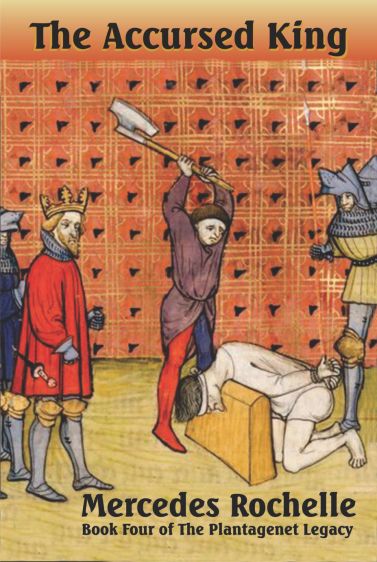
 Today, I welcome Mercedes Rochelle to my blog to promote her latest novel, “The Accursed King ( The Plantagenet Legacy Book 4)”. I want to thank Mercedes Rochelle and The Coffee Pot Book Club for allowing me to be part of this tour.
 Buy Links:
 Author Bio:
 The year is 1480. Intrigue and murder lurk everywhere at the Palace of Westminister, where no one is safe. A mysterious letter and the men who want the letter back lead to the murder of one of the clerks from the Office of the King’s Secretary. Under the orders of powerful men at court, including King Edward IV himself, Seb Foxley must join his wayward brother Jude as one of Secretary Oliver’s clerks to uncover the truth of the conspiracy against the crown. Can the brothers work together to decode the truth and save the life of the king’s beloved heir in time? Seb Foxley’s latest adventure is told in book ten of Toni Mount’s Sebastian Foxley Medieval Murder Mystery series, “The Colour of Rubies.”
 When we think of the past, especially those close to a thousand years past our current time, we tend to think about kings and conquerors who transformed the political landscape of certain countries. However, kings and conquerors would be nothing more than mere men if it was not for advisors and allies that stood by their sides or against them. For example, for nearly a century, the men and women of the House of Godwin were at the center of Anglo-Saxon politics and helped or hindered the path of those who wished to sit on the throne of England. The House of Godwin might not be a familiar family for those who are not familiar with Anglo-Saxon England before the Norman Conquest. Still, Michael John Key takes on the challenge to tell their story in his book, “The House of Godwin: The Rise and Fall of an Anglo-Saxon Dynasty.”
 The year is 1522, and London is in a jovial mood. King Henry VIII and his wife Catherine of Aragon are to play host to the Holy Roman Emperor Charles V as he visits England. As one of King Henry VIII’s most loyal advisors, Cardinal Wolsey had the great honor of hosting a grand masque featuring King Arthur and the Black Knight for the distinguished company. Unfortunately, as preparations for the luxurious masque are in full swing, Wolsey’s historian is horrifically murdered. The only one who can solve the case is Anthony Blanke, the son of John Blanke, the trumpeter before the masque is ruined, and Henry VIII discovers the truth. The story of this case is told in Steven Veerapen’s latest novel, “Of Blood Descended.”
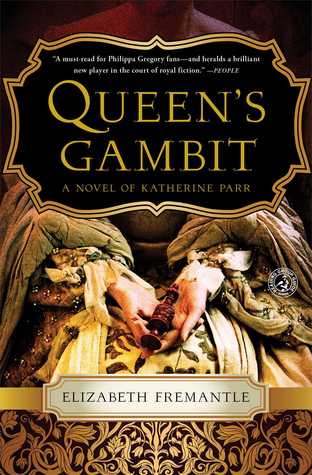 To be married to a king may seem like a dream, but reality can be cruel. Take the wives of Henry VIII. After saying ” I do,” each wife had to deal with complex challenges after saying “I do.” We all know the poem; divorced, beheaded, died, divorced, beheaded, survived, but does that define these queens? After the death of her second husband, Katherine Parr must choose between Henry VIII and Thomas Seymour, the man who has captured her heart. She must navigate love, court intrigues, and the treacherous religious landscape of England in the 1540s to survive. Katherine’s life as Queen of England and how close she came to a disastrous fall from grace are explored in Elizabeth Fremantle’s first novel, “Queen’s Gambit: A Novel of Katherine Parr.”
 When we think about the Tudor dynasty, we think about the monarchs who made the dynasty, but we also pay attention to those around the king or queen who sat on the throne. There were families like the Boleyns, the Howards, and the Seymours who stood on the sidelines for a short amount of time, but one family saw the majority of the dynasty through highs and extreme lows. The Dudleys have been seen as a power-hungry family who would do anything to sit on the throne of England, but is there more to their story? In her debut book, “The House of Dudley: A New History of Tudor England,” Joanne Paul explores the lives of this extraordinary family to find the truth about their ambitions and their resilience.
 English kings are some of the most recognizable monarchs in all of European history, and when we think of Kings of England, a few names pop into our minds. Edward, George, and William tend to be popular, but you cannot study English history without Henry. Eight kings of England were Henry, and they would change the history of England forever. These eight kings give us an entire range of what kingship was like in medieval Europe. From men born to be king to opportunists who decided to take the throne as their own, from saints to warrior kings, the Henrys of English history were a colorful group of characters. Each king has had numerous biographies written about him, but there has never been a collection of biographies about the kings named Henry until now. This is “Harry of England: The History of Eight Kings, From Henry I to Henry VIII” by Teresa Cole.
 England is in danger of falling to its Danish invaders. The kingdoms of East Anglia, Northumbria, and Mercia have already fallen; all that stands in the way of complete Danish domination is Wessex and its king Alfred. Yet this king is more of a saint than a warrior, so Alfred desperately needs a man who knows how to fight. A man like Uhtred of Bebbanburg is a skilled warrior even though he doesn’t always see eye to eye with Alfred on matters of faith. When Alfred and his family become fugitives, he must rely on Uhtred to help restore him and his family to ensure Wessex does not fall. This is the premise of book two of The Saxon Stories series by Bernard Cornwell, “The Pale Horseman.”
 The Tudor dynasty was full of colorful characters and events that defined the era. Their lives were full of love affairs, marriages, births, wars, tragedies, and triumphs. In numerous books about these monarchs and this period in history, we have seen the significant events that defined the era, but what about lesser-known social events that these monarchs participated in. The bulk of the research into this dynasty focuses on those who ruled, from Henry VII to Elizabeth I, because their lives give us a brilliant insight into what it was like to live in the glittery Tudor court. In “The Tudor Socialite: A Social Calendar of Tudor Life,” Jan-Marie Knights gives her readers a glimpse into the social calendar of the Tudor rich and famous.
 Adventures of a Tudor Nerd