Book Review: “Dark Renaissance: The Dangerous Times and Fatal Genius of Shakespeare’s Greatest Rival” by Stephen Greenblatt

Sixteenth-century England was a time of great change. There were religious changes as the crown passed from one member of the Tudor family to another. Wars and illnesses like the plague and the sweating sickness were rampant. However, this was also a time of an explosion of the arts, particularly of the theatre. We see men like William Shakespeare and Ben Jonson rise from obscurity to write plays that would propel them to become phenomena. There was a third playwright who should be included in this list. He was the son of a cobbler who was educated at Cambridge University. A brilliant man who wrote groundbreaking plays while he was a spy for her majesty Queen Elizabeth I, his cause of death when he was only in his twenties would remain a mystery for centuries. Christopher (Kit) Marlowe’s story is told in Stephen Greenblatt’s latest book, “Dark Renaissance: The Dangerous Times and Fatal Genius of Shakespeare’s Greatest Rival.”

I would like to thank W. W. Norton & Company and Net Galley for sending me a copy of this book. I will be honest. Although I do spend a lot of time studying the 16th century, I don’t read a lot of plays by Shakespeare or Marlowe. So, when I saw this book and its premise, it piqued my curiosity. I knew that Marlowe was a famous playwright, he was a spy, and that he died young, but that’s all I knew before reading this book. I wanted to know more about Kit Marlowe and his world.

Christopher Kit Marlowe was the son of John Marlowe, an immigrant shoemaker, and his wife, Katherine Arthur. As their only son, it was believed that Kit would become a cobbler, but he had different skills that were more academically inclined. The cobbler’s son would study the classical writers of Ancient Greece and Rome, while learning Latin and debating theology. Kit would find himself at Cambridge University, and he paid for his education on a scholarship. While the main focus of these chapters is Marlowe, Greenblatt does show the lives of the scholars and fellow students who would shape Marlowe’s writings and his path in life.

Just as Marlowe was about to complete his Master of the Arts degree, his attendance dropped, and he was seen in Rheims in France. He was beginning to establish connections to the Elizabethan spy network with William Cecil, Lord Burghley, and Sir Francis Walsingham. This is the stage of life where we not only see Marlowe get in trouble with the law, but we also get to see Marlowe become a playwright who would rival Shakespeare himself. Greenblatt takes his time to analyze Marlowe’s works, including Tamburlaine the Great, Edward II, The Jew of Malta, and Doctor Faustus. Finally, Greenblatt examines Marlowe’s death on May 30, 1593, and who might have been responsible for his murder.

I found this book extremely informative, not only when it comes to the life of Christopher Kit Marlowe, but also the worlds of Elizabethan higher education, the theatrical community, the divides on religious beliefs, and the spy world. Marlowe is one of those figures who challenged what it meant to be a playwright through his rather controversial works, which inspired others like William Shakespeare. If you want a book about a playwright with a tragic end who doesn’t get a lot of attention, I highly recommend you read “Dark Renaissance: The Dangerous Times and Fatal Genius of Shakespeare’s Greatest Rival” by Stephen Greenblatt.

Book Review: “Henry VIII’s Controversial Aunt, Honor Lisle: Her Life, Letters, and Influence on the Tudor Court” by Amy Licence

Marrying into the royal family is not all sunshine and rainbows. Of course, we tend to think about those who marry the king, the queen, the prince, or the princess. But we also need to consider the aunts and the uncles of the royals as part of the family. Take, for example, Arthur Plantagenet, the illegitimate son of Edward IV and the uncle of Henry VIII. His second wife, Honor Lisle, would help him rule Calais; however, she is best known for her letters and her devout Catholic faith during the Reformation in England. So why is Honor Lisle considered a controversial figure, and what was the cause of the fall of Honor and Arthur from the royal good graces? Amy Licence explores the life of Henry VIII’s step-aunt in the first full biography dedicated to Honor Lisle, which is entitled “Henry VIII’s Controversial Aunt, Honor Lisle: Her Life, Letters, and Influence on the Tudor Court.”

I would like to thank Pen & Sword Books and NetGalley for providing me with a copy of this book. I have heard of Honor Lisle and her letters, but I did not know much about her life before this book. I did know that she was married to Arthur Plantagenet, but I had assumed that he was her first husband, so I didn’t know about her life before Arthur. When I saw that Amy Licence was writing a biography about Honor Lisle, I knew I wanted to read it.

Licence begins with the birth of Honor Grenville, Lady Basset, Lady Lisle Plantagenet. She was born in 1493 to Thomas and Isabel Grenville in the small town of Bideford, Devon. Her father served the first Tudor king, Henry VII, as Esquire of the Body, so Honor’s family did have some connection before Honor’s marriage to Arthur. Honor’s mother died a year after she was born, but her father did not die until 1513. In 1515, Honor would marry her first husband, Sir John Basset, and they would have between 7 and 8 children before his death in January 1528. 

A year later was a monumental year for England as it was the start of the divorce between Henry VIII and Catherine of Aragon, which would be known as the Great Matter. It was also the year that Honor married Arthur Plantagenet. The couple would move to Calais, where Arthur would rule for his nephew. This is where we get to see the Lisle letters, Honor’s dictated correspondence to prominent figures in Tudor England. Honor and Arthur would go into debt, dealing with the constant threat of war, balance their faith and be loyal to the King, and handle a plot by Reginald Pole that would try to remove Henry VIII from the throne. 

I found it so interesting to see Honor’s perspective on the big issues of the Tudor court while staying in France, as well as how life in Calais was different from it was in London during this time. Honor Lisle’s life and letters give us great insight into the reign of Henry VIII from the perspective of someone who was outside of England during the major events of his reign. Licence’s research, combined with an easy-to-follow writing style, makes this a very well-written biography. If you want a biography about a lesser-known Tudor woman and her famous letters, I highly recommend you read “Henry VIII’s Controversial Aunt, Honor Lisle: Her Life, Letters and Influence on the Tudor Court” by Amy Licence.

Guest Post: “Historical Setting for ‘The Herb Knot’ by Jane Loftus”

I am pleased to welcome Jane Loftus to my blog today to share a guest post about the historical setting of her novel, “The Herb Knot.” I would like to thank The Coffee Pot Book Club and Jane Loftus for allowing me to participate in this blog tour. 
The historical setting for the Herb Knot is mainly Winchester, where I live (which makes things a lot easier!).  The early chapters were set in Ghent, where I used maps, drawings, pictures, and the history of the Flanders cloth trade as a guide, but tried hard to focus on people and their interactions rather than straying too far into descriptions of Ghent itself. I’ve never been to Ghent, although, as it happens, I will be there at the end of August. 

Winchester, however, is within walking distance of my house, and its medieval layout and industry have been extremely well documented. The city itself was the former capital of England and seat of King Alfred, but compared to many other cities – Salisbury, for instance, which is also mentioned in the novel – it is quite small.  This gives the author fewer opportunities for geographical variety – you’re not going to get docks, as you would in Southampton, or mazes of streets to get lost in, as you would in London.  However, this does have advantages. 

When Rafi looks out the window in Joan’s turret, it is perfectly feasible for him to have seen all the way down the high street to where his enemies were having a menacing huddle. When he runs from Stefan and gets stuck at the bottom of Hammond’s passage, there really isn’t anywhere else for him to go. He can’t wander unseen through Seven Dials or hide in a Southampton dock warehouse. Unless you leave the city and hide out in the marshes or woods, you’ll probably get caught.  

It does make Rafi’s attempts to hide from Roger as he goes about his business that much more difficult, and, ultimately, futile.  Roger could stand in any number of places on the High Street and see absolutely everything. It does eventually bite Roger on the backside when Rafi is able to see him leg it up Blue Boar Hill and follow him, but we all know that incident doesn’t end particularly well. 

In terms of comparisons with then and now, the castle gate is still there, although the castle itself is long gone. The Guildhall has moved, the inns are now shops, and the Helle Tavern is somewhere beneath Montezuma’s chocolate shop and Occitane, the beauty shop. Not sure either of these would appeal to Adam as much as a large, frothy ale. St Maurice’s, where the curfew bell was rung, is just a tower now, with a flower market underneath. The Abbey has completely gone, bar a few stone tombs near the Tourist Information Board, and the charnel chapel is (probably) under the public toilets in Abbey Gardens. 

The cathedral, of course, is still there.  There are no markets in the immediate environs anymore; they’re on the High Street. It is not, as Rafi observes, as graceful and elegant as Salisbury Cathedral. It’s squat, it’s square, it’s a bit in your face. But it’s quite lovely and I’m very fond of it even though it was put there by the Normans and I’m not much of a fan of theirs. The top cathedral they built there, though. Gotta give them credit for that. 

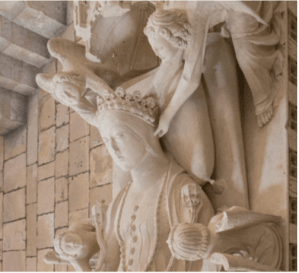
St John’s is still there, on the hill in the east, overlooking the city. As with many churches, it’s rarely open. It is outside the soke, so not within the city proper, and as you climb, it’s as if you’re in a completely different world. It’s suddenly quieter; there are usually very few people around. If you decided to do a Stefan and hurl someone at a hawthorn tree, you probably wouldn’t be seen (please don’t do this). The frieze is still there and is quite remarkable. 

Doesn’t feature top of the list of things to do in Winchester, but it’s top of my list. If it’s open, go in; you won’t be disappointed. 

Try not to hide under any tombs, though. 

Blurb:   

The Hundred Years’ War comes to life in this spellbinding tale of love, betrayal, and conspiracy …  

A quest born on the battlefield will change a young boy’s destiny…  

Rafi Dubois is five years old when his mother is murdered after the Battle of Crecy in 1346. Alone and lost, Rafi is given a token by the dying Englishman who tried to save his mother’s life: a half-broken family seal which he urges Rafi to return one day to Winchester.  

Years later, when Rafi saves a wealthy merchant’s wife from a brutal robbery, he is rewarded with the chance to travel to England, taking the seal with him.  

But when he reaches Winchester, Rafi finds himself in a turbulent world full of long-held allegiances, secrets, and treachery. His path is fraught with danger and with powerful enemies working against him, Rafi falls in love with Edith, a market apothecary. But in doing so, Rafi unleashes a deadly chain of events which threatens to overwhelm them both…  

The Herb Knot is a sweeping and passionate novel set in one of the most tumultuous times in English history, from a powerful new voice. 

Buy Link:  

Universal Buy Link:  https://books2read.com/u/bzN6Z2  

Author Bio:  

Jane Loftus gained a degree in 16th-century European and British history from Surrey before taking a postgraduate degree in modern political history. As a lone parent, she worked in Winchester Waterstones before returning to IT once her son was older. 

Hugely passionate about the Middle Ages, she drew inspiration for this novel from the medieval layout of Winchester, which has been painstakingly documented. 

Jane is originally from London but has lived in Winchester for over twenty years. When not writing, she is usually out walking or watching costume dramas on Netflix – the more medieval the better. She also plays far too many RPGs. 

Author Links:  

Website: https://janeloftus.com/  

Facebook: https://www.facebook.com/profile.php?id=61577760507961 

Instagram: https://www.instagram.com/janeloftusauthor/   

Bluesky: https://bsky.app/profile/janeloftus.bsky.social  

Amazon Author Page: https://www.amazon.co.uk/stores/author/B0F3Q52X9Y  

Goodreads: https://www.goodreads.com/author/show/29357528.Jane_Loftus  


Book Review: “Daughter of the Tarot” by Clare Marchant

A single deck of cards changed the fate of generations of women. The tarot cards, created in 16th-century Italy, will connect two women separated by centuries. One was a woman in 17th-century London, originally from Milan, who used the cards to rescue women from abusive relationships. The other is a woman from modern-day London starting her life anew when she comes across an old tarot card deck with a missing card. What began as a hunt for a missing card will connect the two women and change lives forever. The cards hold secrets to the past, but will they bring hope or disaster? This is the premise for Clare Marchant’s latest dual-timeline novel, “Daughter of the Tarot.”

I would like to thank Boldwood Books and Net Galley for sending me a copy of this novel. I recently read her novel, “The Shadow on the Bridge,” which I enjoyed, so when I saw this novel, it had such an intriguing description that I wanted to read it. I am not familiar with the history of tarot cards, and I have not read many novels set in the 17th century, so I was excited for a new adventure.

As this is a dual-timeline novel, there are two protagonists from two different periods: Portia from 17th-century England and Beatrice from 21st-century England. We begin in Milan in 1629, which has just been hit by the plague, where we are introduced to Portia and her baby daughter, Vittoria, who are struggling to survive. The next time we see Portia and Vittoria, iits 1644 and they are living in London. Vittoria is 15 years old, and Portia is using her talent with tarot cards to help those in need. What Vittoria does not know is that Portia uses her readings to help women escape abusive relationships by using the Devil’s Card as a message for the boatsman Jack, who is in love with Portia. Secrets and truths slowly begin to reveal themselves as someone from Portia’s past has come to London and may destroy her relationship with Vittoria.

In the modern storyline, we meet Beatrice, or Bea, who is starting a new life in London and is opening her own antiques shop. Bea has been avoiding her father and his new love interest since her mother died. She has the gift of reading tarot cards, and one day, she comes across an old deck of cards. The only problem is that it is missing a key card, the Devil’s Card. Bea and her landlord, Jack, search high and low for the missing card and find exactly what they are searching for, and some surprises.

It took me a while to get into this book as it was a slower pace than the previous novel that I read by Marchant. While I enjoyed the modern storyline, the 17th-century portion felt a bit slower, and it didn’t feel like the 17th century to me, but more like the 16th century. Overall, I think it was a decent novel with an interesting pair of protagonists. If you want a story about the 17th century with a unique premise, I recommend you read “Daughter of the Tarot” by Clare Marchant.

Book Review: “Mistress of Dartington Hall” by Rosemary Griggs

One of the greatest threats to England during the reign of Elizabeth I was the Spanish Armada, under the orders of King Philip II of Spain. In the year 1587, the Spanish ships were spotted off the coast of Devon. Fear grips the country, but one woman is up to the task of keeping her beloved Dartington Hall and its inhabitants from harm. Roberda Chapernowne knows what it means to fight for those she loves and is willing to do it again while her husband, Gawen, is away in Ireland fighting for the Queen after he almost divorced Roberda. Roberda’s life turns upside down when Gawen returns home. Can they rekindle their relationship, or will they fall into despair and ruin? Rosemary Griggs concludes Roberda and Gawen Chapernowne’s stories in her latest novel, “Mistress of Dartington Hall.”

I would like to thank Troubador Publishing and Net Galley for sending me a copy of this novel. I have enjoyed Griggs’ previous novels, so when I saw that she had another novel coming out to end Roberda Chapernowne’s story, I knew I had to read it to see how Roberda’s story ended.

We are thrust straight into the action with this novel. It’s 1587, and rumors of Spanish ships have been spotted off the English coast. Fear grips the inhabitants of Dartington Hall, but the mistress of the house, Roberda Chapernowne, is ready to take control of the situation. She has been in charge for the last three years, following her husband, Gawen, who left her and his family to fight in Ireland for Queen Elizabeth I. Now, Gawen has returned home, which makes things extremely awkward as Gawen tried to divorce Roberda. Now, he is back and wants to reconcile their relationship, but Roberda’s faithful maid Clotilde, who has stood by her side every step of the way, is hesitant.

Gawen and Roberda reconcile while raising their children while dealing with the threat of a Spanish invasion. Unfortunately, their brief return to normalcy is dashed when Gawen is injured while hunting and dies, leaving Roberda to take care of the children and the estate. But being a widow who has mostly daughters and only one son is difficult. We see how Roberda deals with her children’s inheritances, her family in France, and a budding romance for Roberda.

I found this an enjoyable conclusion to Roberda Chapernowne’s story. I liked how this book series and this novel in particular focused on lesser-known figures in the Tudor age, instead of the typical royals. If you are a fan of the previous novels in this series, I recommend you read “Mistress of Dartington Hall” by Rosemary Griggs.

Book Review: “Thomas More: A Life” by Joanne Paul

The year is 1535, and an educated scholar, father, writer, and the former Chancellor of England marches to his demise. His crime was staying silent on an issue that the King deemed extremely important: the idea that the King of England should be the Supreme Head of the Church of England, not the Pope. As a Catholic, Sir Thomas More does not agree with this decree and must die. How did one of the most prominent Tudor scholars of his age fall so quickly? Joanne Paul explores the rise and dramatic fall of this infamous Tudor figure in her latest biography, “Thomas More: A Life.”

Joanne Paul is slowly becoming one of my favorite nonfiction writers. Her debut, “The House of Dudley,” was spectacular, and when I heard that she was writing a biography about Thomas More, I knew I wanted to read it. I know the basic information about Thomas More’s life and his books about the Wars of the Roses and Utopia, but I wanted a book that gives more details about his life.

Thomas More was the son of the lawyer John More and his wife Agnes, born in 1478. A child of the Wars of the Roses, the shifting sands of the political landscape of his youth will prepare him for the tumultuous Tudor court of his adulthood. While he recalls the reign of King Richard III in his book about the period, it should be noted that he was a boy during the king’s reign. 

Thomas became a scholar who specialized in Humanism and created a community of like-minded scholars and artists, including men like Desiderius Erasmus. Thomas More would marry twice, to Jane Colt, the mother of his children, Margaret, Elizabeth, Cecily, and John, and Alice Harpur. He would ensure that all his children received a proper Humanist education, and his children, especially Margaret, were praised for their scholarly abilities. He would begin to write like he was running out of time and create one of his most famous works about politics, Utopia, as well as go toe to toe against Martin Luther himself. 

 More would continue his academic pursuits, even when he captured the attention of King Henry VIII, who would appoint him Chancellor of England. While a great honor, Thomas did not agree with the King on the Great Matter as he believed Queen Katherine of Aragon was the rightful wife of King Henry VIII. He would persecute those whom he deemed as heretics as a devout Catholic man, and it was ultimately his faith that would lead to his earthly doom. When Henry VIII decided that he wanted his people to swear an oath that Henry VIII was the Supreme Head of the Church of England instead of the Pope. As a devout Catholic, Thomas More’s silence was deafening, and he was condemned as a traitor to the crown, destined to be executed.

Even though Thomas More was a controversial figure of the Tudor era for Ricardians and Protestants alike, we in the modern age can learn a lot from his life and apply it to our own time. Paul does it again, as this is a stunning biography of a man who was a scholar and an outspoken Catholic in a time when the King’s power was becoming dangerous.  The way she weaves the historical facts, including More’s numerous pieces of writing, with a narrative that is easy to follow is astounding. Truly, this is the definitive biography on Sir Thomas More. If you want a fabulous biography on such an infamous figure of the Tudor age, I highly recommend you read “Thomas More: A Life” by Joanne Paul.

Guest Post: “Excerpt from ‘The Will of God’ by Julian de la Motte”

I am pleased to welcome Julian de la Motte to my blog to share an excerpt from his novel, “The Will of God.” I would like to thank The Coffee Pot Book Club and Julian de la Motte for allowing me to be part of this blog tour.

Excerpt:

And so there had been, far more than a ‘little something’ in fact. Grandesmil was carrying in his panniers documents that entitled him to vast swathes of new lands in the Cotentin, and he was carrying in his head visions of the likely reaction to William’s death of certain of his more immediate family. And thus, to Robert, his eldest son: The boy had been with the King of France for four years now. Kept on a short leash and harboured by William’s greatest enemy, a boy caught in rebellion and open defiance of his father. To Robert, then, full pardon and restitution and the bestowing of the Duchy of Normandy for himself, but no Crown of England.

And thus, to Odo, his half-brother. A man so steeped in sin and villainy and treachery that he could no longer personally enjoy his former high estate. While he languished under close but comfortable confinement for his unchurchly crimes, the bounty of Kent, his bishopric of Bayeux, and a score of other properties and estates had gone, untasted by him and savoured by others. To Odo, then, forgiveness and a return of all his former glories and previous estate. To his problematic and scandalous second son William, called Rufus for his red hair and high complexion, the great prize of the Kingdom of England itself and all that it brought, good and bad. To Henry, his youngest and avaricious son, the sum of the weight of five thousand pounds of silver, to make of it what he would.

It was ever the fate of younger sons to make of themselves what they could. That, after all, was what the wild lands of Spain, of Italy, and Sicily and the possessions of the Byzantines were for, so that determined men with horses and swords could take and make of them what they could. But the strange and cold and calculating boy would not embark upon the world empty-handed.

Blurb: 

“Deus Lo Vult!” 

Gilles is the natural son of the Earl Waltheof, executed by William the Conqueror for supposed treachery. Raised in Normandy by Queen Matilda of England, Gilles is a young servant of Robert, Duke of Normandy, when the first call for a Holy War against the infidel and the liberation of Jerusalem is raised in Christendom. Along with thousands of others, inspired by a variety of motives, intense piety mixed with a sense of adventure and the prospects of richness, Gilles becomes a key and respected follower of the Duke of Normandy and travels through France and into Italy to the point of embarkation for Constantinople and the land of the Greeks. 

In this epic first phase of a long and gruelling journey, Gilles begins to discover a sense of his strengths and weaknesses, encounters for the first time the full might and strength of the Norman war machine and achieves his much coveted aim of knighthood, as well as a sense of responsibility to the men that he must now lead into battle. 

The Will of God is the literal translation of the Latin phrase “Deus Lo Vult,” a ubiquitous war cry and a commonly offered explanation of all the horrors and iniquities unleashed by the First Crusade of 1096 to 1099, when thousands of Europeans made the dangerous and terrifying journey to the Holy Land and the liberation of Jerusalem. It is the first of two books on the subject. 

Praise for The Will of God: 

“De la Motte has superpowers as a writer of historical fiction; he’s a warhorse of a writer bred to stun and trample the literary senses. You won’t stop turning the pages of The Will of God.”  

~ Charles McNair, Pulitzer Prize nominee and author of Land O’Goshen 

Buy Link: 

Universal Buy Link:  https://geni.us/uXe6u  

Author Bio

Julian de la Motte is a Londoner. He graduated from the University of Wales with a degree in Medieval History. He was further awarded a Master of Arts qualification in Medieval English Art from the University of York.  


He studied and taught in Italy for nearly four years before returning to the U.K. and a career as a teacher, teacher trainer, and materials designer before taking up a new role as the Director of Foreign Languages and of English as a Foreign Language. 


Married and with two grown-up children, He is now extensively involved in review writing and historical research, primarily on medieval history. 


The Will of God” [the first of two books on the subject of the First Crusade] is his third novel. 

Author Links

Website: www.historiumpress.com/julian-de-la-motte  

Facebook: https://www.facebook.com/julian.delamotteharrison.3  

Amazon Author Page: https://www.amazon.com/stores/author/B08XWMRPYK  

Goodreads: https://www.goodreads.com/author/list/20873400.julian_de_la_Motte  


Book Review: “Marguerite: Hell Hath No Fury” by Judith Arnopp

I would like to thank The Coffee Pot Book Club and Judith Arnopp for sending me a copy of this novel. I have enjoyed her novels about Margaret Beaufort, so when I heard that she was writing a novel about Margaret of Anjou, I was intrigued to see what she could add to her story.

Arnopp begins with Marguerite on the verge of leaving her beloved France to become the new Queen of England. She is to be the bride of the son of King Henry V, King Henry VI. She imagines that her new husband will be similar to his father, a warrior, and that Marguerite will be able to stop the Hundred Years’ War between France and England. Instead, she is married to Henry VI, a man who is extremely devout to his faith, and lives in an England that hates Marguerite. It’s not the picture-perfect situation, but Marguerite tries to make the best of it, including falling in love not only with her husband but also with Somerset and Exeter, men loyal to her husband.

In time, Marguerite does indeed become a mother to Prince Edward, the Lancastrian heir, but it is then that her life truly begins to fall apart. A few months before, King Henry VI fell ill and remained that way for the rest of his life. Marguerite tried to become the Protector of the Realm, but the position went to Richard, Duke of York. Rivalries would turn deadly, and the Lancastrians would face the Yorkists on the battlefield. With the king incapacitated, Marguerite must be a mother, wife, queen, and general to make sure that the Lancastrian cause survives and her family can live to fight for the crown that is rightfully theirs.

This was a very good novel about a woman who was trying to keep her family and her country together while finding love. Arnopp does a great job exploring what life must have been like for Marguerite in a turbulent time. If you want a novel that explores what life was like for the Lancastrian queen during the Wars of the Roses, I recommend you read “Marguerite: Hell Hath No Fury” by Judith Arnopp. 

Blurb: 

Marguerite: Queen of England 

From the moment Henry VI’s new queen, Marguerite of Anjou, sets foot on English soil, she is despised by the English as a foreigner and blamed for the failures of the Hundred Years’ War in France. 

 Her enemies impede her role as the king’s consort, and when Henry sinks into apparent madness, her bid to become regent is rejected. Marguerite must fight, not only for her position but to maintain Henry’s possession of the crown.  

The ambitious Duke, Richard of York, seizes control of the country, thrusting Marguerite aside and inflating the mutual hatred between the houses of York and Lancaster. But the queen refuses to relinquish power and fights determinedly for the rights of her son, Edward of Lancaster. 

The long and bitter civil conflict, which come to be known as the War of the Roses, commences. 

Buy Link: 

Universal Buy Link: https://mybook.to/mhhnf  

This title is available to read on #KindleUnlimited. 

Author Bio

A lifelong history enthusiast and avid reader, Judith holds a BA in English / Creative Writing and a Master’s in Medieval Studies. She lives on the coast of West Wales, where she writes both fiction and non-fiction. She is best known for her novels set in the Medieval and Tudor period, focusing on the perspective of historical women, but recently she has written a trilogy from the perspective of Henry VIII himself. 

Judith is also a founder member of a re-enactment group called The Fyne Companye of Cambria, which is where and why she began to experiment with sewing historical garments. She now makes clothes and accessories both for the group and others. She is not a professionally trained sewer but, through trial, error, and determination, has learned how to make authentic-looking, if not strictly historically accurate, clothing. A non-fiction book about Tudor clothing, How to Dress like a Tudor, was published in 2023 by Pen and Sword. 

She runs a small seaside holiday let in Aberporth and when she has time for fun, likes to garden and restore antique doll’s houses. You can find her on most social media platforms. 

Her novels include: 

A Song of Sixpence: The Story of Elizabeth of York 

The Beaufort Chronicle: the life of Lady Margaret Beaufort (three-book series) 

The Henrician Chronicle: comprising: 

A Matter of Conscience: Henry VIII, the Aragon Years (Book One of The Henrician Chronicle) 

A Matter of Faith: Henry VIII, the Days of the Phoenix (Book Two of The Henrician Chronicle) 

A Matter of Time: Henry VIII, the Dying of the Light (Book Three of The Henrician Chronicle) 

The Kiss of the Concubine: A Story of Anne Boleyn 

The Winchester Goose: at the court of Henry VIII 

Intractable Heart: The Story of Katheryn Parr 

Sisters of Arden: on the Pilgrimage of Grace 

The Heretic Wind: The Life of Mary Tudor, Queen of England 

Peaceweaver 

The Forest Dwellers 

The Song of Heledd 

The Book of Thornhold 

A Daughter of Warwick: The Story of Anne Neville, Queen of Richard III 

Marguerite: Hell Hath no Fury! 

Author Links

Website: http://www.judithmarnopp.com/ 

Blog: http://www.juditharnoppnovelist.blogspot.co.uk/  

Twitter / X: https://twitter.com/JudithArnopp  

Facebook: https://www.facebook.com/thetudorworldofjuditharnopp  

Instagram: https://www.instagram.com/tudor_juditharnopp/  

Threads: https://www.threads.net/@tudor_juditharnopp  

Bluesky: https://bsky.app/profile/jarnopp.bsky.social  

Pinterest: https://www.pinterest.co.uk/jarnopp/  

Book Bub: https://www.bookbub.com/profile/judith-arnopp  

Amazon Author Page: http://author.to/juditharnoppbooks  

Goodreads: https://www.goodreads.com/author/show/4088659.Judith_Arnopp  

Book Review: “Sinners” by Elizabeth Fremantle

The year is 1599 in Rome, Italy. A young rich woman stands in front of an executioner’s block. She is a mother, a daughter, a sister, a lover, and a killer. Her victim was her father, a man who made her life and the lives of her family members a living hell. When she falls in love with one of her father’s spies, she believes that it is a way out. However, the path she chooses to embark on will bring deadly consequences. What is the truth surrounding this case, and is Beatrice Cenci a cold-blooded murderer or a victim looking for her freedom? Elizabeth Fremantle explores the life of Beatrice Cenci and the circumstances of this crime in her latest novel, “Sinners.”

When I heard that Elizabeth Fremantle had a new novel coming out soon, I jumped at the chance to read it. I loved “Disobedient” and “Queen’s Gambit,” so I was excited to see what story she would tell in this novel. I had never heard of Beatrice Cenci before reading this novel, which was a thrilling prospect, as it allowed me to discover a new historical figure.

We begin with Beatrice as a young girl being forced to leave the convent where she received her education. Her father, Francesco Cenci, had just remarried, and Beatrice had a new stepmother named Lucrezia. We then jump forward twelve years to the Palazzo Cenci in Rome. Beatrice found the body of her brother Rocco, who was killed by the Orestesi, the mortal enemy of the Cenci. After the funeral, Francesco decides to move to La Rocca, a fortress which is more of a prison than a home.

Francesco becomes paranoid and even more possessive of his family, especially Beatrice, who should have been married by now. Instead, Beatrice is trapped in her grief and fears her father. But, there is a glimmer of hope for Beatrice as she finds her soul mate in the castle keeper and spy for her father, Olimpio. Unfortunately, the glimmer can only last for a moment as Francesco’s paranoia reaches a fever pitch and a plan is hatched to rid the family of Francesco forever. Even with the death of Francesco, the family is not out of danger as they must deal with the consequences of their plan.

This is another grippingly beautiful and tragic novel written by Elizabeth Fremantle. Beatrice Cenci’s story was heartbreaking and heavy, but it was a stunning read. I found myself feeling so sympathetic towards Beatrice and Olimpio, even though she did commit a heinous crime. “Sinners” by Elizabeth Fremantle is a binge-worthy read that will have you on the edge of your seat the entire time and will give you a better understanding of the treacherous time and Beatrice Cenci, a woman trapped in an impossible situation. An absolute must-read for any fan of historical fiction.

Guest Post: “Spotlight for ‘A Shape on the Air’ by Julia Ibbotson”

Today, I am pleased to welcome Julia Ibbotson back to my blog to share a blurb for her novel, “A Shape on the Air.” I would like to thank The Coffee Pot Book Club and Julia Ibbotson for allowing me to participate in this blog tour. 
Blurb: 

Can echoes of the past threaten the present? They are 1500 years apart, but can they reach out to each other across the centuries? One woman faces a traumatic truth in the present day. The other is forced to marry the man she hates as the ‘dark ages’ unfold.

How can Dr Viv DuLac, medievalist and academic, unlock the secrets of the past?  

Traumatised by betrayal, she slips into 499 AD and into the body of Lady Vivianne, who is also battling treachery. Viv must uncover the mystery of the key that she unwittingly brings back with her to the present day, as echoes of the past resonate through time. But little does Viv realise just how much both their lives across the centuries will become so intertwined. And in the end, how can they help each other across the ages without changing the course of history? For fans of Barbara Erskine, Pamela Hartshorne, Susanna Kearsley, and Christina Courtenay. 

Buy Link:  

Universal Buy Link: https://myBook.to/ASOTA 

This title is available to read on #KindleUnlimited. 

Author Bio

Julia Ibbotson is fascinated by the medieval world and the concept of time. She is the author of historical mysteries with a frisson of romance. Her books are evocative of time and place, well-researched and uplifting page-turners. Her current series focuses on early medieval time-slip/dual-time mysteries.  

Julia read English at Keele University, England, specialising in medieval language/literature/history, and has a PhD in socio-linguistics. After a turbulent time in Ghana, West Africa, she became a school teacher, then a university academic and researcher. Her break as an author came soon after she joined the RNA’s New Writers’ Scheme in 2015, with a three-book deal from Lume Books for a trilogy (Drumbeats) set in Ghana in the 1960s. 

She has published five other books, including A Shape on the Air, an Anglo-Saxon timeslip mystery, and its two sequels, The Dragon Tree and The Rune Stone. Her latest novel is the first of a new series of Anglo-Saxon dual-time mysteries, Daughter of Mercia, where echoes of the past resonate across the centuries.  

Her books will appeal to fans of Barbara Erskine, Pamela Hartshorne, Susanna Kearsley, and Christina Courtenay. Her readers say: ‘Julia’s books captured my imagination’, ‘beautiful storytelling’, ‘evocative and well-paced storylines’, ‘brilliant and fascinating’, and ‘I just couldn’t put it down’. 

Author Links

Website: https://juliaibbotsonauthor.com 

Twitter / X: https://twitter.com/@juliaibbotson 

Facebook: https://www.facebook.com/JuliaIbbotsonauthor 

Instagram: https://www.instagram.com/julia.ibbotson 

Bluesky:  https://bsky.app/profile/juliaibbotson.bsky.social 

Pinterest: https://www.pinterest.co.uk/juliai1 

Amazon Author Page: https://Author.to/JuliaIbbotsonauthor 

Goodreads: https://goodreads.com/juliaibbotson