 I am pleased to welcome Karen Heenan to my blog today to discuss life at the Tudor Court. This is part of the book tour to promote Karen Heenan’s book, “Songbird (The Tudor Court, book 1). Thank you The Coffee Pot Book Club and Karen Heenan for allowing me to participate in this tour.
 “Bess!”
The voice, close to my ear, startled me awake. I’m alone in the bed, and the small attic room shared by the female members of the music is empty but for Flora and one other girl. They are nearly dressed—I’m late. Bolting out of bed, I asked Flora, “Why didn’t you wake me?”
She shrugged. “The rest of us get up when Mistress Edith calls.” Relenting, she said, “Here, I’ll help you.”
I pulled my nightdress over my head and washed quickly at the basin. Flora handed me my shift, then helped lace my kirtle. My hair was braided for sleeping, so I pinned it into a hasty knot and settled a white linen coif over it, hoping I wouldn’t run into Nick Hawkins when I looked so untidy.
Breakfast was served in the great hall, which was filled with trestle tables and benches. Servants brought out great bowls of steaming pottage and pitchers of ale, and there were loaves of bread set along the length of the table, for us to cut with our knives.
When the trenchers have been cleared, and the remaining food was taken away for manners—to feed the beggars at the gate—we make out way to the chapel. I let my mind drift during mass until the choir begins to sing. It is impossible not to pay attention to every sound, every note—my dream, when I first arrived, had been to sing in the choir, but girls were not permitted to offer their voices to God. No one had still given me a good explanation as to why.
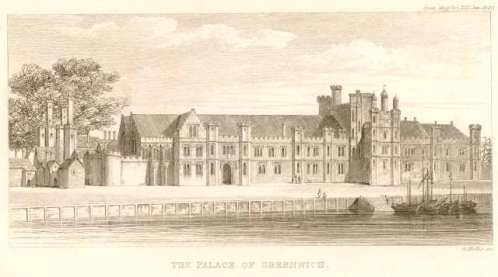
If we were at Greenwich—where we would travel in the morning, the king had decided to move from Westminster in London—we could also attend the local church, St. Nicholas. Their choir was inferior, but it was pleasing to get outside the palace. The king had less need of us at Greenwich than Westminster, where we were held constantly within call.
Once mass was done, I was free to do what I liked until dinner. Flora had gone off with friends, so I went up to the practice rooms. Someone might be willing to play for me, but if not, I would sing along. If I was fortunate, Tom would be there. He was my dearest friend, and a talented lutenist and composer, though he would blush and deny that his songs are any good.
Someday it would be known, and his songs would be sung all over the court, and perhaps all over England.
He was there, supervising the packing of the many musical instruments which would be transported to Greenwich, along with all the nobles and a good number of the court servants, and all their varied possessions.
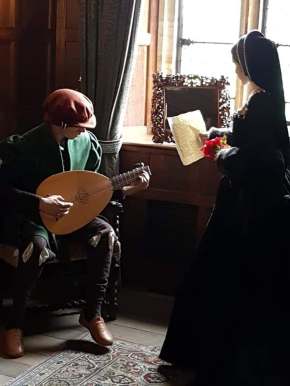 “Do you want me to play for you?” he asked, swaddling a lute in soft wrappings like a babe. His own instrument, I knew, would travel in his grasp; Tom would not trust it to the rough men who loaded the carts and barges for the trip between palaces.
“I can wait.” I leaned against the window, watching the flurry of activity below. In addition to the carts which would start this day so that things might be in place when King Henry stepped off his barge on the morrow, there were the usual clusters of men and horses, servants scurrying across the courtyard on some errand or another, and, to my delight, a certain gentleman atop a shining black horse.
I let my eyes rest on him. A man such as Nick Hawkins would never pay any mind to a minstrel girl, no matter how lovely my voice. The fact that he had spoken to me on occasion proved nothing. He was handsome—beautiful, really—and powerful, a friend of the king. A man who could have any woman in the kingdom, save the queen.
He would never look at me.
I turned to Tom, smiling. He would always look at me, always see me for who I was. But it wasn’t the same, and though I loved him as a friend and a brother, I did not think of him as I drifted off to sleep.
“What will you have me play?” Tom settled on a stool with his instrument on his lap, the light from the narrow window falling on his fair hair. “Bess?”
“Sorry.” I shook away my fancies. “We are to perform this evening for the French ambassador and his party.”
“At least we will have time to eat.” He tuned the lute carefully. “And we will be in the gallery, so you can watch the gathering to your heart’s content.”
I ignored his words, knowing he was teasing. I did like singing from the gallery so I could watch the crowd, and not just because of Nick. It was more impressive, somehow, from above. Crowded in the narrow gallery with the other minstrels, with the horns and drums and shawms, and Tom’s lute singing a sure line beneath for me to follow, I was at peace and could watch the dancers and pretend I was one of them.
A gathering for the French ambassador was sure to run late; I should go back to the girls’ chamber and pack my things for the morning so that when we were done, I could just fall into bed. “Are you happy about going to Greenwich?”
“What does it matter?” he asked. Seeing my expression, he said, “I am if you must know. The stables are closer to the palace.”
Tom loved horses, and though our indoor lives gave us little contact with the beasts, when we were at Greenwich or visiting the cardinal at Hampton Court, he always found his way to the stables. I was glad he was happy, but prolonged time in the stables made me sneeze, and I preferred to walk in the gardens if I was to take my scant free time outdoors.
Other minstrels came in and we went over our evening’s program until the bells chimed eleven; then we all streamed downstairs to dinner. I stayed with Tom; even if the others left us after the meal, we would probably sing and play together until it was time to get ready for the evening’s entertainment. Despite my dreams of greater things, singing with him was when I was happiest, and when I knew that my father had done the right thing.
I belonged in this place.
 Several hours later, changed into a green gown and clean coif, with my few things packed into a small chest for the morning, I reassembled with other members of the Music in the gallery overlooking the presence-chamber. The vast room was hung on all sides with vivid tapestries depicting scenes both secular and religious, interspersed with gold and silver plate that reflected the hundreds of candles lighting the space.
The king was all aglitter himself, clad head-to-toe in cloth of gold studded with diamonds and pearls. His queen, Katherine, was dressed more soberly, though her fabrics were equally rich. They sat on their thrones under the gold cloth of state, speaking quietly, until the music started. Then the king stopped, mid-sentence, his ear cocked toward the gallery. How fortunate that Tom had instructed the others to begin with one of Henry’s own songs.
He leaned over to the French ambassador, who stood near the throne, and gestured toward us. I imagined he was telling the Frenchman that he’d written the song—though he praised us lavishly, it was much more likely that he was taking credit for the song.
I sang while the people below mingled and preened, showing off their finery for the king and each other. When the dancing started, I would step back; my voice did not lend itself to the stately pavanes which began the dancing each evening. Those were for the musicians—Tom, Harry, and Gilbert would play their instruments and the courtiers would parade slowly down the length of the room, bowing and circling, flirting with their eyes and their hands, the only parts of their bodies which touched during the dance.
King Henry began the dancing, leading Queen Katherine down from the dais and onto the floor. The jeweled crowd stepped back to give them room, and they traversed the floor alone, the focus of all eyes before the king raised his hand and called for everyone to join him. Then the courtiers paired off, men swiftly bowing before ladies and taking their chosen partner to join the king.
Nick was there, I noticed almost immediately. He danced with the prettiest women, and once arrived before a woman at the same time as King Henry, bowing deeply and giving way to his monarch, who would dance until dawn if allowed. The queen would retire early, taking her women, though some of them crept back after Her Majesty had been settled for the night.
It was after midnight when the chamber finally began to empty. I sipped from the ale which had been set aside for us; my throat was dry from singing for hours in the stuffy gallery. Tom was yawning behind his hand, and several of the other looked as though they were asleep on their feet. I was still wide awake, but perhaps it was excitement: it was spring, and tomorrow we would journey to Greenwich, where I had begun my life with the Tudor court.
[Illustration #1 – Palace of Westminster, Wikipedia]
[Illustration #2 – Minstrels, Nikki Piggott, photographer, used w/permission]
[Illustration #3 – Greenwich Palace, Wikipedia]
 Blurb
Blurb
She has the voice of an angel…
But one false note could send her back to her old life of poverty.
After her father sells her to Henry VIII, ten-year-old Bess builds a new life as a royal minstrel, and earns the nickname “the king’s songbird.”
She comes of age in the dangerous Tudor court, where the stakes are always high, and where politics, heartbreak, and disease threaten everyone from the king to the lowliest musician.
Her world has only one constant: Tom, her first and dearest friend. But when Bess intrigues with Anne Boleyn and strains against the restrictions of life at court, will she discover that the biggest risk of all is listening to her own stubborn heart?
Buy Links:
Amazon UK • Amazon US • Amazon CA • Barnes and Noble • Kobo
Audio Buy Links:
Narrated by Jennifer Summerfield
Audible • Authors Direct • Nook • Hoopla • Apple Books • Kobo • Scribd • Google Play • Amazon
 Author Bio
Karen Heenan
Karen Heenan was born and raised in Philadelphia, PA. She fell in love with books and stories before she could read, and has wanted to write for nearly as long. After far too many years in a cubicle, she set herself free to follow her dreams—which include gardening, sewing, traveling, and, of course, lots of writing.
She lives in Lansdowne, PA, not far from Philadelphia, with two cats and a very patient husband, and is always hard at work on her next book.
Connect with Karen:
Website • Twitter • Facebook • Instagram • Pinterest • Book Bub • Amazon • Goodreads

 Margery Kempe, the only daughter of the mayor of Bishop’s Lynn, England has made a tough decision in 1413. She has decided to leave her home, her husband, and her fourteen children to go on a pilgrimage to the holy city of Jerusalem as a way to honor her late father’s dying wishes. As she begins her journey, she meets the famous anchoress Julian of Norwich, who entrusts Margery with an important mission. She gives Margery her book Revelations of Divine Love and tells her to spread her message throughout the world in secret. Margery’s pilgrimage, her connection to Julian of Norwich, and the aftermath of her journey are intricately woven together in Mary Sharratt’s stunning novel, “Revelations”.
 I am pleased to welcome Judith Arnopp to my blog today to share an excerpt from her latest novel, “A Matter of Conscience: Henry VIII, The Aragon Years”. Thank you, The Coffee Pot Book Club and Judith Arnopp for allowing me to host a spot on this blog tour.
  Blurb
Blurb Author Bio:
 Have you ever read a history book and wondered what life was really like for those who lived in the past? To understand a time period and the motives of the people of the past, we have to understand the structure of their society. How they understood things like class, sex, violence, government, and religion is essential for us to understand what separates us from our ancestors. What they ate, what they wore, and where they slept also give a unique insight into the time period. It can be a difficult undertaking to figure out all of the different aspects of the past connect and to present it cohesively, yet acclaimed historian Ian Mortimer has embraced this challenge head-on to tackle one of the most complex periods of the past; the Elizabethan era. His love letter to the Elizabethan age entitled, “The Time Traveler’s Guide to Elizabethan England” is a delightfully imaginative guide to the past.
 In 1483, King Edward IV’s family received a devastating announcement; the king in the prime of his life died, leaving the throne to his young son Edward V. However, neither Edward V nor his younger brother Richard of York would ever see the throne. Instead, they were taken to the Tower of London by their protector, Richard of Gloucester, for protection, never to be seen again. For over five hundred years, many theories have emerged about what happened to the princes in the tower and who might have possibly killed the boys. In MJ Trow’s latest book, “The Killer of the Princes in the Tower: A New Suspect Revealed”, he works hard to uncover the truth of what might have happened to the sons of King Edward IV.
 The year is 1399 in Paris and the royal family is concerned about the Priory in Poissy. Something has happened behind the cloistered walls and only one person who is extremely loyal to the king and queen can figure out what is amiss, Christine de Pizan the famous medieval writer. Christine goes to Poissy to act as a copyist for the prioress, but she soon finds herself in the middle of a sinister murder case. A nun has been found dead and it is up to Christine and her allies, plus one frenemy, to figure out who killed the nun while protecting the king’s youngest daughter who calls the priory home. Can Christine figure out who murdered the young nun and make it out of the priory alive? This is the premise of Tania Bayard’s latest installment of her Christine de Pizan murder mystery series, “Murder in the Cloister”.
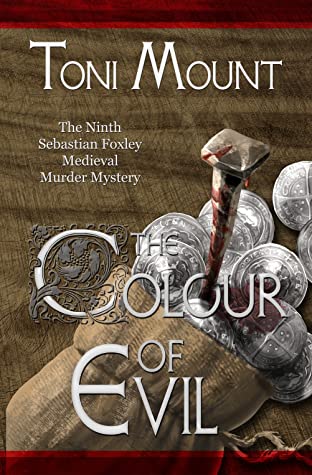 Money problems litter the streets of London like debris. Those who have money have power. Yet, there are those who try to beat the system by making their own counterfeit currency to beat the system. When this counterfeit currency leaves to murder, only Seb Foxley and his merry band of friends and family members can bring justice to those who were killed. When unexpected complications arise, like Seb’s wayward brother Jude coming home with an Italian child bride and a commission from King Edward IV himself, can Seb solve the case before anyone else becomes the next victim in this vicious cycle of greed and exploitation? Toni Mount takes her readers on another thrilling adventure in, “The Colour of Evil”, the ninth installment of the Sebastian Foxley Medieval Murder Mystery series.
 The last Tudor monarch, Queen Elizabeth I, was known for many things, but her main legacy is that she never chose to marry anyone. She was the infamous “Virgin Queen”. However, there were those around her who manage to capture her attention and her admiration for a time. The most famous of these men was Robert Dudley, Earl of Leicester. He was a massive supporter of the arts and the Protestant faith, gaining prestige and praise from his highly exalted monarch. Yet, his life and his relationship with his wives, his enemies, and Elizabeth I was full of dangers and numerous scandals. Who was this man who wooed the heart of the most eligible woman in all of 16th century Europe? Robert Stedall investigates the relationship between these two lovers destined to never marry each other in, “Elizabeth I’s Secret Lover: Robert Dudley, Earl of Leicester”.
 August 22, 1485, marked the end of the Plantagenet Dynasty with the death of King Richard III at the Battle of Bosworth Field. The man who succeeded him as King of England after his death was young Henry Tudor, whose dynasty would live in infamy in English history, thought that he was done fighting on the battlefield for his right to rule. This was only the beginning of a decades-long war against those who claimed to be lingering shadows of the past. They claimed to be the Princes in the Tower, whose disappearances in 1483 left to doubt and confusion on what happened to them and gave those who despised this new dynasty opportunity to exploit a young king’s fear of being overthrown. The young men who made this king who won his way to the throne on a battlefield quake in his boots are known today as “the Pretenders”, but who were they? In Nathen Amin’s much-anticipated book, “Henry VII and the Tudor Pretenders: Simnel, Warbeck, and Warwick”, he traces the origins of each pretender to show what type of threat that they posed to the first Tudor king.
 On September 8, 1560, a woman was found dead at the bottom of a flight of stairs inside Cumnor Place. The only visible marks on her body were two wounds on the side of her head, yet her neck was clearly broken. If she was an ordinary woman, her death would not have been remembered through the centuries, yet she was no ordinary woman. She was the wife of Robert Dudley, the man who was considered as one of Queen Elizabeth I’s favorite courtiers. Amy Robsart was a third wheel in the relationship between her husband and the queen, but does that mean that she was murdered? In her latest book, “Chronos Crime Chronicles- The Death of Amy Robsart: An Elizabethan Mystery”, Sarah-Beth Watkins plays detective to uncover the cause of death and the possible motive for those who wanted to see Amy dead.
 Adventures of a Tudor Nerd