
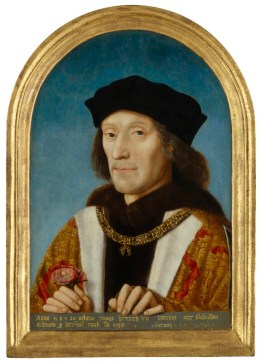
 (Born January 28, 1457- Died April 21, 1509). Son of Margaret Beaufort and Edmund Tudor, 1st Earl of Richmond. Married to Elizabeth of York. Father of Arthur, Prince of Wales, Margaret, Queen of Scots, Henry VIII, King of England and Mary, Queen of France. Henry VII went from an exile to the founder of one of the most powerful dynasties in all of English history, the Tudor Dynasty.
Henry Tudor, later Henry VII, was born at Pembroke Castle to Margaret Beaufort and Edmund Tudor, 1st Earl of Richmond on January 28, 1457. Henry never met his father Edmund because he died three months before Henry was born. His grandfather, Owen Tudor, was married to Katherine of Valois which made Henry’s father half brother of King Henry VI. Henry’s mother was the great granddaughter of John of Gaunt and his third wife Katherine Swynford. Henry’s mother Margaret Beaufort was only 13 when she gave birth to Henry and because his father died, his uncle Jasper Tudor took care of him.
Life was stable for Henry Tudor for a few years, until Edward IV won the crown in 1461, sending Henry’s uncle Jasper into exile and the title of Earl of Pembroke as well as Pembroke Castle and the wardship of Henry went to a Yorkist supporter William Herbert. Henry stayed with William Herbert until 1469, when the Earl of Warwick Richard Neville switched sides to the Lancastrians and had Herbert executed. Warwick restored Henry VI to the throne in 1470, Jasper came back from exile, and Henry was allowed to go to court.
This return of Henry VI would not last long as Edward IV was restored to the throne and Warwick was killed. Henry and Jasper tried to gather more support for the Lancastrian cause but they got caught in a bad storm in the English Channel while escaping from Tenby. They landed in Brittany where they sought the protection of Francis II, Duke of Brittany, which he did give to them. The Lancastrians along with Jasper and Henry, were housed at the Château de Suscinio in Sarzeau. Edward IV tried his best to apprehend Jasper and Henry but he failed to do so. Edward IV died on April 9, 1483, leaving his throne to his young son Edward V. After a few weeks, Edward V and his siblings were declared illegitimate and the throne was passed onto Edward V’s uncle Richard Duke of Gloucester, who became Richard III. Edward V and his brother Richard Duke of York were never seen again.
Henry’s mother Margaret Beaufort saw an opportunity for her son to become king. During this time Margaret was plotting with Elizabeth Woodville to arrange a marriage between Henry and Elizabeth Woodville eldest daughter, Elizabeth of York. Henry and Jasper tried to invade England in October 1483, but they were forced to go back to Brittany. It was in December 1483 that Henry made an oath in Rennes, France to marry Elizabeth of York when he became King of England. When the Duke of Brittany got very ill in 1484, his treasurer Pierre Landais made a deal with Richard III to give over Henry and Jasper Tudor in exchange for 3,000 English archers to defend a French attack. A bishop in Flanders John Morton heard about the deal and warned Henry and Jasper just before Landais could reach them. Henry and Jasper fled into France where King Charles VIII allowed them to stay until Duke Francis II felt better.
Henry and Jasper Tudor made their way back to England in August 1485, where they faced off against Richard III at the Battle of Bosworth Field on August 22, 1485. Richard III was defeated and Henry became Henry VII. Henry was crowned king on October 30, 1485 and he would marry Elizabeth of York the following year on January 18, 1486. The couple had their first child, Arthur, on September 20, 1486. Henry and Elizabeth would have 4 children who would survive into adulthood; Arthur Tudor, Margaret Tudor, Henry Tudor, and Mary Tudor. During 1487, a young man named Lambert Simnel, claimed that he was the earl of Warwick, Elizabeth’s cousin, so Henry VII had the real earl of Warwick taken from the Tower and paraded through London. It was at the last battle of the Wars of the Roses, the Battle of Stoke Field on June 16, 1487 that Lambert Simnel was defeated. Henry decided to let the boy live and gave him a job at the castle.
In 1490, a young man named Perkin Warbeck, appeared and claimed to be Richard Duke of York. Warbeck won the support of Edward IV’s sister Margaret of Burgundy and James IV of Scotland. In September 1497 Warbeck landed in Cornwall with a few thousand troops, but was soon captured. He was allowed to live in the court and his wife Lady Catherine Gordon was made one of the ladies in waiting for Elizabeth of York. Warbeck tried to escape and it landed him in the Tower of London, close to Edward Plantagenet, 17th Earl of Warwick, son of the late George, Duke of Clarence. Warbeck and Warwick plotted to escape the Tower, but the plan was uncovered and both men were charged with treason. Perkin Warbeck was hanged at Tyburn on November 23, 1499.
Henry VII was a cautious man and decided that it was better to make alliances through marriages than to launch into expensive wars, like his predecessors. Henry VII was one of the first European monarchs to recognise the importance of the newly united Spanish kingdom under Isabella of Castile and Ferdinand of Aragon and concluded the Treaty of Medina del Campo, by which his son, Arthur Tudor, was married to Catherine of Aragon. He also concluded the Treaty of Perpetual Peace with Scotland, which betrothed his daughter Margaret to King James IV of Scotland. Henry VII hoped to break the Auld Alliance between Scotland and France through the marriage of Margaret to the Scottish king, but it did not happen. Henry was also able to form alliances with Pope Innocent VIII and Holy Roman Emperor Maximilian I.
On November 14, 1501, Arthur Tudor married Katherine of Aragon. The following year, tragedy hit hard as Arthur died on April 2, 1502. His son’s death hit Henry hard and it was his wife Elizabeth of York who consoled him and convinced him that he still had Henry, his youngest son, as his heir and that they were still young enough to have children. Henry VII wanted to maintain the Spanish alliance. He therefore arranged a papal dispensation from Pope Julius II for Prince Henry to marry his brother’s widow Katherine. Elizabeth would have one more child, a girl named Katherine, on February 2, 1503, but the baby would not live long. Elizabeth of York would die on her 37th birthday, on February 11, 1503. Henry would grieve over the loss of his wife and son the rest of his life. He retreated to Richmond Palace, which was the former Sheen Palace but it was badly damaged in a fire in 1497 and rebuilt. Henry’s health failed him and he would die on April 21, 1509 at Richmond Palace. His only son Henry Tudor succeeded his father and became Henry VIII.
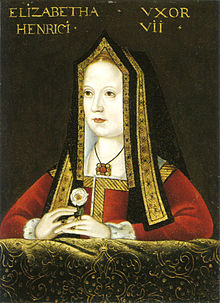 (Born February 11, 1466- Died February 11, 1503). Daughter of King Edward IV and Elizabeth Woodville. Married to King Henry VII. Mother of Arthur, Prince of Wales, Margaret, Queen of Scots, Henry VIII, King of England and Mary, Queen of France.
 Werbecque and Katherine de Faro. Married to Lady Catherine Gordon. Perkin Warbeck was one of the pretenders during the reign of Henry VII. He would proclaim himself Richard IV, also known as Richard Duke of York, in 1494.
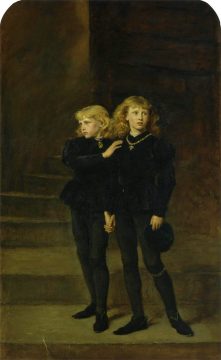 Edward V (Born November 2, 1470- Date of Death Unknown). Richard Duke of York (Born August 17, 1473- Date of Death Unknown). Sons of King Edward IV and Elizabeth Woodville. Richard was married to Anne Mowbray. Edward V and Richard Duke of York are known as “The Princes in the Tower”. They were placed in the Tower of London after their father’s death and were never seen again. Their disappearances and whether or not they were murdered has become one of the greatest mysteries in history.
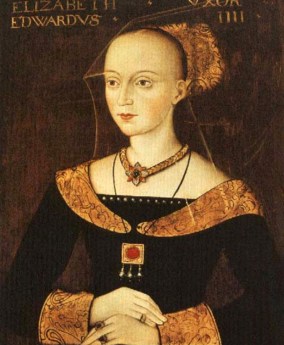 Richard Woodville. Married to Sir John Grey and King Edward IV of England. Mother of Thomas Grey, Marquess of Dorset, Richard Grey, Elizabeth, Queen of England, Mary of York, Cecily, Viscountess Welles, Edward V, King of England, Margaret of York, Richard, Duke of York, Anne, Lady Howard, George, Duke of Bedford, Catherine, Countess of Devon and Bridget of York. Elizabeth Woodville was the woman who Edward IV fell in love with and married, much to the chagrin of Warwick. Elizabeth was the mother of the Princes in the Tower and Elizabeth of York, the mother of the Tudor Dynasty.
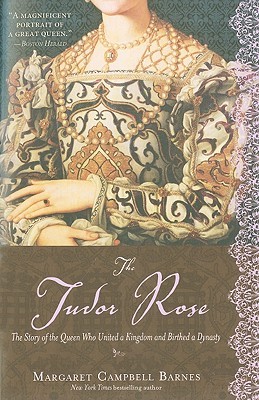 The beginning of the Tudor Dynasty was full of action and drama. Richard III and Henry Tudor met on the battlefield at Bosworth on August 22, 1485 to determine who would be the King of England. Richard III fell and Henry Tudor triumph, becoming Henry VII. However, there was another person whose fate was determined on that battlefield; Elizabeth of York, daughter of Edward IV and Elizabeth Woodville. It was at this battle that Elizabeth knew that she would marry Henry Tudor and become queen of England. But what was it like for her to live through this time of change? From the death of her father to the case of her missing brothers. From to Richard III’s short reign to her relationship with her husband Henry VII and her children. How did she feel during the most difficult times in her life? Margaret Campbell Barnes explores this question in her novel, “The Tudor Rose”.
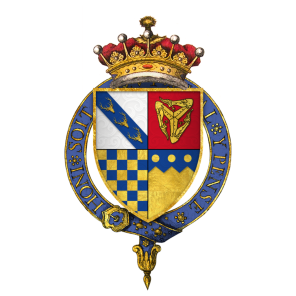 (Born 1435- Died July 29, 1504). Son of Thomas Stanley, 1st Baron Stanley and Joan Goushill. Married to Lady Eleanor Neville and Lady Margaret Beaufort. Father of George Stanley, 9th Baron Strange, Sir Edward Stanley, James Stanley, Bishop of Ely. Thomas Stanley was a wealthy landowner who was able to find favor with successive kings during the Wars of the Roses, until his death in 1504.
 (Born October 2, 1452- Died August 22, 1485). Son of Richard 3rd Duke of York and Cecily Neville. Married to Anne Neville. Father of Edward of Middleham, Prince of Wales.
 (Born June 11, 1456- Died March 16, 1485). Daughter of Richard Neville, 16th Earl of Warwick and Anne Beauchamp, 16th Countess of Warwick. Married to Edward of Westminster, Prince of Wales and King Richard III. Mother of Edward of Middleham, Prince of Wales. Anne Neville was the daughter of “the Kingmaker”. She was part of the powerful Neville family and she was married to two very important people in the houses of Lancaster and York respectfully. She played a critical role in the Wars of the Roses.
 Adventures of a Tudor Nerd