
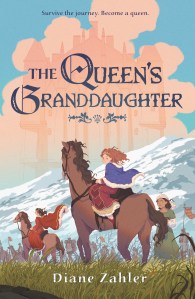
 When a medieval princess married, most of the time, she had to take an arduous journey to their new country. For many of these royal ladies, they had an idea that this would be their fate at a young age, but for others, it would come as a complete surprise. Take, for example, Blanca (Blanche) of Castile. She was the granddaughter of the indomitable Eleanor of Aquitaine. When it is time to create a marriage alliance between Castile and France, Blanca believes that her sister Urraca will be the one who will become Queen of France. However, Eleanor has other plans. How will the journey change Blanca and get her ready to rule a nation? Diane Zahler tells the tale of Blanca’s journey to the throne in her middle grade novel, “The Queen’s Granddaughter.”
I would like to thank Roaring Brook Press and Net Galley for sending me a copy of this novel. I tend to read books tailored towards young adults and adults, but I wanted to see how middle grade books handle historical figures. My love of history started with a middle grade book, so I wanted to see how middle grade books are for the next generation of history nerds.
We are introduced to Blanca of Castile when she was twelve years old. As the daughter of Alfonso VIII of Castile and Eleanor of England, Blanca realizes that she will have to marry one day, but she wants to stay with her family in Castile. With the arrival of her grandmother, Eleanor of Aquitaine, from England to discuss a match between Castile and the French dauphin Louis. Blanca believes that the intended bride will be her elder sister Urraca, but she doesn’t want her sister to leave. Grandmother Eleanor has a different plan and says that the bride to be is Blanca.
To say Blanca is shocked will be an understatement, but after spending time with her best friend Suna and her family, who are Almohads, Blanca decides that she will go to France. Suna, grandmother Eleanor, and Sir William Marshal join Blanca in her journey over the Pyrenees Mountains to France. The journey is arduous as they encounter a snow storm that lands the party in a cave while grandmother Eleanor recovers from an illness. They also face off against Hugh de Lusignan, a man who is seeking vengeance. Throughout the journey, Blanca learns that a queen must make difficult decisions and say the hardest goodbyes for the good of her new kingdom.
This was a great novel to get younger future history nerds interested in history. It was well researched and even gives Zahler’s readers mini biographies about the main characters so that they can begin their own journey into medieval European history. If you want a book for a young history lover in your life that focuses on medieval Castile and France, I recommend you check out “The Queen’s Granddaughter” by Diane Zahler.
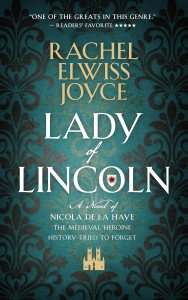 Medieval England, under the reign of Henry II and Eleanor of Aquitaine, was a turbulent time. The focus tends to be on the rebellion of Henry’s sons against their father and how Eleanor sided with her sons. This story has been told, but there is a story of another woman who was caught directly in the middle of the entire ordeal. Her story is most known for her role during the reign of King John and the Magna Carta, but that was when she was an older woman. The story of Nicola de la Haye and Lincoln Castle has been told in biographies and nonfiction books, but not really in historical fiction novels. Rachel Elwiss Joyce hopes to change that with her novel, “Lady of Lincoln.”
 The year 1120 was a horrible year for King Henry I. His only legitimate son William died when his ship, The White Ship, sank in the middle of the night. This tragedy left Henry with one option, his legitimate daughter Matilda, the former Holy Roman Empress, would become Queen of England, and her sons would continue the royal line. Unfortunately, Matilda’s throne was taken by Stephen of Blois, and now Matilda must join forces with her stepmother Her stepmother Adeliza has always stood by Matilda’s side. Still, when she remarries after Henry’s death, Adeliza struggles to support the rightful queen but stays loyal to her new husband, who supports Stephen. Matilda and Adeliza are caught in the middle of the Anarchy in Elizabeth Chadwick’s novel, “Lady of the English.”
 When one thinks about epic tales stories of adventures and romance tend to come to mind. One hardly thinks about the construction of a magnificent building as an “epic tale” with monks and builders as the main characters. We see cathedrals as these massive buildings from the past used as churches, but we rarely think about how they were constructed and why. Who were the people who decided to make these spectacular buildings and what might have their lives have been like? These are just some of the questions that Ken Follett wanted to try and answer in his monumental historical fiction masterpiece, “The Pillars of the Earth”.
 Adventures of a Tudor Nerd