
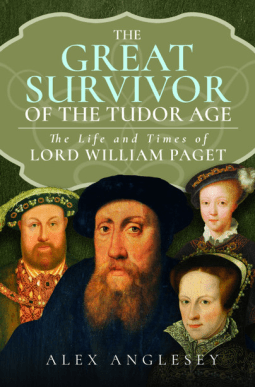
 Rulers cannot govern alone. They require a team of men and women behind them to operate as a cohesive unit. The same can be said for rulers during the Tudor dynasty. We know the stories of men like Cardinal Wolsey and Thomas Cromwell, two men who rose through the ranks to prominent seats of power to ultimately have disastrous falls from grace. However, there was a third Tudor politician who should be in this discussion about rags-to-riches stories. He was the son of a common merchant who went to serve most of the Tudor monarchs as an advisor. Conspiracies and rebellions kept him on his toes, but he ultimately survived the Tudor dynasty, which was a difficult thing to achieve. His name was Lord William Paget and his story is told by his descendant Alex Anglesey in his debut book, “The Great Survivor of the Tudor Age: The Life and Times of Lord William Paget.”
I would like to thank Pen and Sword Books and Net Galley for sending me a copy of this book. I have heard the name William Paget in previous books that I have read about the Tudors, but he is one of those figures that felt like a footnote to me. When I heard that there was going to be a biography about Paget, I wanted to read it and learn more about this Tudor politician.
Alex Anglesey, the current Marquess of Anglesey, tells the story of how when he was a child living in the family home of Plas Newydd. Anglesey was able to use family letters to piece together the story of his ancestor, William Paget, a man of low status who rose through the ranks and served four Tudor monarchs.
The beginning of Paget’s international political career was traveling all across Europe to convince other European countries to accept the Great Matter. During this time, William married Anne Preston and they had nine children. He was the secretary for both Queen Jane Seymour and Anne of Cleves, and he witnessed the dissolution of the monasteries before making his way into the Privy Council as a clerk.
Paget’s first major role was as the English ambassador to France during the reign of King Francis I and gave news to the king about the downfall of Katherine Howard, but it did not last long as he was needed back in England to become Secretary of State. He was King Henry VIII’s private secretary towards the end of his life and helped craft Henry’s last will and testament. After siding with Edward Seymour during the reign of Edward VI, William barely survived a stay in the Tower of London, but he did. During Mary I’s reign, he helped organize the marriage between Mary I and Philip and witnessed the infamous burnings of Protestants. Paget only saw a few years of Elizabeth’s reign before he passed away.
Anglesey shows how Paget and his family were able to survive the Tudor dynasty by staying neutral on matters like religion while still promoting peace. I did find this book a bit dry in places and some of the references to the modern age felt a bit out of place. Overall, it was informative and not a bad read for a debut book. If you want to learn more about a lesser-known political figure who lived during the Tudor dynasty, I suggest you read, “The Great Survivor of the Tudor Age: The Life and Times of Lord William Paget” by Alex Anglesey.
 When we think of the word “education,” images of sitting in school rooms for hours, listening to lectures, and doing endless homework pop into our minds. Our modern education system tends to focus on math, science, language arts, and history as the core subjects we study, with music and physical education as something that we in America call an “elective.” But have you ever wondered what education looked like in the past? How did the Tudors pass on their knowledge to future generations? What subjects did the Tudors consider essential, and how did the amount of education you received change depending on your class? Amy McElroy explores these questions in her book, “Educating the Tudors.”
 Adventures of a Tudor Nerd