
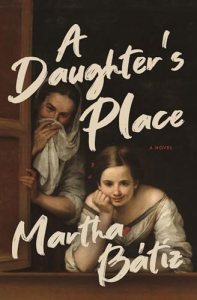
 Miguel de Cervantes, the author of Don Quixote, lived quite an interesting life. He was a poet, soldier, war hero, prisoner, husband, brother, uncle, father, and author. His writing might portray a man of honor and dignity, but his home life was messy. You see, Miguel was married, but his daughter was not the daughter of his wife, Catalina de Salazar. His daughter, Isabel, was illegitimate, and when her mother died, Miguel decided the best possible solution was to invite Isabel to live with his sisters and his niece. What’s the worst that could happen? Martha Batiz explores the women’s lives connected to Miguel de Cervantes in her debut novel, “A Daughter’s Place.”
I would like to thank the House of Anansi Press and Net Galley for sending me a copy of this novel. I had never read Don Quixote, and I knew nothing about Miguel de Cervantes or his family, so I was excited to learn more. Stories like this add depth to the understanding of the late 16th and early 17th centuries in Spain and Europe as a whole.
This novel is broken into five sections and contains three different narrators: Isabel, the illegitimate daughter of Miguel de Cervantes, Constanza de Ovando, Miguel’s niece, and Catalina de Salazar, Miguel’s wife. Our story begins with Isabel, who just turned fifteen. All of her life, she believed that she was the daughter of a tavern owner, that is, until she met Magdalena de Cervantes, who claims to be her aunt, as Isabel’s true father is none other than the famous war hero turned author Miguel de Cervantes. After the death of Isabel’s mother, Miguel has decided to have Magdalena as Isabel’s legal guardian and raise her to be part of his family, although not with the de Cervantes name. Constanza de Ovando has been dumped after a long engagement and is nearing the age of spinsterhood. She is jealous of Isabel and wonders if she will ever marry and have her own life. Finally, we have Catalina de Salazar, who lives far away from the family and did not know that her husband, Miguel, had an illegitimate child.
We see this family slowly adjust to having a new family member and the repercussions of Isabel being part of the de Cervantes family. While the family is getting used to one another, King Philip III of Spain threw a monkey wrench into their plans as he moved the royal court from Madrid to Valladolid and back to Madrid. Since Miguel is writing his magnum opus, Don Quixote, and is looking for sponsors, the family has to move alongside the court, which causes its special kinds of headaches and heartbreaks. There are so many twists and turns, especially the last twist, that kept me guessing until the end of how this novel was going to end.
Batiz has created such a believable world of 16th and 17th century Spain with a colorful cast of characters in the de Cervantes family. I got very attached to this family, and to see what would happen to them as life kept causing chaos. As a debut historical fiction novel, this is such an enjoyable, beautifully written, and extremely well-researched novel, and I hope that Batiz continues to write historical fiction. If you want an excellent novel about one of the most celebrated authors in Spanish history and his family, I highly recommend you read “A Daughter’s Place” by Martha Batiz.
 The Italian Renaissance was a time of great artwork, eccentric artists, and patrons who created these masterpieces. While the art tells a story, the artist and patron want the audience to understand, but sometimes the story of how the art came to be can be just as fascinating. One of the most famous pieces of art from the early 16th century was the ceiling of the Sistine Chapel. A stunning piece created by an artist who primarily created sculptures, and his patron was a pope who was more like a warrior. The story of how Michelangelo and Pope Julius II created an unlikely team to create this remarkable masterpiece is told in Ross King’s book, “Michelangelo and the Pope’s Ceiling.”
 We all know the gist of the tragic tale of Katharine of Aragon. A Spanish princess who was brought to England to marry the heir of the Tudor throne, Prince Arthur Tudor. When the prince died mere months after their wedding day, Katharine was left in limbo and desolate as the Kings of Spain and England bickered over her dowry. Eventually, she would marry King Henry VIII, was his wife for over twenty years, and have numerous miscarriages before Henry decided to divorce her and marry Anne Boleyn. We know how Katharine’s story ends, but how did the stories of her Trastamara family influence her life and her reign as Queen of England? Heather R. Darsie explores Katharine’s Spanish origins in her latest book, “Katharine of Aragon, Spanish Princess: ‘I Am Not as Simple as I May Seem.’”
 Do you have a favorite painting? One that grabs your attention whenever you look at it and discover something new. Most paintings are from da Vinci, van Gogh, Rembrandt, Picasso, or Michelangelo, just to name a few. However, there is one artist that I feel doesn’t get a whole lot of attention unless you study the 16th century: Hans Holbein the Younger. While Holbein is known for his single portraits, his double portrait, known as The Ambassadors, is stunning to look at and is filled with symbolism. Tracy Borman, in collaboration with the National Gallery, has written a short book about this remarkable painting entitled “Holbein: The Ambassadors.”
 For centuries, fairy tales have entertained and taught lessons to those young and young at heart. One of the most memorable stories was the tale of Rapunzel, the maiden a witch kidnapped because her parents stole a Rapunzel plant from her while Rapunzel’s mother was pregnant. For years, Rapunzel languished in a Tower, her hair growing exponentially until a rogue/ prince climbs her hair and rescues the damsel in distress. The witch dies and Rapunzel and her hero live happily ever after. At least, that is how the story has been passed down to us throughout the centuries, but where did the story come from and how are the stories of three women from different generations and countries connected? Kate Forsyth weaves together the stories of three women and their fates into one delightful novel called, “Bitter Greens.”
 When we think about live theater, we often think about big actors, elaborate sets, and glittery costumes. The world of the Tudor theater, especially during the reign of Elizabeth I, was similar in some ways, but there was an element of danger. Richard Shakespeare, an actor in the Lord Chamberlain’s Men company and a former thief, knew the dangers of Tudor theater life better than anyone. When a manuscript is stolen, suspicion lands squarely on Richard’s shoulders. Can Richard clear his name, or will it be his final curtain call? Bernard Cornwell tells the story of Richard Shakespeare and the debut of A Midsummer’s Night Dream in his novel, “Fools and Mortals.”
 When we think about the period known as the Renaissance, we often think about Italy and the artists like painters and sculptors. However, other craftsmen made Italy their home. Take, for example, tailors and seamstresses. These skilled craftsmen and women can create art you can walk in with their hands. However, there are gender barriers between tailors and seamstresses in that only men can be tailors and only women can be seamstresses. One orphan girl from Bologna not only challenges what it means to be a woman tailor but also challenges one of the wealthiest merchants in the entire city who has a dark connection to her past. This is the premise for Glennis Virgo’s debut novel, “City of Silk.”
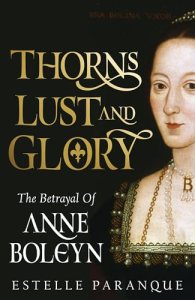 A young woman catches the attention of a king already married to a princess from a faraway kingdom. The king desires the young lady and divorces his wife to marry her. However, there is a catch. The young lady spent some time in the French court of Francis I and Claude of France, whereas the king’s wife was the daughter of the Spanish King and Queen as well as the aunt of the Holy Roman Emperor. The Great Matter of Henry VIII, Anne Boleyn, and Catherine of Aragon is considered one of the messiest divorces in English history and rightfully so when you consider the diplomatic consequences that this divorce would have across Europe. Estelle Paranque highlights the connection between Anne Boleyn and the French court in her latest book, “Thorns, Lust, and Glory: The Betrayal of Anne Boleyn.”
 Have you ever read about a historical figure and wondered what it would be like to interact with them in the present day? How would they deal with modern problems and technology? Could they function in the 21st century or would they become overwhelmed? And even if they could come to the 21st century, how would it affect their timeline and history? This intriguing premise plays out in Maria Vetrano’s novel, “Queen Bess: A Tudor Comes to Save America,” which sees Queen Elizabeth I coming forward about 400 years in time to become the President of the United States in the 2028 election.
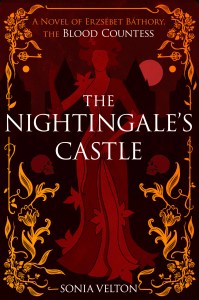 A castle looms in the distance and the owner, a glamourous countess, has asked for fair maidens from the surrounding areas to work for her. But this is not an ordinary castle and this was not a benevolent countess. The rumors say if you enter the castle, you will never return as the infamous Blood Countess Erzsebet Bathory will kill you and bathe in your blood. A rather gruesome tale that has been told for centuries, but how true is this story? What truly happened in the Countess’s castle and what was the countess like? Sonia Velton hopes to answer these questions in her novel about Erzsebet Bathory’s life, entitled “The Nightingale’s Castle.”
 Adventures of a Tudor Nerd