
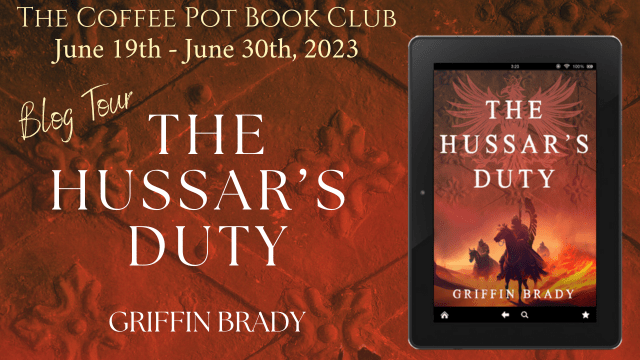
 Today, I am pleased to welcome Griffin Brady to my blog to share a guest post as part of the blog tour for her novel, “The Hussar’s Duty.” I would like to thank Griffin Brady and The Coffee Pot Book Club for allowing me to be part of this blog tour.
War wagon, war fortress, rolling fortress, rolling stock, stock, wagon fort, mobile fortress, and tabor. These terms all mean the same thing. Until I did my research on the Battle of Cecora for The Hussar’s Duty, I wasn’t familiar with any of them. I came up to speed quickly because the war wagon played an essential role in the story.
When Poland’s Grand Hetman of the Crown, Stanisław Żółkiewski, first set out to meet the Ottomans on a battlefield just east of Cecora (modern-day Țuțora in Romania), he took 9,000 Polish troops with him. Despite his recruiting efforts, his force was less than he had hoped for, but he wasn’t concerned—he didn’t expect a clash. He was confident he and the Ottoman commander, Iskender Pasha, would negotiate without bloodshed, as they had done before. What Żółkiewski didn’t anticipate, however, was inaccurate intelligence that led to underestimating the enemy’s strength. Further complicating matters, Żółkiewski’s army was comprised largely of magnates’ private troops with their agendas, and he had great difficulty controlling them.
Żółkiewski had proved himself a brilliant strategic commander in the past, but he was now in his early seventies and poor health. Recognizing combat was imminent—and that a Tatar army had joined Ottoman ranks—Żółkiewski showed flashes of his genius when he struck upon employing the tabor at Cecora, harkening back to 15th-century Hussite victories. The battlefield’s open, flat ground lent itself well to the mobile fortresses, which could be used to devastating effect.

The tabor was a square or rectangular arrangement of wagons equipped with guns and manned by soldiers, artillerymen, and crossbowmen/archers. Within the formation, surrounded by the wagons, a calvary was placed. The wagons were pulled by teams of horses arranged so they nearly touched the back of the wagon before them, creating a sort of impenetrable “chain.”
Tabor tactics were broken into two phases: defensive and counterattack. As the enemy advanced on the mobile fortress, they were fired upon until weakened. Then the counterattack began, and cavalry and infantry filed inside the wagon formation, engaging the demoralized troops.
Żółkiewski laid out a plan that involved two tabors. The tabors were each defended by 500-700 men and flanked each side of his main strike force. That strike force comprised five cavalry regiments, a mix of Polish winged hussars and light cavalry. The scale of his formation was massive, a whopping .68-.75 miles wide and .62 miles deep. It’s difficult for me to wrap my head around what it must have looked like!
For all its innovation, though, the scheme held several devastating flaws. First, rather than a wide, shallow formation, it compressed the regiments into tight columns, limiting their mobility. Second, the success of the mission depended on the tabor remaining intact. One breach and the entire formation would be compromised.
The battle began at noon on September 19, 1620. At first, the Poles succeeded in pushing the enemy back. However, the right tabor encountered a trench that caused it to swing to the right, opening a gap at its rear and exposing the central strike force. Though Żółkiewski had beefed up the sides and rear to counter any potential breach, it proved too little. Tatar horsemen swept in, overwhelming the trapped Polish cavalry and wreaking havoc.
The Poles fell back, abandoning the men in the compromised tabor. Sadly, most of those left behind were captured or killed. At the end of the day, Żółkiewski’s force was reduced by a third. Making matters worse, that night, Polish troops fled from camp in a mass crossing over the Prut River. Some made it to safety, but many drowned during the attempt or were captured by Tatars.
After days of failed negotiations with Iskender Pasha, with supplies rapidly depleting and morale plummeting among his remaining ranks, Żółkiewski decided to retreat. But how could he preserve his weakened army with the enemy poised to pursue? Enter the tabor once more in a different configuration.
This time, it was a single formation with six rows of wagons, in lines of one hundred each, placed behind tethered horses. The horses acted as battering ram and a shield to protect against Tatar arrows. Their grouping also prevented any of Żółkiewski’s men from escaping on horseback. The wagons in the lead were loaded with cannons and hook guns and protected by infantry and artillerymen. Beside the wagons marched three rows of hussar and other cavalry banners carrying loaded firearms. The rear was defended by more cannons and guns, along with additional infantry and the Lisowczycy (a Polish mercenary cavalry also known as the Lost Men or Forlorn Hope). The wounded and sick were placed on carts at the interior of the tabor.
The retreat began on September 29, ten days after the battle itself. The enemy pursuit began in earnest the following day (the enemy was either caught by surprise by the exodus and/or was too busy plundering the abandoned camp to go after the fleeing army). However, when the attacks did come, they were rebuffed without much consequence, despite the Poles being harangued daily. The tabor was doing its job. That’s not to say Żółkiewski’s troops weren’t under tremendous duress. Unable to dismantle the Poles’ formation, the enemy took to a scorched earth policy, burning fields and buildings in the Poles’ path, leaving no resources whatever. To avoid enemy encounters, Żółkiewski’s men marched at night, suffering from lack of sleep, food, and water. Despite the hardships, the army averaged an astonishing pace of seventeen miles per day (27.5 km). It was a mere six miles from Mohylów, a fortified Polish border town, on October 5 when they chose to stop and rest—despite Żółkiewski urging them on.

That ill-advised layover, along with several other critical errors in judgment, would cause an ensuing cascade of calamities during the night of October 5-6. Among other tragedies, Żółkiewski lost his life—and his head. Ultimately, only a few thousand of his original 9,000 troops made it back to Poland alive. Had he had better control, had his army remained disciplined and stuck to their formation, they would have likely crossed the border into safety that night. In the end, the tabor’s undoing was not its concept, formation, or parts. Its final failing came at the hands of human nature.
 Blurb:
Poland’s most valiant winged hussar is called to fight in a campaign ripe for disaster. But he must also protect those he loves from jackals waiting to pounce. How does he choose between duty and devotion when death is on the line?
When Sultan Osman II sends Poland’s envoy packing, the Commonwealth must prepare for war against one of the largest armies the Ottomans have ever assembled. Tasked with repelling the invasion is Grand Hetman of the Crown Stanisław Żółkiewski, and he knows who to turn to: Jacek Dąbrowski, the Commonwealth’s most valiant Polish winged hussar.
Jacek has been idle far too long, and the call to arms is a siren’s song he can’t resist. But he has built a life far from the battlefield with his wife, Oliwia, and their children. If he pursues his quest for glory, who will safeguard them?
Oliwia knows her husband is restless. In fact, she’s been sending Jacek on cross-country errands for years in the hopes of quelling his lust for battle. When she realizes her efforts are futile, she resolves herself to letting him go—after hatching a scheme to accompany him.
Honor. Obligation. Devotion. These forces push and pull Jacek in different directions. His country needs him, but so does his family. Where does his duty lie? His choice will cause catastrophic ripples no matter which path he follows … and could very well bring the loss of his loved ones or his life.
Will the cost of defending the king and country prove too steep for this warrior?
This is a standalone continuation in The Winged Warrior Series.
Buy Links:
This title is available to read on #KindleUnlimited.
Universal Link: https://readerlinks.com/l/3336453
Amazon US: https://www.amazon.com/dp/B0C2VZ2963/
Amazon UK: https://www.amazon.co.uk/dp/B0C2VZ2963/
Amazon AU: https://www.amazon.com.au/dp/B0C2VZ2963/
Amazon CA: https://www.amazon.ca/dp/B0C2VZ2963/
 Author Bio:
Griffin Brady is an award-winning historical fiction author interested in the Polish Winged Hussars of the 16th and 17th centuries. She is a member of the Historical Novel Society and Rocky Mountain Fiction Writers. Her debut novel, The Heart of a Hussar, was a finalist for the 2021 Chaucer Early Historical Fiction Award and a 2021 Discovered Diamond.
The proud mother of three grown sons, she lives in Colorado with her husband. She is also an award-winning bestselling romance author who writes under the pen name G.K. Brady.
Social Media Links:
Website: https://www.griffin-brady.com/historical-fiction/
Twitter: https://twitter.com/griffbrady1588
Facebook: https://www.facebook.com/AuthorGriffinBrady
Book Bub: https://www.bookbub.com/profile/griffin-brady
Amazon Author Page: https://www.amazon.com/author/griffinbrady
Goodreads: https://www.goodreads.com/author/show/20675881.Griffin_Brady
 When we think of the German Duchy of Cleves, our first thoughts tend to go to Anna of Cleves, King Henry VIII’s fourth wife, whom he immediately divorced due to not being attracted to her looks, at least according to English tales. We tend to leave Anna’s German life to the side and forget about her family’s story when we study the ever-changing 16th and 17th centuries, even though Germany was dealing with the Reformation. We have an inkling about how life might have been like for Anna of Cleves in England with the fabulous book, “Anna, Duchess of Cleves: The King’s Beloved Sister,” but what about Anna’s siblings, Sybylla, Wilhelm, and Amalia? Heather Darsie has decided to take up the challenge of telling the story of Anna of Cleves’ family from the German perspective in her latest book, “Children of the House of Cleves: Anna and Her Siblings.”
 A man hidden from the world languishes for decades in a prison cell. He is not allowed to speak to anyone, or he will face severe consequences. Often in literature, his head is covered in a mask made of iron. His identity and why he angered King Louis XIV so much have remained a mystery for centuries. The prisoner was known as the man in the iron mask throughout history, but who was this enigmatic figure? In her latest book, “The Man in the Iron Mask: The True Story of Europe’s Most Famous Prisoner,” Josephine Wilkinson dives deep into the archives to construct his story and the stories of the men behind the mystery.
 Today, it is my pleasure to welcome Deborah Swift to my blog to discuss the inspiration for her latest novel,


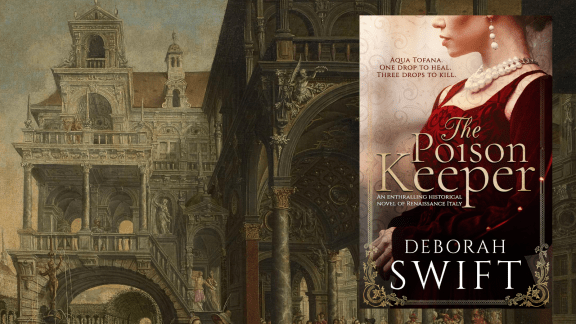 (Blurb)
 Author Bio:
 Adventures of a Tudor Nerd