
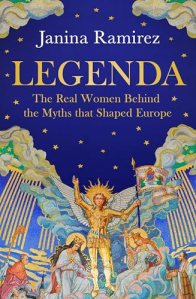
 When we think of famous medieval European women, we often think of figures like Joan of Arc and Isabella of Castile. They are seen as women who broke the mold and challenged traditional stereotypes by becoming leaders in traditionally male-dominated fields. These women would be used to craft the identities of their respective nations, but they would help shape the identities of other women from the 18th and 19th centuries. We think we know the stories about these medieval women and their lives, but what new information can we learn from their lives when we examine their lives from their eras? Janina Ramirez takes the stories of seven medieval women and their contemporaries to show how their legacies have been transformed in her latest book, “Legenda: The Real Women Behind the Myths That Shaped Europe.”
This is the third book that I have read by Janina Ramirez, as I have read her book “Femina” and her biography on Julian of Norwich, which I loved. So when I saw that she was writing a new book about medieval women, I knew it was an instant buy for me.
While there have been centuries worth of amazing women from all over the world, Ramirez is focusing on seven countries/areas of interest: France, the Iberian Peninsula, Greece, the Low Countries, Germany, Italy, and Britain. In each chapter, Ramirez focuses on two women or groups of women, one from the medieval era and one from either the 18th or the 19th century. For the medieval period, she has selected: Joan of Arc, Isabella of Castile, Anna Komene, Marie of Oignies and the Beguines, Empress Adelaide of Bavaria, Catherine of Siena, and Lady Godiva. For the more modern women, Ramirez focuses on Charlotte Corday, Agustina Raimunda Maria Saragossa, Laskarina Bouboulina, the Sisters of Notre Dame de Namur, Lola Montez, Anna ‘Nina’ Morisi, and Queen Victoria.
What is truly inspiring about this book is seeing these stories removed from the glossy veneer used to promote nationalism, to show that these women were real and they made a difference by being themselves. We get to see warriors, writers, queens, empresses, revolutionaries, and religious women. However, we also get to see them as daughters, sisters, wives, and mothers. These women did not live in a vacuum. They lived and were more than just symbols for their nations. They fought in their own ways for what they believed was right, whether it was to protect their families or their nations, or following the path set forward by their faith. These women were real, and they were not myths; they were human.
This is another sensational book by Ramirez. While I did know a few of the medieval women featured in this book, I knew nothing about the 18th and 19th-century women, which was thrilling to see how Ramirez weaved these tales together. I loved this book so much, and I am excited to see what she will write next. If you love medieval women’s history and learning more about their legacies, I highly recommend you read “Legenda: The Real Women Behind the Myths That Shaped Europe” by Janina Ramirez.
 When we think of the greatest writers of all time, we often think about novelists like Jane Austen and Agatha Christie. There is a playwright who we know quite well in our century, but he wrote during the sixteenth century; William Shakespeare, “the Bard.” He may have been a star in his own time and is seen as one of the greats in our era, but it took a while to get him to such a status. In fact, he was forgotten for quite some time, until the 18th century, when an unlikely group of women decided to save the bard from obscurity. The story of the Shakespeare Ladies Club, its members, and the women’s impact is told in Christine and Jonathan Hainsworth’s book, “The Shakespeare Ladies Club: The Forgotten Women Who Rescued the Bawdy Bard.”
 Adventures of a Tudor Nerd