 I am pleased to welcome Mercedes Rochelle back to my blog to share an excerpt from her novel, “The Agincourt King.” I would like to thank Mercedes Rochelle and The Coffee Pot Book Club for allowing me to be part of this blog tour.
THE CABOCHIEN REVOLT IN PARIS
There was no doubt that France was in turmoil. King Henry IV of England wasn’t even cold in his grave at Canterbury Cathedral when a fierce rebellion broke out in Paris. As usual, King Charles VI had sunk into insensibility and the city simmered uneasily, agitated by John the Fearless, the Duke of Burgundy. Private and public accusations were aimed against the king’s ministers, and the most threatened among them started to leave town for the safety of the provinces. But another consideration had arisen to complicate matters. Louis the Dauphin had reached his sixteenth year and was poised to take on the regency while his father was incapacitated. Already he was chafing under Burgundy’s authority…
Although today Burgundy was in charge, he was concerned about Louis the Dauphin. To control the heir to the throne, he had arranged a marriage between Louis and his daughter Margaret. Unfortunately, the union was not working out. The lad showed a disturbing independence and tended to reject his wife whenever possible. It was time to teach him a good lesson.
It didn’t take long to devise a plan. Duke John secretly conversed with Governor Jacqueville (who happened to be the chamberlain) and others of his household. As he conveniently withdrew, the citizens worked themselves into another frenzy under the urging of their governor. Jacqueville mounted a platform and held up his hands for attention.
“I have a list of traitors the Dauphin harbours under his protection,” he shouted. “They seek to strip you of your rights and privileges. We must take them prisoner! See here, the Duke of Bar is your enemy, and the Dauphin’s chancellor Jehan de Vailly. We must arrest the queen’s brother Duke Louis of Bavaria, members of her household, and her ladies in waiting. I have the list here!”
Jacqueville waved a paper over his head. He was about to say more when a burly citizen mounted the platform. The crowd cheered and he recognized this man, a well-known mischief-maker who was popular with the people. He was dressed as a common workman, with a swarthy face and hair that stuck up like a brush. He strutted across the platform like he owned the place.
“I am Simon Caboche, to those who do not know me,” the newcomer called out to much laughter. “I am a skinner of the Paris Boucherie and leader of our butcher’s guild. Follow me to the Hôtel de Guyenne, where we will have a parley with the Dauphin.” He pulled out a white hood—chaperon—from under his belt. “All those who are with me, here is our badge!” And to the governor’s amazement, most of the Parisians had a white hood, too. Who was playing into whose hand?
Giving Jacqueville a meaningful look, Caboche took charge and led a shouting mob to the Dauphin’s hôtel. By the time they reached the Rue St. Antoine, they were six thousand strong and growing. The men guarding the door didn’t even try to interfere. While the Parisians surrounded the hôtel, the leaders pushed their way inside.
“Where is he?” bellowed Caboche at the first servant he saw. The man backed against the wall. “Where is the Dauphin?”
The poor servant blubbered in terror, and Caboche growled at him before continuing down the hall. Two old women carrying linens were just coming out a door when the butcher pointed at them. “Take us to the Dauphin!” he demanded. Looking at each other, the servants froze.
“Come, friends,” he said more gently. “We won’t hurt you. We need to speak to the Dauphin.”
One of the women pursed her lips and then gave her bundle to her companion. Jerking her head, she led the intruders to the Dauphin’s private apartment. Nodding his thanks, Caboche shoved open the door with a slam, surprising Louis while he was conversing with the Duke of Bar.
Louis sprang awkwardly to his feet. “What is the meaning of this?” he cried in an unsteady voice. Unfortunately, the Dauphin did not inspire confidence and he knew it. His short frame was overweight, heavy, and slow. He was already known for keeping late hours and general laziness. Fond of excessive jewellery and rich clothing, he relied on the trappings of royalty to sustain his fragile dignity.
Caboche stepped forward, flanked by his closest associates. He did not remove his white hood. “Our most redoubted lord,” he said, his voice barely respectful, “I have come with my fellow Parisians, who require, for your welfare and your father’s, that you deliver up certain traitors who are now in your hôtel.”
Recovering his nerve, the Dauphin was filled with anger. “This is absurd. What you demand is impossible. There are no traitors in this hôtel.”
“That is not true. I see them right before me.” Caboche nodded toward his victims and some of his men leapt across the room, grabbing the Duke of Bar by the arm; others seized the Dauphin’s chancellor. While Louis turned around in apprehension, his wife screamed. She had thrown her arm around one of his valets, trying to hold him back from two of the butchers who yanked him loose. Another servant was thrown to the floor.
“Stop this!” cried Louis.
Caboche gave him a sideways grin. “If you are willing to give them up,” he said, “well and good. Otherwise, we will take them right before your face and punish them as they deserve.”
“I command you to let them go!” shouted the Dauphin. “My affairs are none of yours.”
Jacqueville stepped up beside the butcher. “Monseigneur, this is very much our business. You have been badly misled, and your behaviour is that of a spoiled young man. You are sorely in need of correction.”
“Get out of my sight!” cried the Dauphin. “Guards, help me! Guards!”
Alerted by the shouting, several of the Dauphin’s men rushed into the room and threw themselves onto the intruders, who enthusiastically fought back. But no sooner had the scuffle begun when the Duke of Burgundy pushed his way into the room, shouting for order. His own men bore halberds and quickly interceded, pushing the antagonists apart. The Cabochiens, as they already called themselves, grouped together, still hanging onto their prisoners.
Louis whirled around, pointing at his father-in-law. “This is your doing,” he growled. “These are your men. One day you will regret this. I won’t always be under your thumb.”
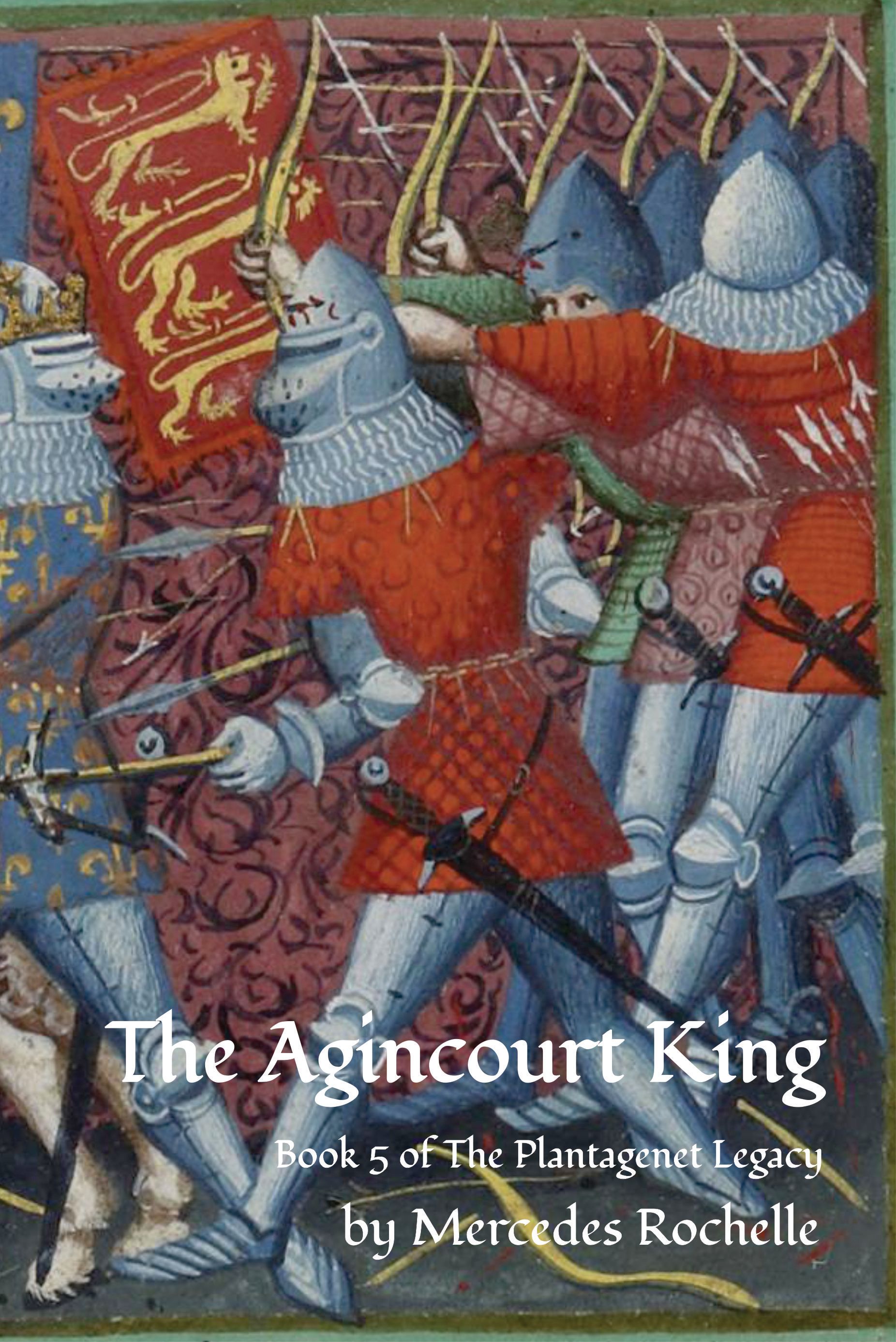 Blurb:
From the day he was crowned, Henry V was determined to prove the legitimacy of his house. His father’s usurpation weighed heavily on his mind. Only a grand gesture would capture the respect of his own countrymen and the rest of Europe. He would follow in his great-grandfather Edward III’s footsteps, and recover lost territory in France.
Better yet, why not go for the crown? Poor, deranged Charles VI couldn’t manage his own barons. The civil war between the Burgundians and Armagnacs was more of a threat to his country than the English, even after Henry laid siege to Harfleur. But once Harfleur had fallen, the French came to their senses and determined to block his path to Calais and destroy him.
By the time the English reached Agincourt, they were starving, exhausted, and easy pickings. Or so the French thought. Little did they reckon on Henry’s leadership and the stout-hearted English archers who proved, once again, that numbers didn’t matter when God was on their side.
Buy Links:
This title is available to read on #KindleUnlimited.
Universal Buy Link: https://books2read.com/u/mq70Ze
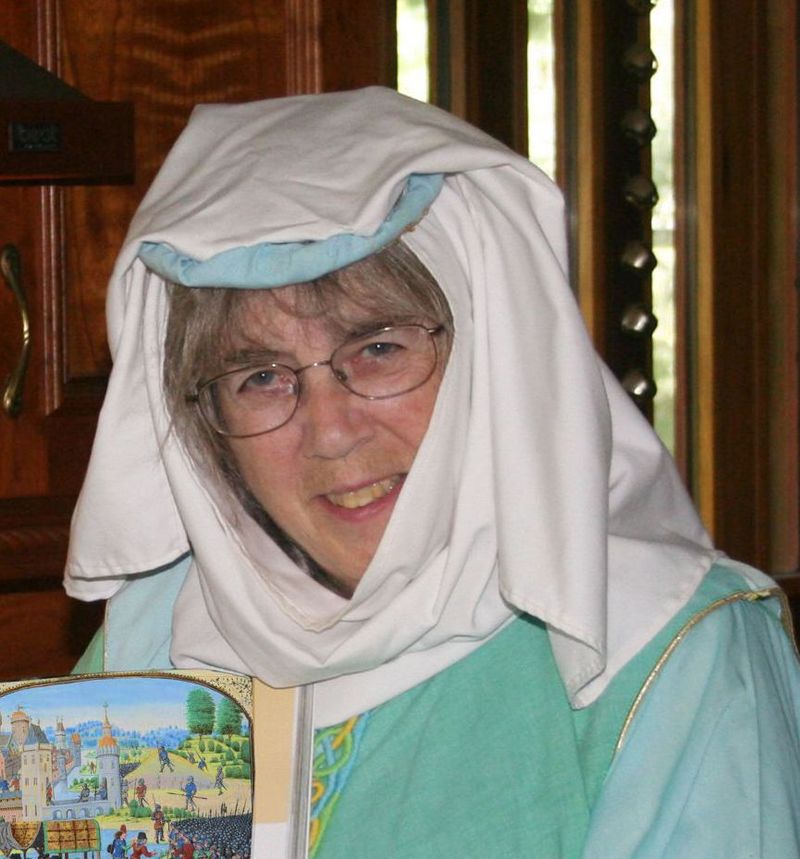 Author Bio:
Mercedes Rochelle is an ardent lover of medieval history and has channeled this interest into fiction writing. Her first four books cover eleventh-century Britain and events surrounding the Norman Conquest of England. The next series is called “The Plantagenet Legacy” and begins with the reign of Richard II.
She also writes a blog: www.HistoricalBritainBlog.com to explore the history behind the story. Born in St. Louis, MO, she received by BA in Literature at the Univ. of Missouri St.Louis in 1979 then moved to New York in 1982 while in her mid-20s to “see the world”. The search hasn’t ended!
Today she lives in Sergeantsville, NJ with her husband in a log home they had built themselves.
Author Links:
Website: https://mercedesrochelle.com/
Blog: https://historicalbritainblog.com/
Twitter / X: https://x.com/authorrochelle
Facebook: https://www.facebook.com/mercedesrochelle.net
Book Bub: https://www.bookbub.com/authors/mercedes-rochelle
Amazon Author Page: https://www.amazon.com/stores/Mercedes-Rochelle/author/B001KMG5P6
Goodreads: https://www.goodreads.com/author/show/1696491.Mercedes_Rochelle

 Medieval Europe was a time of conflicts and change. While smaller disputes between countries or civil wars would define borders, the most prominent conflict during this period was the Hundred Years’ War. A conflict that has been traditionally taught to have lasted 116 years between England and France. It is often told from the English perspective, with battles such as Agincourt, Crecy, and Poitiers celebrated. But what if we look at the bigger picture and expand our lens to the whole of Europe while keeping a neutral approach to the France vs England conflict? What if the conflict did not last a mere hundred years, but in fact two hundred years? What type of story would this kind of approach tell when it comes to medieval European history? Michael Livingston takes on the mammoth challenge of telling the tale of how this war changed European history forever in his latest book, “Bloody Crowns: A New History of the Hundred Years War.”
 English kings are some of the most recognizable monarchs in all of European history, and when we think of Kings of England, a few names pop into our minds. Edward, George, and William tend to be popular, but you cannot study English history without Henry. Eight kings of England were Henry, and they would change the history of England forever. These eight kings give us an entire range of what kingship was like in medieval Europe. From men born to be king to opportunists who decided to take the throne as their own, from saints to warrior kings, the Henrys of English history were a colorful group of characters. Each king has had numerous biographies written about him, but there has never been a collection of biographies about the kings named Henry until now. This is “Harry of England: The History of Eight Kings, From Henry I to Henry VIII” by Teresa Cole.
 Adventures of a Tudor Nerd