
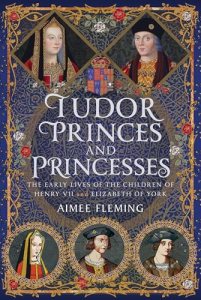
 The year is 1485, and the last Plantagenet king, Richard III, is dead. The young man whose army defeated the king is Henry Tudor, and he is about to start a dynasty that will reshape world history forever. Henry Tudor, now King Henry VII, married the daughter of King Edward IV and Elizabeth Woodville, Elizabeth of York. Their marriage and their children would lay the foundation for the Tudor dynasty, but what was life like for the children who were the first generation of this remarkable dynasty? Aimee Fleming explores the lives of these royal siblings in her latest book, “Tudor Princes and Princesses: The Early Lives of the Children of Henry VII and Elizabeth of York.”
I would like to thank Pen and Sword Books and NetGalley for sending me a copy of this book. I enjoyed her previous book about Margaret More Roper, so when I heard that she was writing a book about the children of Henry VII and Elizabeth of York, I was curious to see what new information Fleming would include in this book.
Fleming begins with the aftermath of Bosworth as King Henry VII begins his new life as a king and husband to Elizabeth of York. As they anticipate the arrival of their firstborn child, we get to see how their childhoods influenced their parenting style. The couple’s firstborn child, Prince Arthur Tudor, would be born in Winchester, the city where the mythical Camelot is supposed to be. As the heir to the dynasty and a boy named after the legendary King Arthur, the young prince was seen as the embodiment of the Tudor rose and the hope of the dynasty’s future. No pressure at all for the young prince.
After the birth of Prince Arthur, Henry and Elizabeth welcomed Margaret, Henry, Elizabeth, Edward/Edmund, and Mary into the family. While Princess Elizabeth and Prince Edward/Edmund died young, we get to see Princesses Margaret and Mary, as well as Prince Henry, grow up in the royal nursery, being educated for their important roles as future monarchs, and the bond they shared as siblings. They had to deal with the ever-changing world of the 16th century and navigate the uncertainty of court life, especially with the pretenders waiting in the wings to snatch the crown. Margaret, Henry, and Mary had to deal with the death of Prince Arthur shortly after he married Catherine of Aragon, and their mother, Elizabeth of York, after she gave birth to her final daughter, who also died. Blood may have connected these siblings, but love and shared experiences made this family tight-knit.
Overall, I thought this book was a nice review book for those who know about the Tudors, and a nice introductory book for those who are not familiar with this family. If either of these descriptions sounds like you, if you are a Tudor nerd, I recommend you read “Tudor Princes and Princesses: The Early Lives of the Children of Henry VIII and Elizabeth of York” by Aimee Fleming.
 When we think about the great female minds of the 16th century, we often think about those closest to the throne. Women of privilege who were destined to rule or to be a queen consort in a far-off land where their education would be imperative for the success or failure of their respective dynasty. However, some women did not live a life of glitz and glamor and received an equally impressive education. One such woman was the daughter of the great statesman Sir Thomas More, Margaret More Roper. Her remarkable story is told in the debut book by Aimee Fleming, “The Female Tudor Scholar and Writer: The Life and Times of Margaret More Roper.”
 Adventures of a Tudor Nerd