
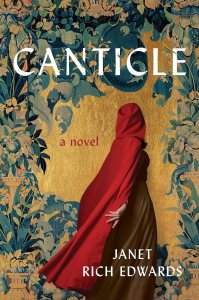
 Have you ever believed in something or someone so much that you were willing to do anything to be with them? What if it meant isolating yourself from everyone and everything you loved? Aleys knows this all too well. Born near Bruges during the 13th century, Aleys believes that she is destined for great things and has religious visions. Can this young woman survive both religious and political challenges to make her aspirations of being closer to God a reality, or will she fly too close to the sun and lose everything? Janet Rich Edwards tells Alleys’ tale in her debut novel, “Canticle.”
I would like to thank Spiegel & Grau and Net Galley for sending me a copy of this novel. I am always looking for a fresh approach to the past, so when I read the premise of this novel, it sparked an interest in me. As it is a debut featuring a religious group of women that I was not familiar with, the beguines, I wanted to see how Edwards’s writing style would bring something new to medieval historical fiction.
“Canticle” is a novel that follows three main narrators: Aleys, the young woman who longs to have a deeper relationship with God; Friar Lukas, who wants to grow his monastery; and Jaan Smet, Bishop of Tournai, who wants to get closer to the pope and power. We begin with Aleys as a young woman. She lives with her mother, father, brothers, and sister. Her mother died during childbirth, leaving the family broken. Aleys’s father decides to marry her off to a rich merchant, but Aleys decides that she wants to live a religious life, so she runs away. It is here she meets Friar Lukas, a Franciscan, and she wants to become a Franciscan, but Lukas convinces her to join the community of beguines.
It is in the community of beguines that Aleys discovers her true self and a series of translations that will send shockwaves all the way to Rome. The Bishop wanted to take down this community so that he could earn the respect of Rome and possibly become a cardinal. However, it was Aleys who was about to change with a miracle that sent the town into a frenzy. It was Friar Lukas who convinced Aleys to take the ultimate step and become an anchoress. It was when Aleys became an anchoress that Edwards truly shines because she shows the isolation that an anchoress might feel in her cell. But life has a way of reaching even an isolated cell, and Aleys must choose whether to save herself or her beloved beguines.
I found this a delightfully evocative novel about medieval religious life. It made me feel sympathy for the beguines and the anchoresses who were willing to risk it all to get closer to God. I really enjoyed Edwards’ writing style, and I can’t wait to see what she will write about next. If you want something medieval that focuses on religious life, I would recommend you read “Canticle” by Janet Rich Edwards.
 Margery Kempe, the only daughter of the mayor of Bishop’s Lynn, England has made a tough decision in 1413. She has decided to leave her home, her husband, and her fourteen children to go on a pilgrimage to the holy city of Jerusalem as a way to honor her late father’s dying wishes. As she begins her journey, she meets the famous anchoress Julian of Norwich, who entrusts Margery with an important mission. She gives Margery her book Revelations of Divine Love and tells her to spread her message throughout the world in secret. Margery’s pilgrimage, her connection to Julian of Norwich, and the aftermath of her journey are intricately woven together in Mary Sharratt’s stunning novel, “Revelations”.
 Adventures of a Tudor Nerd