
 The story of King Henry VIII and his six wives has been regaled for centuries in different mediums. We love the marital problems of this one English king because of how much of an impact it made on all of Europe in the 16th century and beyond. Yet our love affair with the Tudor dynasty would not have gotten to the point that it is today without the tireless efforts of the ambassadors who went to England to report the news of the day to their respected kings and emperors. We tend to think that the ambassadors are better left in the shadows, working to promote peace between countries and report what was happening, but one man made a name for himself as an ambassador and transcended time. His name was Eustace Chapuys. His story and his mission are finally being told in Lauren Mackay’s brilliant debut book, “Inside the Tudor Court: Henry VIII and his Six Wives through the eyes of the Spanish Ambassador”.
I have heard about this book in the past and how much of an impact it has made in the Tudor community in the past. I have read Lauren Mackay’s two other books and I have enjoyed them thoroughly and so I really wanted to read this book.
To understand the man behind the now-infamous words about the Tudors, especially Henry VIII and Anne Boleyn, we have to go back to Chapuys hometown of Annecy. It is here where we see the Chapuys family rise in prominence to the point where Eustace Chapuys was employed by the Holy Roman Emperor Charles V as the Spanish Ambassador to England. His main job was to report information back to Charles about the Henirican court as accurately as possible.
Chapuys started his job as ambassador at a critical junction in English history when Henry VIII was in the middle of his divorce from his first wife Katherine of Aragon in 1529. Chapuys admired Katherine of Aragon’s strength and worked tirelessly to protect her daughter Mary. Since Chapuys had a close connection to those who were essential in the Tudor court, he has given historians fabulous insights into these tumultuous times. It was really his relationship with Anne Boleyn which has caused a lot of controversy over the years and has blackened Chapuys’ name for centuries. Mackay has masterfully examined Chapuys’ correspondences to uncover the truth about how he felt about the Tudor court from 1529 until 1545.
You cannot separate Tudor history during the reign of Henry VIII and the works of Eustace Chapuys, which is why this biography and Mackay’s research are so essential in understanding the 16th century. It sheds new light on the stories of Henry VIII and the lives of his six wives; Katherine of Aragon, Anne Boleyn, Jane Seymour, Anne of Cleves, Catherine Howard, and Catherine Parr. Chapuys was not afraid to speak his mind and to share the rumors of the day, which gives us significant insight into how the royal family was perceived by their public, both the positive and the negative aspects.
Eustace Chapuys has been one of those ambassadors who we think we know, but do we really? Mackay has rescued the much-maligned messenger of Charles V and restored him to the glory that he so rightfully deserves. Chapuys’ story was hidden in plain sight, but it took an extraordinary historian to bring his story to the spotlight. If you think you know about Eustace Chapuys and the Henrician court, you need to read this sublime biography, “Inside the Tudor Court: Henry VIII and his Six Wives through the eyes of the Spanish Ambassador” by Lauren Mackay. It might change how you view the Tudor dynasty.
 Divorced, beheaded, died. Divorced, beheaded, survived. For those who study Tudor history, we have heard this unimaginative rhyme to refer to the wives of Henry VIII for the longest time. We all know the stories of the queens, especially Anne Boleyn, but the fifth wife and the second one to be beheaded tend to be cast aside for some of the more intriguing tales. Her name was Catherine Howard, Henry’s youngest bride. Her story is full of rumors and myths, just like her cousin Anne Boleyn. Most know of her romantic dalliances that, in the end, led to her demise, but what was her reign like as queen? What was the court of Henry VIII like during his fifth marriage as his health was failing? In Gareth Russell’s brilliant biography, “Young and Damned and Fair: The Life and Tragedy of Catherine Howard at the Court of Henry VIII”, he dives deep into the archives to shine a light on the life of this tragic and young queen.
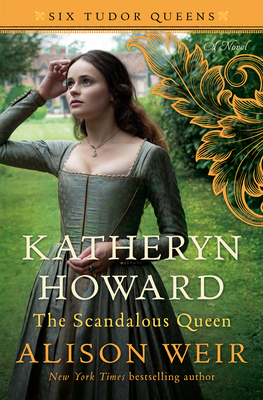 The year is 1540 and King Henry VIII has grown tired of his fourth wife from Germany, Anne of Cleves. The aging king longs for another heir to make sure that his dynasty is secure, which means he is searching for his fifth wife. Henry’s wandering eye lands on a young girl who happens to be a cousin of his second wife of Anne Boleyn. The young woman’s name who caught the king’s attention is Katheryn Howard. Henry believes that his new bride is virtuous as well as being very beautiful, but what secrets does this young queen hide? In her latest installment of the Six Tudor Queens series “Katheryn Howard: The Scandalous Queen”, Alison Weir takes a look into the life of this young woman and the men who loved her.
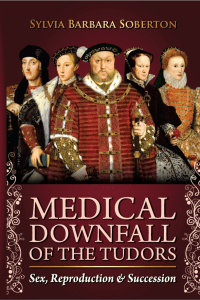 Today, I would like to welcome Sylvia Barbara Soberton to my blog as part of the book tour to promote her latest book, “Medical Downfall of the Tudors”, which is available now.
 One of the most popular Tudor historical fiction series in recent memory has revolved around the enigmatic Thomas Cromwell. Of course, I am talking about the famous
  The year 1540 during the reign of Henry VIII was a turbulent time. Henry’s new wife, Anne of Cleves, is not exactly the person who he imagined and his eye is starting to wander to a new woman, Katherine Howard. The reformers are starting to lose favor with the king as they and Catholics alike are being executed for treason. This is the London that Matthew Shardlake, our favorite hunchback lawyer turned detective, calls home. He thinks that he has retired from his detective work and serving Thomas Cromwell, but he is sadly mistaken. His next adventure has twice the number of cases and just as much danger that makes his trip to the monastery in “Dissolution” look easy. In the second book of the Shardlake series, “Dark Fire”, C.J. Sansom turns up the heat, the action, and the danger.
 A foreign princess who travels to England to marry the king to establish a strong political alliance. To those who study history, this is a story that has been told numerous times, but what makes this particular story unique is the people involved. The bridegroom was the recently-widowed Henry VIII, the shadow of his former self and notorious throughout Europe for having his second wife Anne Boleyn executed. His new bride to be is the German princess Anna of Kleve. To say that they did not see eye to eye would be an understatement as the marriage did not last long. Her story is often swept under the rug. Anna is often viewed as the “lucky” wife of Henry VIII, but was she? What was Anna’s story and what was her marriage with Henry really like? Alison Weir has taken up the challenge to give her readers a taste of what Anna’s life might have been like in this novel, “Six Tudor Queens: Anna of Kleve, Queen of Secrets”.
 The stories of King Henry VIII and the men around him have fascinated generations of historians, but there was one man who has received a negative reputation for his actions. He was the supposed son of a butcher who rose to be Henry VIII’s right-hand man, until his dramatic fall in July 1540. Thomas Cromwell was credited for helping Henry with his Great Matter, the fall of Anne Boleyn, the establishment of the Church of England, and the disastrous marriage between Henry and Anna of Cleves. Diarmaid MacCulloch has taken on the challenge to figure out who Thomas Cromwell really was by sifting through all remaining archival records that we have from this extraordinary man. It is in this book, “Thomas Cromwell: A Revolutionary Life” that MacCulloch masterfully explores the story of this man who changed English and European history forever.
 The Tudor dynasty and the enigmatic figures who made this time period so fascinating have been hotly discussed for centuries. Henry Tudor, who became King Henry VII after defeating King Richard III at the Battle of Bosworth Field in 1485. King Henry VIII, the second son whose numerous wives and his split from the Catholic Church made his name infamous in history. King Edward VI, Henry VIII’s beloved son who died before he really could accomplish the reformation that he had planned for England. Queen Mary I, who was the first Queen of England to rule in her own right and wanted to restore the Catholic Church. Finally, Queen Elizabeth I, who never married and led England to a “Golden Age”. Many historians have viewed the Tudor dynasty as a time of great change and England was in a good place. However, G.J. Meyer paints a darker picture of the era in his book, “The Tudors: The Complete Story of England’s Most Notorious Dynasty”.
 Try Me, Good King- Immersive Classical Concert of Tudor Tales and Shakespearean Stories
 Adventures of a Tudor Nerd