
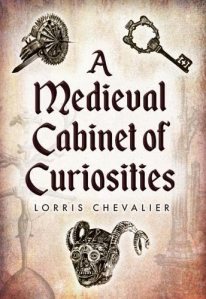
 When we think about how we study history, we often consider documents and chronicles that can provide us with dates and the stories of historical figures. However, this is only half the story. We can learn a great deal from the artifacts left behind. Each era left behind its treasure trove of trinkets for archaeologists and historians to discover and interpret their meanings and purposes. One of the most fascinating periods of history was medieval Europe, full of war, religious struggles, artwork, plagues, and technological advances. What types of artifacts were left behind from medieval Europe? Lorris Chevalier explores the trinkets and artifacts left behind in his book, “A Medieval Cabinet of Curiosities.”
I would like to thank Amberley Publishing for sending me a copy of this book. When I saw the concept for this book, it was intriguing. I was hoping that Chevalier would expand the medieval world to include Eastern Europe, Asia, South America, and perhaps Africa, as they don’t get a whole lot of attention when it comes to medieval studies and a more public history view. I wanted to learn something new.
Chevalier explains that this book explores fifty objects from the Viking Age to the end of the 16th century. These objects range from the religious and extraordinary to the most common articles of clothing. Each item has a unique story to share, which Chevalier discusses succinctly. His goal in this book is to break medieval stereotypes and show how diverse the medieval world was. A nice added feature of this book was that, instead of photographs of the artifacts, Chevalier included watercolor portraits at the end of each section to show what the artifact looked like.
I enjoyed this book for the new stories and characters that I got to meet along the way. These artifacts and stories were fresh and gave depth to the medieval period, even if he did bring up the Dark Ages a few times. I did have a few issues with the book. I did wish we had a wider range in medieval history, which covered more diverse stories than European medieval history. I also wish that the stories and artifacts were in more of a chronological order so readers can see the evolution of the medieval world. As it is written, it felt like it was a cluttered cabinet with no rhyme or reason to the organization, whereas I wanted something a bit more organized.
Overall, I found this quite a fascinating read. Chevalier is extremely knowledgeable about medieval Europe and these artifacts, no matter how obscure. If you want a book that tells the stories of medieval Europe through the trinkets left behind, I recommend you read “A Medieval Cabinet of Curiosities” by Lorris Chevalier.
 When we think of the term “Viking”, we often get images of battle-harden warriors, covered in guts and dirt, with horned helmets. We also believe that Vikings are warriors primarily from the Scandinavian world and that the Viking age ended in 1066 with the Norman Invasion of England. Our assumptions, thanks to television and a certain operatic cycle, are wrong. The Viking Age is a complex period of the past that spans centuries over half the known world. Using archeological evidence and written records, Eleanor Barraclough tells the tale of the Viking Age in her book, “Embers of the Hands: Hidden Histories of the Viking Age.”
 Castles, the monuments of medieval times, are buildings that hold many tales. Tales of sieges and sorrow, triumphs and tribulations. Through the centuries, their stones and foundations held many secrets. Some of the stories are famous, but most are hidden in the shadows of time and are hidden in ruins. Although castles exist in numerous countries and are centuries old, the castles of medieval England tell a story of a country facing turmoil and changing European and world history forever. Malcolm Hislop, a historian and researcher who specializes in architecture and archaeology, has written a single book exploring every medieval castle and its original architecture entitled, “A Guide to the Medieval Castles of England.”
 When we think of the phrase “middle ages,” we think of a time of bloody battles and deadly plagues, full of warriors and kings, and a more patriarchal society where women sat on the sidelines. Only the highly pious women or women who tore down barriers genuinely stood out in the history books. At least, that is what we have been told for centuries, but what does archeological research tell us? How about the newly discovered historical records? In her latest book, “Femina: A New History of the Middle Ages, Through the Women Written Out of It,” Janina Ramirez tells the story of the Middle Ages innovatively; through the stories of women who, until recently, were hidden voices from the past.
 Adventures of a Tudor Nerd