
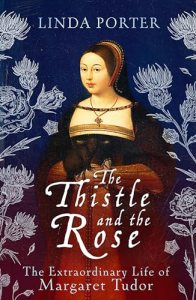
The Tudors have been an area of fascination for historians and history nerds alike for centuries. The attention tends to focus on either Henry VIII and his six wives or his daughter, Elizabeth I, but we need to remember that they were not the only Tudors. In fact, we should remember that Henry VIII had siblings, Arthur, Margaret, and Mary. While Arthur and Mary tend to get more attention due to their proximity to Henry VIII and his marital life, Margaret Tudor had her own eventful life as Queen of Scotland and the mother of King James V. Linda Porter tells Margaret’s story in her latest biography, “The Thistle and the Rose: The Extraordinary Life of Margaret Tudor.”
I had heard that Porter was writing a new biography about Margaret Tudor, so I knew I wanted to read it. I have read a few books about Margaret Tudor, but they have been relatively short, so I wanted to see what new information Porter would include in this book.
Margaret Tudor was the second child of King Henry VII and Queen Elizabeth of York. As such, she was destined to marry a foreign prince and create a strong alliance for the brand-new Tudor dynasty. Since her brother Arthur was betrothed to Catherine of Aragon, Margaret’s parents chose a match with Scotland and King James IV, who was twice the age of Margaret. As Queen of Scotland, Margaret did her best to bridge the gap between England and Scotland, deal with her husband’s mistresses and illegitimate children, and be a mother to her son, King James V.
Everything changed when James IV died at the Battle of Flodden. Margaret was now a widow and regent for the young King James V. To protect her family, Margaret decided to marry Archibald Douglas, 6th Earl of Angus, which turned out to be a trainwreck. Although Archibald did give Margaret her daughter, Margaret Douglas, he was stealing from Margaret’s own properties, which was a jerk move. Margaret wanted a divorce, but her dear brother Henry VIII was against the idea. A bit hypocritical, especially since he would divorce Catherine of Aragon a few years later. Eventually, Margaret would divorce Archibald and marry a third time to Henry Stewart, Lord Methven.
Throughout history, Margaret Tudor has been viewed negatively because she married Archibald so quickly, but Porter showed that Margaret should be applauded for how she survived during difficult circumstances. She fought for herself and her children, even if it meant that she was at odds with her husbands or her brother. Through her letters, we see how Margaret was a diplomat trying to make peace between England and Scotland.
Porter does an excellent job telling Margaret’s story in a respectful manner. This book is extremely well researched and easy to read. If you are a Tudor fan and you want to learn more about Henry VIII’s sister Margaret Tudor, I highly recommend you read “The Thistle and the Rose: The Extraordinary Life of Margaret Tudor” by Linda Porter.
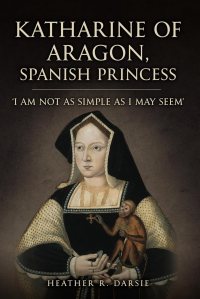 We all know the gist of the tragic tale of Katharine of Aragon. A Spanish princess who was brought to England to marry the heir of the Tudor throne, Prince Arthur Tudor. When the prince died mere months after their wedding day, Katharine was left in limbo and desolate as the Kings of Spain and England bickered over her dowry. Eventually, she would marry King Henry VIII, was his wife for over twenty years, and have numerous miscarriages before Henry decided to divorce her and marry Anne Boleyn. We know how Katharine’s story ends, but how did the stories of her Trastamara family influence her life and her reign as Queen of England? Heather R. Darsie explores Katharine’s Spanish origins in her latest book, “Katharine of Aragon, Spanish Princess: ‘I Am Not as Simple as I May Seem.’”
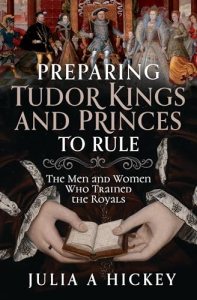 In life, when it comes to a new skill or job, you must be trained to become good at it. The same can be said for the monarchy, which in a sense is a job that encompasses one’s entire life. You have to understand different languages, rhetoric, the arts of dancing, and music, as well as diplomacy and physical activities if you want to rule a nation. It may seem like a lot for one person to handle, but from the moment of their birth, a prince or princess has a team of people behind them to make sure that they are ready to either rule their home country or create an alliance with other nations. The Tudors knew how important educating their future monarchs was for the survival of the dynasty. Julia A. Hickey examines the people behind the teams raising the future Tudor monarchs in her book, “Preparing Tudor Kings and Princes to Rule: The Men and Women Who Trained the Royals.”
 The life of a 16th-century princess is not all that it is cracked up to be. You can have jewels, and glamorous dresses, attend the glittering yet treacherous court, and have numerous homes. You must marry the person the king says you should marry to create strong alliances for the kingdom, so the concept of marrying for love is not in your vocabulary. You had to ensure your opinions were kept in line with the monarch’s views so you didn’t meet a disastrous end. In other words, the closer you are to the throne, the more scrutiny is forced upon you. No one understood this advice better than Mary Tudor, the daughter of King Henry VII and the younger sister of Henry VIII. She was a daughter, a sister, a wife, a queen, a duchess, and a mother. Her remarkable story is told in Amy McElroy’s book, “Mary Tudor: Queen of France.”
 During medieval wars, one’s fate is often determined by the spin of the Wheel of Fortune, even for those who did not fight a single battle. One could be living a life of luxury, stability reigning supreme, and is destined to marry a foreign king or prince, but when the wheel begins to spin, all seems lost, and the things that once were as good as guaranteed fall by the wayside. This description could fit any number of stories from the past. Still, the one highlighted in this particular novel is the story of the eldest daughter of King Edward IV and Elizabeth Woodville and the first Tudor queen. In the first book of her latest book series, “The Last White Rose: A Novel of Elizabeth of York,” Alison Weir shows how one woman was able to ride the highs and lows of life to secure her family’s legacy and transform English history forever.
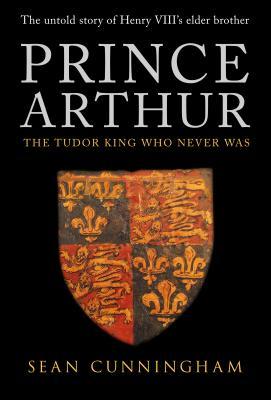 A new dynasty is born out of war and bloodshed. Hope is restored to the land as the remains of the Houses of York and Lancaster are united when Henry VII marries Elizabeth of York. It was not until the birth of their eldest child and heir, Prince Arthur, that the union was truly complete. Arthur was the hope for the nation, but when he tragically died shortly after marrying Catherine of Aragon, he was replaced by his younger brother who would become King Henry VIII. Arthur’s life was indeed very short, but his legacy and untimely death altered the course of history forever. Arthur tends to be a footnote in history, between Henry VII’s and Henry VIII’s reigns, but what was this young prince like? Why did his death leave such a large hole in the plans for the future of the Tudor dynasty? What was his relationship like with his family and those closest to the prince? These questions and more are explored in Dr. Sean Cunningham’s brilliant biography, “Prince Arthur: The Tudor King Who Never Was”.
 A series of wars that engulfed England for over thirty years finally comes to its conclusion. The Plantagenet dynasty is no more and the once outlaw is now the first king of the brand new dynasty, the Tudors. Margaret Beaufort is reunited with her beloved son, Henry Tudor as he is crowned King Henry VII. As Henry faces the numerous challenges of being a father and a king, his mother is right by his side to guide and protect him and his family. In the epic conclusion to her Beaufort Chronicle series, Judith Arnopp explores the transition for Margaret Beaufort in the early years of the Tudor dynasty in, “The King’s Mother”.
 The stories of the men behind the English crown can be as compelling as the men who wore the crown themselves. They were ruthless, cunning, power-hungry, and for many of them, did not last long. However, there were a select few who proved loyal to the crown and lived long and eventful lives. They are not as well known as their infamous counterparts, yet their stories are just as important to tell. One such man was the grandfather of two of Henry VIII’s wives and the great-grandfather of Elizabeth I. He lived through the reign of six kings and led his men to victory at the Battle of Flodden against King James IV of Scotland towards the end of his life. Thomas Howard, 2nd Duke of Norfolk had his fair shares of highs and lows, including imprisonment, but his story is rarely told. That is until now. Kirsten Claiden-Yardley has taken up the challenge to explore the life of this rather extraordinary man in her book, “The Man Behind the Tudors: Thomas Howards, 2nd Duke of Norfolk”.
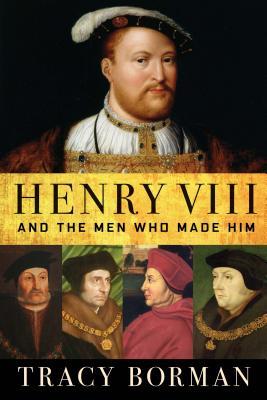 The story of the reign of King Henry VIII has been told mainly through his numerous marriages and through the lives of his children. Although his immediate family was a big part of his legacy, there is much more to his story than his tempestuous relationships. There were also his legal, religious, and military exploits. The ones who were with Henry when he made these decisions were the men who were loyal to him, his counselors and companions. Their tales are often told separately, until now. Tracy Borman has decided to masterfully combine their tales to explore the life of their infamous king in her latest biography, “Henry VIII and the Men Who Made Him”.
  The children of King Henry VII and Elizabeth of York lived rather eventful and fascinating lives. We all know the stories of Prince Arthur, who tragically died, his younger brother Henry, who would become the notorious King Henry VIII, and Mary, who would become Queen of France and then marry the man she loved, Charles Brandon. The one sibling that many tend to forget about is Margaret Tudor, who would become the wife of King James IV and the mother of King James V and Margaret Douglas. Her love life was quite rocky, but she kept fighting for what she believed was right for her family and her adoptive country of Scotland. This remarkable woman didn’t receive much attention in her lifetime, but Melanie Clegg hopes that people today will know Margaret’s story. This is why she wrote this delightful biography of the Tudor princess turned Queen of Scotland, “Margaret Tudor: The Life of Henry VIII’s Sister”.
  Adventures of a Tudor Nerd