
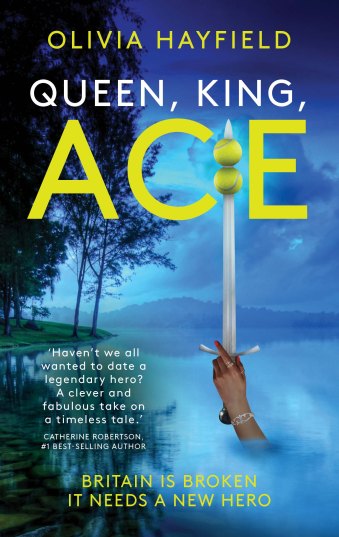
 England is in desperate need of a hero. After the Covid pandemic and the Brexit debacle, England is in despair, and only one man can save the day. He does not wield a sword, but a tennis racket and his fair maiden is the badass CEO of the Rose Corp. Ace Penhelagon and Eliza Rose seem like a picture-perfect pair, but every rose has thorns that protect it from a dark past. What dark secrets do these two hide away from the flashes of the paparazzi and can love endure over fate? Olivia Hayfield’s latest novel, “Queen, King, Ace,” is a modern love story that combines the elements of the Arthurian myths with the Tudor dynasty to answer the question of what might King Arthur and Queen Elizabeth be like in the 21st century.
I would like to thank Sue Copsey/ Olivia Hayfield for sending me a copy of this novel. I have seen Hayfield’s previous modern historical retellings, “Notorious”, “Wife After Wife,” and “Sister to Sister” online on social media, and they have looked intriguing, but I have yet to read one. When I heard the premise of this novel, it intrigued me as I was not sure how a modern story with the Tudors and the court of King Arthur would work out.
We begin our modern Tudor/ Arthurian adventure with Eliza Rose, the new CEO of Rose Corp, discussing with Terri Robbins-More about a new tennis phenom named Ace Penhelagon and their planned interview with him for their magazine, The Rack. Eliza agrees to the interview and asks her right-hand man, best friend, and writer extraordinaire, Will Bardington, to write the article. A chance encounter blossoms into a romance between Eliza and Ace, but obstacles get in the way.
Eliza is dealing with the aftermath of the murder of someone whom she considered a soul mate, Kit Marley, who was also very close to Will. Ace is on track to complete the Golden Slam, which is when a tennis player wins the Australian Open, the French Open, Wimbledon, the US Open, and the Olympic gold medal, which is a tall order for any athlete. From the meddling press to stalkers and parents questioning their intentions, it seems like fate is throwing everything it has at this young couple. The final twist in this tale was something I was not expecting and kept me on the edge of my seat. When I finished reading this novel, I wanted to read Hayfield’s other modern historical retellings.
This book may have not been a book that I thought I would enjoy in the concept alone, being a modern retelling of the Tudors and the Arthurian myths, but by the end, I was engrossed in the tale and a bit sad that it ended. I am a fan of modern tales from time to time, but the fact that Hayfield added a Tudor/Arthurian twist was a bit of fun searching for those little Easter eggs. If you are a fan of contemporary fiction, the Tudors, and the Arthurian legend, you should check out, “Queen, King, Ace” by Olivia Hayfield.
 The year is 1522, and London is in a jovial mood. King Henry VIII and his wife Catherine of Aragon are to play host to the Holy Roman Emperor Charles V as he visits England. As one of King Henry VIII’s most loyal advisors, Cardinal Wolsey had the great honor of hosting a grand masque featuring King Arthur and the Black Knight for the distinguished company. Unfortunately, as preparations for the luxurious masque are in full swing, Wolsey’s historian is horrifically murdered. The only one who can solve the case is Anthony Blanke, the son of John Blanke, the trumpeter before the masque is ruined, and Henry VIII discovers the truth. The story of this case is told in Steven Veerapen’s latest novel, “Of Blood Descended.”
 Adventures of a Tudor Nerd