
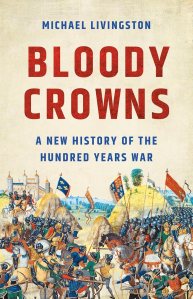
 Medieval Europe was a time of conflicts and change. While smaller disputes between countries or civil wars would define borders, the most prominent conflict during this period was the Hundred Years’ War. A conflict that has been traditionally taught to have lasted 116 years between England and France. It is often told from the English perspective, with battles such as Agincourt, Crecy, and Poitiers celebrated. But what if we look at the bigger picture and expand our lens to the whole of Europe while keeping a neutral approach to the France vs England conflict? What if the conflict did not last a mere hundred years, but in fact two hundred years? What type of story would this kind of approach tell when it comes to medieval European history? Michael Livingston takes on the mammoth challenge of telling the tale of how this war changed European history forever in his latest book, “Bloody Crowns: A New History of the Hundred Years War.”
I would like to thank Basic Books and Net Galley for sending me a copy of this book. I enjoyed the previous book that I read by Michael Livingston on the Battle of Crecy, so when I heard that he was writing a new book about the Hundred Years’ War, I was intrigued. I wanted to see what new information he could provide for a conflict that has been discussed heavily for centuries.
Livingston delivers with a plethora of information. He begins by explaining that the term Hundred Years’ War came from a French textbook in 1823. We often think that it began when King Philippe VI of France declared English lands forfeit on May 24, 1337, so King Edward III declared that he was the rightful king of France; and the end of the war was when the French seized the city of Bordeaux on October 19, 1453. However, Livingston argues that the war began in 1292 and ended in 1492, which means it was a two-hundred-year war. Livingston then goes into explaining the origins of France and England to explain how on earth they even got to a state of strife.
While the study of the conflict between France and England tends to focus on these countries, Livingston expands his view to include a pirate war between English and Norman merchants, wars in Portugal, the Burgundian Wars, fights between England, Scotland, and Wales, peasant revolts of all varieties, and wars with the Flemish. We also see a few civil wars in both France and England, including the Wars of the Roses. There are also colorful characters, including a couple of mad kings, the Black Prince, Henry V, Joan of Arc, William Wallace, earls and dukes of every variety, knights who were loyal to a fault, queens who fought for their families, heiresses fighting for their land rights, and a ton of family squabbles. And of course, Livingston focuses on the battles that defined the period, including Crecy, Poitiers, Agincourt, and Orleans, as well as lesser-known battles that helped shift the momentum for either side. Livingston can provide such vivid details that it feels like you are on the battlefield, even when it comes to the more obscure battles.
In my opinion, Livingston is one of the finest medieval military historians right now, and this is his magnum opus. I learned so much by reading this book that it kind of redefined what I think of the Hundred Years’ War. This is one of the best books I have read this year. If you want a book about medieval Europe that will challenge your way of thinking about one of the biggest conflicts of the age, I highly recommend you read “Bloody Crowns: A New History of the Hundred Years War” by Michael Livingston.
 Adventures of a Tudor Nerd