 Today, I am pleased to welcome J R Tomlin to my blog to share a guest post as part of the blog tour for her latest novel, “The Douglas Bastard / The Archibald the Grim Series.” I would like to thank J R Tomlin and The Coffee Pot Book Club for allowing me to be part of this blog tour.
Many people think that Scotland always fought alone against the English conquest. This was partially true.
In 1290, civil war loomed after the death of Scotland’s seven-year-old queen, Margaret, the Maid of Norway. The Scots turned to what they thought was a friendly monarch, England’s King Edward I. (Sounds crazy, I know, but Scotland and England had been at peace for most of the 13th century). The Scottish government started looking for allies. Phillip IV had just declared England’s possession of Gascony forfeit, so an alliance between Scotland and France looked like a good idea. A Scottish embassy traveled to negotiate with King Phillip, and the Treaty of Paris was signed on October 24, 1295.
In the short term, the alliance was no protection for Scotland. Edward invaded Scotland in 1296, temporarily crushed resistance, stripped the King of Scots, John de Balliol, whom he had chosen, and temporarily ended any Scottish government. It was, in effect, a province of England. Three years later, England and France signed a treaty of perpetual peace, leaving Scotland on its own. In France’s defense, there was effectively no Scottish government for it to support.
As we all know, Scotland refused to remain crushed. Andrew de Moray led the resistance in the north of Scotland, and William Wallace, aided by Robert the Bruce and Sir William Douglas, raised an army in the south. They joined forces to defeat the English at the Battle of Stirling Bridge. De Moray was killed in that battle. Wallace had probably met with the King of France but received no French aid, and the Scottish resistance was once more crushed, ending with the execution of Wallace.
Again, Scotland refused to stay crushed and rose once again under the leadership of King Robert the Bruce. But the Bruce had killed one of the Balliol (remember them?) inside a church. (I reject the idea that it was a planned ambush. The Bruce was too intelligent a man to plan to do something so stupid) The pope almost immediately excommunicated him and all of his followers. Luckily for him and Scotland, many Scottish bishops rejected the ex-communication based on English lies to the pope. But the effect was that the King of France would defy the pope by coming to the aid of a government under anathema.
The war lasted a very long time, and it was not until In 1324 that Bruce’s nephew, Thomas Randolph, Earl of Moray, met the Pope in person at his court in Avignon. Randolph successfully persuaded Pope John to recognize Robert as King of Scots, a major diplomatic coup that allowed the French the option of renewing relations with Scotland. A new, largely precautionary, treaty between France and Scotland, again negotiated by the Earl of Moray, was signed two years later.
The following year, King Edward III signed a treaty recognizing Scotland’s independence and Robert the Bruce as the rightful King of Scots. That should have been the end of it. See me roll my eyes.
King Robert died in 1327, leaving his only son, then five years old, as king and Thomas Randolph as regent.
Edward III felt humiliated by his defeat in the field by a Scottish army led by Sir James Douglas and Thomas Randolph and by having had to sign a peace treaty with Scotland. He backed John Balliol’s claim to the throne of Scotland and repudiated the peace treaty. Randolph died on his way to fight the invasion by Balliol, which the English king secretly backed. So now, that treaty with France would have some use.
At first, the defense against the invasion went badly. Many leading nobles were killed at the Battle of Dupplin Moor, including the new Guardian and thousands of Scottish troops. Although Balliol was then driven from Scotland by a later attack by the Scots, King Edward openly invaded. Soon most of Scotland was in English hands, with only a few castles holding out, and a majority of Scottish nobles, at least for a time, swore fealty to the English and their pretender.
Now Scotland needed that ally. In the winter of 1332, King Phillip dispatched a flotilla of ten ships to aid the Scots, but they were blown off course in a storm and never arrived. In the spring of 1334, £1000 came from France to be distributed to the Scottish defenders along with an offer of sanctuary to young King David, his queen, and members of his court. David or Moravia, Bishop of Moray and determined defender of Scottish independence, founded the Scots College of the University of Paris in 1333. He had to have been in Scotland at the time and may have had some influence on France.
The situation in Scotland was desperate enough that the Scots accepted the offer. In May 1334, King David and Queen Joanna arrived in France, along with their confessors, tutors in arts and arms, the king’s sisters, the Douglas children, the late regent’s sons, other children of Scottish nobles, and a number of clerics and nobles. They were given Château Gaillard as a residence. The French regularly sent supplies to Scotland and paid an annual pension of £2000 for the upkeep of King David’s court in exile. In June 1339, William Douglas, Lord of Liddesdale, visited King David in France and returned to Scotland, taking with him Arnoul d’Audrehen in command of 200 French troops and several ships, which aided in the attack on and capture of Perth. I have some doubt that Scotland as a kingdom would have survived without this ongoing aid.
In 1346, Edward overwhelmed French forces at the Battle of Crécy. Two months later, David II of Scotland was captured at the Battle of Neville’s Cross in response to a request from the French to attack England in order to force King Edward to return home; King David invaded England. The English captured him at the disastrous Battle of Neville’s Cross. However, the French continued to supply money and some troops to distract King Edward from his war in France, sending substantial funds and about sixty knights to aid in the capture of Berwick. Berwick was quickly lost, but it distracted Edward, who led a large army to ravage southern Scotland. William Douglas, later 1st Earl of Douglas, took part in that and, the following year, led 200 men-at-arms and forty knights to fight with the French at the Battle of Poitiers.
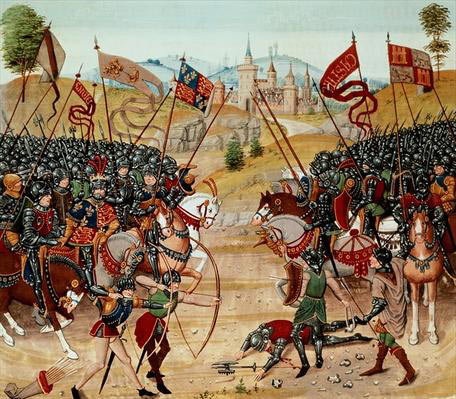
For a time, France was so battered as to have no funds for sending to Scotland, and Scotland’s King David I took peace with England as a policy. Even after King Robert II’s accession and the treaty’s renewal, neither nation saw any effects. It was in the following century that thousands of Scots once more went to the defense of Scotland. The Earl of Douglas’s son, the Earl of Wigtoun, and the Earl of Buchan helped the French defeat the English at the Battle of Baugé in 1421. It was a turning point in the Hundred Years’ War. King Charles VII granted Douglas the Duchy of Touraine, the first foreigner to be granted a dukedom in France. On May 8, 1429, Scots fought with Joan of Arc in the relief of Orléans, where legend has it bagpipes played Marche des Soldats de Robert Bruce as she entered the city.
England’s War of the Roses reduced the danger to both Scotland and France, at least for a time, but sometimes for good but often for bad, very bad; the Auld Alliance went on until James VI of Scotland, heir to the throne of England, repudiated it to strengthen his ties with England.
That, however, did not end the strong cultural ties between Scotland and France. The Scots’ language absorbed many French words. The ties with France could be seen in Scottish architecture, such as at Bothwell and Kildrummy Castle, built on French models. Many Scots who fought for France stayed to become citizens eventually. Scottish poets, bishops, and authors studied in France for centuries and brought the French influence home with them. The founder of Scotland’s first university, Bishop Henry Wardlaw, studied in France. So if you study there, you are benefiting from the Auld Alliance.
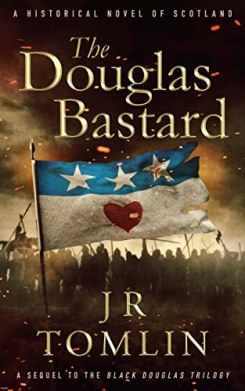 Blurb:
Young Archibald, the Black Douglas’s bastard son, returns from exile to a Scotland ravaged by war. The war-hardened Knight of Liddesdale will teach him what he must learn. And with danger on every side, he must learn to sleep with one eye open and a claymore in his hand because even their closest ally may betray them…
Buy Links:
The Douglas Bastard:
Universal Link: https://books2read.com/u/4AAwdp
Amazon UK: https://www.amazon.co.uk/dp/B0968X5V3Y
Amazon US: https://www.amazon.com/dp/B0968X5V3Y
 Amazon CA: https://www.amazon.ca/dp/B0968X5V3Y
Amazon AU: https://www.amazon.com.au/dp/B0968X5V3Y
Barnes and Noble: https://www.barnesandnoble.com/w/the-douglas-bastard-a-historical-novel-of-scotland-j-r-tomlin/1140930069
Kobo: https://www.kobo.com/ebook/the-douglas-bastard
iBooks: https://books.apple.com/us/book/id1606972264
Google Play: https://play.google.com/store/books/details/J_R_Tomlin_The_Douglas_Bastard?id=AM12EAAAQBAJ
Archibald the Grim Series on Amazon:
Amazon UK: https://www.amazon.co.uk/dp/B0BDW1VJ61
Amazon US: https://www.amazon.com/dp/B0BDW1VJ61

Author Bio:
J R Tomlin is the author of twenty historical novels.
Her historical novels are mainly set in Scotland. You can trace her love of that nation to the stories of Robert the Bruce and the Black Douglas that her grandmother read her when she was small and to her hillwalking through the Scottish Cairngorms, where the granite mountains have a gorgeous red glow under the setting sun.
In addition to having lived in Scotland, she has traveled in the US, mainland Europe, and the Pacific Rim. She now lives in Oregon.
Social Media Links:
Website: http://www.jrtomlin.com
Twitter: https://twitter.com/TomlinJeanne
Book Bub: https://www.bookbub.com/profile/j-r-tomlin
Amazon Author Page: https://www.amazon.com/stores/J.R.-Tomlin/author/B002J4ME1S
Goodreads: https://www.goodreads.com/author/show/4094154.J_R_Tomlin

 The year is 1342 in the sleepy coastal English town of Hookton when marauders attack and steal a precious relic. Thomas, a young archer, is the only survivor. With his father’s dying breath, he has given Thomas a mission to carry out, retrieve the relic, and avenge his family’s honor. The hunt for the man responsible takes Thomas to France during the beginning of the conflict that will be known as the Hundred Years’ War. Can Thomas of Hookton find the relic he was tasked to find or will another quest drag him into an even darker path? Thomas’s tale begins in the first book of the Grail Quest trilogy by Bernard Cornwell called, “The Archer’s Tale.”
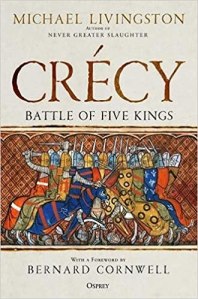 The year is 1346 and war has just begun between France and England. This conflict would be known as the Hundred Years War, which lasted over 116 years and ended in failure for the English. However, some glorious moments like Agincourt gave the English cause to celebrate, but none more so than the Battle of Crecy. It was a colossal battle between five European kings, leaving countless dead on the field without many long-term rewards. So how did the French and English armies meet on the field of Crecy and what truly happened? Michael Livingston dives deep into the archives and archaeological research to tell the truth of this famous battle in his book, “Crecy: Battle of Five Kings.”
 known as the Hundred Years’ War, and the massively destructive illness that we know today as either “the Black Death” or “the Black Plague”. This was a time of despair, but it was also a time where we see a shift from old traditions of the church and the state. It is also two centuries after the events of Ken Follett’s massively popular book, “The Pillars of the Earth”. Follett explores how the people of Kingsbridge survived during this tumultuous time in his second book of the Kingsbridge series, “World Without End”.
 Adventures of a Tudor Nerd