
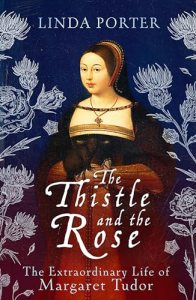
The Tudors have been an area of fascination for historians and history nerds alike for centuries. The attention tends to focus on either Henry VIII and his six wives or his daughter, Elizabeth I, but we need to remember that they were not the only Tudors. In fact, we should remember that Henry VIII had siblings, Arthur, Margaret, and Mary. While Arthur and Mary tend to get more attention due to their proximity to Henry VIII and his marital life, Margaret Tudor had her own eventful life as Queen of Scotland and the mother of King James V. Linda Porter tells Margaret’s story in her latest biography, “The Thistle and the Rose: The Extraordinary Life of Margaret Tudor.”
I had heard that Porter was writing a new biography about Margaret Tudor, so I knew I wanted to read it. I have read a few books about Margaret Tudor, but they have been relatively short, so I wanted to see what new information Porter would include in this book.
Margaret Tudor was the second child of King Henry VII and Queen Elizabeth of York. As such, she was destined to marry a foreign prince and create a strong alliance for the brand-new Tudor dynasty. Since her brother Arthur was betrothed to Catherine of Aragon, Margaret’s parents chose a match with Scotland and King James IV, who was twice the age of Margaret. As Queen of Scotland, Margaret did her best to bridge the gap between England and Scotland, deal with her husband’s mistresses and illegitimate children, and be a mother to her son, King James V.
Everything changed when James IV died at the Battle of Flodden. Margaret was now a widow and regent for the young King James V. To protect her family, Margaret decided to marry Archibald Douglas, 6th Earl of Angus, which turned out to be a trainwreck. Although Archibald did give Margaret her daughter, Margaret Douglas, he was stealing from Margaret’s own properties, which was a jerk move. Margaret wanted a divorce, but her dear brother Henry VIII was against the idea. A bit hypocritical, especially since he would divorce Catherine of Aragon a few years later. Eventually, Margaret would divorce Archibald and marry a third time to Henry Stewart, Lord Methven.
Throughout history, Margaret Tudor has been viewed negatively because she married Archibald so quickly, but Porter showed that Margaret should be applauded for how she survived during difficult circumstances. She fought for herself and her children, even if it meant that she was at odds with her husbands or her brother. Through her letters, we see how Margaret was a diplomat trying to make peace between England and Scotland.
Porter does an excellent job telling Margaret’s story in a respectful manner. This book is extremely well researched and easy to read. If you are a Tudor fan and you want to learn more about Henry VIII’s sister Margaret Tudor, I highly recommend you read “The Thistle and the Rose: The Extraordinary Life of Margaret Tudor” by Linda Porter.
 The stories of the men behind the English crown can be as compelling as the men who wore the crown themselves. They were ruthless, cunning, power-hungry, and for many of them, did not last long. However, there were a select few who proved loyal to the crown and lived long and eventful lives. They are not as well known as their infamous counterparts, yet their stories are just as important to tell. One such man was the grandfather of two of Henry VIII’s wives and the great-grandfather of Elizabeth I. He lived through the reign of six kings and led his men to victory at the Battle of Flodden against King James IV of Scotland towards the end of his life. Thomas Howard, 2nd Duke of Norfolk had his fair shares of highs and lows, including imprisonment, but his story is rarely told. That is until now. Kirsten Claiden-Yardley has taken up the challenge to explore the life of this rather extraordinary man in her book, “The Man Behind the Tudors: Thomas Howards, 2nd Duke of Norfolk”.
 The children of King Henry VII and Elizabeth of York lived rather eventful and fascinating lives. We all know the stories of Prince Arthur, who tragically died, his younger brother Henry, who would become the notorious King Henry VIII, and Mary, who would become Queen of France and then marry the man she loved, Charles Brandon. The one sibling that many tend to forget about is Margaret Tudor, who would become the wife of King James IV and the mother of King James V and Margaret Douglas. Her love life was quite rocky, but she kept fighting for what she believed was right for her family and her adoptive country of Scotland. This remarkable woman didn’t receive much attention in her lifetime, but Melanie Clegg hopes that people today will know Margaret’s story. This is why she wrote this delightful biography of the Tudor princess turned Queen of Scotland, “Margaret Tudor: The Life of Henry VIII’s Sister”.
 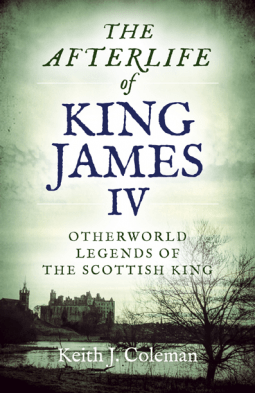 A king who died on the battlefield and his remains were never found. His story and his legacy went through many revisions throughout history. This sounds like a certain English king, King Richard III, but this story actually takes place decades after Richard’s death in Scotland. This is the story of King James IV of Scotland, who died at the Battle of Flodden in 1513. It was this event and how James IV was viewed afterward which Keith J. Coleman explores in his book, “The Afterlife of King James IV: Otherworld Legends of the Scottish King”.
 When one thinks about Queens of Scotland during the time of the Tudors, many automatically think of Mary Queen of Scots and her tragic life. However, there was another queen who had a deep connection to the Tudors and was also a queen of Scotland. She tends to be pushed aside in favor of her more famous siblings; Arthur Tudor, Henry VIII, and Mary Tudor. Her story is full of turmoil and triumphs. Her only desire was to unite England and Scotland peacefully, but the choices that she made in her lifetime would prove foolish, leading to more troubles between the two nations. This is the story of Henry VIII’s oldest sister Margaret, which is brought to life in Sarah-Beth Watkins’ book, “Margaret Tudor Queen of Scots: The Life of King Henry VIII’s Sister”.
  Adventures of a Tudor Nerd