
Today, I am pleased to welcome Gabrielle Storey to share a blurb from her latest book, “Berengaria of Navarre, Queen of England, Lord of Le Mans.”
 Blurb
Blurb
‘Berengaria of Navarre, Queen of England, Lord of Le Mans’ is a biography of one of our least-known queens of medieval England. Wife of Richard the Lionheart, daughter-in-law of Eleanor of Aquitaine, and a participant of the Third Crusade, Berengaria sat at the crossroads of several major political figures and events of the twelfth and thirteenth centuries. Yet her story has received scant attention by historians and the public until now.
This biography, including material not previously discussed in English scholarship, brings a new light to Berengaria’s life, covering her journeys from Navarre, across Europe to Sicily, Cyprus, the Holy Land, and then to the Angevin domains in France. It shows how women exercised power in medieval Europe, and brings to the fore a greater understanding of the life of one of England’s most forgotten queens. Grounded in academic research and written for the interested reader, this biography gives a welcome insight into Berengaria as a woman, queen, widow, and lord.
Launch 20% discount code for purchases made through the Routledge website: EFLY01
 Author Bio:
Dr Gabrielle Storey is a historian of monarchy, gender, and sexuality. Her research interests include the exercise of power, rulership, and monarchs in the medieval West. She has featured on several podcasts including the BBC ‘You’re Dead To Me’ on Eleanor of Aquitaine and writes regularly for several history magazines including History Extra and Medieval World: Culture and Conflict.
She is currently working on her first non-fiction book for the wider public. Her first book, the academic and accessible biography of Berengaria of Navarre, is published with Routledge in June 2024.
You can find more about her work here: https://gabriellestorey.com/public-engagement/
Author Links:
Website: https://gabriellestorey.com/
X: https://twitter.com/GabbyStorey
Instagram: https://www.instagram.com/drgabbystorey/
Bluesky: https://bsky.app/profile/gabbystorey.bsky.social
Amazon Author Page: https://www.amazon.co.uk/stores/Gabrielle-Storey/author/B0CVSCZVFY
Goodreads: https://www.goodreads.com/author/show/30441642.Gabrielle_Storey
 The Woodvilles were a family synonymous with the Wars of the Roses and the rise of King Edward IV. Some of the more notable names from this family include Jacquetta Woodville, the family’s matriarch, and Elizabeth Woodville, the controversial choice for King Edward IV’s wife. However, it was not just the women of the Woodville family who made a name for themselves. Anthony Woodville, the son of Jacquetta and brother of Elizabeth Woodville, would become famous for his unexpected execution at Pontefract Castle. Still, there was so much more to his story than his death. Who was Anthony Woodville and what is his legacy? Danielle Burton hopes to answer these questions and more in her debut biography, “Anthony Woodville: Sophisticate or Schemer?”
 The final wife, the one who survived. These words are what people think about when it comes to Katherine (Kateryn) Parr. However, before she even met Henry VIII, she had already lived quite a life, being married twice before meeting the king. She was a scholar, reformer, daughter, stepmother, wife, and mother. A woman who lived a rather intriguing life and happened to marry the King of England, Kateryn Parr’s life has been told in numerous mediums for centuries. Now, Laura Adkins has chosen to write about this famous Tudor wife in the biography, “Kateryn Parr: Henry VIII’s Sixth Wife.”
 Illegitimate royal children have been known to make an impact on history. Take Henry Fitzroy, the illegitimate son of Henry VIII, and Bessie Blount, whom Henry VIII acknowledged as his son. There were discussions about Henry Fitzroy becoming the heir apparent if Henry VIII did not have a legitimate son. But what about the illegitimate children that a king did not acknowledge? What might their lives have been like? The story of Mary Boleyn and her affair with King Henry VIII has been told many times, but the story of her daughter born during that time is lesser known. In her first full-length nonfiction book, “Henry VIII’s True Daughter: Catherine Carey, A Tudor Life,” Wendy J Dunn has taken on the task of discovering the truth of Catherine Carey’s parentage and how it impacted her life.
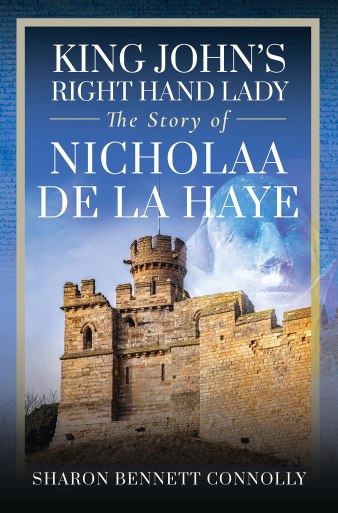 The year is 1217, and Lincoln Castle is being attacked. King John is dead, and his son Henry III is now king, but chaos still reigns. Noblemen are fighting against each other, and amid this conflict is a woman in her sixties. She is used to the instability of England as she is not only the constable of the castle being besieged, but she has earned the right to be named the first female sheriff of England. She was a daughter, a wife, a mother, a widow, and someone the Plantagenets could depend on. The name of this remarkable woman is Nicholaa de la Haye, and her unbelievable story is told in Sharon Bennett Connolly’s latest book, “King John’s Right Hand Lady: The Story of Nicholaa de la Haye.”
 When we think of the infamous queens of England, some names come to mind, but one rises to the top for the number of black myths and influence surrounding her name: Eleanor of Aquitaine. The orphaned Duchess of Aquitaine, who married the future King Louis VII of France, went on the Second Crusades with her husband, survived battles and kidnappings, and ended up divorcing her first husband because she couldn’t give a male son. So, she married the young Count of Anjou, who would become the first king of the Plantagenet dynasty, King Henry II, who had a large family and split her time between England and France. Eleanor would eventually side with her sons, rebel against Henry, and spend 15 years in prison. A fire-cracker of a queen, but how many of the stories surrounding the titular queen are true? In her latest biography, “Eleanor of Aquitaine: Queen of France and England, Mother of Empires,” Sara Cockerill dives deep into the archives to tell the true story of this much-maligned queen of England and France.
 One of the most critical years in English history was 1066, when William Duke of Normandy invaded England in the Norman Conquest. Known as William the Conqueror, his strength and ruthlessness made him a legend, but William would not have been the Duke or King of England without his equally formidable wife. Matilda of Flanders stood her ground, became the Duchess of Normandy, had a large family with William, and would become the first crowned Queen of England. Although much has been written about William the Conqueror and the Norman Conquest, Matilda of Flanders has not received the same attention until now. Tracy Borman has written the first biography dedicated to this remarkable woman entitled, “Matilda: Wife of the Conqueror, First Queen of England.”
 The House of Windsor has been attracting worldwide attention in recent decades with scandals, deaths, weddings, and the birth of royal children. As living symbols of England, the Windsors are seen as an above-average family with numerous jobs and responsibilities. We know their names; King George VI, Queen Elizabeth II, Prince Phillip, Prince (now King) Charles, Princess Diana, and Prince William. We know their stories from the numerous books, tabloids, and documentaries about their lives, but what about their lives when they go home to relax? Gareth Russell peels back the gilded curtain to explore the life of Elizabeth Bowes-Lyon, lovingly known as the Queen Mother, in his latest biography, “Do Let’s Have Another Drink: The Singular Wit and Double Measures of Queen Elizabeth The Queen Mother.”
 When we think about women rulers in the 16th century, some names, like Queen Mary I, Queen Elizabeth I, and Mary Queen of Scots, come to mind. However, another woman should be included in this list as her life helped keep the Valois dynasty alive and well in France, even though she was Italian by birth. Her name has been tainted with dark legends of poisoning, deadly incidents, and the infamous St. Bartholomew’s Day Massacre. This notorious queen was Catherine de Medici, and Leonie Frieda has chosen to shed some light on the myths and mysteries surrounding this misunderstood woman in her biography, “Catherine de Medici: Renaissance Queen of France.”
 When we think about those who rose through the ranks to achieve significant titles in the Tudor Court, we instantly think about Thomas Cromwell. However, we should also consider his mentor as one of these great men, Cardinal Thomas Wolsey. The son of Robert Wolsey, an Ispwich businessman, and his wife, Joan Daundy, who worked hard and ended up being the right-hand man of the young King Henry VIII. The man behind Hampton Court helped start the Great Matter and The Field of Cloth of Gold, Wolsey had numerous achievements. Who was the man behind these significant Tudor moments? This is the question Phil Roberts tries to address in his book, “Cardinal Wolsey: For King and Country.”
 Adventures of a Tudor Nerd