
 Today, I am pleased to welcome Ken Tentarelli to share information about his research into Renaissance Italy for his novel, “The Blackest Time.” I would like to thank The Coffee Pot Book Club and Ken Tentarelli for allowing me to participate in this blog tour.
Readers expect historical fiction to be authentic, and that aligns well with my passion for research. Often, I spend more time doing research than writing. The fun comes in discovering little-known bits of history. As an example, when you look at maps of Renaissance Italy, you’ll find brightly colored drawings showing the Republic of Florence, the Duchy of Milan, and the other major city-states, but those simplifications ignore the small independent jurisdictions.
Prepping for my fourth book, Conspiracy in Bologna, I came upon an item describing how the border was established between the Papal States and the Republic of Florence. Both agreed to use the course of a stream as their border, and both sent out teams of surveyors to create maps. As luck would have it, the two teams of surveyors identified different streams, leaving land and a town between the two streams unclaimed by either side. The land and the town became the Republic of Cospaia, which remained an independent republic for four hundred years. You’d be hard pressed to find a map of Renaissance Europe showing that tiny republic or the many other independent jurisdictions sprinkled throughout Italy.
We are blessed today with the internet, where we can find copies of original source documents written a thousand years ago. Many have been translated into English. I’m fortunate that I can read the ones that are still available only in Italian. One helpful resource for my latest book, The Blackest Time, was a journal written by Giorgio Villani, a banker in Florence. He wrote about life in Florence at the time of the Black Plague until he finally succumbed to the plague. His writings are available on the Internet in Italian.
Though extensive, the internet is not all-encompassing. In one of my books, a group of men was following an ancient Roman road through central Italy. The road ran alongside the Tiber River—the same river that flows through the center of Rome, but the story is set close to its source in the Apennine Mountains. The men wanted to cross the river to a town on the opposite bank, and for them to get across, I needed to know how they could cross the river. Today, a bridge spans the river, but nowhere on the internet could I find whether a bridge or a ferry was used during the Renaissance, so I emailed the town’s historical society asking whether their records held the answer. They kindly responded with information saying that not only was there a bridge during the Renaissance, but the Romans had built the first bridge at that site nearly two thousand years ago. I could have just picked one of the possibilities, bridge or ferry; after all, the book is fiction, but I felt better knowing the story accurately reflected the history.
Tidbits I found while doing research for a book in my Renaissance mystery series are what led me to write a book set during the time of the Black Plague. Although the mysteries are set during the 1400s, I got carried away at one point, looked further back in time, and came upon three significant events: a triple conjunction of planets, which was taken as an ill omen by astrologers, two years of incessant rain that destroyed farm crops and caused famine in the cities, and the Black Plague. Those three events happening within a brief span of time convinced me there had to be a story worth telling.
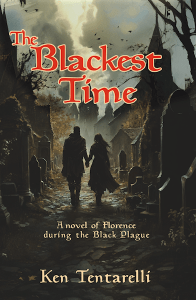 Blurb:
Set in the 1300s during the devastating black plague, The Blackest Time is a powerful tale of compassion, love, and the human spirit’s ability to endure immense adversity.
Gino, the central character, is a young man who leaves his family’s farm to find work in a pharmacy in Florence. His experiences show us how people coped in the most horrific time in history.
Shortly after Gino arrived in the city, two years of incessant rain destroyed crops in the countryside, leading to famine and despair in the city. Gino offers hope and help to the suffering— he secures shelter for a woman forced to leave her flooded farm, rescues a young girl orphaned by the plague, and aids others who have lost everything.
The rains had barely ended when the plague hit the city, exposing the true character of its people. While some blamed others for the devastation, the story focuses on the compassionate acts of neighbors helping each other overcome fear and suffering. Doctors bravely risk infection to care for their patients. A woman healer, wrongly accused of witchcraft and driven from the city, finds a new beginning in a village where her skills are appreciated.
Despite the hardships, love blossoms between Gino and a young woman he met at the apothecary. Together they survive, finding strength in each other and hope in a world teetering on the edge.
The Blackest Time is a testament to the strength of the human spirit in overcoming unimaginable tragedy.
Buy Link:
Universal Buy Link: https://books2read.com/u/bPO08J
 Author Bio:
Ken Tentarelli is a frequent visitor to Italy. In travels from the Alps to the southern coast of Sicily, he developed a love for its history and its people.
He has studied Italian culture and language in Rome and Perugia, a background he used in his award-winning series of historical thrillers set in the Italian Renaissance. He has taught courses in Italian history spanning time from the Etruscans to the Renaissance, and he’s a strong advocate of libraries and has served as a trustee of his local library and officer of the library foundation.
When not traveling, Ken and his wife live in beautiful New Hampshire.
Author Links:
Website: https://KenTentarelli.com
Facebook: https://www.facebook.com/ken.tentarelli.3/
Instagram: https://www.instagram.com/kententarelliauthor/
Book Bub: https://www.bookbub.com/authors/ken-tentarelli
Amazon Author Page:
https://www.amazon.com/stores/Ken-Tentarelli/author/B07PDYZ34Q
Goodreads: https://www.goodreads.com/author/show/18920645.Ken_Tentarelli
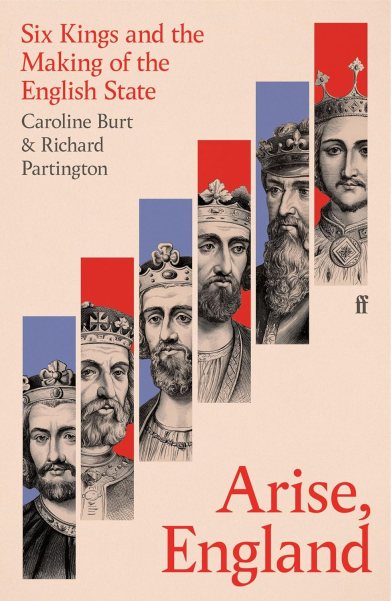 Like many other countries, England has been through growing pains when it comes to reforming its political, military, and judicial systems. None more so than the pains of the medieval period, specifically from 1199 to 1399. In those two centuries, there were six Plantagenet kings, each with a different style of being king and a different way of changing England with each reign. We often think that the biggest change to England’s political history during this time was the Magna Carta, but in fact, that was only just the beginning. Caroline Burt and Richard Partington have combed the archives to do a deep dive into each reign of these Plantagenet kings, examining the political and judicial changes that happened in a short period. Their comprehensive book is entitled, “Arise, England: Six Kings and the Making of the English State.”
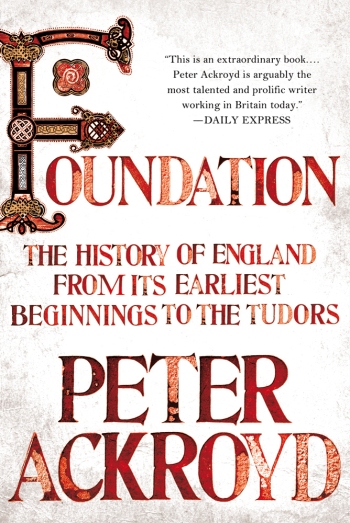 England is a nation that is rich in history and conflicts galore. Through the centuries, England has seen so much change. Many of us know the stories of the medieval and the Tudor kings and queens of England, covered in numerous books, but Peter Ackroyd has taken this concept a step forward. Ackroyd embarked on an epic quest to chronicle the history of England from its prehistoric origins to the modern age. In “Foundation: The History of England From Its Earliest Beginnings to the Tudors,” Peter Ackroyd begins his epic journey into the past to explore the origins of English history.
 When we think of the title “medieval queen,” a few things come to mind. They were seen as mere trophy wives who were only suitable for making alliances and giving birth to children. It may be a cruel assessment for a modern audience, but that was the reality of the medieval world. However, the late Plantagenet queens decided to step outside the socially acceptable path for their lives and forged a new one. In Alison Weir’s latest nonfiction book, “Queens of the Age of Chivalry: England’s Medieval Queens,” she explores the lives of five Plantagenet queens who had to adapt quickly to the ever-changing world of late medieval England.
 When we study human history, in general, we tend to pick a country and a period to focus on and research. Books on the subject material tend to focus on one land with interactions between other nations. It is infrequent for authors to take on multiple countries unless concentrated on one event that affected numerous locations. Those books often read like textbooks and can be a bit dry. Finding the perfect balance between these elements and engaging with the reader is a monumental task for any author, but Dan Jones has taken on the challenge. His latest behemoth tome, “Powers and Thrones: A New History of the Middle Ages,” takes on the gigantic task of telling the story of the Middle Ages from diverse perspectives.
 The period of human history that we know today as the Middle Ages spanned over a thousand years, and within that time, significant progress was made into understanding our world. Inventions and discoveries were made not just in Europe but throughout the known world during this time. One area of study that saw a lot of change was medical studies and understanding the human body. How did physicians heal the sick during the Middle Ages, and how did their experiences change their field of study? These questions and more are all explored in Juliana Cummings’ latest book, “Medicine in the Middle Ages: Surviving the Times.”
 known as the Hundred Years’ War, and the massively destructive illness that we know today as either “the Black Death” or “the Black Plague”. This was a time of despair, but it was also a time where we see a shift from old traditions of the church and the state. It is also two centuries after the events of Ken Follett’s massively popular book, “The Pillars of the Earth”. Follett explores how the people of Kingsbridge survived during this tumultuous time in his second book of the Kingsbridge series, “World Without End”.
 Adventures of a Tudor Nerd