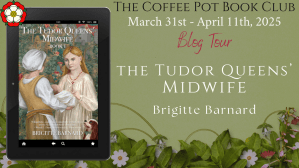
Book Review: “The Tudor Queens’ Midwife” by Brigitte Barnard

Throughout history, the true defining feature of a good queen was whether or not she could give birth to a male heir and a spare to keep the dynasty going. No dynasty relied heavily on the pregnancy of a queen and a male heir than the Tudor dynasty of England. While we tend to focus on the women who wear the crown and give birth to the potential heir, another stands beside her during the entire process; the royal midwife. Not much attention has been given to the royal midwife until now. Brigitte Barnard explores the life of a royal midwife and her daughter who work to help Queen Katherine of Aragon in her novel, “The Tudor Queens’ Midwife.”

I want to thank The Coffee Pot Book Club and Brigitte Barnard for sending me a copy of this book. When I read the description of this book for a blog tour that I was invited to join, it was an appealing concept. I like reading novels where the royal family takes a back seat, so seeing a novel about a royal midwife was different and I wanted to read it. 

In the glittering court of Henry VIII and Katherine of Aragon, Sarah Menendez the midwife and her daughter Faith must deal with the dangers of childbirth. Through dealing with miscarriages and stillbirths, Sarah and Faith help the queen in any way they can. But this mother and daughter have a secret. While serving Katherine of Aragon, the Spanish Catholic queen, they are not Catholic or Protestant. They are Jews who were exiled from their native Spain after the Inquisition that was put in place due to Katherine’s mother.

Throughout this novel, we witness Sarah and Faith helping Katherine of Aragon up to the Great Matter and other noble women and working women alike. Some of the women found the joys of motherhood while others paid the ultimate sacrifice to bring new life into the world. We also get to see the bond between Sarah and Faith and how fortune’s wheel continues to turn even for normal men and women. I also enjoyed the fact that we got to experience what life might be like for a Jewish family living in England when religion was a hot topic and the Jews had been banned from England for centuries.

 I enjoyed this novel. It was a fresh take on the Tudor era in England that explores what it might have been like to be a Jewish midwife when Katherine of Aragon was queen. As a debut, I think Barnard does a good job of creating believable characters and great scenarios. I am looking forward to her next novel and I hope she continues telling the story of these midwives. If you want a novel that is full of secrecy, religious conflict, and a loving family, I would suggest you read, “The Tudor Queens’ Midwife” by Brigitte Barnard.

Blurb: 

In the glamorous, glittering, and dangerous court of King Henry VIII and his queen Katherine of Aragon, the desperate desire for a healthy male heir overshadows all. Plagued by a series of miscarriages the queen is left grappling with the weight of her singular duty to provide a son for the Crown. Amidst this turmoil, the queen turns to Sarah Menendez, the most highly skilled midwife in England. Sarah, exiled from her homeland and concealing her true identity must serve the queen and battle her deepest fears. As Sarah strives to save the queen from the perils of childbirth, the specter of her past threatens to unravel the carefully crafted identity Sarah has created for herself and her young daughter. 

  In a world where power, politics, and religion collide, Sarah finds herself entangled in a web of intrigue and deadly danger. The fate of the queen’s unborn child, the survival of the midwife and her daughter, and the stability of the kingdom hang in the balance. Sarah Menendez must employ all of her skills, cunning, and courage to protect those she holds dear as well as the life of the queen and her unborn child. 

The Tudor Queens’ Midwife is a gripping tale of secrecy, sacrifice, and religious turmoil amongst the most opulent courts the world has ever seen.  

Buy Link: 

Universal Buy Link: https://books2read.com/u/4jzxyk  

Author Bio

Brigitte Barnard is an amateur historian of Renaissance English history and an author of the trilogy The Tudor Queens’ Midwife, of which the first book in the series is available. She is currently writing a non-fiction book about Tudor midwifery for Pen and Sword Publishing House.  

Brigitte is a former homebirth midwife, and she lives at home with her husband and four children. She also raises Cavalier King Charles Spaniels.  

Author Links

Website: http://thetudormidwife.com/  

Twitter: https://x.com/TheTudorMidwife  

Instagram: https://www.instagram.com/thetudormidwife

Guest Post: “The Spanish Armada” by Justin Newland

I am pleased to welcome Justin Newland to my blog today to share some background information about his novel,  The Midnight of Eights. I want to thank The Coffee Pot Book Club and Justin Newland for allowing me to be part of this blog tour.

This guest post relates to the historical background of my novel, The Midnight of Eights. The genesis of any single historical event is always multiple, a combine compound of different influences, some obvious, some subtle, So, in this short space, the best I can do is paint some broad brush strokes.  

The novel culminates in the repulse of the Spanish Armada, but what led to King Philip of Spain’s fatal decision to build and dispatch a fleet of 130 warships to invade England in 1588 AD?  

Let’s start in 1556. That was when Charles V, the Holy Roman Emperor and King of Spain, abdicated and passed his territories to his son, Philip, who inherited the Netherlands. The Dutch were mostly Protestant but were now under the control of a Catholic monarch. Philip sent the Duke of Alba to suppress any revolt and impose Catholic rule.  

In England in 1570, the Protestant Queen Elizabeth suppressed the Catholic-inspired Northern rebellion and for her troubles was excommunicated by Pope Pius V. In a Papal Bull entitled Regnans in Excelsis, he declared her to be a heretic and “the pretended Queen of England and the servant of crime.” Significantly for English Catholics, the Pope released all of her subjects from any allegiance to her and excommunicated any that obeyed her. 

In December 1585, Elizabeth and the Privy Council finally responded to the Dutch call for help, and the Queen sent English troops and vessels to support their resistance.  

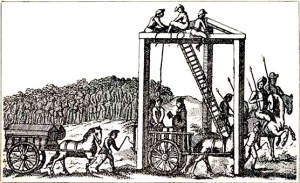
The Papal Bull persuaded many English Catholics to plot against Elizabeth. One was Sir Francis Throckmorton, a Catholic noble. He planned to depose Elizabeth and replace her with Mary, Queen of Scots. Mary, the Queen’s cousin, was Catholic, and a distant heir to the English throne. Francis Walsingham, the Queen’s spymaster, with the help of Nelan Michaels, the hero of the novel The Midnight of Eights, uncovered his plot and had Throckmorton executed at Tyburn in London in July 1584. The Tyburn Tree, a nickname for the gallows at Tyburn, was a prominent site for public executions in London and was given the chilling epithet, ‘the tree that was never green.’ 

Anthony Babington was the next English Catholic noble to attempt to depose Elizabeth and replace her with Mary. But when her letters to Babington were intercepted by Walsingham’s spies, proving her involvement to depose Elizabeth, Mary, Queen of Scots, was tried and executed in 1587. For King Philip, Mary’s death was the tipping point. He decided to despatch the Armada and bring England and its heretic Queen to heel once and for all.  

During the fleet preparations in Cadiz, Philip ordered his admirals to search for women on board the ships and remove them, so that God’s will prevailed.  

In April 1588, the Pope blessed the Armada emblem, the Madonna, and all the Spanish mariners watched in holy awe as it fluttered high on the masts of the galleons, galleasses, and supply ships.  

The Armada was not just a fleet of ships. As far as the Spanish were concerned, it was primarily a holy instrument to remove evil from the world.  

Justin Newland  

18th March 2025 

Photo #1: Pope Pius V, courtesy of Wikipedia  

Photo #2: The Tyburn Tree, courtesy of Wikipedia  

Blurb:

1580-Nelan Michaels docks at Plymouth after sailing around the world aboard the Golden Hind. He seeks only to master his mystical powers – the mark of the salamander, that mysterious spirit of fire – and reunite with his beloved Eleanor.  

After delivering a message to Francis Walsingham, he’s recruited into the service of the Queen’s spymaster, where his astral abilities help him to predict and thwart future plots against the realm. 

But in 1588, the Spanish Armada threatens England’s shores. 

So how could the fledgling navy of a small, misty isle on the edge of mainland Europe repulse the greatest fleet in the world? 

Was the Queen right when she claimed it was divine intervention, saying, ‘He blew with His winds, and they were scattered!’? 

Or was it an entirely different intervention – the extraordinary conjunction of coincidences that Nelan’s astral powers brought to bear on that fateful Midnight of Eights? 

Buy Links: 

Universal Buy Link: https://mybook.to/TheMidnightofEights  

Author Website (where buyer can enter a dedication): https://www.justinnewland.com/the-midnight-of-eights~193  

Wordery (for free UK delivery): https://wordery.com/the-midnight-of-eights-justin-newland-9781835740330   

Barnes and Noble (US): https://www.barnesandnoble.com/w/the-midnight-of-eights-justin-newland/1146325263?ean=2940185990643  

Waterstones (UK): https://www.waterstones.com/book/the-midnight-of-eights/justin-newland/9781835740330  

Kobo (International): https://www.kobo.com/gb/en/ebook/the-midnight-of-eights  

Saxo (DK): https://www.saxo.com/dk/the-midnight-of-eights_bog_9781835740330  

Kindle Unlimited:  

https://www.amazon.co.uk/Midnight-Eights-Justin-Newland-ebook/dp/B0D9Y7YRDG   

Author Bio

Justin Newland’s novels represent an innovative blend of genres from historical adventure to supernatural thriller and magical realism.  

Undeterred by the award of a Maths Doctorate, he conceived his debut novel, The Genes of Isis (ISBN 9781789014860, Matador, 2018), an epic fantasy set under Ancient Egyptian skies.  

His second book, The Old Dragon’s Head (ISBN 9781789015829, Matador, 2018), and is set in Ming Dynasty China in the shadows of the Great Wall.  

Set during the Great Enlightenment, The Coronation (ISBN 9781838591885, Matador, 2019) speculates on the genesis of the most important event in the modern world – the Industrial Revolution.  

The Abdication (ISBN 9781800463950, Matador, 2021) is a mystery thriller in which a young woman confronts her faith in a higher purpose and what it means to abdicate that faith. 

The Mark of the Salamander (ISBN 9781915853271, Book Guild, 2023), is the first in a two-book series, The Island of Angels. Set in the Elizabethan era, it tells the epic tale of England’s coming of age.  

The latest is The Midnight of Eights (ISBN 9781835740 330, Book Guild, 2024), the second in The Island of Angels series, which charts the uncanny coincidences of time and tide that culminated in the repulse of the Spanish Armada.  

His work in progress is The Spirit of the Times which explores the events of the 14th Century featuring an unlikely cast of the Silk Road, Genghis Khan, the Black Plague, and a nursery rhyme that begins ‘Ring a-ring a-roses’.  

Author, speaker, and broadcaster, Justin gives talks to historical associations and libraries, appears on LitFest panels, and enjoys giving radio interviews. He lives with his partner in plain sight of the Mendip Hills in Somerset, England. 

Author Links

Website: https://www.justinnewland.com/ 

Twitter: https://x.com/JustinNewland53  

Facebook: https://www.facebook.com/justin.newland.author/ 

LinkedIn: https://www.linkedin.com/in/justin-newland-b393aa28/  

Instagram: https://www.instagram.com/drjustinnewland/ 

Book Bub: https://www.bookbub.com/authors/justin-newland  

Goodreads: https://www.goodreads.com/jnewland  

Amazon Author Page: https://www.amazon.co.uk/stores/Justin-Newland/author/B06WRQVLT8  

Guest Post: “Research of the Locations Featured in Sword Brethren” by Jon Byrne

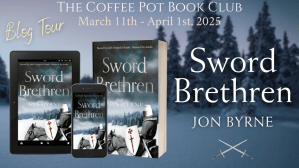
I am pleased to welcome Jon Byrne to my blog today to share information about his research for the locations in his novel Sword Brethren.  I would like to thank The Coffee Pot Book Club and Jon Byrne for allowing me to participate in this blog tour.

Detailed research is important for all writers – but for those writing historical fiction, it is vital. While much can be gained by researching information on the internet or reading books on the subject, one of the best things for me is the chance to visit the locations depicted in the book. Sometimes it is only by going to a place that you can really get a feel for how it might have been. Having said that, all of the places depicted in Sword Brethren have changed so much over the last 800 years that it is still difficult to imagine how a location would have looked so long ago, especially as there is so little remaining from this period. 

The story begins in Cranham, a fictional village in East Anglia in England, located somewhere between Bury St Edmunds and Thetford. I traveled the area a few years ago, visiting the local castles like Framlingham and Orford, as well as the village of Lavenham – one of the best-preserved medieval villages in England. This helped to get an idea of what the area might have been like in the High Middle Ages, but even here most of the buildings date from the late medieval and Tudor periods.  

One of the places that I found particularly helpful was Eye Castle – originally a motte and bailey fortress built during the reign of King William I. This is even earlier than the timeframe of the book, which made it far more relevant, but the castle is ruined, and a house was built on the motte in 1844, which has since decayed and collapsed. Nevertheless, the fictional village and castle of Cranham would not have been dissimilar. 

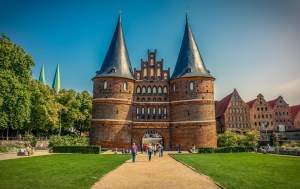
Lübeck, in northern Germany, is now a UNESCO World Heritage Site and the location for approximately a third of the book. I spent a very satisfying weekend walking the cobbled streets and visiting the historical sites it has to offer – made considerably easier for me because at the time I lived in Berlin, which is only 280 km (approx. 170 miles) away.  


Caption: The Holsten Gate in Lübeck (built between 1464 to 1478). On the right can be seen some of the buildings of the Salzspeicher – a row of historic salt warehouses. On the left, the spires of St Mary’s Church (Marienkirche) pokes above the trees. 

Founded in the mid-12th century, Lübeck became known as the Queen of the Hanseatic League (originally a powerful trading network of merchant communities in Northern Germany) and was the main point of departure for the Northern Crusades. Unfortunately, most of the late medieval buildings that the city is famous for – the Holsten Gate (Ger. Holstentor), St Mary’s Church (Ger. Marienkirche), St Peter’s Church (Ger. Petrikirche), the Salzspeicher (salt warehouses) and the famous brick-built gable houses – were not constructed at the time of this book. Only the cathedral that still stands (Ger. Dom zu Lübeck) existed in the early 13th century, and it was under construction, although it has been modified many times since and was almost completely destroyed in the Second World War. Much of the half-island that today makes up the old town was undeveloped and prone to flooding in the period of the book. The Holstenbrücke (Holsten Bridge) was first mentioned in 1216 but it is conceivable that a bridge existed beforehand. This would have been constructed from wood. 

One of the highlights of researching Sword Brethren was a week-long trip I spent in Latvia with my family. We were based in Riga, which is a fascinating city that I would recommend anyone visit. Again, most of the architecture is later than the events in my book. In the early 13th century, Riga was made almost entirely of wood (including the churches), and despite being the largest city in the eastern Baltic at this time, it was little more than a village when compared to cities in Western and Central Europe. 

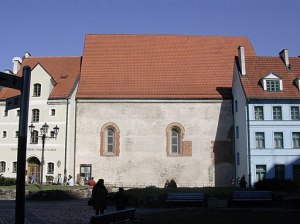
One of the first buildings made of stone in Riga was the original St George’s Castle, the first headquarters of the Livonian Brothers of the Sword, an order of warrior-monks, similar to the Knights Templar, who were formed to protect the fledgling German colony. It is the oldest surviving stone building in Riga. The only part still surviving is the chapel, now used by the Latvian Museum of Decorative Arts and Design. 

(Wikimedia Commons):  

Caption: St George’s Chapel – the oldest stone building in Riga and the original headquarters of the Livonian Brothers of the Sword.  

Outside of Riga, the only buildings that still remain from the period of the book are the stone castles built by the Brothers of the Sword and the Livonian Order of the Teutonic Knights that followed them. Most of these are either ruins or in various states of repair. Many of these castles were built on the banks of the River Daugava (Ger. Düna) by the German settlers and crusaders, using the river to improve their defenses. Sadly, today many are submerged beneath the waters of the Daugava that engulfed them when the Riga Hydroelectric Power Plant was built. 

Nevertheless, two castles that remain in good condition lie northeast of Riga, only 23 miles or so from each other. The first is at Sigulda (Ger. Segewold), which was first constructed in 1207 and later rebuilt into a convent-type fortress. From its elevated position on a steep slope above the Gauja River, you can see another castle at Turaida across the water, built on the remains of an old pagan hillfort. It is a beautiful location, with the thick forest around it, and it gives a good flavor of how it might have felt to live here in the early 13th century. 


 Turaida castle (Ger. Treiden) (taken by author):  

Caption: The view from Sigulda castle. 

The second castle, one of the best preserved in all of Latvia, is at Cēsis (Ger. Wenden). This is a huge castle, much of it still complete, with several relatively intact towers and walls. This is the castle that later became the main seat of the Brothers of the Sword and the Teutonic Order afterward. It is an impressive fortress that features more in the next book of the series, Soldier of Christ

 (taken by author):  

Caption: Cēsis castle – probably the best-preserved castle in Latvia from the early 13th century 

However, it is only possible to learn a certain amount from visiting sites in the book personally. The bulk of research – for me at least, is reading some of the excellent books and research papers concerning the Northern Crusades. 

The principal first-hand source is The Chronicle of Henry of Livonia, which was written by a priest, Henricus des Lettis, probably around 1229. The chronicle deals with events in the eastern Baltic between 1180 to 1226. Hardly surprisingly, it is written from the German point of view and describes the role of the Latin Church in colonizing and spreading Christianity to the local pagan tribes.  

His chronicle is a highly detailed account, rich in human history, and he provides eye-witness testimony of the events at this time, depicting not only the military campaigns but interesting facts about the local people themselves. This is particularly valuable as there is practically no other first-hand evidence of the events of the early Christian settlement in what is now Latvia and Estonia. 

Blurb:

1242- After being wounded in the Battle on the Ice, Richard Fitz Simon becomes a prisoner of Prince Alexander Nevsky of Novgorod. Alexander, intrigued by his captive’s story, instructs his scholar to assist Richard in writing about his life. 

Richard’s chronicle begins in 1203 when his training to be a knight is disrupted by treachery. He is forced to flee England for Lübeck, where he begins work for a greedy salt merchant. After an illicit love affair, his new life is thrown into turmoil, and he joins the Livonian Brothers of the Sword as they embark on imposing the will of God on the pagans of the eastern Baltic. Here, he must reconcile with his new life of prayer, danger, and duty – despite his own religious doubts, with as many enemies within the fortified commandery as the wilderness outside. However, when their small outpost in Riga is threatened by a large pagan army, Richard is compelled to make a crucial decision and fight like never before. 

Buy Links:  

Universal Ebook Buy Link: https://books2read.com/u/boVKlV  

Barnes and Noble: https://www.barnesandnoble.com/w/sword-brethren-jon-byrne/1146519606?ean=2940184429601 

Waterstones: https://www.waterstones.com/book/sword-brethren/jon-byrne/9781835740798 

Author Bio

Jon Byrne, originally from London, now lives with his German family by a lake in Bavaria with stunning views of the Alps. As well as writing, he works as a translator for a local IT company and occasionally as a lumberjack.  

He has always been fascinated by history and has studied the Medieval world for over twenty years, building up a comprehensive library of books. In his research, he has traveled to all of the locations mentioned in the book (East Anglia, Bremen, Lübeck, Latvia, etc).  

Sword Brethren (formerly Brothers of the Sword) made it to the shortlist of the Yeovil Literary Prize 2022 and the longlist of the prestigious Grindstone International Novel Prize 2022. It is the first book in The Northern Crusader Chronicles

Author Links

Website: https://www.jonbyrnewriter.com/ 

Facebook: https://www.facebook.com/JonByrneAuthor 

Amazon Author Page: https://www.amazon.co.uk/stores/Jon-Byrne/author/B0DJC6PL8D 

Goodreads: https://www.goodreads.com/author/show/52458339.Jon_Byrne  


Guest Post: “Spotlight for ‘The Rune Stone’ by Julia Ibbotson”

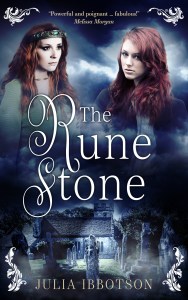
I am pleased to welcome Julia Ibbotson to my blog to share the blurb for her novel, “The Rune Stone.” I want to thank Julia Ibbotson and The Coffee Pot Book Club for allowing me to participate in this blog tour.

Blurb: 

A haunting time-slip mystery of runes and romance 

When Dr Viv DuLac, medievalist and academic, finds a mysterious runic inscription on a Rune Stone in the graveyard of her husband’s village church, she unwittingly sets off a chain of circumstances that disturb their quiet lives in ways she never expected. 

She, once again, feels the echoes of the past resonate through time and into the present. Can she unlock the secrets of the runes in the life of the 6th century Lady Vivianne and in Viv’s own life? 

Again, lives of the past and present intertwine alarmingly as Viv desperately tries to save them both without changing the course of history. 

For fans of Barbara Erskine, Pamela Hartshorne, Susanna Kearsley, and Christina Courtenay. 

Praise for Julia Ibbotson:

(for A Shape on the Air) “In the best Barbara Erskine tradition …I would highly recommend this novel” –Historical Novel Society 

(for the series) “Julia does an incredible job of setting up the idea of time-shift so that it’s believable and makes sense” – book tour reviewer 

(for The Rune Stone) “beautifully written”, “absorbing and captivating”, “fully immersive”, “wonderfully written characters”, “a skilled storyteller” – Amazon reviewers

“Dr Ibbotson has created living, breathing characters that will remain in the reader’s mind long after the book is read … The characters are brought to life beautifully with perfect economy of description … fabulous!” – Melissa Morgan. 
 

“A rich and evocative time-slip novel that beautifully and satisfyingly concludes this superb trilogy. The story is woven seamlessly and skillfully between the past and the present, and the reader is drawn deeply into both worlds.  Her portrayal of the 6th century and its way of life are authoritative, vivid and memorable.” – Kate Sullivan. 

Buy Link: 

Universal Buy Link:  https://myBook.to/TRS 

This title is available to read on #KindleUnlimited. 

Author Bio

Julia Ibbotson is fascinated by the medieval world and the concept of time. She is the author of historical mysteries with a frisson of romance. Her books are evocative of time and place, well-researched, and uplifting page-turners. Her current series focuses on early medieval time-slip/dual-time mysteries.  

Julia read English at Keele University, England, specializing in medieval language/ literature/ history, and has a PhD in sociolinguistics.  

After a turbulent time in Ghana, West Africa, she became a school teacher, then a university academic and researcher. Her break as an author came soon after she joined the RNA’s New Writers’ Scheme in 2015, with a three-book deal from Lume Books for a trilogy (Drumbeats) set in Ghana in the 1960s.  

She has published five other books, including A Shape on the Air, an Anglo-Saxon timeslip mystery, and its two sequels, The Dragon Tree and The Rune Stone. Her work in progress is a new series of Anglo-Saxon mystery romances, beginning with Daughter of Mercia, where echoes of the past resonate across the centuries.  

Julia’s novels will appeal to fans of Barbara Erskine, Pamela Hartshorne, Susanna Kearsley, and Christina Courtenay. Her readers say: ‘Julia’s books captured my imagination’, ‘beautiful story-telling’, ‘evocative and well-paced storylines’, ‘brilliant and fascinating,’ and ‘I just couldn’t put it down’. 

Author Links

Amazon Author page: Author.to/JuliaIbbotsonauthor 

Author website & blog: www.juliaibbotsonauthor.com 

Facebook (author):  https://www.facebook.com/JuliaIbbotsonauthor 

Twitter:  https://twitter.com/JuliaIbbotson 

Instagram: https://www.instagram.com/julia.ibbotson 

Pinterest:  http://pinterest.com/juliai1/ 

Goodreads author page:  https://www.goodreads.com/juliaibbotson 

Bluesky: https://bsky.app/profile/juliaibbotson.bsky.social

Guest Post: “Book Blast for ‘The Welsh Warrior’s Inheritance’ by Arianwen Nunn”

Today, I am pleased to welcome Arianwen Nunn to my blog to share the blurb for her book “The Welsh Warrior’s Inheritance.” I want to thank The Coffee Pot Book Club and Arianwen Nunn for allowing me to participate in this book tour. 

Blurb: 

It is 1109, and the Welsh warrior and firebrand Owain ap Cadwgan abducts Princess Nest from the castle she shares with her children and her husband, Gerald of Windsor. King Henry of England, furious that Nest, also his lover and mother of his son, begins a manhunt to find Owain and return Nest to her husband. In Gwynydd, King Gruffydd ap Cynan and his wife risk everything to hide them and get them to safety in Ireland despite the efforts of Gronwy ap Owain, Angharad’s vicious brother, who would like to see Gruffydd and Owain dead. 

King Henry uses Bishop Richard to start kinship warfare in Wales, then declares war against the Welsh, determining to exterminate them all. Can Gruffydd and his family survive the greatest army ever led against Wales? 

Buy Link: 

Universal Buy Link: https://books2read.com/u/bWkZq7  

Author Bio: 

Arianwen Nunn was born in Wales but now lives in Australia and writes historical fiction based on the Welsh kingdoms in the Middle Ages.  

Arianwen has written a series of three books, ‘The Welsh Traitor’s Daughter’, ‘The Welsh Warrior’s Inheritance’, and ‘Bards Sing of Love and War’, which follow the lives of King Gruffydd ap Cynan, his wife Angharad, and their family.  

She has also written two children’s books, ‘The Welsh Warrior’s Wonder’ and ‘Where Dragons Still Roar’. 


Author Links: 

Website: www.arianwennunn.com 

Twitter: https://x.com/Arianwen_Nunn  

Facebook: https://www.facebook.com/profile.php?id=100091729185630  

Instagram: https://www.instagram.com/arianwen_nunn  

Amazon Author Page: https://www.amazon.com/stores/Arianwen-Nunn/author/B0C69H8RFN  

Goodreads: https://www.goodreads.com/author/show/35601482.Arianwen_Nunn  

Guest Post: “New Release Book Blast for ‘Ghost Encounters: The Lingering Spirits of North Devon’ by Helen Hollick with Kathy Hollick”

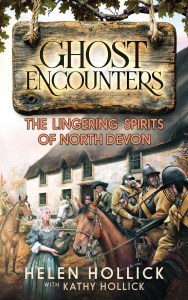
I am pleased to welcome Helen and Kathy Hollick to my blog today to share a blurb for their book Ghost Encounters: The Lingering Spirits of North Devon. I want to thank The Coffee Pot Book Club and Helen and Kathy Hollick for allowing me to participate in this blog tour.

Blurb: 

Everyone assumes that ghosts are hostile. Actually, most of them are not.

You either believe in ghosts or you don’t. It depends on whether you’ve encountered something supernatural or not. But when you share a home with several companionable spirits or discover benign ghosts in public places who appear as real as any living person, skepticism is abandoned and the myth that ghosts are to be feared is realized as nonsense.

It is a matter for individual consideration whether you believe in ghosts or not, but for those who have the gift to see, hear, or be aware of people from the past, meeting with them in today’s environment can generate a connection to years gone by. Kathy and Helen Hollick have come across several such departed souls in and around North Devon and at their 18th-century home, which they share with several ‘past residents’.

In GHOST ENCOUNTERS: The Lingering Spirits Of North Devon, mother, and daughter share their personal experiences, dispelling the belief that spirits are to be feared.

Ghost Encounters will fascinate all who enjoy this beautiful region of rural South-West England, as well as interest those who wish to discover more about its history… and a few of its ghosts.

(Includes a bonus of two short stories and photographs connected to North Devon)

cover design: Avalon Graphics
cover artwork: Chris Collingwood 

Buy Link:  

Universal Buy Link: https://mybook.to/GhostEncounters 

This title will be available to read on #KindleUnlimited.

Author Bios: 

ABOUT HELEN HOLLICK 

Known for her captivating storytelling and rich attention to historical detail, Helen might not see ghosts herself, but her nautical adventure series, and some of her short stories, skillfully blend the past with the supernatural, inviting readers to step into worlds where the boundaries between the living and the dead blur.  

In addition to her historical fiction, Helen has written several short stories, further exploring themes of historical adventure or the supernatural with her signature style. Whether dealing with the echoes of the past or the weight of lost souls, her stories are as compelling as they are convincing. Through her work, she invites readers into a world where the past never truly lets us go. 

Helen started writing as a teenager, but after discovering a passion for history, was published in the UK with her Arthurian Pendragon’s Banner Trilogy and two Anglo-Saxon novels about the events that led to the 1066 Battle of Hastings, one of which, The Forever Queen (USA title – A Hollow Crown in the UK) became a USA Today best-seller. Her Sea Witch Voyages are nautical-based adventures inspired by the Golden Age of Piracy. She also writes the Jan Christopher cozy mystery series set during the 1970s, and based around her, sometimes hilarious, years of working as a North London library assistant. 

Helen, her husband Ron, and daughter Kathy moved from London to Devon in January 2013 after a Lottery win on the opening night of the London Olympics, 2012. She spends her time glowering at the overgrown garden and orchard, fending off the geese, helping with the horses, and, when she gets a moment, writing the next book… 

ABOUT KATHY HOLLICK 

Diagnosed as severely dyslexic when she was ten, Helen pulled Kathy out of school at fifteen to concentrate on everything equine. 

When not encountering friendly ghosts, Kathy’s passion is horses and mental well-being. She started riding at the age of three, had her Welsh pony at thirteen, and discovered showjumping soon after. Kathy now runs her own Taw River Equine Events, and coaches riders of any age or experience, specializing in a positive mindset and overcoming confidence issues via her Centre10 accreditation and Emotional Freedom Technique training. EFT, or ‘tapping’, uses the body’s pressure points to aid calm relaxation and to promote gentle healing around emotional, mental, or physical issues. 

Kathy lives with her farmer partner, Andrew, in their flat adjoining the main farmhouse. She regularly competes at affiliated British Showjumping, and rides side-saddle (‘aside’) when she has the opportunity. She produces her horses, several from home-bred foals. 

She also has a fun diploma in Dragons and Dragon Energy, which was something amusing to study during the COVID lockdown. 

Authors’ Links: 

Helen: 

Website: https://helenhollick.net/ 

Twitter: https://twitter.com/HelenHollick 

Facebook: https://www.facebook.com/helen.hollick 

Bluesky: https://bsky.app/profile/helenhollick.bsky.social  

Amazon Author Page: https://viewauthor.at/HelenHollick 

Goodreads: https://www.goodreads.com/helenhollick 

Blog: supporting authors & their books https://ofhistoryandkings.blogspot.com/ 

Monthly ‘newsletter’: Thoughts from a Devonshire Farmhouse.  

https://thoughtsfromadevonshirefarmhouse.blogspot.com/ 

Kathy:  

Website: https://www.white-owl.co.uk/ 

Facebook: North Devon – Taw River Equine Events https://www.facebook.com/groups/1491518561152309 

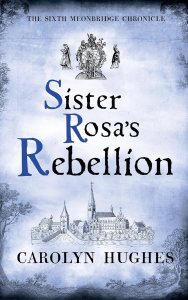
Guest Post: “Audiobook Extract from ‘A Woman’s Lot’ by Carolyn Hughes

I am pleased to welcome Carolyn Hughes back to my blog to share an audiobook extract from her novel, “A Woman’s Lot.” I want to thank The Coffee Pot Book Club and Carolyn Hughes for allowing me to be part of this blog tour.

Audiobook Extract

The following link is the extract for the audiobook for “A Woman’s Lot” by Carolyn Hughes, narrated by Alex Lee. 

https://soundcloud.com/cathie-dunn/a-womans-lot-agnes-by-carolyn-hughes

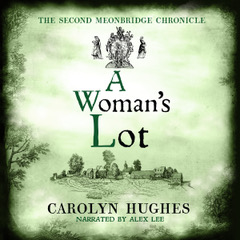
Blurb: 

How can mere women resist the misogyny of men?

1352. In Meonbridge, a resentful peasant rages against Eleanor Titherige’s efforts to build up her flock of sheep. Susanna Miller’s husband, grown melancholy and ill-tempered, succumbs to idle gossip that his wife’s a scold. Agnes Sawyer’s yearning to be a craftsman is met with scorn. And the village priest, fearful of what he considers women’s “unnatural” ambitions, is determined to keep them firmly in their place. 

Many men hold fast to the teachings of the Church and fear the havoc the “daughters of Eve” might wreak if they’re allowed to usurp men’s roles and gain control over their own lives. 

Not all men in Meonbridge resist the women’s desire for change – indeed, they want it for themselves. Yet it takes only one or two misogynists to unleash the hounds of hostility and hatred… 

If you enjoy immersive historical fiction with a strong authentic feel, set in a time of change and challenge, especially for women, you’ll love A Woman’s Lot, the second MEONBRIDGE CHRONICLE. Find out for yourself if Meonbridge’s “unnatural” women stand up to their abusers! 

Praise: 

This book exceeded all my expectations. I did not read this story. I lived it!”  

~ The Coffee Pot Book Club 


“A treat for all the senses…totally true to its time and setting…”  

~ Being Anne  


I didn’t so much feel as if I were reading about medieval England as experiencing it first hand.” 

~ Linda’s Book Bag 


An absorbing account of the times.” 

~ Historical Novel Society 

Buy Link: 

Universal Buy Link: https://books2read.com/u/4jzKJY  

This title is available to read on #KindleUnlimited. 

Audiobook Links: 

Audible: https://buff.ly/4gw1xs3  

Audible UK: https://www.audible.co.uk/pd/A-Womans-Lot-Audiobook/B0DW4HR5HW  

Audible US: https://www.audible.com/pd/A-Womans-Lot-Audiobook/B0DW4FZLCZ  

Author Bio

Carolyn Hughes has lived much of her life in Hampshire. With a first degree in Classics and English, she started working as a computer programmer, which was a very new profession. But it was technical authoring that later proved her vocation, word-smithing for many different clients, including banks, an international hotel group, and medical instruments manufacturers. 

Although she wrote creatively on and off for most of her adult life, it was not until her children flew the nest that writing historical fiction took center stage. But why historical fiction? Serendipity! 

Seeking inspiration for what to write for her Creative Writing Masters, she discovered the handwritten draft, beginning in her twenties, of a novel, set in 14th-century rural England… 


Intrigued by the period and setting, she realized that, by writing a novel set in the period, she could learn more about the medieval past and interpret it, which seemed like a thrilling thing to do. A few days later, the first Meonbridge Chronicle, Fortune’s Wheel, was underway. 


Six published books later (with more to come), Carolyn does now think of herself as an Historical Novelist. And she wouldn’t have it any other way… 


Author Links


Website: https://carolynhughesauthor.com  

Twitter: https://x.com/writingcalliope  

Facebook: https://facebook.com/CarolynHughesAuthor  

Bluesky: https://carolynhughes.bsky.social  

Book Bub: https://www.bookbub.com/authors/carolyn-hughes 

Amazon Author Page: https://www.amazon.co.uk/stores/Carolyn-Hughes/author/B01MG5TWH1  

Goodreads: https://www.goodreads.com/author/show/16048212.Carolyn_Hughes  


Guest Post: “The Percies and the Battle of Shrewsbury” by Mercedes Rochelle

I am pleased to welcome Mercedes Rochelle back to my blog to share an article about the Percy family and the Battle of Shrewsbury as part of the blog tour for her novels The Usurper King and The Accursed King. I want to thank Mercedes Rochelle and The Coffee Pot Book Club for allowing me to be part of this blog tour.
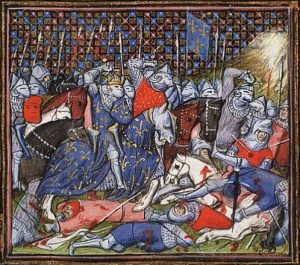
The Percies were such a powerful force in the North they practically acted like rulers in their own kingdom. For much of Richard II’s reign and the beginning of Henry IV’s, Earl Henry Percy and his son, Sir Henry (nicknamed Hotspur) alternated between the wardenships of the East Marches and the West Marches toward Scotland. They were experienced in dealing with the tempestuous Scots, and their retainers were fiercely loyal. When Henry IV returned from exile and began his campaign that led to the throne, the Percies were his staunchest supporters; they provided a large portion of his army. Henry Percy was directly responsible for persuading King Richard to turn himself over to Henry Bolingbroke—the beginning of the end of Richard’s fall. 

Caption: Froissart Chronicles by Virgil Master, Source: Wikimedia 

Naturally, this was not done out of sheer kindness. Henry Percy expected to be amply rewarded for his services, and at the beginning he was. But the king was uncomfortable about the potential threat of this overweening earl. He soon began to promote his brother-in-law, Ralph Neville the Earl of Westmorland as a counterbalance, chipping away at Percy’s holdings and jurisdictions. Additionally, the Percies felt that they were not being reimbursed properly for their expenses; by 1403 they claimed that the king owed them £20,000—over £12,000,000 in today’s money. But even with all this going on, it’s likely that the earl may have contained his discontent, except for the belligerence of his impetuous son.  

One possible catalyst was Hotspur’s refusal to turn over his hostages taken at the Battle of Homildon Hill. This battle was a huge win for the Percies in 1402, where so many leaders were taken—including the Earl of Douglas—that it left a political vacuum in Scotland for many years to come. Once he learned of this windfall, King Henry insisted that the Percies turn over their hostages to the crown. It was his right as king—even if it was against the code of chivalry— though his highhanded demand was probably not the wisest choice, considering the circumstances. There were many possible reasons he did so. He was desperately short of funds—as usual. It’s possible he may have wanted to retain the prisoners as a means of ensuring Scottish submission. Earl Henry agreed to turn over his hostages, but Hotspur absolutely refused to surrender Archibald Douglas, letting his father take the king’s abuse. One can only imagine that all was not well in the Percy household, either. 

There was more at stake. The king had just returned from a humiliating fiasco in Wales, where he had campaigned in response to the English defeat at Pilleth, where Edmund Mortimer was captured by the Welsh. Mortimer was the uncle of the eleven-year-old Earl of March, considered by many the heir-presumptive to the throne (and in Henry’s custody). Edmund was also the brother of Hotspur’s wife. By the time Henry demanded the Scottish hostages, it was commonly believed that the king had no intention of ransoming Mortimer; after all, he was safely out of the way and couldn’t champion his nephew’s cause. This rankled with Hotspur, and it is possible that he thought to use Douglas’s ransom money to pay for Mortimer’s release himself. 

Hotspur finally rode to London in response to the king’s demands, but he went without Douglas. Needless to say, this immediately provoked an argument. When Hotspur insisted that he should be able to ransom his brother-in-law, Henry refused, saying he did not want money going out of the country to help his enemies. Hotspur rebutted with, “Shall a man expose himself to danger for your sake and you refuse to help him in his captivity?” Henry replied that Mortimer was a traitor and willingly yielded himself to the Welsh. “And you are a traitor!” the king retorted, apparently in reference to an earlier occasion when Hotspur chose to negotiate with Owain Glyndwr rather than arrest him. Allegedly the king struck Percy on the cheek and drew his dagger. Of course, attacking the king was treason and Hotspur withdrew, shouting “Not here, but in the field!” All of this may be apocryphal, but it is certainly powerful stuff. 

The whole question of Mortimer’s ransom became moot when he decided to marry the daughter of Glyndwr and openly declare his change of loyalties on 13 December 1402. No one knows whether Hotspur’s tempestuous interview with King Henry happened before or after this event; regardless, a bare minimum of eight months passed before Shrewsbury. Were they planning a revolt all this time? It is likely that early in 1403 one or both of the Percies were in communication with the Welsh. Owain Glyndwr was approaching the apex of his power, and a possible alliance between him, Mortimer, and the Percies could well have been brewing. It would come to fruition later on as the infamous Tripartite Indenture (splitting England’s rule between them), but by then Hotspur was long dead. 

Caption: BnF MS Franc 81 fol. 283R Henry IV and Thomas Percy at Shrewsbury from Jean de Wavrin- Creative commons license 

No one has been able to satisfactorily explain just why the Percies revolted against Henry IV. Most of the evidence points to their self-aggrandizement. And looking at the three years following his coronation, it became evident that King Henry was not willing to serve as their puppet, nor was he willing to enhance their power at the expense of the crown. The Percies’ ambitions were thwarted by the king’s perceived ingratitude, and the consensus of modern historians is that they hoped to replace him with someone more easily manipulated. 

There was one more Percy involved in all this: Thomas, younger brother of Earl Henry and uncle to Hotspur. He was probably the most able—if the least flamboyant—member of the Percy clan in this period. From soldier to commander, Admiral of England to Ambassador, Captain of Calais, Justiciary of South Wales, he made it all the way to Steward of the Royal Household. And that wasn’t all. He was also Earl of Worcester, which almost made him an equal to his brother, the great Earl of Northumberland.  

His involvement in the Shrewsbury uprising was puzzling. He had much to lose and nothing to gain. Shakespeare notwithstanding, I don’t really think Thomas was the motivating force behind the rebellion that led to the Battle of Shrewsbury. It’s true that his fortunes were waning; the king had recently replaced him as Lieutenant of Wales with the sixteen-year-old Prince Henry. Whether the Percies won or lost the battle, there’s a better-than-even chance that he would rise and fall along with them, whether he participated in the rebellion or not. Was that enough to push him over the edge? I suspect that his affection for Hotspur had a lot to do with it, and in the end, it’s likely he couldn’t conceive of fighting against his own kin. Poor Thomas lost his head the day after the battle, paying a high price for his loyalty. 

THE USURPER KING by Mercedes Rochelle 

Book 4 of The Plantagenet Legacy 

Blurb: 

From Outlaw to Usurper, Henry Bolingbroke fought one rebellion after another. First, he led his own uprising. Then he captured a forsaken king. Henry had no intention of taking the crown for himself; it was given to him by popular acclaim. Alas, it didn’t take long to realize that having the kingship was much less rewarding than striving for it. Only three months after his coronation, Henry IV had to face a rebellion led by Richard’s disgruntled favorites. Repressive measures led to more discontent. His own supporters turned against him, demanding more than he could give. The haughty Percies precipitated the Battle of Shrewsbury which nearly cost him the throne—and his life. 

To make matters worse, even after Richard II’s funeral, the deposed monarch was rumored to be in Scotland, planning his return. The king just wouldn’t stay down and malcontents wanted him back. 

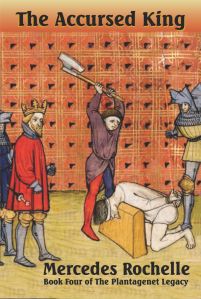
THE ACCURSED KING by Mercedes Rochelle 
Blurb: 

What happens when a king loses his prowess? 

The day Henry IV could finally declare he had vanquished his enemies, he threw it all away with an infamous deed. No English king had executed an archbishop before. And divine judgment was quick to follow. Many thought he was struck with leprosy—God’s greatest punishment for sinners. From that point on, Henry’s health was cursed and he fought doggedly on as his body continued to betray him—reducing this once great warrior to an invalid. 

Fortunately for England, his heir was ready and eager to take over. But Henry wasn’t willing to relinquish what he had worked so hard to preserve. No one was going to take away his royal prerogative—not even Prince Hal. But Henry didn’t count on Hal’s dauntless nature, which threatened to tear the royal family apart.

Buy Links: 

Universal Buy Links: 

The Usurper King: https://books2read.com/u/3nkRJ9  

The Accursed King: https://books2read.com/u/b5KpnG  

The Plantagenet Legacy Series Links: 

Amazon US Series Link 

Amazon UK Series Link 

All titles in the series are available to read on #KindleUnlimited. 

Author Bio

Mercedes Rochelle is an ardent lover of medieval history and has channeled this interest into fiction writing. She believes that good Historical Fiction, or Faction as it’s coming to be known, is an excellent way to introduce the subject to curious readers. 

Her first four books cover eleventh-century Britain and events surrounding the Norman Conquest of England. Her new project is called “The Plantagenet Legacy” taking us through the reigns of the last true Plantagenet King, Richard II, and his successors, Henry IV, Henry V, and Henry VI. She also writes a blog: HistoricalBritainBlog.com to explore the history behind the story.  

Born in St. Louis, MO, she received by BA in Literature at the University of Missouri St.Louis in 1979 then moved to New York in 1982 while in her mid-20s to “see the world”. The search hasn’t ended! 

Today she lives in Sergeantsville, NJ with her husband in a log home they had built themselves. 

Author Links

Website: https://mercedesrochelle.com/   

Twitter: https://x.com/authorrochelle  

Facebook: https://www.facebook.com/mercedesrochelle.net  

Book Bub:  https://www.bookbub.com/authors/mercedes-rochelle  

Amazon Author Page:  https://www.amazon.com/stores/Mercedes-Rochelle/author/B001KMG5P6  

Goodreads: https://www.goodreads.com/author/show/1696491.Mercedes_Rochelle

Guest Post: “Book Blast for ‘Harold the King/ I am the Chosen King’ by Helen Hollick

January Harold25YearsI am pleased to welcome Helen Hollick to share the blurb for her book, “Harold the King/ I am the Chosen King,” celebrating its 25th Publication Anniversary. I want to thank The Coffee Pot Book Club and Helen Hollick for allowing me to be part of this special blog tour.

Cover Harold The King UKBlurb: 

First published in 2000 – Celebrating a Silver Anniversary! 

The events that led to the Battle of Hastings and the Norman Conquest of England in 1066 – told from the English point of view. 

Two men. One crown. 

England, 1044. Harold Godwinesson, a young, respected earl, falls in love with an ordinary but beautiful woman. In Normandy, William, the bastard son of a duke, falls in love with power. 

In 1066 England falls vulnerable to the fate of these two men: one, chosen to be a king, the other, determined to take, by force, what he desires. Risking his life to defend his kingdom from foreign invasion, Harold II led his army into the great Battle of Hastings in October 1066 with all the honor and dignity that history remembers of its fallen heroes. 

In this beautifully crafted tale, USA Today bestselling author Helen Hollick sets aside the propaganda of the Norman Conquest and brings to life the English version of the story of the man who was the last Anglo-Saxon king, revealing his tender love, determination, and proud loyalty, all to be shattered by the desire for a crown – by one who had no right to wear it. 

Cover I Am The Chosen King USPraise for Helen Hollick:

“Helen Hollick has it all! She tells a great story, gets her history right, and writes consistently readable books” 

~ Bernard Cornwell 

“A novel of enormous emotional power” 

~ Elizabeth Chadwick 

“Thanks to Hollick’s masterful storytelling, Harold’s nobility and heroism enthrall to the point of engendering hope for a different ending…Joggles a cast of characters and a bloody, tangled plot with great skill” 

~ Publisher’s Weekly 

“Don’t miss Helen Hollick’s colorful recreation of the events leading up to the Norman Conquest.” 

~ Daily Mail 

“An epic re-telling of the Norman Conquest” 

~ The Lady 

“If only all historical fiction could be this good” 

~ Historical Novel Society Review 

Buy Links: 

Universal eBook Link, Harold The King: https://books2read.com/u/4jOdYj  

Harold the King (UK): https://viewbook.at/HaroldTheKing 

I Am the Chosen King (US): https://viewBook.at/ChosenKing 

This title is available on #KindleUnlimited, excerpt in US & Canada.

Helen Hollick (edited)Author Bio: 

First accepted for traditional publication in 1993, Helen became a USA Today Bestseller with her historical novel, The Forever Queen (titled A Hollow Crown in the UK) with the sequel, Harold the King (US: I Am The Chosen King) being novels that explore the events that led to the Battle of Hastings in 1066. Her Pendragon’s Banner Trilogy is a fifth-century version of the Arthurian legend, and she writes a nautical adventure/supernatural series, The Sea Witch Voyages. She has also branched out into the quick read novella, ‘Cosy Mystery’ genre with her Jan Christopher Mysteries, set in the 1970s, with the first in the series, A Mirror Murder incorporating her, often hilarious, memories of working as a library assistant. The fifth in the series, A Memory Of Murder, was published in May 2024. 

Her nonfiction books are Pirates: Truth and Tales and Life of a Smuggler. She is currently writing about the ghosts of North Devon and Jamaica Gold for her Sea Witch Voyages.  

Recognized by her stylish hats, Helen tries to attend book-related events as a chance to meet her readers and social-media followers, but her ‘wonky eyesight’ as she describes her condition of Glaucoma, and severe arthritis is now a little prohibitive for travel. 

She lives with her family in an eighteenth-century farmhouse in North Devon, with their dogs and cats. On the farm, there are showjumper horses, fat Exmoor ponies, an elderly Welsh pony, geese, ducks, and hens, as well as several resident ghosts.

Author Links: 

Website: https://helenhollick.net/ 

Amazon Author Page: https://viewauthor.at/HelenHollick 

Facebook: https://www.facebook.com/helen.hollick 

Blog, supporting authors & their books: https://ofhistoryandkings.blogspot.com/ 

Bluesky: https://bsky.app/profile/helenhollick.bsky.social  

Twitter / X: https://x.com/HelenHollick 

Monthly newsletter: Thoughts from a Devonshire Farmhouse: 

Start Here: January 2024 https://ofhistoryandkings.blogspot.com/2024/01/thoughts-from-devonshire-farmhouse.html (posted on her blog)

Guest Post: “Historical Background to ‘On a Sword’s Edge’ by JR Tomlin”

I am pleased to welcome JR Tomlin to my blog today to share a guest post for her latest novel, “On a Sword’s Edge.” I want to thank JR Tomlin and the Coffee Pot Book Club for allowing me to be part of this blog tour.

During the Viking Age, which ended sometime around 1050, the Norse conquered the Western and Northern Isles of Scotland as well as Caithness in the Northern Scottish mainland. That the Viking Age was over did not mean that the Norse turned around and sailed back to Norway.  

These islands and Caithness were part of Norse jarldoms which they had no intention of giving up. It hardly needs to be mentioned that as the Kingdom of Scotland grew stronger and more organized and gained control of most of what is now Scotland, this would lead to conflict. 

In 1222, Scotland’s King Alexander II subjugated Caithness with what appears to have been little opposition from the Norse. For a time, he was busy subjugating the hitherto semi-independent Argyll and dealing with a revolt in the always difficult region of Galloway. Then he would have turned back to pushing the Norse out of the Isles, but died suddenly, leading a force to the Hebrides. His seven-year-old son, also named Alexander, was the new King of Scots. 

Ecclesiastes 10:16 states with considerable truth: “Woe to you, land, when your king is a child, and your leaders start their parties in the morning!” There were fourteen years of regents squabbling and fighting for power. At several points, the young king and his queen, the daughter of the King of England, were held prisoner by one or another of the factions. However, regencies end eventually and when that one did, a determined young king meant to finish what his father had started. 

As soon as he reached his majority, King Alexander III sent negotiators to discuss the purchase by the Scots of the Western Isles. The King of Norway, King Haakon, was a formidable ruler who had subjugated both Greenland and Iceland. He had no interest in giving up any of the lands subjugated by the Norse. The negotiations quickly broke down. 

At about that time, and the date is vague but probably around 1260, the Stewarts of Dundonald took the Isle of Bute from the Norse. That Isle was essential in that it gave control over important shipping, so this was a serious blow. Faced with a growing threat to their control of those islands and the surrounding waters, King Haakon put together a fleet of more than a hundred warships and sailed first to Shetland and then to the Hebrides. 

King Alexander once more sent negotiators, but events prove he was also planning for invasion. Haakon sailed his fleet around Cape Wrath some four hundred miles south to the Firth of Clyde. He first subjugated Bute, retaking the Stewart’s Rothesay Castle, and sent ships up Loch Long and portaged them to Loch Lomond, ravaging the area. There was little opposition, possibly because King Alexander had already called up the levies. 

The main Norse fleet remained in the Firth of Clyde, just off the coast of Ayr. Whether he intended to attack Ayr itself is open to question, but merely taking Bute was not the end of his intentions. Whatever those intentions were, a particularly severe storm hit on the 1st of October in 1263, sinking several of Haakon’s ships and forcing some aground near the village of Largs. Which is the point at which the novel takes up. 

Blurb: 

Scotland. 1263. The scent of rain mingles with the smoke of campfires as word spreads: the Norse are coming… 

As tempers rise between King Alexander and the Norse King Haakon, at the center of it all is sixteen-year-old William Douglas, a squire in service to Sir John Stewart, Lord High Steward of Scotland. 

When Haakon’s fearsome fleet is espied approaching Scotland’s shores, carrying the greatest invasion force the Norse have ever mustered, the dread of battle settles over the land. Summoned to Ayr Castle, William joins the Scottish forces in a desperate defense. Now tasked with serving his newly knighted brother, Hugh, William has little time to dwell on the fear – or thrill – of his first real taste of war. 

And once the Norse’s menacing line of ships finally touches the shore, Scotland’s fate may rest on more than noble titles and knightly deeds— it’ll take the mettle of every soul on the ground for them to triumph. 

Set against the wind-swept coast of medieval Scotland, On a Sword’s Edge takes you right into the center of The Battle of Largs alongside a mere – yet fearless – squire. 

Buy Link: 

Universal Buy Link: https://books2read.com/u/3R7l8D  

Author Bio:

JR. Tomlin is the author of more than twenty historical novels, set for the most part in Scotland. Her love of that nation is traced from the stories of King Robert the Bruce and the Good Sir James her grandmother read to her when she was small to hillwalking through the Cairngorms where the granite hills have a gorgeous red glow under the setting sun. Later, her writing was influenced by the work of authors such as Alexander Dumas, Victor Hugo, and of course, Sir Walter Scott.

When JR isn’t writing, she enjoys spending time hiking, playing with her Westie, and killing monsters in computer games. In addition to having lived in Scotland, she has traveled in the US, Europe, and the Pacific Rim. She now lives in Oregon in the beautiful Pacific Northwest. 

Author Links

Website: https://www.jrtomlin.com  

Twitter: https://x.com/TomlinJeanne  

Bluesky: https://bsky.app/profile/jrtomlin.bsky.social  

Book Bub: https://www.bookbub.com/authors/j-r-tomlin  

Amazon Author Page: https://www.amazon.com/author/jrtomlin  

Goodreads: https://www.goodreads.com/author/show/4094154.J_R_Tomlin