
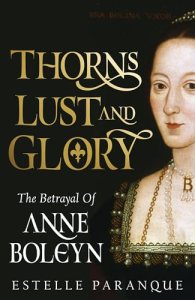
Book Review: “Thorns, Lust, and Glory: The Betrayal of Anne Boleyn” by Estelle Paranque

A young woman catches the attention of a king already married to a princess from a faraway kingdom. The king desires the young lady and divorces his wife to marry her. However, there is a catch. The young lady spent some time in the French court of Francis I and Claude of France, whereas the king’s wife was the daughter of the Spanish King and Queen as well as the aunt of the Holy Roman Emperor. The Great Matter of Henry VIII, Anne Boleyn, and Catherine of Aragon is considered one of the messiest divorces in English history and rightfully so when you consider the diplomatic consequences that this divorce would have across Europe. Estelle Paranque highlights the connection between Anne Boleyn and the French court in her latest book, “Thorns, Lust, and Glory: The Betrayal of Anne Boleyn.”

I want to thank Hachette Books and Net Galley for sending me a copy of this book. I heard that Estelle Paranque was writing a new book about the 16th century, but when I heard that it dealt with Anne Boleyn’s connections with the French court, I jumped at the chance to read it. While I do know quite a bit about the rise and fall of Anne Boleyn, it is her connection with the French court that I have never really explored in depth.

Paranque begins her book by examining the meeting between King Henry VIII and King Francis I with Anne Boleyn at Calais between October 25th and 27th, 1532. This was a significant meeting as it was right before Henry and Anne married in secret and they desired that Francis would support their side in the Great Matter. But how did they get to this meeting in Calais? This is where this book shines as Paranque takes the time to show her audience what life was like for Anne in the French court and the connections that she forged with women like Louise of Savoy, Claude of France, and Marguerite of Angouleme Queen of Navarre. It was fascinating to see how the Boleyns were able to use their connections to forge alliances with the French court that would prove useful in the future.

Possibly my favorite part of this book was seeing how the diplomatic channels across Europe interacted with one another during the Great Matter, the queenship of Anne Boleyn, and the fall of the Boleyns. I think we so often overlook that there were diplomats who were working on the sidelines to convey messages between kings and emperors to form or strengthen alliances. While many might consider the way Paranque wrote the correspondence and dialogue between diplomats and the monarchy as hard to get used to because she does insert emotions, I believe it adds depth to the story because they were human beings not in a vacuum. They had feelings about what was happening around them, passionate feelings in fact, and that should be displayed to readers.

While the actual events of this book were not new to me, the way that Paranque was able to present the information and show the men behind the scenes was fascinating. It presents the relationship between Henry VIII and Anne Boleyn in a different more complex light. If you want a different angle to the rise and fall of Anne Boleyn, I recommend you read, “Thorns, Lust, and Glory: The Betrayal of Anne Boleyn” by Estelle Paranque.

Book Review: “Stuart Spouses: A Compendium of Consorts from James I of Scotland to Queen Anne of Great Britain” by Heather R. Darsie

English royal history is filled with fantastic stories of triumphs and tribulations, grand romances, and divorces that shook the foundations of the monarchy. It is also filled with struggles over religion, wars both inside England and with foreign nations, and heartbreaking child losses. We often think about the spouses of the Plantagenets and the Tudors when we think about royal romances, but we shouldn’t forget about the dynasties that came after, like the Stuarts. So how did the Stuart dynasty come to be and how did the unions between monarchs and their significant others affect the dynasty and England? Heather R. Darsie explores this often-overlooked dynasty and the stories of their marriages and romances in her latest book, “Stuart Spouses: A Compendium of Consorts from James I of Scotland to Queen Anne of Great Britain.”

I want to thank Pen and Sword Books and Net Galley for sending me a copy of this book. I didn’t know much about the Stuarts before reading this book, except for those associated with the Plantagenets and the Tudors. I wanted to learn more about the Stuarts because I tend to stop after the death of Elizabeth I, so when I heard that Darsie was writing a book about the consorts of the Stuart dynasty, it was intriguing to me.

Darsie begins by explaining that she will be exploring the entirety of the Stuart dynasty, starting with its patriarch Walter Fitzalan, Stewart of Scotland for David I of Scotland in the 1100s. It is a fascinating story of how the family went from serving the monarchy to being the rulers of Scotland, all the way up to 1406 when James I became King of Scotland. The first royal consort that Darsie discusses might be familiar to anyone who knows about the origins of the Tudors, Joan Beaufort. We then track the Scottish story of the Stuarts through the death of Mary Queen of Scots through their significant others such as Mary of Guelders, Margaret of Denmark, Margaret Tudor, Madeleine of Valois, Marie de Guise, Francis II of France, Henry Stewart Lord Darnley, and James Hepburn 4th Earl of Bothwell.

It was under James VI of Scotland that things changed drastically for both England and Scotland as James became King James I of England with the death of Elizabeth I, and so James’ wife Anna of Denmark became the first Stuart Queen of England. This is the segment that I thoroughly enjoyed because they were new stories for me. We have Henriette Marie of France, a Catholic queen who married Charles I who was a Protestant, which did not have a happy ending as we get to see the English Civil War play out and the execution of Charles I on January 30, 1649. Darsie also includes the stories of the women who married Oliver Cromwell and his son Richard Cromwell, both Lord Protectors of England when the monarchy was not popular. Eventually, the Stuarts returned to their place on the English throne with Charles II and his queen Catherine of Braganza; followed by the women who married James Stewart Duke of York, Anne Hyde and Mary of Modena. James would become James II before the Glorious Revolution led by William of Orange, which led to the co-rulers William III and Mary II. Finally, we reach the tragic tale of Queen Anne of Great Britain and her Prince Consort George of Denmark.

I was so impressed with the amount of stories over centuries that Darsie was able to cover in this book. It was a fantastic introduction to Scottish Stuart history, how the dynasty survived, and created international relationships that allowed England to thrive. There were tales of tragedies, but there were also alliances that created stronger bonds, religious rifts, and romances. This was another triumph for Darsie and it is a book that made me interested in reading more about the Stuarts. If you are like me and you want a book that is a fantastic introduction to the Stuart monarchs and their consorts, I highly recommend you read, “Stuart Spouses: A Compendium of Consorts from James I of Scotland to Queen Anne of Great Britain” by Heather R. Darsie.

Book Review: “Henry V: The Astonishing Triumph of England’s Greatest Warrior King” by Dan Jones

English history is filled with kings who had to fight for their crown, both at home and away in foreign lands. Men like William the Conqueror, Henry II, Henry IV, Edward IV, and Henry VII can be considered warrior kings, but one stands above them all. He only ruled for a little over nine years, but he proved his worth time and time again, especially against his French adversaries, and secured the crown of France for his young son. He was the son of Henry Bolingbroke, King Henry IV, and the grandson of John of Gaunt. He was Henry V and his story is one of the most remarkable tales in English medieval history, told masterfully in Dan Jones’ latest book, “Henry V: The Astonishing Triumph of England’s Greatest Warrior King.”
I have been a fan of Dan Jones and his books for a few years now and always jump at the chance to read his latest book. When I heard that he was writing a biography about Henry V, it was an instant pre-order for me because it is Dan Jones’ first biography and I did not know much about Henry V minus the main points about his life and reign.

It was a miracle that Henry V became King of England. Henry was the son of Henry Bolingbroke and Mary de Bohun, the grandson of John of Gaunt, and cousin to King Richard II. He was the son of an Appellant lord who was banished from England for opposing Richard II, so the likelihood that he would even be the next Duke of Lancaster was significantly small. Jones shows his audience what Henry’s childhood was like before his father was banished and after he returned and took the throne from Richard II. It was a dramatic change for the young man as it meant that he had to adapt to life as the Prince of Wales, which meant that he had to fight for English control of Wales and against those who also claimed his title, primarily Owain Glyndwr and the Percy family (including Henry Hotspur Percy). The fight for Wales culminated in the Battle of Shrewsbury where Henry Percy died and the army of Henry IV was victorious. Henry V was shot in the face with an arrow and almost died, but Doctor John Bradmore saved his life.

After the arrow incident, we see a different side of the young Prince as he is more mindful of religious matters. When his father Henry IV falls ill, we also see Prince Henry take more of a leading role in politics as part of a council meant to help the king rule England. When Henry IV died on March 20, 1413, the young King Henry V was ready to rule. He believes that to be a strong ruler, he must show it by facing the English’s mortal enemies, primarily France, in battle. He led England to great victories against the French, including the Battle of Agincourt, which was marked as one of the greatest victories for the English during the Wars of the Roses. Henry V was a competent ruler who made England a powerhouse in European history. He was able to secure the French throne for his young son Henry VI, the only child of Henry V and his wife Catherine of Valois before the great warrior king died on August 30, 1422.

I was thoroughly impressed with this biography and I am surprised that it took Dan Jones this long to write a biography. You can tell his passion for the life of Henry V through every page. I hope Jones will write another biography soon. If you are a Dan Jones fan, a medievalist, or just a fan of fantastic biographies, I highly suggest you read, “Henry V: The Astonishing Triumph of England’s Greatest Warrior King” by Dan Jones.

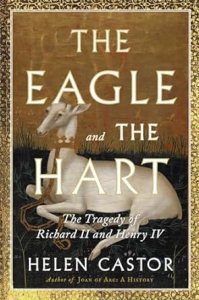
Book Review: “The Eagle and the Hart: The Tragedy of Richard II and Henry IV” by Helen Castor

The story of the Plantagenets is filled with high triumphs and devastating tragedies. It is a story of families torn apart for a crown and the desire to either rule with an iron fist for the glory of England or live a life of luxury at the expense of their citizens. The story explored in this particular book is the tale of two cousins born months apart, Richard of Bordeaux and Henry Bolingbroke. Richard and Henry were not born to become King of England, but Fortune’s Wheel had a different plan for the cousins. So how did these cousins become kings and how did their tale turn to tragedy not only for their relationship but for all of England? Helen Castor tells the tale of these two Plantagenet kings in her latest book, “The Eagle and the Hart: The Tragedy of Richard II and Henry IV.”

I want to thank Avid Reader Press and Net Galley for sending me a copy of this book. I have seen this book on social media and ever since it was announced, I knew I wanted to read it. I have enjoyed Castor’s posts online as well as her documentary on the She-Wolves, based on her book of the same name, so when I heard about this one, it was an intriguing premise and so I jumped at the chance to read it. 

The fact that Richard of Bordeaux and Henry Bolingbroke became King Richard II and King Henry IV respectively is quite the story. Richard was the son of Edward The Black Prince and Henry was the son of John of Gaunt; both of their fathers were sons of Edward III and so the idea was that one of his sons would inherit the throne. However, Edward III had different plans after the death of Edward The Black Prince. It was announced that the young Richard of Bordeaux would be crowned King of England. This should have been the first red flag for England because it means that a Regency council must be formed. There are fights for power and fights over finances that culminate in the Peasants’ Revolt. Richard II doesn’t have much desire to fight for his country on the battlefield against the French or the Scottish, but he does care about favoring his favorites, even if it means turning the government against him. One such group, the Appellant Lords, will prove an extremely dangerous challenge for Richard II, and it will include his cousin Henry Bolingbroke. While many of the Appellant Lords will end up dead, Henry Bolingbroke is merely exiled, which in the long run, was not the best decision for Richard II. 

In 1400, John of Gaunt died and the title as well as the lands of the Duke of Lancaster were turned over to Richard II while Henry Bolingbroke was in exile in France. This marks the turning point for Henry as he decides to invade England while Richard is away dealing with problems in Ireland. It will end with Richard’s abdication and the coronation of Henry Bolingbroke as King Henry IV. However, things are not all sunshine and rainbows for Henry IV, the 1st Lancastrian King of England, as he finds out that it is not easy being a king. 

I must applaud Castor for writing a dual biography that is both balanced and utterly brilliant. It did take me a while to read this book because I was taking so many notes while I was reading and it gave me a better understanding of this tumultuous time. I would suggest that if you do read this book, take your time so that you can understand the complex nature of the conflict between these two cousins. If you are a fan of the Plantagenet dynasty, I highly recommend you read, “The Eagle and the Hart: The Tragedy of Richard II and Henry IV” by Helen Castor.

Book Review: “Queen Bess: A Tudor Comes to Save America” by Maria Vetrano

Have you ever read about a historical figure and wondered what it would be like to interact with them in the present day? How would they deal with modern problems and technology? Could they function in the 21st century or would they become overwhelmed? And even if they could come to the 21st century, how would it affect their timeline and history? This intriguing premise plays out in Maria Vetrano’s novel, “Queen Bess: A Tudor Comes to Save America,” which sees Queen Elizabeth I coming forward about 400 years in time to become the President of the United States in the 2028 election.
I want to thank Maria Vetrano for sending me a copy of her novel. When I read the description of this novel, it was an intriguing concept to me. I do enjoy a modern tale from time to time and I was interested to see how Queen Elizabeth I of England could become a US President and how she would adjust to life in the modern world.

We begin our adventure with Dakota Wynfred, a self-made billionaire in the cybersecurity field, whose only desire is to go back in time to see her mother one more time and potentially bring her mother back to the year 2027. As Dakota and her mother are discussing matters, she tells her mother that the political environment is a mess thanks to President Robert Vlaskas, who Dakota cannot stand. Dakota believes that there is no one capable in modern time to defeat Vlaskas so a plan is formulated to use Dakota’s time travel machine to go back in time even further to get a leader who she believes can defeat Vlaskas. She has chosen Gloriana herself, Queen Elizabeth I from 1588. While transporting the queen from the Tudor era is easy, acclimating her to the ways of the 21st century proves a challenge, especially knowing that they have a limited window to make sure Elizabeth is ready to run for president.

While I thought the concept of this book was unique, the execution for me is what let this book down. I’ll start with the time travel element. As someone who watched Star Trek and the Librarians, I know there are some rules of time travel like not telling the people in the period of the past you are visiting you are from the future (or giving them a biography about their life), and you don’t bring anyone into the future from the past as there could be consequences to history in general. I wanted to see more of how Elizabeth being in the 21st century would affect the 16th century and the idea of technology not working in the 16th century as it was not invented during that time, but that is not what I got as a reader. When Elizabeth did arrive in the year 2027, we see her getting used to the world of technology, fashion, and popular culture, which did not seem to help with running a political campaign and Elizabeth’s accent in this book bothered me quite a bit. I feel like Vetrano should have done more research into the 16th century and Elizabeth’s reign to make this version of Elizabeth I more believable. Finally, I think the ending is rushed and left me questioning this book and what the point of this novel truly was.

Overall, this was a frustrating read for me as I saw the potential for a cool book, but it stumbled so many times. It felt like the Tudor/historical elements were sprinkled in a modern sci-fi/political fantasy novel, which just did not work well for me as a reader. This may not have been the book for me, but if you want a different take on the Tudors, a time travel novel with modern political elements, “Queen Bess: A Tudor Comes to Save America” by Maria Vetrano might be a book for you.

Book Review: “Queen Macbeth” by Val McDermid

When we think of the name Macbeth, we often imagine the play by William Shakespeare of a power-hungry man and his equally vicious wife willing to do whatever it took to become King and Queen of Scotland. It is a play about revenge and murder, but Shakespeare did not pull these characters out of thin air. He took these characters from the annals of history, such as a man named Macbeth and his wife, a Lady Macbeth named Gruoch. However, the names are about as much as Shakespeare gets right regarding the story of one of the first Kings of Scotland. Val McDermid tells her version of Macbeth and Gruoch’s story in her latest novel, “Queen Macbeth.”

I want to thank Atlantic Monthly Press and Net Galley for sending me a copy of this novel. It has been a minute since I read the Shakespearean play of Macbeth, but I did know that it was a story based on history. When I saw that this was specifically about Macbeth’s wife, it was intriguing to me and I knew I wanted to give it a try.

We begin with a sense of panic and dread. Reports have reached Gruoch that her husband Macbeth was slain at the Battle of Lumphanan and now Gruoch is on the run from his enemy Malcolm. Their son, Lulach, is on his way to be crowned King of Scotland while Gruoch, her ladies (Ligach, Aife, and Eithne), and Macbeth’s man Angus wait for the opportune moment to escape the monastery they are staying in before Malcolm catches up to them.

Sprinkled in between events in the modern day, McDermid included flashbacks to how Macbeth and Gruoch met and fell in love. At the time of their first meeting, Gruoch was the wife of Gille Coemgain, the Mormaer of Moray. Macbeth believes that Gille was responsible for the death of his father, Findlaich, and Gruoch fears that Macbeth is only visiting Gille to seek his revenge. However, this unexpected encounter between Macbeth and Gruoch turns into love and they have a child while Gruoch is still married to Gille. A rather awkward situation, but eventually, Macbeth and Gruoch are united to become King and Queen of Scotland.

As someone who is not familiar with the historical story of Macbeth and Gruoch, I found this novella engrossing and thrilling. This version of Macbeth and his Lady Macbeth was much more believable with danger around every corner and I did not know where the story was heading. It did not feel like a novella and I did not want it to end. If you are a Shakespeare fan or someone who loves a good medieval tale, I highly recommend you read, “Queen Macbeth” by Val McDermid.

Book Review: “The Archer’s Tale” by Bernard Cornwell

The year is 1342 in the sleepy coastal English town of Hookton when marauders attack and steal a precious relic. Thomas, a young archer, is the only survivor. With his father’s dying breath, he has given Thomas a mission to carry out, retrieve the relic, and avenge his family’s honor. The hunt for the man responsible takes Thomas to France during the beginning of the conflict that will be known as the Hundred Years’ War. Can Thomas of Hookton find the relic he was tasked to find or will another quest drag him into an even darker path? Thomas’s tale begins in the first book of the Grail Quest trilogy by Bernard Cornwell called, “The Archer’s Tale.”

I found this particular book in a used bookstore and it caught my eye. I have enjoyed the Saxon Stories series by Bernard Cornwell and so when I saw that he had written a trilogy set during the Hundred Years’ War, I was intrigued. I wanted to see how well he would tackle the medieval period and the conflict between England and France.

We begin with the massacre of Hookton, which happened in the early hour of Easter morning 1342. The prize that the raiders are after is the lance that St. George used to slay the dragon, or that’s the story that Father Ralph tells the town. His illegitimate son Thomas is given the task of recovering the lance for a man wearing black armor with a blue and yellow standard who happened to be Thomas’s cousin. As there is nothing left for Thomas in Hookton, he decides to join Will Skeat and his archers in France as they fight for King Edward III and his son Edward the Black Prince. It is in Brittany that Thomas is introduced to the Blackbird, a female archer whose true identity is Jeanette the widowed Countess of Armorica who is trying to protect her young son, the new Count of Armorica from the English.

After saving Jeanette from a complicated situation, Thomas is on the run for killing a man. It is while he is on the run that his life is saved by a Jewish doctor and in return, Thomas saves the life of a girl named Eleanor. This girl is the illegitimate daughter of Sir Guillaume d’Evecque, a French nobleman who was with the black armored man who attacked Hookton. They both have a grudge against the man, but Sir Guillaume offers Thomas a different quest, which is to find the Holy Grail, the same relic the man in black armor is searching for. Thomas decides that he must help his friends in the English army as they face off against the French army in the battle that will be known as the Battle of Crecy.

As someone who is a fan of the Saxon Stories series, I felt like Thomas of Hookton was very much like Uhtred of Bebbanburg in the way that he is on a long quest for revenge, but he discovers that he is destined for a bigger purpose and an even more deadly path. I found myself enjoying the way Cornwell portrays medieval England and France during this conflict and I am looking forward to seeing where Thomas of Hookton will go next and if he will get his revenge and recover the Holy Grail. If you love medieval tales full of adventure and action, you should check out the first book in The Grail Quest, “The Archer’s Tale” by Bernard Cornwell.

Book Review: “The Most Maligned Women in History” by Samantha Morris

Throughout history, women have been seen as pious mothers, wives, or daughters who stayed in their lane or vile manipulators who wanted power and were willing to do anything to maintain their status. While the former group of women would be an interesting study, as the saying goes, well-behaved women seldom make history. So why did certain women receive a villainess lens when we look at their lives and what do the historical records tell us about them? Samantha Morris has chosen to take the stories of these misunderstood maidens and tell them in her latest book, “The Most Maligned Women in History.”
I want to thank Pen and Sword Books and Net Galley for sending me a copy of this book. I enjoyed the previous books that I have read by Samantha Morris which covered Lucrezia and Cesare Borgia and Girolamo Savonrola When I heard that she was writing a book about maligned women in history, it caught my attention immediately as I wanted to see which women would be discussed in this book.

As Morris states in her introduction, there are numerous women who she could have chosen for this book she could make a second book, but in the end, she selected eleven women from different countries and centuries to highlight. The eleven women in this book are Cleopatra VII, Empress Wu, Joan of Arc, Lucrezia Borgia, Anne Boleyn, Elizabeth Bathory, Catherine the Great, Marie Antoinette, Lizzie Borden, Empress Dowager Cixi, and Iva Toguri the “Tokyo Rose.” Morris takes the time to tell their stories succinctly while explaining why they are considered maligned.

I do appreciate the fact that she included women from different walks of life and different centuries to show how women have been vilified throughout history. We had women who were born queens, those who were mistresses or concubines and became rulers, and average women who did extraordinary things to the ire of those in charge. While I knew some of these stories like Anne Boleyn, Marie Antoinette, Cleopatra, and Lucrezia Borgia, others were completely new to me, such as Empress Wu, Empress Dowager Cixi, and Iva Toguri. The other women in this book were names that I had heard mentioned and knew some elements of their tales, but I didn’t know their full stories.

I found this book such a fun read full of vivacious women who were not afraid to go beyond the status quo. I do hope Morris will write a sequel book and include even more women from the past who have been viewed as maligned and maybe include women from Africa, Australia, and South America to show women from even more diverse backgrounds. If you want a delightful and insightful book about women who had some bad reputations, I highly suggest you read, “The Most Maligned Women in History” by Samantha Morris.

Book Review: “The Nightingale’s Castle” by Sonia Velton

A castle looms in the distance and the owner, a glamourous countess, has asked for fair maidens from the surrounding areas to work for her. But this is not an ordinary castle and this was not a benevolent countess. The rumors say if you enter the castle, you will never return as the infamous Blood Countess Erzsebet Bathory will kill you and bathe in your blood. A rather gruesome tale that has been told for centuries, but how true is this story? What truly happened in the Countess’s castle and what was the countess like? Sonia Velton hopes to answer these questions in her novel about Erzsebet Bathory’s life, entitled “The Nightingale’s Castle.”

I want to thank Harper Perennial and Net Galley for sending me a copy of this novel. I have heard about Elizabeth Bathory the Blood Countess, but just the dark tales about how she killed virgins and bathed in their blood to keep her youth. Sadly, I don’t know much about the woman herself and the circumstances around her life that made the charges around her so extreme.

We begin with a scene in the future from a court case where we see a mysterious girl listing the names of the accomplices who helped the countess, namely Janos Ficzko Ujvary, Ilona Jo Nagy, Dorottya (Dorka) Szentes, and Katalin Beneczky. The mysterious figure also reveals that there is a ledger that she claims lists the names of every victim of the countess, which totals hundreds of young ladies. Then, we jump to the main story with two servants of the countess, Dorka, and Fickzo, looking for a new woman to work at Cachtice Castle, which they find in Boroka Libalany, the adopted daughter of the town doctor Jozsef. It is at the castle where Boroka meets another girl named Suzanna and the two girls form a sort of friendship as they work in the laundry.

Things seem to be going well for Boroka and Suzanna until they realize that there is something off about this castle. While Boroka meets Countess Erszebet Bathory and gets to interact with her court of young noble ladies, Suzanna sees the darker side of the castle. I do appreciate that each one of the accomplices of the countess gets their unique backstories on how they met Erszebet Bathory. As Boroka gets closer to the countess and earns her trust as a stand-in for her portrait by Valentino, she discovers an intricately craved box and a journal inside that tells the story of Boroka’s birth mother, however the context of the box changes for those who open it. While I do enjoy learning more about Boroka’s familial connection to the countess, the magical box element almost felt unnecessary as she could have easily found the diary in the countess’s library and it would have had the same effect for Boroka.

Finally, we get to see how the case against Erszebet Bathory and her accomplices occurred. Gyorgy Thurzo Count Palatine of Hungary joins with King Matthias of Hungary to create a case against the countess. We get to see the arrest of the countess and her accomplices, the trial, and the aftermath of this case on the entire cast of characters, but especially Boroka.

As this was the first novel that I have read set in late 16th/ early 17th century Hungary and that was about Erszebet Bathory “the Blood Countess,” I found this novel extremely engrossing. It was a haunting yet stunning story filled with so many twists and turns that I did not want it to end. If you want a riveting retake on the life of the infamous Blood Countess, I highly recommend you read, “The Nightingale’s Castle” by Sonia Velton.

Book Review: “The Lady Rochford Saga Part 2: Tourmens de Mariage” by Danielle Marchant

Marriage has been an integral part of life for centuries. It has been used to create strong alliances and cement love matches. However, once the wedding ceremony is finalized, the facade often fades and the truth about the families is revealed. Jane Parker finally marries the love of her life, George Boleyn, but she soon realizes that her new family is full of ambition, especially her new sister-in-law Anne Boleyn. As one of the greatest marriages of the 16th century is beginning to fall apart, can a new romance be waiting in the wing to rock England and all of Europe to its core and whose side will Jane join in the end? Danielle Marchant continues her exploration of Jane Parker Boleyn, Lady Rochford’s life in her novel, “The Lady Rochford Saga Part 2: Tourmens de Mariage.”

I’d like to thank Danielle Marchant for sending me a copy of this novel. I enjoyed the first novel in this series, “Into the Ranks of the Deceived,” so I wanted to see how Marchant would continue this series and where book two would end. 

We begin with Catherine of Aragon attending the Blackfriars to discuss her marriage with Henry VIII. He wants the marriage dissolved because Catherine was married to his brother Prince Arthur Tudor and that is why they cannot have any living male children. Obviously, Catherine disagrees and is fighting for her marriage, which gains the respect of Jane Parker. However, Anne is not interested in the affairs of the queen and instead has her heart set on marrying Henry Percy. This does not work out for Anne as Cardinal Wolsey finds out and decides to put a stop to their engagement, which creates animosity between Anne and Wolsey. 

While Anne is trying to figure out her love life, we see Mary Boleyn become a mother of two while dealing with the death of her husband William Carey. Jane must navigate these complex issues of her new family while she enters a new chapter of her life when she marries the love of her life, George Boleyn. However, Jane’s married life is not all sunshine and rainbows and she realizes that they are having problems conceiving a child. I think the story of this second novel was good, but I think it should have covered a bit more ground and possibly gone to the marriage of Anne Boleyn and Henry VIII so that the third book could focus on the fall of Anne and George Boleyn and hopefully show a glimpse of Jane’s fall from grace.

Overall, I think it was a decent novel that shows the softer side of Jane and George’s relationship which is sometimes lacking in other novels. I think it was a bit short for the material that I hoped she would cover in this series since there is so much to Jane’s story, but I think she can create a story with believable characters that you don’t want to stop reading. If you have enjoyed the first book in this trilogy, I think you should read, “The Lady Rochford Saga Part 2: Tourmens de Mariage” by Danielle Marchant.