
 Marriage has been an integral part of life for centuries. It has been used to create strong alliances and cement love matches. However, once the wedding ceremony is finalized, the facade often fades and the truth about the families is revealed. Jane Parker finally marries the love of her life, George Boleyn, but she soon realizes that her new family is full of ambition, especially her new sister-in-law Anne Boleyn. As one of the greatest marriages of the 16th century is beginning to fall apart, can a new romance be waiting in the wing to rock England and all of Europe to its core and whose side will Jane join in the end? Danielle Marchant continues her exploration of Jane Parker Boleyn, Lady Rochford’s life in her novel, “The Lady Rochford Saga Part 2: Tourmens de Mariage.”
I’d like to thank Danielle Marchant for sending me a copy of this novel. I enjoyed the first novel in this series, “Into the Ranks of the Deceived,” so I wanted to see how Marchant would continue this series and where book two would end.
We begin with Catherine of Aragon attending the Blackfriars to discuss her marriage with Henry VIII. He wants the marriage dissolved because Catherine was married to his brother Prince Arthur Tudor and that is why they cannot have any living male children. Obviously, Catherine disagrees and is fighting for her marriage, which gains the respect of Jane Parker. However, Anne is not interested in the affairs of the queen and instead has her heart set on marrying Henry Percy. This does not work out for Anne as Cardinal Wolsey finds out and decides to put a stop to their engagement, which creates animosity between Anne and Wolsey.
While Anne is trying to figure out her love life, we see Mary Boleyn become a mother of two while dealing with the death of her husband William Carey. Jane must navigate these complex issues of her new family while she enters a new chapter of her life when she marries the love of her life, George Boleyn. However, Jane’s married life is not all sunshine and rainbows and she realizes that they are having problems conceiving a child. I think the story of this second novel was good, but I think it should have covered a bit more ground and possibly gone to the marriage of Anne Boleyn and Henry VIII so that the third book could focus on the fall of Anne and George Boleyn and hopefully show a glimpse of Jane’s fall from grace.
Overall, I think it was a decent novel that shows the softer side of Jane and George’s relationship which is sometimes lacking in other novels. I think it was a bit short for the material that I hoped she would cover in this series since there is so much to Jane’s story, but I think she can create a story with believable characters that you don’t want to stop reading. If you have enjoyed the first book in this trilogy, I think you should read, “The Lady Rochford Saga Part 2: Tourmens de Mariage” by Danielle Marchant.
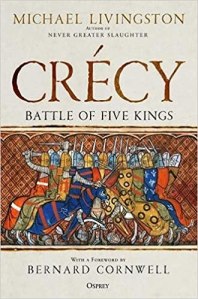 The year is 1346 and war has just begun between France and England. This conflict would be known as the Hundred Years War, which lasted over 116 years and ended in failure for the English. However, some glorious moments like Agincourt gave the English cause to celebrate, but none more so than the Battle of Crecy. It was a colossal battle between five European kings, leaving countless dead on the field without many long-term rewards. So how did the French and English armies meet on the field of Crecy and what truly happened? Michael Livingston dives deep into the archives and archaeological research to tell the truth of this famous battle in his book, “Crecy: Battle of Five Kings.”
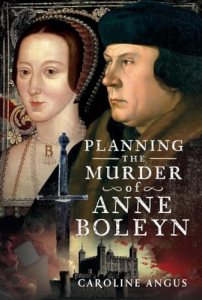 The 16th century was filled with tales of remarkable women. Still, one of the most defining figures of the century was a woman of noble birth who the King of England fell in love with and decided that he was going to divorce his first wife of over twenty years to marry her. The Great Matter caused a great scandal across Europe, however, it was a love match that would not last long. The relationship between Henry VIII and his second wife Anne Boleyn would turn volatile and in the end, Anne and the men around her would be executed. We often blame Anne Boleyn’s death at the foot of Henry VIII’s right-hand man Thomas Cromwell, but who was behind the death of this famous queen? Caroline Angus has chosen to re-examine the case to find out who was truly responsible for the fall of this famous queen in her latest book, “Planning the Murder of Anne Boleyn.”
 Weddings are supposed to be happy occasions to unite two families through the bonds of love, at least in our more modern sense of the ceremony. However, in the past, weddings were ceremonies that would unite families through contracts to create powerful alliances—hardly a romantic endeavor. One of the grandest weddings of the 16th century was meant to unite France, which led to bloodshed between Catholics and Huguenots. Minou Joubert and her family are invited to the wedding of Marguerite de Valois and Henri of Navarre in Paris, but the decision to attend the lavish event leads her family on a path full of tears and heartbreak. The story of the Joubert family’s struggle to fight for the faith they strongly believe in and to unite their broken family is masterfully told in Kate Mosse’s novel, “The City of Tears.”
 The year is 1517, and Florence is experiencing great change. No longer is it a grand republic that it once was; instead, it is under the control of the Medici family. They ruthlessly controlled Florence, especially Pope Leo X, who was born Giovanni di Lorenzo de’ Medici. The people suffer as the Medici become increasingly wealthy, but a band of misfits and thieves plan to give some power back to the people with one of the greatest heists of 16th century Italy. Can they survive as a group when revelations from the past and dangers lurk around every corner? The adventure with this ragtag team of thieves as they fight for Florence is explored in Caitlin Schneiderhan’s novel, “Medici Heist.”
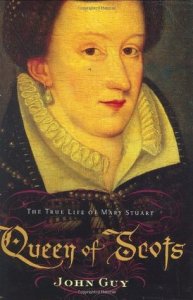 Women rulers in the past have either been praised or pushed down. They are either seen as ideal women or power-hungry villains. One such figure who suffered the worst from having her image raked through the mud for centuries was Mary Stuart, known throughout history as Mary, Queen of Scots. The Queen of Scotland who was married three times, was once the Queen of France, the mother of the future King of both England and Scotland, accused of having a hand in her second husband’s murder, plotted to overthrow Elizabeth I, and was executed for treason. Her story is well known, but what does the archival information tell us about Mary Stuart? John Guy scoured the archives to find the truth about this queen and presented his research in his biography, “Queen of Scots: The True Life of Mary Stuart.”
 As humans, we love a good love story. Tales of courtships, grand confessions of love, over-the-top weddings, and marriages that last decades. These seem like high expectations, especially when we compare these expectations to royal courtships of the past. The majority of royals married and they were more focused on political matches instead of love. However, few chose a different path altogether, they decided to be single. One of the most famous monarchs with a single status was Queen Elizabeth I of England, the Virgin Queen So why did Elizabeth stay single throughout her reign, and how did she navigate her numerous suitors? Carol Ann Lloyd tries to answer these questions in her latest book, “Courting the Virgin Queen: Queen Elizabeth I and Her Suitors.”
 When we think about the great female minds of the 16th century, we often think about those closest to the throne. Women of privilege who were destined to rule or to be a queen consort in a far-off land where their education would be imperative for the success or failure of their respective dynasty. However, some women did not live a life of glitz and glamor and received an equally impressive education. One such woman was the daughter of the great statesman Sir Thomas More, Margaret More Roper. Her remarkable story is told in the debut book by Aimee Fleming, “The Female Tudor Scholar and Writer: The Life and Times of Margaret More Roper.”
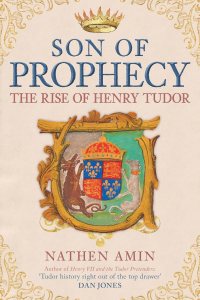 The date is August 22, 1485, and a young man stands in the middle of a battlefield. He has done what seemed nigh impossible, he defeated the last Plantagenet king Richard III to become the new King of England. His heritage makes this man unique and qualified to start a new dynasty. His mother’s family the Beauforts have been explored quite heavily by historians and authors alike. They see this victory as a change in English history whereas his father’s family sees it as a sign of something deeper. To the Tudors and Henry’s fellow Welshmen, it is the fulfillment of a centuries-old prophecy. So who were Henry Tudor’s ancestors and what did it mean for Henry to be the titular Son of Prophecy? Nathen Amin tells the remarkable story of the Tudors and how their struggles and triumphs led to Henry Tudor taking the throne in his latest book, “ Son of Prophecy: The Rise of Henry Tudor.”
 The 16th century is known to be a century full of powerful women rulers; Mary I, Elizabeth I, Catherine de Medici, and Mary Queen of Scots, just to name a few. However, these rulers were towards the end of the 16th century. For the first half of the 16th century, Europe and the Middle East rulers were predominantly male. Four men truly dominated this period, each with their objectives and desire for glory; Henry VIII of England, Francis I of France, Charles V the Holy Roman Emperor, and Suleiman the Magnificent the ruler of the Ottoman Empire. In his book, “Four Princes: Henry VIII, Francis I, Charles V, Suleiman the Magnificent, and the Obsessions that Forged Modern Europe,” John Julius Norwich hopes to shed some light on the relationships of these men and how they shaped the political landscape of Europe.
 Adventures of a Tudor Nerd