
 The year is 1523, and England is again preparing for war against its mortal enemy, France. Cardinal Wolsey is firmly in power as King Henry VIII’s right-hand man who is about to open Parliament, but Sir Thomas More’s star is slowly rising. London is busy, and at the center of it, all is Wolsey’s trumpeter and groom, Anthony Blanke. In this chaos of Wolsey’s household where murder and betrayal lie, and the enemies of the Cardinal begin to pile up. It is up to Anthony Blanke to clear his name and find the murderer before it is too late. Anthony’s latest thrilling adventure occurs in Steven Veerapen’s novel, “Of Judgement Fallen: An Anthony Blanke Tudor Mystery.”
Thank you, Polygon Books and Steven Veerapen, for sending me a copy of this novel. I enjoyed the first Anthony Blanke novel, “Of Blood Descended,” so when I heard that there was going to be a second mystery, I could not wait to read it.
Veerapen opens his novel with his first victim, Lancelot Cosyn, a scholar who is in a lot of pain and is on a mission. He is a man who detests Cardinal Wolsey, who he thinks is the source of evil in England, and he has chosen to take action by visiting the great man. Unfortunately, he is found dead inside Wolsey’s home before the meeting. Wolsey assigns Anthony Blanke the task of finding the person behind the murder of Cosyn before the news reaches the King’s ear and before Parliament opens.
As Anthony begins his investigation, more bodies of the Cardinal’s enemies start to pile up around him, so he enlists the help of Sir Thomas More to find the murderer. The color of his skin and how close Anthony is to the case make people suspect him of being involved in these dastardly deeds. Anthony, his friend Mark, and a pup named Bo work with Thomas More to prove Anthony’s innocence and determine why these people were murdered and who was behind the chaos in London.
What I love about this series is the diversity that Veerapen has chosen to show in Tudor England. Racism and religious issues are complex issues to discuss. Still, Veerapen has given his audience a window into the past and showed what it might have been like for a person of color to prove themselves in the court of Henry VIII while also dealing with people deemed as heretics for their beliefs.
This was a well-written mystery full of twists and turns that kept me guessing until the end. I had no clue who might have done it until the end, a sign of a fantastic mystery writer. If you are a fan of the first Anthony Blanke murder mystery and want another adventure, “Of Judgement Fallen: An Anthony Blanke Tudor Mystery” by Steven Veerapen must be on your to-be-read pile.
 When we think about the Tudor dynasty, we often focus on the women in King Henry VIII’s life and his children, at least when it comes to novels. Writing about this larger-than-life figure, this notorious king and controversial figure in English history, are usually considered ambitious. Few have attempted to write a book about the king’s entire reign, but Alison Weir has embarked on this endeavor in her latest novel, “The King’s Pleasure: A Novel of Henry VIII.”
 The year is 855, and the country that one day will be known as England is relatively peaceful. The Danes have their kingdom in the north, while the Saxons, under King Alfred, rule Wessex in the south. Uhtred of Bebbanburg, a Saxon man raised by Danish warriors, lives with his wife Gisela and his children in Wessex, where he is sworn to protect Alfred and his family. It is a touchy alliance, but when rumors about a dead man speaking reach Uhtred’s home, he knows that he must pick up Serpent-Breath once again and make a choice that could change the direction of England as a whole. What do the dead man and new Viking invaders have in plan for Uhtred, and how will it affect Wessex and the rule of King Alfred? Another engaging adventure for Uhtred of Bebbanburg is book four of The Saxon Tales, “Sword Song” by Bernard Cornwell.
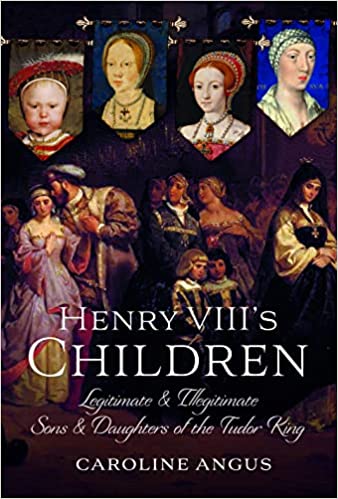 When we think about the title royal children, images of children who get whatever they want, being spoiled with gems and gowns, and ruling kingdoms, they are married to create alliances. In that sense, it would define a life of luxury. However, for the children of King Henry VIII, luxury was not always in their dictionary. What was life like for the legitimate and illegitimate children of Henry VIII? Caroline Angus explores this question in her latest book, “Henry VIII’s Children: Legitimate and Illegitimate Sons and Daughters of the Tudor King.”
 The year is 1217, and Lincoln Castle is being attacked. King John is dead, and his son Henry III is now king, but chaos still reigns. Noblemen are fighting against each other, and amid this conflict is a woman in her sixties. She is used to the instability of England as she is not only the constable of the castle being besieged, but she has earned the right to be named the first female sheriff of England. She was a daughter, a wife, a mother, a widow, and someone the Plantagenets could depend on. The name of this remarkable woman is Nicholaa de la Haye, and her unbelievable story is told in Sharon Bennett Connolly’s latest book, “King John’s Right Hand Lady: The Story of Nicholaa de la Haye.”
 Two women destined to be rivals for one man’s affection. One is the daughter of royalty, destined to become Queen of England since she was a baby. Her first husband died suddenly, and she married her brother-in-law, the young King Henry VIII. The other woman is the daughter of a family on the rise at court. She has been educated in courts abroad but has returned to her native England to serve the Queen of England, but King Henry VIII falls in love with this young woman. Catherine of Aragon and Anne Boleyn; are two women destined to be rivals, but a new museum exhibit uncovers these women’s similarities. In this corresponding book, “Catherine and Anne: Queens, Rivals, Mothers,” Owen Emmerson, Kate McCaffrey, and Alison Palmer share the latest academic research to understand better these two queens who dominated the 16th century.
 When we think of the infamous queens of England, some names come to mind, but one rises to the top for the number of black myths and influence surrounding her name: Eleanor of Aquitaine. The orphaned Duchess of Aquitaine, who married the future King Louis VII of France, went on the Second Crusades with her husband, survived battles and kidnappings, and ended up divorcing her first husband because she couldn’t give a male son. So, she married the young Count of Anjou, who would become the first king of the Plantagenet dynasty, King Henry II, who had a large family and split her time between England and France. Eleanor would eventually side with her sons, rebel against Henry, and spend 15 years in prison. A fire-cracker of a queen, but how many of the stories surrounding the titular queen are true? In her latest biography, “Eleanor of Aquitaine: Queen of France and England, Mother of Empires,” Sara Cockerill dives deep into the archives to tell the true story of this much-maligned queen of England and France.
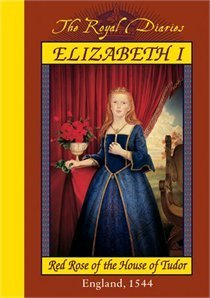 What was the first book you read that excited you so much about the historical figure that you wanted to continue studying history? You would read any text you could get ahold of that mentioned their name, including encyclopedia entries. You have fond memories of that book and wish to reread it as an adult to see if it is still a great book with all its charms. I have noted numerous times that the book series that enticed me to study history was The Royal Diaries Series. The book that started my fascination with the Tudors was “The Royal Diaries- Elizabeth I: Red Rose of the House of Tudor” by Kathryn Lasky.
 When we think of the phrase “middle ages,” we think of a time of bloody battles and deadly plagues, full of warriors and kings, and a more patriarchal society where women sat on the sidelines. Only the highly pious women or women who tore down barriers genuinely stood out in the history books. At least, that is what we have been told for centuries, but what does archeological research tell us? How about the newly discovered historical records? In her latest book, “Femina: A New History of the Middle Ages, Through the Women Written Out of It,” Janina Ramirez tells the story of the Middle Ages innovatively; through the stories of women who, until recently, were hidden voices from the past.
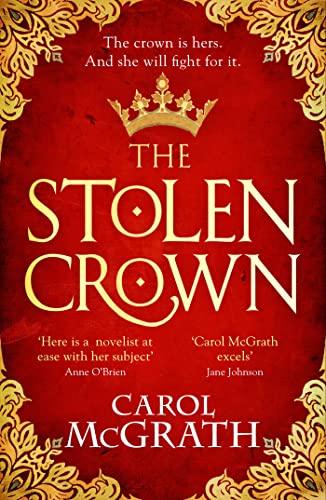 A nautical disaster has left Henry I of England in a bind. His only legitimate child is his daughter Matilda, the former Holy Roman Empress. Matilda’s path to the throne may seem straightforward as she has the oaths of all the leading men in the kingdom and a new younger husband named Geoffrey of Anjou, but things take a drastic turn when Henry I dies. Chaos reigns supreme as her cousin, Stephen of Blois, is declared King of England. Matilda knows that the throne is rightfully hers, and she will fight tooth and nail to recover what has been lost. Her story is told in Carol McGrath’s latest novel, “The Stolen Crown.”
 Adventures of a Tudor Nerd