
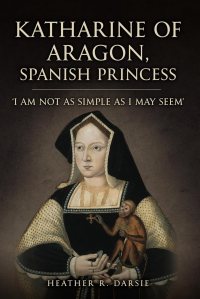
 We all know the gist of the tragic tale of Katharine of Aragon. A Spanish princess who was brought to England to marry the heir of the Tudor throne, Prince Arthur Tudor. When the prince died mere months after their wedding day, Katharine was left in limbo and desolate as the Kings of Spain and England bickered over her dowry. Eventually, she would marry King Henry VIII, was his wife for over twenty years, and have numerous miscarriages before Henry decided to divorce her and marry Anne Boleyn. We know how Katharine’s story ends, but how did the stories of her Trastamara family influence her life and her reign as Queen of England? Heather R. Darsie explores Katharine’s Spanish origins in her latest book, “Katharine of Aragon, Spanish Princess: ‘I Am Not as Simple as I May Seem.’”
I would like to thank Amberley Publishing for sending me a copy of this book. I have enjoyed Darsie’s books, “Anna, Duchess of Cleves: The King’s Beloved Sister” and “Children of the House of Cleves: Anna and Her Siblings.” While her previous books focus on German history and sources, Darsie decided to shift her attention to Spain with this particular book. I was curious how much new information and insight Darsie would provide about Katharine’s life.
Darsie begins by having lovely family trees and a timeline listing the numerous figures that will be covered in this book, because as stated before, this book covers the origins of Katharine of Aragon’s family, the Trastamaras. The book is broken down into three sections. The first focuses on the Trastamaras and the history of the crowns of Castile and Leon and Aragon, culminating with Katharine’s parents, Isabella I of Castile and Leon, and Ferdinand II of Aragon. The second focuses on Katharine’s early life, how she became the bride of Prince Arthur Tudor of England, and how his death affected Katharine. Finally, part three explores Katharine of Aragon’s life as queen consort of King Henry VIII.
To me, the true highlight of this book is the exploration of the Trastamara family tree. While I do know a bit about the origins of Isabella I of Castile and Leon from a book I just read on her life, I did not know the origins of the family. Starting with the origins of both the elected composite crown of Aragon and the inherited composite monarchy of Castile and Leon, we see how the Trastamara dynasty started like the Tudor dynasty. It was a dynasty full of drama, civil wars, a member who married a corpse, a king who died due to alcohol burns, and many mistresses. It is through these stories that you can see where Katharine of Aragon and her daughter Mary I got their strength and determination to keep on fighting for what they believed in, even when the odds were very much against them.
This is yet another triumph by Darsie. It is extremely informative, meticulously researched, and easy to read. It gives the reader a better understanding of not only Spanish royalty and its complexity, but also a better appreciation of Katharine of Aragon. If you want an excellent book exploring the life of King Henry VIII’s first wife from a different perspective, I highly recommend you read “Katharine of Aragon, Spanish Princess: ‘I Am Not as Simple as I May Seem’” by Heather R. Darsie.
 The Wars of the Roses are ending, and with it comes uncertainty about who will lead the country. On one side is King Richard III, who many believe killed his nephews to become King of England; on the other is Breton Henry, Henry Tudor, who believes he is the rightful king due to his bloodline. However, there is a third player in this entire debacle. A young farm boy named John Collan may spend his days daydreaming and studying to his heart’s content, but he is destined for more. A path that will lead him to hobnob with nobility and become the enemy of a king who just sat on his throne. Just who is John Collan, and how did this boy go from the farm to a life of infamy? Jo Harkin tells the story of how John Collan became Lambert Simnel in her novel, “The Pretender.”
 Do you have a favorite historical figure whom you have wondered what would have happened if they survived their dark fate? Have you wondered what would happen if they had fantastical abilities, such as transforming into animals? Maybe the last piece sounds a bit too far-fetched, but it makes for an interesting concept for a novel. What if we took the story of Lady Jane Grey, the Nine-Day Queen of England, and turned the tale into a fantastical comedy full of romance and adventure? Then, you would get the premise of “My Lady Jane” by Cynthia Hand, Brodi Ashton, and Jodi Meadows.
 We all know the story of the last Tudor monarch, Queen Elizabeth I, who often viewed herself as a female king and who remained a virgin for her entire life. With her death, the Tudor dynasty ended, and a brand new dynasty made its mark on English history. It was a dynasty in England that the son of Elizabeth started I’s rival, Mary Queen of Scots, King James VI of Scotland. King James was not just a king, but a man in love with numerous lovers, and when he fell in love, he fell hard. Gareth Russell explores the life of King James VI/I, who ruled two nations while searching for true love in his latest book, “Queen James: A New History About the Life and Loves of Britain’s First King, James Stuart.”
 Throughout English history, a colorful cast of queens has left their marks in their distinct ways. While the Plantagenet and Tudor queens are more well-known, the Stuart queens and the mistresses of the Stuart kings were dynamic in their unique ways. One of the lesser-known queens was the wife of King Charles II. Though Charles II is known for his numerous mistresses, his wife Catherine of Braganza is not discussed much in England, but in her native Portugal, she is famous. So who was Catherine of Braganza, and what is her legacy in England and Portugal? Susan Abernethy tells the story of this almost forgotten queen in her book, “Charles II’s Portuguese Queen: The Legacy of Catherine of Braganza.”
 History is not just dates and conflicts with men and women sprinkled in, so we can learn a lesson. It’s not just births, conflicts, triumphs, marriages, and deaths. The people of the past are similar to us in so many ways, and it is through the field of study known as Living History or Experimental Archeology that we can understand the past through a more hands-on approach. One of the most popular methods of studying living history is cooking recipes from the past. But one must wonder how our tastes and understanding of the benefits of food change over time. Emma Kay takes the question of how eating and drinking changed over the medieval period in England and explores it in her book, “Wortes and All: Medieval Cooking.”
 A princess born to a king and his second wife lost her title and legitimacy when her father decided that her mother, Anne Boleyn, needed to die. Elizabeth Tudor knows the meaning of resilience as she survived her childhood during her father King Henry VIII’s reign. Now that her father is dead Elizabeth is at the mercy of her half-siblings Edward and Mary, plus any scheming man who wants to marry her and get closer to the crown. Can Elizabeth survive her siblings’ reigns or is she destined to be locked in the Tower to await her ultimate fate like her mother? Janet Wertman explores the life of Elizabeth Tudor in her latest series
  Throughout history, many civil wars have altered the course of the history of the countries where they occurred. While we think about the American Civil War, the French Revolution, and the Wars of the Roses, another civil war often overlooked outside of England is the English Civil Wars. A series of conflicts between the Parliamentarians and the Royalists led to the execution of King Charles I and the rise of the English Republic under Oliver Cromwell. We often view the conflict from either Charles’ or Oliver’s perspective, but we have to consider the family that Charles left behind. How did the English Civil Wars mold the children of Charles I and his Catholic Queen Henrietta Maria? Linda Porter explores the lives of the royal children in her book, “Royal Renegades: The Children of Charles I and the English Civil Wars.”
 Throughout history, the true defining feature of a good queen was whether or not she could give birth to a male heir and a spare to keep the dynasty going. No dynasty relied heavily on the pregnancy of a queen and a male heir than the Tudor dynasty of England. While we tend to focus on the women who wear the crown and give birth to the potential heir, another stands beside her during the entire process; the royal midwife. Not much attention has been given to the royal midwife until now. Brigitte Barnard explores the life of a royal midwife and her daughter who work to help Queen Katherine of Aragon in her novel, “The Tudor Queens’ Midwife.”
 Blurb:
 Author Bio
 Adventures of a Tudor Nerd