
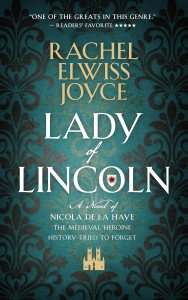
 Medieval England, under the reign of Henry II and Eleanor of Aquitaine, was a turbulent time. The focus tends to be on the rebellion of Henry’s sons against their father and how Eleanor sided with her sons. This story has been told, but there is a story of another woman who was caught directly in the middle of the entire ordeal. Her story is most known for her role during the reign of King John and the Magna Carta, but that was when she was an older woman. The story of Nicola de la Haye and Lincoln Castle has been told in biographies and nonfiction books, but not really in historical fiction novels. Rachel Elwiss Joyce hopes to change that with her novel, “Lady of Lincoln.”
I would like to thank Books Go Social, Hedgehog Books, and Net Galley for sending me a copy of this novel. I first became aware of Nicola de la Haye from Sharon Bennett Connolly’s book on the women of the Magna Carta, followed up by her fantastic biography about Nicholaa de la Haye. I am familiar with her story, but I was curious to see how her life would translate to a novel. When I saw the description of this novel, it definitely caught my attention.
We are introduced to Nicola de la Haye as a young woman who is helping a young soldier, Suardinc, train, when her mother goes into labor and loses her son. That means that Nicola and her sisters are the heiresses of the de la Haye estates. Their father gives her sister, Julia Normandy, and Nicola receives Lincolnshire and Lincoln Castle. Nicola loves Lincoln Castle and the people who inhabit Lincolnshire, including the Jews that the constable of the castle must protect. Nicola wants to be a constable, but her father reminds her that she must marry and her husband will become the constable of Lincoln Castle. Three men want to marry Nicola: Gerard de Camville, the man whom Nicola’s father wants her to marry; Sir Alured of Pointon, the outside schemer who wants Nicola’s lands; and Sir William FitzErneis, the man Nicola falls hard for.
We get to see Nicola fall in love with her first husband, Sir William FitzErneis, even if they face extreme monetary hardships. FitzErneis decides to side with the Young King Henry when he rebelled against his father, King Henry II. This placed Nicola, her family, and the castle in a precarious situation as Alured became the sheriff and tried every which way to make Nicola his, even when she was married. Luckily, Gerard de Camville keeps a close eye on Nicola, even though he himself has fallen for Nicola.
We get to see Nicola transform from a naive young woman to a fiercely determined mother and wife who would do anything to protect her family, her friends, and her family home. I enjoyed that we not only got to see Nicola interacting with the typical nobility, but also the common people, including the Jewish population of Lincolnshire. If you want a well-written novel about one of the most important women in 12th century England, I recommend you read “Lady of Lincoln” by Rachel Elwiss Joyce.
 Adventures of a Tudor Nerd