
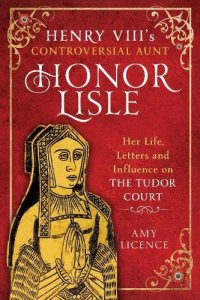
Book Review: “Henry VIII’s Controversial Aunt, Honor Lisle: Her Life, Letters, and Influence on the Tudor Court” by Amy Licence

Marrying into the royal family is not all sunshine and rainbows. Of course, we tend to think about those who marry the king, the queen, the prince, or the princess. But we also need to consider the aunts and the uncles of the royals as part of the family. Take, for example, Arthur Plantagenet, the illegitimate son of Edward IV and the uncle of Henry VIII. His second wife, Honor Lisle, would help him rule Calais; however, she is best known for her letters and her devout Catholic faith during the Reformation in England. So why is Honor Lisle considered a controversial figure, and what was the cause of the fall of Honor and Arthur from the royal good graces? Amy Licence explores the life of Henry VIII’s step-aunt in the first full biography dedicated to Honor Lisle, which is entitled “Henry VIII’s Controversial Aunt, Honor Lisle: Her Life, Letters, and Influence on the Tudor Court.”

I would like to thank Pen & Sword Books and NetGalley for providing me with a copy of this book. I have heard of Honor Lisle and her letters, but I did not know much about her life before this book. I did know that she was married to Arthur Plantagenet, but I had assumed that he was her first husband, so I didn’t know about her life before Arthur. When I saw that Amy Licence was writing a biography about Honor Lisle, I knew I wanted to read it.

Licence begins with the birth of Honor Grenville, Lady Basset, Lady Lisle Plantagenet. She was born in 1493 to Thomas and Isabel Grenville in the small town of Bideford, Devon. Her father served the first Tudor king, Henry VII, as Esquire of the Body, so Honor’s family did have some connection before Honor’s marriage to Arthur. Honor’s mother died a year after she was born, but her father did not die until 1513. In 1515, Honor would marry her first husband, Sir John Basset, and they would have between 7 and 8 children before his death in January 1528. 

A year later was a monumental year for England as it was the start of the divorce between Henry VIII and Catherine of Aragon, which would be known as the Great Matter. It was also the year that Honor married Arthur Plantagenet. The couple would move to Calais, where Arthur would rule for his nephew. This is where we get to see the Lisle letters, Honor’s dictated correspondence to prominent figures in Tudor England. Honor and Arthur would go into debt, dealing with the constant threat of war, balance their faith and be loyal to the King, and handle a plot by Reginald Pole that would try to remove Henry VIII from the throne. 

I found it so interesting to see Honor’s perspective on the big issues of the Tudor court while staying in France, as well as how life in Calais was different from it was in London during this time. Honor Lisle’s life and letters give us great insight into the reign of Henry VIII from the perspective of someone who was outside of England during the major events of his reign. Licence’s research, combined with an easy-to-follow writing style, makes this a very well-written biography. If you want a biography about a lesser-known Tudor woman and her famous letters, I highly recommend you read “Henry VIII’s Controversial Aunt, Honor Lisle: Her Life, Letters and Influence on the Tudor Court” by Amy Licence.

Book Review: “Heroines of the Tudor World” by Sharon Bennett Connolly

Heroines of the Tudor WorldThe world of the 16th century was full of change and equally colorful characters. Most of the dynamic figures of this century were women, who were willing to fight in their ways for what they believed in, whether it was family, faith, or their country. They were heroines in different ways, and each had a story to tell. Each woman had to deal with her obstacles to reach their desired goal, no matter what her station was, from queens and great heiresses to nuns, and even a pirate. Sharon Bennett Connolly has decided to include a handful of these stories in her latest book, “Heroines of the Tudor World.”

I would like to thank Amberley Publishing for sending me a copy of this book. I have been a fan of Sharon Bennett Connolly’s books on medieval women, so when I heard that she was going to tackle the 16th-century and the Tudor world, I knew I wanted to read it. I wanted to see what stories she would select and how far into the Tudor world she would explore.

Connolly begins her book by explaining how the 16th century differed from the medieval times as records about women were becoming more accessible. It was also a time of transition, reformation, and the discovery of the “new world.” Each chapter focuses on a different kind of woman; from the ideal to martyrs for their faiths, scandalous heroines, those who were disinherited, pawns in the bigger game of life, warriors, captives, and survivors. Although it can be difficult to place certain tales of women in just one category, Connolly gave her readers a thrilling look into the 16th century.

It was the stories of these extraordinary women who made this book an exceptional read. There are the typical women who are featured heavily in these kinds of narratives; Elizabeth of York, Margaret Beaufort, the wives of Henry VIII, Mary I, Elizabeth I, Mary Queen of Scots, and Catherine de Medici. However, Connolly decided to include lesser-known women. We have mistresses like Diane de Poitiers and spies like Margaret Dymoke, Lady Coffin. Some great heiresses were disinherited like Claude of France and Elizabeth Fitzgerald, as well as pawns like Marguerite de Valois and captives such as Lady Katherine Gordon and Honor Grenville, Lady Lisle. Of course, some women decided to take matters into their own hands and fight for what they believed in, such as Isabella of Castile, Jeanne d’Albret Queen of Navarre, and Grace O’Malley.

I thoroughly enjoyed learning about the heroines that Connolly included in this book, but my only complaint is that it was not a longer book. There are so many interesting women outside of the European world in the 16th century and I wish she would have highlighted them. Maybe Connolly will write a sequel book to this one to include even more Tudor heroines. If you have enjoyed Sharon Bennett Connolly’s previous books and you are a Tudor nerd, I highly suggest you read, “Heroines of the Tudor World.”

Book Review: “The Palace: From the Tudors to the Windsors, 500 Years of British History at Hampton Court” by Gareth Russell

The PalaceWhen we think of old homes, we often think of the phrase, “If walls could talk,” because the true treasure of any home is not the floorboards or the walls, but rather the stories of those who lived inside its walls. Take, for example, Hampton Court Palace in England. A home for over 500 years that has seen many architectural and artistic changes in its hallowed halls, but it is the stories of those who stayed for brief periods that truly make this palace spectacular. Stories full of salacious scandals, religious implications, and revelations that would shake England to its core through revolutions. Hampton Court Palace has been the center of English court drama for centuries and finally, these tantalizing tales are being told in a truly remarkable book, “The Palace: From the Tudors to the Windsors, 500 Years of British History at Hampton Court” by Gareth Russell.
I would like to thank Gareth Russell and Atria Books/Simon and Schuster, for sending me a copy of this book. I have enjoyed Russell’s previous biographies about The Queen Mother and Catherine Howard, so when I heard that he was writing a new book about Hampton Court Palace, I knew I wanted to read it.

Russell structures this book similarly to how he structured, “Do Let’s Have Another Drink” in that each chapter is a different tale from this palace’s half a century of history, which is a ton of historical fun to explore. He starts with a story of a ball attended by Elizabeth Windsor, soon to be Queen Elizabeth II, a few days before her coronation in 1953. Full of glitz and glamor, we soon transition to the origins of the land that Hampton Court Palace resides on and how the palace came to be after its humble beginnings as an estate for the Knights Hospitaller. It was not until the Wars of the Roses that the manor gained prominence under a favorite of Henry VII, Giles Daubeney, 1st Baron Daubeney.

By understanding how this phenomenal manor became a palatial palace, we can appreciate the stories that are the bulk of this book. Russell takes his readers through 500 years of English royal history, starting with the tumultuous Tudors, moving to the saucy Stuarts, the haughty Hanovers, the gossiping Georgians, and finishing with the worldly Windsors. Each chapter focuses on one character from each dynasty and one room of the palace.

While I was relatively well aware of the Tudor tales of Cardinal Wolsey, Catherine Howard’s run down the Haunted Gallery, and Mary I’s phantom pregnancies, it was the other dynasties that drew me into an engrossing book. The Stuarts especially shocked me with the colorful cast of characters who ranged from King James I with the King James Bible, Charles II and his many mistresses, and Oliver Cromwell. Russell shows the tragic moments, which included the death of several queens of England, the chaotic period known as the English Civil Wars, the creation of “The Tomb of the Unknown Warrior,” and the story of The Grand Duchess Xenia, the last living sister of Tsar Nicholas II. There are also stories full of art, scientific research, love, humor, and even chocolate and court life.

Russell’s narrative style of writing combined with his meticulous research has created another smash hit. I could not put this book down and I was very sad when I finished reading it, I did not want it to end. I don’t want to spoil much about this book, but it is my new favorite book by Gareth Russell. If you want a book full of fascinating history that you can binge-read, I highly suggest you read, “The Palace: From the Tudors to the Windsors, 500 Years of British History at Hampton Court” by Gareth Russell.

Book Review: “The Last Days of Henry VIII: Conspiracies, Treason, and Heresy at the Court of the Dying Tyrant” by Robert Hutchinson

The Last Days of Henry VIII

King Henry VIII, who ruled as a tyrant for almost 40 years, is dying. He caused mayhem and mischief by marrying six wives, killing two of them, with the dissolution of the monasteries, the creation of the Church of England, and his international policies. In short, it was a hot mess towards the end of his reign. So how did the last few months of King Henry VIII play out and how was he honored by those closest to the throne? Robert Hutchinson takes an in-depth look into this tumultuous period in history in his book, “The Last Days of Henry VIII: Conspiracies, Treason, and Heresy at the Court of the Dying Tyrant.”

I found this particular book in a used bookstore one day and decided to try it. I have heard of Robert Hutchinson, but I have never read any of his books. 

Hutchinson begins with the day that King Henry VIII breathed his last breath on January 28, 1547. He is no longer the glamorous Renaissance prince, but rather he is a hugely obese man with festering wounds on his legs. The years have taken their toll on the king, but no one feels sympathy for the man. He has made so many around him live in abject terror for decades. Now, it is time for a fresh start with the reign of King Edward VI, his beloved son.

We then jump back in time so that Hutchinson can show his readers exactly why King Henry VIII was feared towards the end of his life. He starts with the last three marriages of Henry VIII, Anne of Cleves, Catherine Howard, and Katherine Parr. The way that Hutchinson characterized Anne of Cleves and Catherine Howard in this book irked me quite a bit, even though I know this book is older and there is new research about both queens that contradicts Hutchinson’s perspective. 

Multiple marriages were not the only concern during the last years of Henry VIII’s life as he had to deal with heretics, international politics, and how the country should be run after his death. What I found truly fascinating about this book is the sources that Hutchinson used to tell the tale of the last years of Henry VIII’s life. They show how chaotically terrifying Henry’s court was towards the end. Hutchinson shows how the ambitious men around Edward VI tried to take control, but failed miserably as Edward VI, Mary I, and Elizabeth I ruled with just as much vigor as their powerful father. Finally, we see what happened to Henry VIII’s earthly remains and why his marvelous tomb vanished, leaving a simple marker to indicate where he and his beloved Jane Seymour were buried. 

Hutchinson does his due diligence to show how maniacal Henry VIII was, especially towards the end of his life. He does not mince words in his opinions about Henry and his court, which I may not agree with completely, but he makes strong arguments for his opinions. Overall, a very well-written and informative book. If you want a book that explores the final years of the infamous king, I would suggest you check out, “The Last Days of Henry VIII: Conspiracies, Treason, and Heresy at the Court of the Dying Tyrant” by Robert Hutchinson.

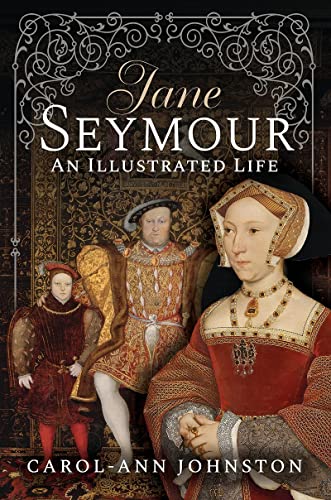
Book Review: “Jane Seymour: An Illustrated Life” by Carol-Ann Johnston

Jane SeymourKing Henry VIII’s six wives each have their unique story that transcends time. Katherine of Aragon was his first wife, the mother of Mary Tudor, and the one Henry left behind after 24 years to marry his mistress Anne Boleyn, the most famous of his wives and the mother of Elizabeth Tudor. Anna of Cleves had the shortest marriage to Henry VIII and ended up with an excellent annulment deal. Catherine Howard was young and a bit naive when it came to the ways of men, which led to her downfall while Catherine Parr survived until the end of Henry VIII’s reign. These five women are stories we know by heart, but the one whose story remains a mystery is Jane Seymour, Henry’s third wife, and the mother of the future King Edward VI. In her debut book, “Jane Seymour: An Illustrated Life” Carol-Ann Johnston tells the story of the wife who gave Henry his desired son.

I want to thank Pen and Sword Books and Net Galley for sending me a copy of this book. Jane Seymour is someone who I have wanted to learn more about ever since I started studying the Tudors. When I heard that the founder of the Jane Seymour- Henry VIII’s Third Wife was turning her research into a book, I knew I wanted to read it.

Johnston begins by tracing the origins of the Seymour family to the town of Touraine, Saint-Maur-sur-Loire, and a man named Richard de St. Maur from the 7th and 8th centuries. She then traces the family to John Seymour, the Sheriff of Hampshire, the one who inherited Wolf Hall, and the grandfather of Jane Seymour. Johnston also explores how Jane Seymour, Anne Boleyn, and Catherine Howard were related, as they were all half-second cousins. Sir John and Margery Seymour had a large family with at least 9 children including Jane, Thomas, and Edward, who would play important roles in the Tudor court.

The bulk of this particular book explores the time Jane Seymour spent at the Tudor court, starting with her time with Katherine of Aragon, exploring her relationship with Anne Boleyn, and finally her time as Queen of England. We get to see how she dealt with big events in the reign of Henry VIII like the Great Matter, the rise and fall of Anne Boleyn, the Pilgrimage of Grace, and the Dissolution of the Monasteries. Johnston also explores what made Jane Seymour famous, the birth of her son Edward VI and her death a matter of days afterward.

For her debut book, I think Johnston does a decent job telling Jane Seymour’s story for a modern audience with lovely photographs of ways she was remembered through art and architecture. There were some really interesting facts about Jane’s life that I did not know about including her family’s origin and her suitor before Henry, but a lot of this felt like information that I already knew from other books. I think it would be nice if Johnston does write another book that she focuses on the origins of the Seymour family because it covers centuries of English history and I am sure there are some intriguing tales in their family tree.
Overall, I enjoyed this book and the information I learned from reading it. If you want to learn more about Jane Seymour’s life and her family, I recommend reading, “Jane Seymour: An Illustrated Life” by Carol-Ann Johnston.

Television Series Review: “The Six Wives of King Henry VIII”

81uwnQbeXvL._SY445_Many actors and actresses have portrayed the lives of Henry VIII and his six wives in modern films and dramas. When asking Tudor nerds which Henry VIII stood out the most, the most popular response is Keith Michell in the 1970s BBC series, “The Six Wives of King Henry VIII.” I had not heard about this series until I started “Adventures of a Tudor Nerd.” Many people have wanted me to watch the series solely for the performance of Keith Michell, so when a coworker allowed me to borrow her DVD copy of the series, I finally decided it was time to tackle this legendary series.

For those unfamiliar with the older Tudor dramas like this series, it should be noted that the focus is not on sex or bloody battles but on the relationships between Henry and his six wives. Therefore, the costumes and the scenery take a step back in quality that one would expect when compared with modern dramas. I think the English brides’ outfits are well done, but the native gowns for Katherine of Aragon and Anne of Cleves felt a bit off for me.

Keith Michell plays the titular king, but I will discuss his performance later. I want to look at the actresses who played Henry’s six wives. Each episode focuses on each wife’s story, how they became his wife, and how their story ended.

We begin with Katherine of Aragon, played by Annette Crosbie, who was the wife of Prince Arthur, but when he died, Katherine struggled to survive in a foreign land until it was decided that she would marry her former husband’s brother, Henry VIII. The couple seems to be in love until Katherine cannot deliver a son for the king, so he decides it’s time for a divorce, which we call The Great Matter. With Katherine out of royal favor, it is time for Henry’s second wife, Anne Boleyn, played by Dorothy Tutin, to make her appearance. When it comes to Anne Boleyn’s performances, I don’t know if I like Tutin’s portrayal; it just rubbed me the wrong way.

My favorite episode of this series was Jane Seymour, played by Anne Stallybrass, who shows a more complex side to Jane’s story. We see her interacting with the Seymour family and her desire to reunite Henry VIII and his daughter Mary. The way the episode was structured with Jane on her death bed and witnessing flashbacks to her time with Henry VIII, the issue of the Pilgrimage of Grace, and the birth of her beloved son Edward. With Jane’s death, we see the more human side of Henry as he is in deep mourning for his beloved queen.

It would be several years until he married again to Anne of Cleves to secure a German Protestant alliance. Anne of Cleves, played by Elvi Hale, is a young woman of average looks and very little money who wants to learn everything she can about England. I like how we are introduced to Hans Holbein in this episode and to see how Anne felt about her marriage and ultimate divorce from Henry VIII.

With the divorce of Anne of Cleves settled, Henry VIII turned his gaze on the young Catherine Howard, played by Angela Pleasence. Catherine is young, naive, and only concerned about being queen and having men fawn over her. It was interesting to see Catherine Howard as a nursemaid to the King and how angry he was with her uncle after her execution. Finally, we are introduced to Henry’s final wife, the devout reformer Catherine Parr, played by Rosalie Crutchley. We witness the end of the King’s reign and the rise of the Seymour family to help the young king Edward VI.

Of course, these stories could not be told without side characters like Thomas Wolsey, Thomas, and Edward Seymour, King Henry VII, Eustace Chapuys, Jane Boleyn, and Will Somers. I was a little surprised that they included torture scenes for Anne Askew and Mark Smeaton, especially since they did not show the execution scenes for Anne Boleyn and Catherine Howard. Several small Easter eggs for Tudor fans sprinkled in are quite delightful to discover.

Now, it’s time to discuss the big guy, King Henry VIII, played masterfully by Keith Michell. Before watching this drama, I was only familiar with Keith Michell from his performances in Murder She Wrote and the episodes I would watch with my mom. We begin with Henry as a young king enchanted with Katherine of Aragon. They are madly in love, and it is hard to believe they would ever separate, but they eventually do when Anne Boleyn catches his eye.

Throughout this entire series, we see Michell’s acting range through the rapid emotional change of the king. One minute he could be lovey-dovey, the next raging mad, and then bawling his eyes out. What impressed me the most about Michell’s performance was how we saw Henry VIII’s size and shape change in each episode. As Tudor fans, we have screamed at the TV when we see modern adaptations of Henry VIII that do not meet our standards for what older Henry should look like. Michell exceeds all expectations and gives his audience one of the most believable King Henry VIII performances in modern history.

Overall, I found this a decent show where the political and romantic drama of the reign of King Henry VIII shines through the screen. The queens and the counselors did take a back seat to the titular king, but I did not mind that. If you want to watch a legendary series about the reign of King Henry VIII that does not have the sex and scandals of a modern drama, I highly recommend you watch the BBC series, “The Six Wives of King Henry VIII,” starring Keith Michell.

Casting Source:

https://www.imdb.com/title/tt0066714/?ref_=tt_mv_close

Book Review: “Inside the Tudor Court: Henry VIII and his Six Wives through the eyes of the Spanish Ambassador” by Lauren Mackay

25266205The story of King Henry VIII and his six wives has been regaled for centuries in different mediums. We love the marital problems of this one English king because of how much of an impact it made on all of Europe in the 16th century and beyond. Yet our love affair with the Tudor dynasty would not have gotten to the point that it is today without the tireless efforts of the ambassadors who went to England to report the news of the day to their respected kings and emperors. We tend to think that the ambassadors are better left in the shadows, working to promote peace between countries and report what was happening, but one man made a name for himself as an ambassador and transcended time. His name was Eustace Chapuys. His story and his mission are finally being told in Lauren Mackay’s brilliant debut book, “Inside the Tudor Court: Henry VIII and his Six Wives through the eyes of the Spanish Ambassador”.

I have heard about this book in the past and how much of an impact it has made in the Tudor community in the past. I have read Lauren Mackay’s two other books and I have enjoyed them thoroughly and so I really wanted to read this book.

To understand the man behind the now-infamous words about the Tudors, especially Henry VIII and Anne Boleyn, we have to go back to Chapuys hometown of Annecy. It is here where we see the Chapuys family rise in prominence to the point where Eustace Chapuys was employed by the Holy Roman Emperor Charles V as the Spanish Ambassador to England. His main job was to report information back to Charles about the Henirican court as accurately as possible.

Chapuys started his job as ambassador at a critical junction in English history when Henry VIII was in the middle of his divorce from his first wife Katherine of Aragon in 1529. Chapuys admired Katherine of Aragon’s strength and worked tirelessly to protect her daughter Mary. Since Chapuys had a close connection to those who were essential in the Tudor court, he has given historians fabulous insights into these tumultuous times. It was really his relationship with Anne Boleyn which has caused a lot of controversy over the years and has blackened Chapuys’ name for centuries. Mackay has masterfully examined Chapuys’ correspondences to uncover the truth about how he felt about the Tudor court from 1529 until 1545.

You cannot separate Tudor history during the reign of Henry VIII and the works of Eustace Chapuys, which is why this biography and Mackay’s research are so essential in understanding the 16th century. It sheds new light on the stories of Henry VIII and the lives of his six wives; Katherine of Aragon, Anne Boleyn, Jane Seymour, Anne of Cleves, Catherine Howard, and Catherine Parr. Chapuys was not afraid to speak his mind and to share the rumors of the day, which gives us significant insight into how the royal family was perceived by their public, both the positive and the negative aspects.

Eustace Chapuys has been one of those ambassadors who we think we know, but do we really? Mackay has rescued the much-maligned messenger of Charles V and restored him to the glory that he so rightfully deserves. Chapuys’ story was hidden in plain sight, but it took an extraordinary historian to bring his story to the spotlight. If you think you know about Eustace Chapuys and the Henrician court, you need to read this sublime biography, “Inside the Tudor Court: Henry VIII and his Six Wives through the eyes of the Spanish Ambassador” by Lauren Mackay. It might change how you view the Tudor dynasty.

Book Review: “Young and Damned and Fair: The Life and Tragedy of Catherine Howard at the Court of Henry VIII” by Gareth Russell

55728291._SY475_Divorced, beheaded, died. Divorced, beheaded, survived. For those who study Tudor history, we have heard this unimaginative rhyme to refer to the wives of Henry VIII for the longest time. We all know the stories of the queens, especially Anne Boleyn, but the fifth wife and the second one to be beheaded tend to be cast aside for some of the more intriguing tales. Her name was Catherine Howard, Henry’s youngest bride. Her story is full of rumors and myths, just like her cousin Anne Boleyn. Most know of her romantic dalliances that, in the end, led to her demise, but what was her reign like as queen? What was the court of Henry VIII like during his fifth marriage as his health was failing? In Gareth Russell’s brilliant biography, “Young and Damned and Fair: The Life and Tragedy of Catherine Howard at the Court of Henry VIII”, he dives deep into the archives to shine a light on the life of this tragic and young queen.
I would like to thank everyone who has recommended that I read this biography for years now. I have heard the praises about this book and I have enjoyed reading posts by Gareth Russell so I decided that it was about time that I read the book that put him on the map for so many Tudor history fans.

Russell begins his exploration into Catherine’s life with an execution and a wedding. The person being executed on July 28, 1540, was Henry VIII’s former right-hand man Thomas Cromwell and the bride is Catherine Howard. The duality of this first chapter is stunning, showing how favor in Henry VIII’s court was like a wheel constantly turning. A person’s fate was always in the hands of the king. To understand how Catherine caught the roving eye of the ailing king, Russell takes his readers on a journey into her past to show how this young lady made it into the glamorous Tudor court. We all have an idea of what life must have been like for Catherine in her grandmother’s, Agnes Tilney dowager Duchess of Norfolk, household. However, as Russell explains, Catherine’s life and her early romances with Henry Manox and Francis Dereham were not like how it has been portrayed in novels about her life.

Catherine’s life took a dramatic turn when she is chosen to be one of the ladies in waiting for Henry VIII’s fourth wife, Anne of Cleves. This relationship does not last long and Henry casts his eyes upon Catherine and she becomes his fifth wife. However, while at court, Catherine falls in love with the charming Thomas Culpepper. Russell goes further than any other author has in the past to explore the different aspects of Catherine’s reign as queen consort. He explores her household, how she viewed religious issues and political issues that impacted Tudor England during this time. Finally, Russell explores the downfall, the trial, and the execution of Catherine Howard and how her foolish decisions cost her everything.

The way Russell combined his easy to read style of writing with scrupulous attention to detail to create such a vivid account of Catherine Howard’s tragic life is magnificent. It felt as if you could visualize the events as they happened in the Henrician court. Before I read this account, I felt no sympathy for Catherine’s demise, but this beautiful biography changed my view on her life. If you want a hauntingly beautiful biography about the life of Henry VIII’s fifth wife Catherine Howard, you must read, “Young and Damned and Fair: The Life and Tragedy of Catherine Howard at the Court of Henry VIII” by Gareth Russell.

Book Review: “Sovereign” by C.J. Sansom

27151979When one thinks about a royal Progress, we often think about the glitz and glam of the royal family traversing the entire country at a leisurely rate to inspire awe for their subjects. However, the Progress of 1541, when Henry VIII and his fifth wife Catherine Howard traveled to the hostile northern part of England, was anything but a casual visit. It was very political as Henry was trying to make the North submit to him after the Pilgrimage of Grace while at the same time he was waiting for a meeting with King James V of Scotland. It is the city of York and during this important Progress that C.J. Sansom shapes his latest adventure with his hunchback lawyer and part-time detective, Matthew Shardlake, in book three of the delightful Shardlake series, “Sovereign”.
We join Matthew Shardlake and his dedicated assistant Jack Barak on the road to York to join the Progress to take care of local petitions for the King. They have received another complicated mission from their new boss, Archbishop Thomas Cranmer, to look after the wellbeing of a suspected conspirator in a plot to overthrow Henry VIII’s government, so that he can make it to London for further questioning. Things seem to run as smoothly as it could until a master glazer’s mysterious death reveals secrets that will send Shardlake and Barak into a deadly collision course with some of the most powerful men and women in England during this time.

Sansom has done it again. He has expanded Shardlake’s world outside of London to show that England was not all united for the Tudors. As someone who knows about the Wars of the Roses, to read Sansom’s description of the treacherous and rebellious city of York makes sense completely. It is dark and edgy while the glory of the court is on full display. To add more intrigue to this amazing novel, he adds the mystery of a certain member of the Yorkist family’s origins that could change England forever. I personally do not agree with this theory about this particular person’s origins, but it did not take away from my enjoyment of this book. It just added another layer to this enthralling tale.

Of course, since this novel touches on the relationship between Henry VIII and Catherine Howard, Sansom had to include a way for Shardlake to meet these two, as well as confront figures like Lady Rochford, Culpepper, Dereham, and of course Sir Richard Rich. The way he does this is ingenious. Sansom’s attention to details of the Progress is nothing short of extraordinary. Compared to the first two books, this one is much darker as you are unsure how Shardlake and Barak will ever get out of their dangerous situations, but that is what makes it so remarkable.

It is actually difficult for me to write this review without spoiling the ending so I will keep this short. I thought that “Dark Fire” was my favorite in the series, but now “Sovereign” reigns supreme. That might change as I read the rest of this absorbing series. I will say that if you enjoyed the first two books, you have to continue the journey with Matthew Shardlake and Jack Barak in “Sovereign” by C.J. Sansom.

Book Review: “Sir Francis Bryan: Henry VIII’s Most Notorious Ambassador” by Sarah-Beth Watkins

45704941During Henry VIII’s reign, those who were most loyal and the closest to the king did not often last long to enjoy the rewards of his friendship. However, there was one man who stayed in relatively good favor with the king throughout his reign. He was a sailor, a soldier, a diplomat, and acted as an English ambassador mostly in France. He was a cousin to a few of Henry VIII’s wives, a lover of wine, and an infamous womanizer. The name of this rather extraordinary man was Sir Francis Bryan and the story of how he survived the tumultuous reign of Henry VIII is told in Sarah-Beth Watkins’ latest biography, “Sir Francis Bryan: Henry VIII’s Most Notorious Ambassador”.

I would like to thank Sarah-Beth Watkins and Chronos Books for sending me a copy of this book. I have enjoyed Sarah- Beth Watkins’ previous books and this one sounded really interesting to me since I did not know a lot about Sir Francis Bryan before I read this book.

Unlike many of Henry’s closest allies, Sir Francis Bryan was born to help the king. His father, Sir Thomas Bryan of Ashridge, Hertfordshire, was a knight of the body to both King Henry VII and Henry VIII. His mother, Lady Margaret (Bourchier) Bryan, a lady in waiting to Katherine of Aragon and the governess to Henry VIII’s children, was related to Elizabeth Howard, which meant that Francis was related to both Anne Boleyn and Catherine Howard. It was these connections that would prove both a blessing and a curse in Bryan’s career.

Bryan’s career was mostly based abroad as an ambassador for Henry VIII. After his service to the king in Scotland, he was transferred to France where he would prove his loyalty to Henry by pushing his ideas on the French king. It was the way he handled certain situations that gained Bryan the nickname, “ the vicar of hell”. Not exactly flattering, but it helped Bryan keep his head when so many of his friends, allies, and family members did not.

Watkins’ biography on Sir Francis Bryan provides a great window into the life of such a colorful character in Henry VIII’s court who doesn’t get a whole lot of attention. But, it is one thing to tell about Bryan’s life and quite another to allow the readers to read transcribed letters that were either addressed to or about Bryan. They provide great insight into the decisions that Bryan made and his feelings about the events that were going on around him, including The Great Matter and the break from Rome.

Like Watkins’ other books, this one acts as a great introduction to the life of Sir Francis Bryan. It was extremely informative and well written for a small book, acting as a stepping stone for those who want to learn more about “the vicar of hell”. A best friend of King Henry VIII and loyal until the end to the Tudors, Sir Francis Bryan lived a remarkable life. “Sir Francis Bryan: Henry VIII’s Most Notorious Ambassador” by Sarah-Beth Watkins is a book that I highly recommend if you are a fan of Sarah-Beth Watkins or if you want to learn more about Sir Francis Bryan and how he survived the tumultuous reign of King Henry VIII.